
Add ₹999 more to unlock FREE SHIPPING!
Your sacred cart is currently empty.
Shop Photo FramesTo uplift society and Dharma, which had been afflicted by ill practices, the Divine took birth in the land of Maharashtra in the form of many saints. Saints such as Tukaram, Dnyaneshwar, Namdev, Eknath, Janabai, and Chokhamela, through their *ovyas*, *abhangs*, *bharuds*, *kirtans*, and discourses, condemned the undesirable customs, traditions, and practices that had crept into Dharma. Saint Bodhle Maharaj, from this very tradition, is well-known throughout Maharashtra. In Dhamangaon, his birthplace in Barshi Taluka, stands the Samadhi Mandir of Bodhle Maharaj. The renowned *Bhakti Vijay* scripture describes the Maharaj. The *abhangs* composed by the Maharaj are still recited by his devotees today.
This temple, nestled at the foothills of Balaghat on the banks of the Nagzari River, dates back to the seventeenth century. The Dharmeshwar Shivling here, said to have been established by Dharmaraja, one of the five Pandavas, is believed to be thousands of years old. It is from this Dharmeshwar Shiva temple that the village first came to be known as Dharmeshwar Gram, and later Dhamangaon. Born in this village in the year one thousand six hundred and four, Bodhle Maharaj took *Sanjeevan Samadhi* in one thousand six hundred and ninety-four, at the age of ninety. His Samadhi Mandir also belongs to the seventeenth century.
The true name of Saint Shri Mankoji Bodhle Maharaj was Mankoji Jagtap. As his elder brother, Shivaji Jagtap, was of a religious disposition and belonged to the Warkari tradition, the family’s *Patilki* (headmanship) passed to Mankoji Jagtap. Once, when Mankoji went on a pilgrimage to Pandharpur with his elder brother, the atmosphere imbued with Lord Vitthal deeply touched his heart. He resolved to have a *darshan* of Panduranga and remained in Pandharpur for fourteen days without food or water, searching for Vitthal. At that time, Panduranga granted him a direct vision and imparted divine wisdom (*bodh*). Hence, he came to be known as Bodhle Maharaj. The Maharaj brought an idol of Panduranga to Dhamangaon, and after its *pranapratishthapana* (consecration) by the hands of Saint Tukaram and Ramdas Swami, he built a temple there. Since then, to this day, the Ashadhi festival is celebrated for five days in Dhamangaon. Devotees believe that on Ashadhi Ekadashi, the deities come from Pandharpur to Dhamangaon and reside there for five days.
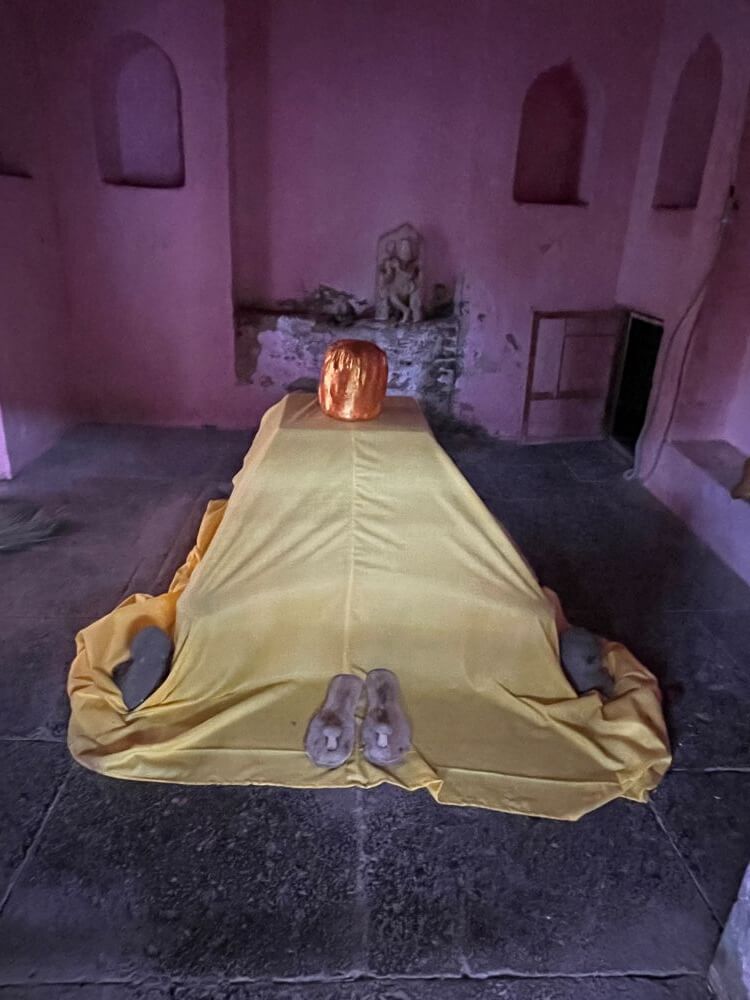
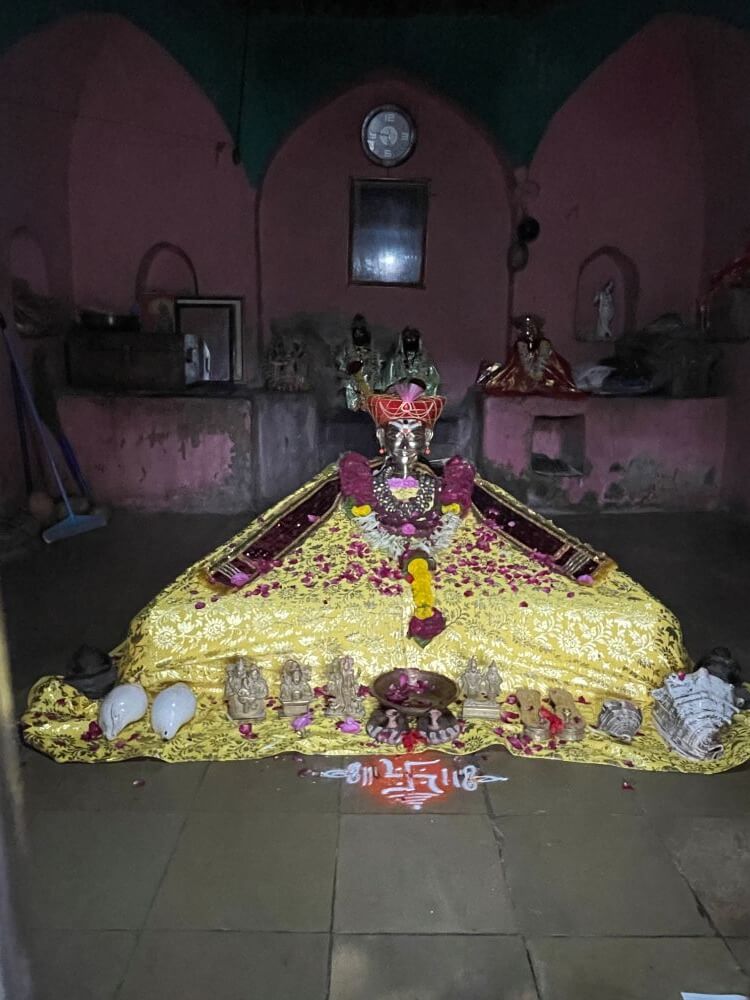
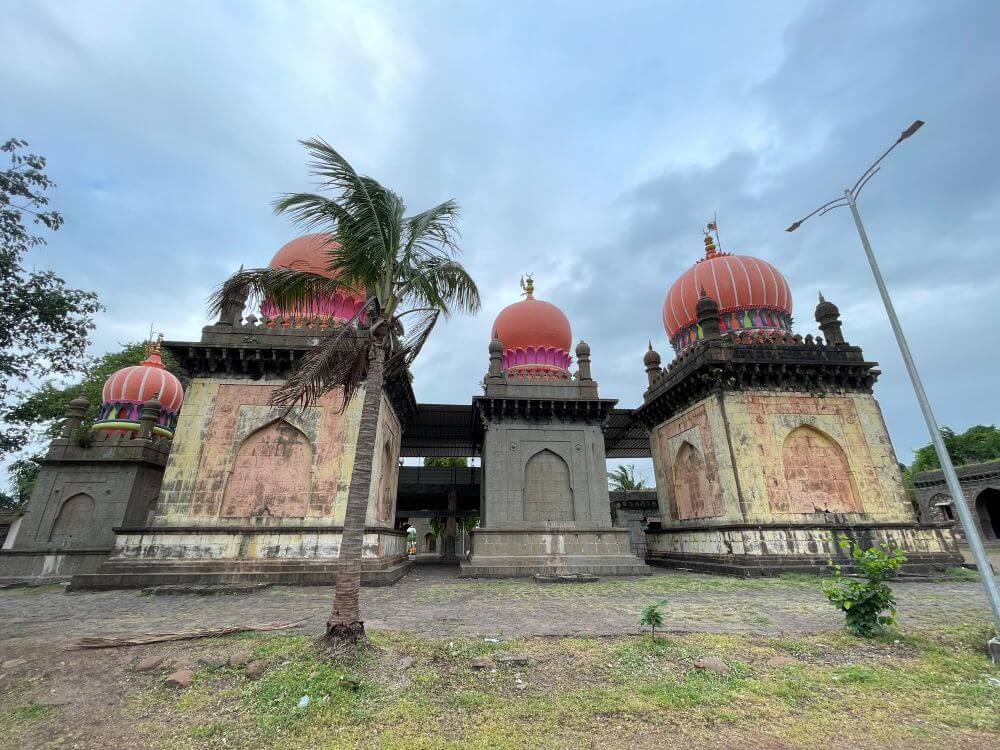
Within the strong ramparts surrounding the temple stands a two-storied main gateway (*Mahadwar*). On both sides of the *Mahadwar* are old-style windows, and on the upper floor is the *Nagarkhana* (drum house). The *Mahadwar* has massive wooden doors, and on both inner sides are guard rooms. Through this entrance, one steps into the temple courtyard, which is paved with stone. In the courtyard is the Samadhi Mandir of Saint Bodhle Maharaj. This temple is built of carved stone on a plinth approximately five feet high. The temple entrance has five steps. In the center of the temple is the plinth of Bodhle Maharaj’s Samadhi, upon which rests a silver mask of the Maharaj wearing a *pheta* (turban).
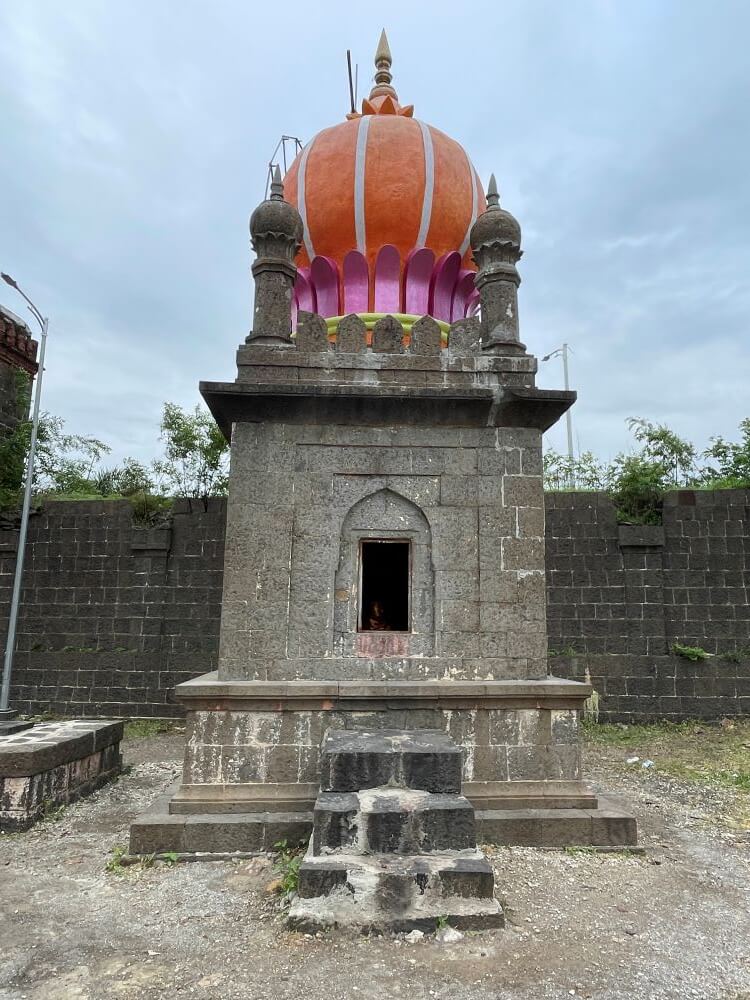
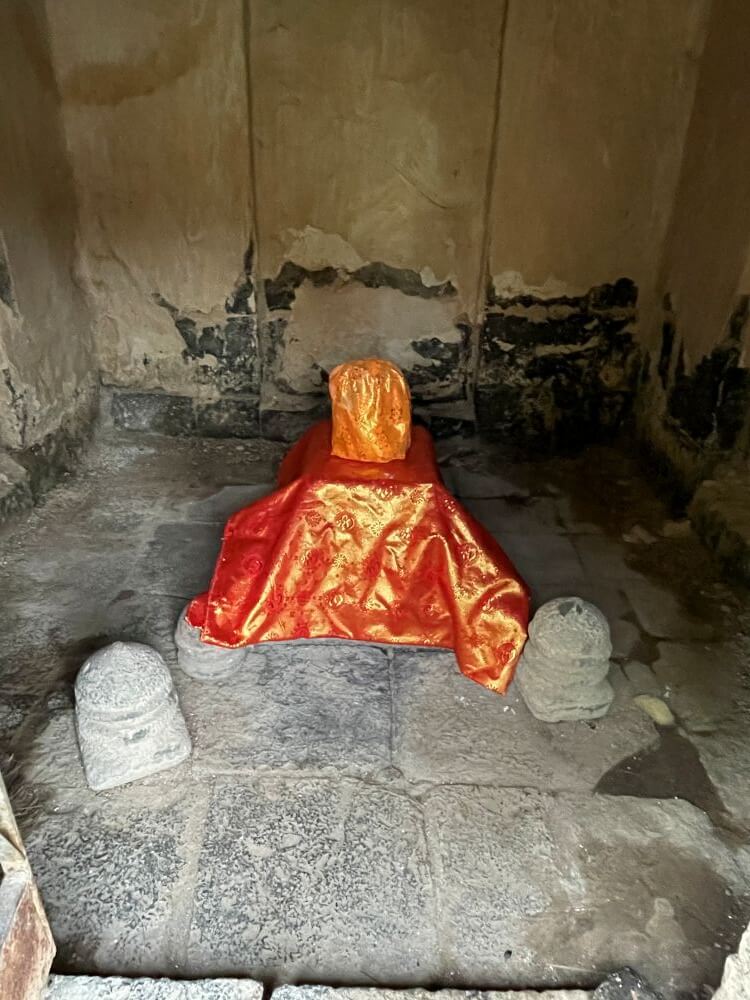
Against the back wall of the temple, on a *Vajrapitha*, are idols of Vitthal and Rukmini. The domed ceiling of the temple is supported by the walls. On the roof of the temple, at all four corners, are minaret-like pillars. Above them are *amalakas*, and on the *amalakas* are stone *kalashas* (finials). In the center of the roof is a domed *shikhara* (spire), topped by a *stupika*, and above that, a *kalasha* adorned with a crescent moon and star. Observing the design of the Samadhi Mandir, the influence of Muslim architectural style is clearly visible. In the temple courtyard are the *samadhis* of Maharaj’s wife, Mamatai, and son, Lakhoji, as well as the *samadhis* of saintly figures such as Bhagirathi Bai, Bhagwant, Bhanji, Bajaji, Dhundiraj, Rangubai, Eknath, Akrut, and Bhauso. The design of all the Samadhi Mandirs is generally similar.
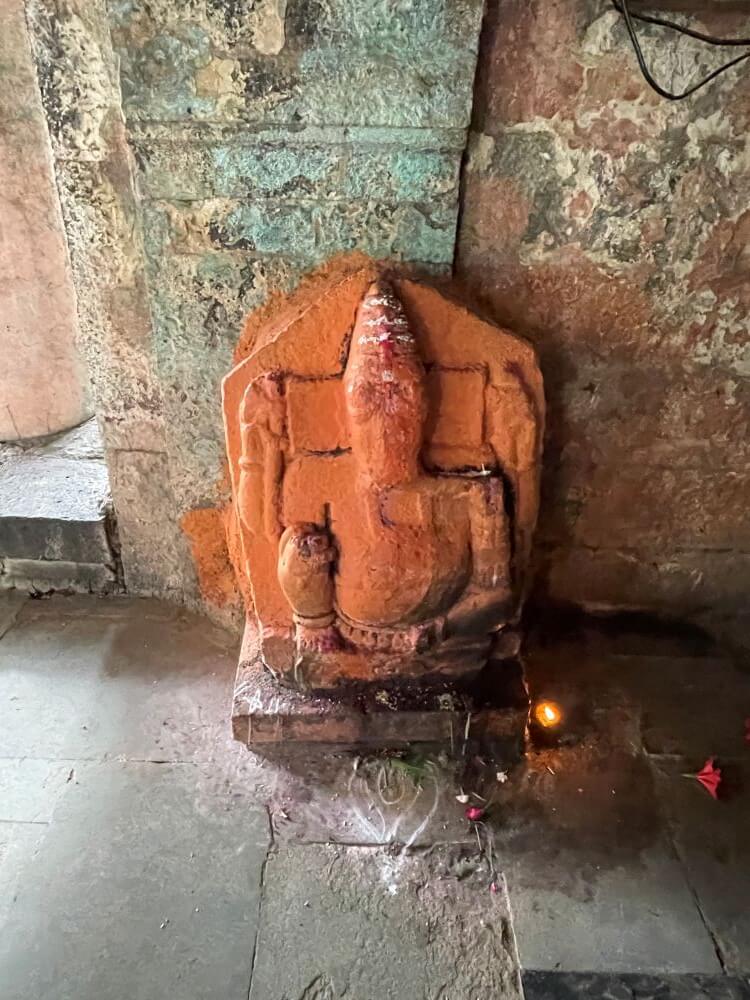
Within the courtyard is the ancient Dharmeshwar Shiva Temple. In front of this temple is a newly constructed, spacious, and open *Rangamandapa*. Adjacent to the *Rangamandapa*, on its outer side, is a Tulsi Vrindavan. Beneath the Vrindavan, in the basement, is an ancient stone-carved sculpture of Vishnu. Above Vishnu’s head is a Naga sculpture holding a canopy. The *Rangamandapa* houses ancient idols and the Samadhi of Saint Dajibua Maharaj. Beyond the *Rangamandapa* is a *Sabhamandapa* (assembly hall) and *Garbhagriha* (sanctum sanctorum) built of stone in the Hemadpanti architectural style. The *Sabhamandapa* has four rows, each with four intricately carved pillars. All pillars stand on square bases, and their shafts are in various geometric shapes: square, hexagonal, octagonal, and circular. Various sculptures are carved on the square panels of the pillar shafts. In the *Sabhamandapa*, on the front wall of the *Garbhagriha*, on both sides of the entrance, are *devakoshthakas* (niches for deities). The doorframes of the *Garbhagriha* are adorned with leaf and flower patterns, and on the *lalatabimba* (lintel center) is an idol of Ganesha. The *mandaraka* has a *chandrashila* (moon-stone). In the center of the *Garbhagriha* is a monolithic Shivling. It is believed that this *pindi* was established here by Dharmaraja, the elder brother of the Pandavas.
Within the temple courtyard, along the ramparts, are ancient stone *ovaries* (verandahs). There is a water tank in the courtyard. On the platform around the tree in the courtyard are ancient sculptures and *nagashilas* (serpent stones). In the temple vicinity are places such as the *Taka* (a spot where the Maharaj brought holy water from Kashi) and *Dev Padvi*.
Twice a year, during Ashadhi and Kartiki Ekadashi to Pournima, a five-day *Jatrotsav* (fair festival) is celebrated with great enthusiasm. During this time, the *Palkhi* (palanquin) of Panduranga comes from Pandharpur to Dhamangaon. Thousands of devotees from across the state come to have *darshan* of the deity and to participate in Panduranga’s *Palkhi*. Amidst the resounding beats of drums and *tashas*, and the showering of *gulal* (red powder), the deity’s *Palkhi* procession is celebrated with great splendor. In this *Palkhi*, the *Bhaldar* (spear-bearer) and *Chopdar* (mace-bearer) belong to the Muslim community. For five consecutive days, programs such as *bhajan*, *kirtan*, *pravachan*, and *mahaprasad* are organized in the temple.
In the temple, important festivals and celebrations throughout the year include Jyeshtha Vadya Tritiya, which marks Mankoji Maharaj’s *Sanjeevan Samadhi* ceremony, as well as Dussehra, Diwali, and Padwa. During festival periods, thousands of devotees from across the state come here to have *darshan* of Bodhle Maharaj’s Samadhi. In addition, a large number of devotees come for *darshan* daily. Devotees can have *darshan* of Bodhle Maharaj’s Samadhi here from early morning until late at night every day.
This sacred temple stands as a testament to deep spiritual devotion, ancient architectural grandeur, and rich local cultural traditions.
The sanctum sanctorum houses the divine idol consecrated according to ancient Vedic traditions, surrounded by serene courtyards and traditional temple architecture.
Navratri, Maha Shivratri, Annual Temple Jatra & Deepotsav
Compare and book flights, secure top-rated local hotels near the temple, hire reliable guides, and rent cars instantly.
Extend your pilgrimage by visiting other highly sacred temples located nearby.


Add ₹999 more to unlock FREE SHIPPING!
Your sacred cart is currently empty.
Shop Photo FramesFill in your delivery details below to place your order.
Add comment