
Add ₹999 more to unlock FREE SHIPPING!
Your sacred cart is currently empty.
Shop Photo FramesSituated in the village of Paroda in the southern part of Goa, the Chandreshwar Bhootnath Temple has a history spanning approximately one thousand five hundred years. This temple of Lord Shiva manifests His Chandreshwar form. The shrine is located atop the high Chandranath hill in Goa. In many temples across the country, a sun-ray festival occurs; however, in this temple, the rays of the moon fall directly upon the Shiva Linga on the full moon day of Chaitra. This is considered a unique feature of this temple. Along with Chandreshwar, who resides here in a self-manifested (Swayambhu) form, there is also a temple dedicated to Bhootnath, one of His one hundred and eight attendants.
The history of the Chandreshwar Bhootnath Temple is linked to the Bhoja dynasty of Goa. According to mythological legends, the Bhojas belonged to the Kaikeya sub-clan of the Yadavas from the Mahabharata. From the fifth to the eighth century CE, their kingdom encompassed South Goa as well as the present-day North Kannada and Belagavi districts. Chandranath or Chandreshwar was the family deity (Kuladaivata) of this dynasty. It is said that the Bhojas named their capital Chandrapur after this deity. Chandrapur, which is present-day Chandor, is located about eight kilometers from Paroda. According to the Goa Gazetteer, a king of the Bhoja dynasty named Chandravarman likely built the Shiva temple on the hill in Paroda in the fifth century and named the Shiva Linga here Chandreshwar or Chandranath. In the tenth century, this region came under the control of the Kadambas. The Kadamba kings also provided protection to this temple.
According to mythological legend, during the churning of the ocean by the gods and demons, fourteen precious gems were obtained: Lakshmi, the Kaustubha gem, the Kalpavriksha, Sura, Dhanvantari, Kamadhenu, Airavata, Rambha-Menaka, the seven-headed horse Uchchaihshravas, Halahala, the Sharanga bow, the Panchajanya conch, nectar, and the moon. Lord Shankara consumed the deadly poison known as Halahala. This generated immense heat in his body. To attain coolness, he adorned the moon upon his forehead. Since then, he has been known as Chandreshwara. The moon considers Shankara its master. It is said that on every Chaitra Purnima, the moon touches the feet of its master. A legend is also told here that in the past, when moonbeams fell upon the Shiva Linga in this temple, water would overflow from it.
In the Chandreshwara Mahatmya chapter of the Sahyadri Khanda in the Skanda Purana, the significance of this place is described as follows: the Kushavati River here originated from the lotus feet of Lord Brahma. It was a divine river beloved by the sages. Once, due to a lack of rainfall for many years, a great famine occurred. Consequently, all the sages began to praise this river. They also sought refuge in Lord Shankara. Pleased after hearing their hymns, Shankara assumed a mountain-like form, several yojanas high, and stood before them. He gave the sages his protection and said that the water originating from his body would sustain their livelihood. Furthermore, consuming this water, which has been in contact with the moon, would destroy their sins and enrich their lives. According to religious belief, the Chandreshwara hill at Paroda is considered to be the Chandrachuda (Chandreshwara) Maha Linga.
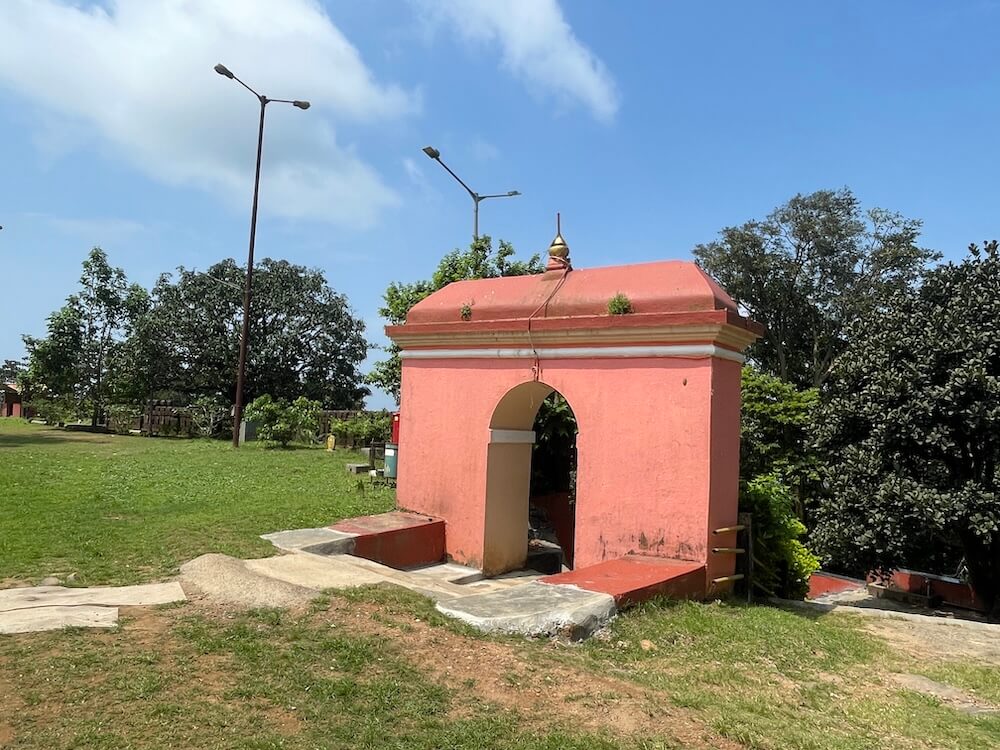
Situated at an altitude of 348 meters above sea level on this Chandranath hill, the grand temple has undergone many renovations over time. The current structure of the temple is said to date back to the seventeenth century. It has also been renovated to some extent. However, the original cave in the sanctum sanctorum of the temple dates back to ancient times. The stairway leading to the temple begins from Mullem village. A grand entrance gate has been erected there. At a short distance along this path, there is a temple of Shankhbhairava. Devotees believe that to be worthy of the blessings of Chandreshwara, it is important to first seek the darshan of Shankhbhairava, the guardian deity of the village. Further ahead, there are some sacred water bodies. They are named Kapila Tirtha, Ganesha Tirtha, and Kamandalu Tirtha. These water bodies contain water throughout the year. The tradition of performing daily abhishek to the deities using water from the pond known as ‘Kamandalu Tirtha’ is still followed here today. This same water is also traditionally used for the abhishek performed by devotees on the day of Mahashivaratri.
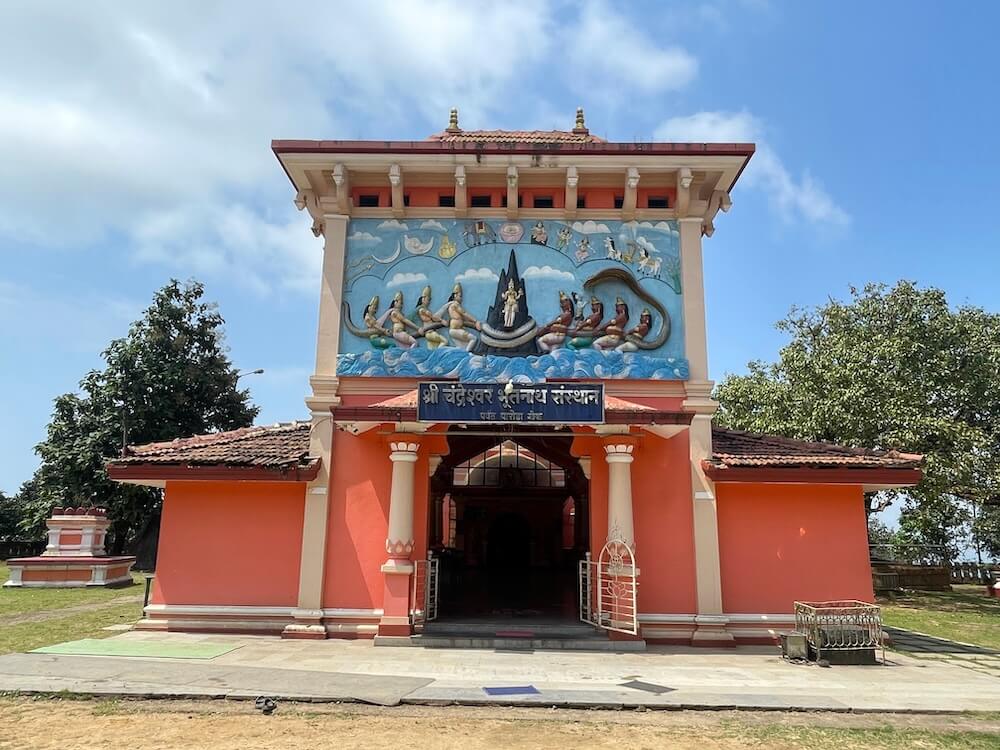
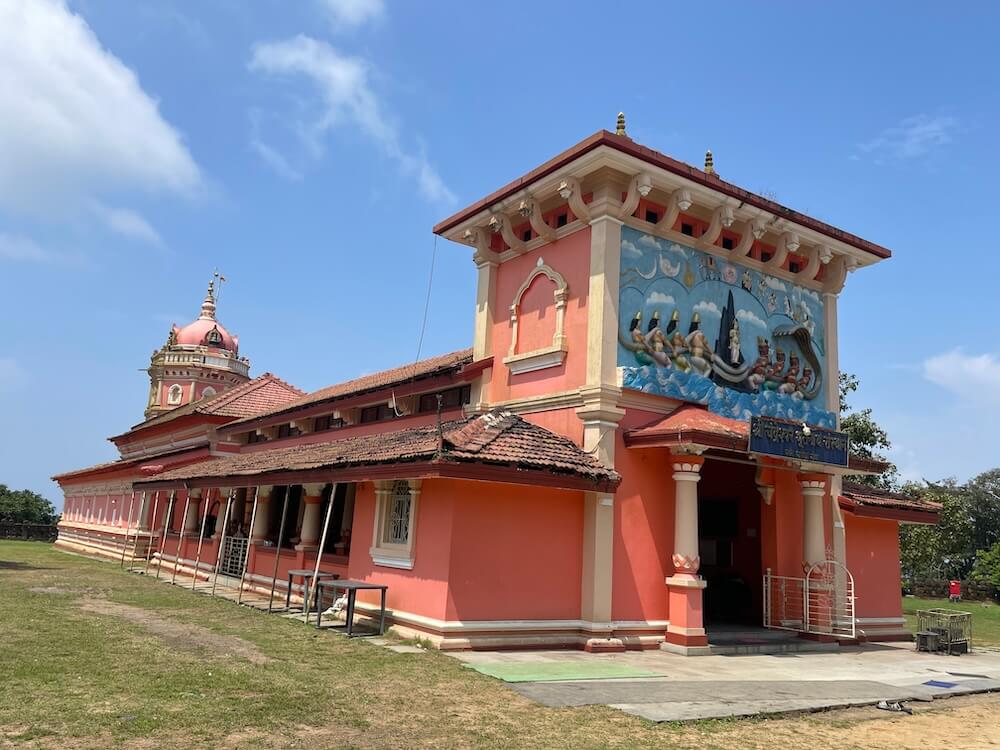
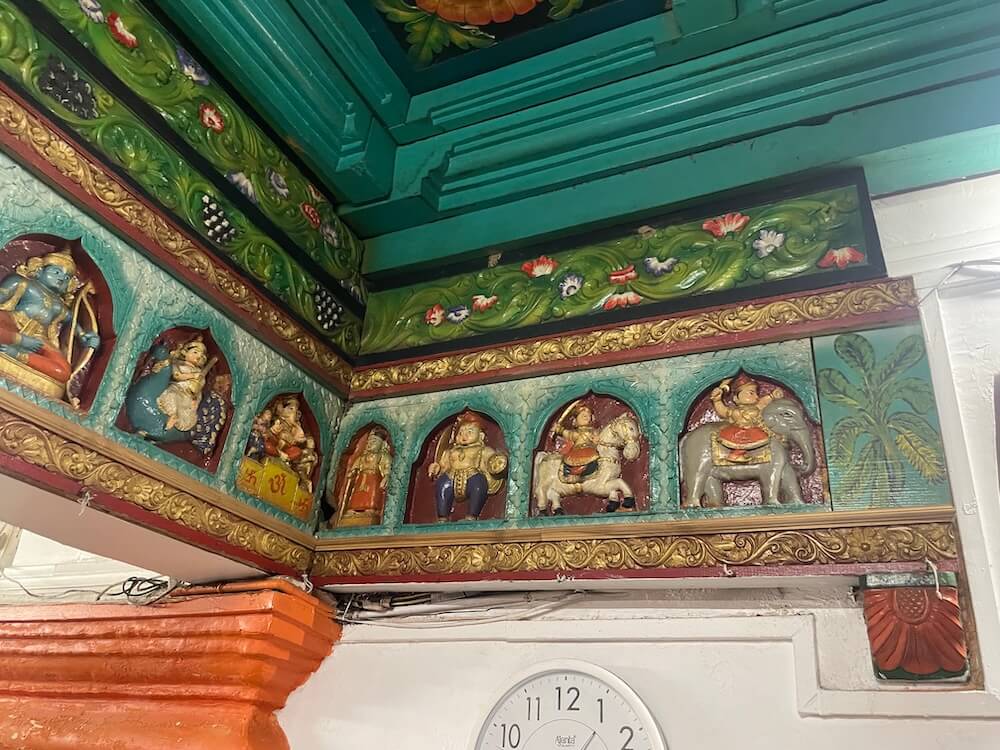
For those who find it difficult to climb the approximately four hundred steps, a road has been constructed so that motor vehicles can reach the top. From where this road ends, one has to climb a few steps to reach the hilltop. The Chandreshwar Bhutnath Temple is situated in a spacious, plateau-like area surrounded by lush greenery, built in the traditional Goan temple architectural style. The temple structure consists of a Nagarkhana-style Mukhamandapa (entrance porch), Sabhamandapa (assembly hall), Mahamandapa (main hall), and Garbhagriha (sanctum sanctorum). There is a circumambulatory path (Pradakshinamarga) around the Garbhagriha accessible from the Mahamandapa. Above the arched entrance of the temple, there is a magnificent relief sculpture of the Samudra Manthan (Churning of the Ocean) on the wall. The Mukhamandapa features a tiled roof, leading into a semi-open Sabhamandapa with a two-tiered roof covered in Mangalore tiles. Beyond this lies the enclosed Mahamandapa. This hall, featuring wide square pillars with marble flooring, is enriched with intricate Goan-style wood carvings on its ceiling. The Mahamandapa is adorned with carved wooden niches, elephant heads (Gajamukhas) on the pillars, Vyala figures, wood carvings of various deities, and ornate ceiling patterns. Directly in front of the Garbhagriha in the Mahamandapa, a Nandi is installed on a high pedestal.
The entrance and the facade of the Garbhagriha are also decorated with wood carvings. At the lintel of the entrance stands an idol of Lord Ganesha. The door frames feature chain patterns, with sculptures of Dvarapalas (gatekeepers) carved at the base. In front of the Mandaraka, there are two wooden Nandi sculptures. On both sides of the Garbhagriha facade, there are wooden niches containing idols of Lord Ganesha and Navadurga, both of which are crafted from black stone. In front of the pillars on both sides of the facade stand ancient idols of Vaishnava Dvarapalas.
The sanctum sanctorum of the temple is highly unique. It is carved out of a single magnificent rock. A portion of this rock can be seen in the circumambulatory path of the sanctum. Inside the sanctum, the masked idol of Chandreshwar Bhutnath is installed within a silver halo. In front of it lies the Shiva Linga, upon which a mask of Lord Shankar is placed. It is said that this Shiva Linga and the original cave housing the sanctum are carved from the same stone. Five deities are worshipped in the sanctum: Chandranath, Ganapati, Navadurga, Mahalakshmi, and Vishnu. Therefore, it is known as a Panchayatan site. Above the sanctum, there is an octagonal structure, topped by a dome, and crowned with a double Amalaka and Kalash. On the four sides of the Shikhara, there are niches containing idols of various gods and goddesses.
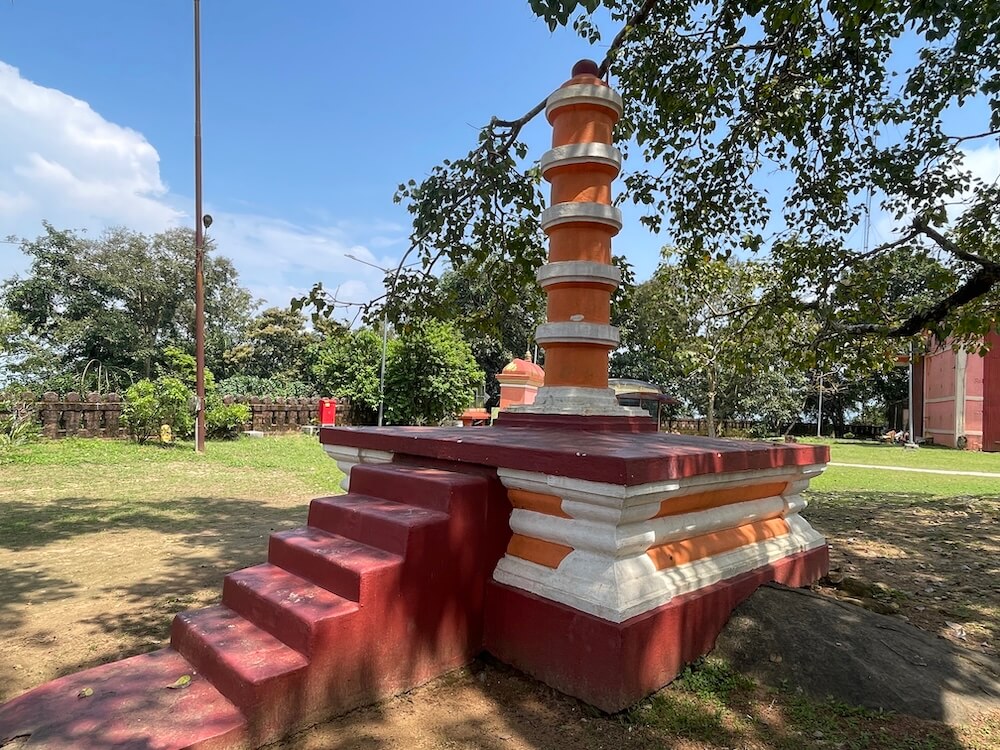
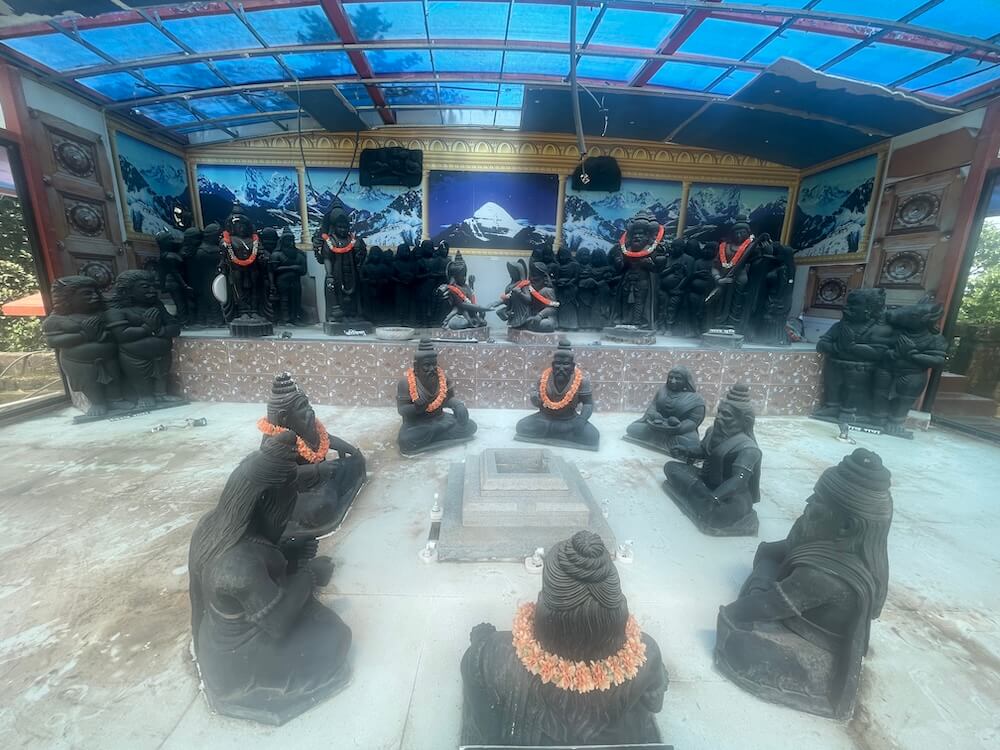
In the temple premises, there is a Tulsi Vrindavan and a Deepmala. Near the Peepal tree here is the seat of Bhutnath, the chief attendant of Chandreshwar. Bhutnath, in the form of a tall, pointed stone, is installed within a large wooden Makhar there. He is considered the Lord of the spirits. The layout of this place is such that both Bhutnath and Chandreshwar can see each other through a small opening. At a short distance from the main temple, in a glass-enclosed hall, several idols carved in black stone are displayed. These primarily include the sages who performed sacrificial rites: Kapila, Atri, Bharadwaja, Vishwamitra, Gautama, Jamadagni, Vashistha, and along with them, Vashistha’s wife, Arundhati. Behind them, the scene of the marriage of Shiva and Parvati is depicted through various idols. Within the temple premises are four chariots used during festivals. These include the Vijay Rath (Horse), Ambari Rath (Elephant), Chandi Rath (Silver), and the Maharath (Grand Chariot).
Hanuman Janmotsav, celebrated on the day of Chaitra Purnima, is considered the largest and most famous festival here. During this five-day festival, which begins from Chaitra Shuddha Ekadashi, various religious rituals such as Laghurudra, Abhisheka, Aarti, and Kirtan are performed. On the first night of the festival, the deity’s Shibikotsav is held; on the second night, a procession is taken out in a howdah; on the third day, a procession is held in a silver chariot; and on the fourth day, a procession is taken out in the Vijay Rath. On the fifth night, the Divjanchi Bhovar takes place here. At this time, the deity’s procession is carried out in a grand chariot. Various cultural programs are also organized throughout all five days. During the festival, Annaprasad is served every afternoon and night. This hill, which is otherwise quiet, becomes bustling on the occasion of the fair.
Among the other festivals held throughout the year, there is a Bhajan program every Monday. At this time, a procession of the deity is taken out in a silver palanquin around the temple premises. Mahashivratri, Divjotsav, Shimgotsav, Shravani Somvar, and Navratri are also celebrated here with grandeur. On the day of Vijayadashami, the Tarangotsav takes place at the Chandreshwar-Bhutnath temple. Around three in the afternoon, the Avasar of Shri Chandreshwar and Shri Bhutnath arrives. After giving Kaul to the assembled devotees, the palanquin, Avasar, and Tarang of Chandreshwar-Bhutnath arrive at the Shankh-Bhairoba temple. A devotee from Kurpe village carries a trident along with the Tarang. This trident is considered the honor of Madhavnath Dev of Kurpe. It is worshipped during Navratri. On Dussehra, the deity’s palanquin procession goes from the top of the hill to the Paroda market. Chandreshwar’s sister comes to meet her brother. The Dussehra festival concludes after the palanquin returns to the temple. Devotees from Goa, Karnataka, and Maharashtra visit this temple to take advantage of these festive occasions.
This sacred temple stands as a testament to deep spiritual devotion, ancient architectural grandeur, and rich local cultural traditions.
The sanctum sanctorum houses the divine idol consecrated according to ancient Vedic traditions, surrounded by serene courtyards and traditional temple architecture.
Navratri, Maha Shivratri, Annual Temple Jatra & Deepotsav
Compare and book flights, secure top-rated local hotels near the temple, hire reliable guides, and rent cars instantly.
Extend your pilgrimage by visiting other highly sacred temples located nearby.


Add ₹999 more to unlock FREE SHIPPING!
Your sacred cart is currently empty.
Shop Photo FramesFill in your delivery details below to place your order.
Add comment