
Add ₹999 more to unlock FREE SHIPPING!
Your sacred cart is currently empty.
Shop Photo FramesSituated on a hill in Takai near Khopoli along the Pen-Khopoli route, the Vithoba-Rakhumai Temple, known as Dhakti Pandhari (Junior Pandhari), is a place of deep faith for thousands of devotees. Sanctified by the holy presence of the supreme saint Jagatguru Tukaram Maharaj, this sacred site is particularly famous among Warkaris by the name ‘Bombalya Vithoba’. During the 15-day annual fair (Yatra) that begins on Kartiki Ekadashi, cattle and dried fish are traded on a large scale, drawing merchants from Maharashtra, Gujarat, and Rajasthan. Apart from these, rice, salt, and traditional coarse woolen blankets (ghongadi) are also bought and sold here.
There is a revered legend behind calling this Lord Vithoba ‘Bombalya Vithoba’. Sant Tukaram Maharaj used to travel from Dehu to the Konkan region to trade in chillies. The first Marathi biography of Tukaram Maharaj was written by Krishnarao Arjun Keluskar, which was published serially in the periodical ‘Adhyatmik Dnyan Ratnavali’ starting in 1893, and later published as a book titled ‘Tukarambovanche Charitra’ in 1896. This biography mentions Tukoba’s business endeavors. Following the demise of his parents and the renouncing of worldly life by his elder brother, Tukoba had attained deep detachment (vairagya). Often, while conducting business, he would become completely absorbed in devotional love for Lord Hari. If someone took chillies from him, he would not even ask for payment, and taking advantage of his pious nature, many traders defaulted on their debts.
He had a similar experience at Sajgaon-Takai. At that time, in order to recover Tukaram’s dues, Lord Vithoba Himself assumed the form of Tukaram’s servant and began shouting out loudly (bombalne), taking the names of the local merchants to demand repayment. Out of shame, the merchants immediately handed over their unpaid amounts to this servant. Once all the debts were recovered, the servant handed the money over to Tukaram, went up to the hill where the temple stands today, and vanished into the divine. When the villagers realized that Lord Panduranga Himself had descended for Tukaram, they constructed a shrine for Panduranga at this sacred spot. Because the Almighty shouted out loudly to recover His devotee’s dues, He came to be affectionately known as ‘Bombalya Vithoba’.
However, the grand historian V. K. Rajwade posited a different historical context behind this name. According to him, Bombalya Vithoba refers to the deity consecrated by Marathas belonging to the Bhaum surname. In his scholarly preface to the historical chronicle ‘Mahikavatichi Bakhar’, he notes: “Just like the surname Bimb, the surname Bhaum is ancient. The Marathi derivative of Bhaum is Bhom, and another linguistic derivative in Marathi is Bomb. Adding self-referential suffixes to the word Bomb gives rise to the Marathi words Bombale and Bombalya. The word Bombalya in the name of Bombalya Vithoba on the Pen-Khopoli road originates from this linguistic lineage. Thus, Bombalya Vithoba means the Vithoba established by Marathas of the Bhaum surname. The word Bombalya here has no connection to ‘Bomb’ in the sense of a conch shell’s sound, nor does it have any relation to the Bombay Duck fish (Bombil).”
Located 300 meters from the Pen-Khopoli highway, the temple of Bombalya Vithoba sits atop a pleasant hill. The entire region is endowed with natural beauty by the sacred Patalganga River, which meanders in a circular loop below the hill. On the banks of this river lies a shrine dedicated to Bhakta Pundalik, from where 70 steps lead up to the hill temple. A direct motorable road is also available for vehicles. Just like the divine realm of Pandharpur, this holy site possesses all four pillars of pilgrimage—Deva (Deity), Tirtha (Sacred Water), Nama (Holy Name), and Bhakti (Devotion)—which earned it the name ‘Dhakti Pandhari’. Dindis (devotional processions) of Warkaris traveling along this route towards Pandharpur and Alandi make it a point to halt here for worship.
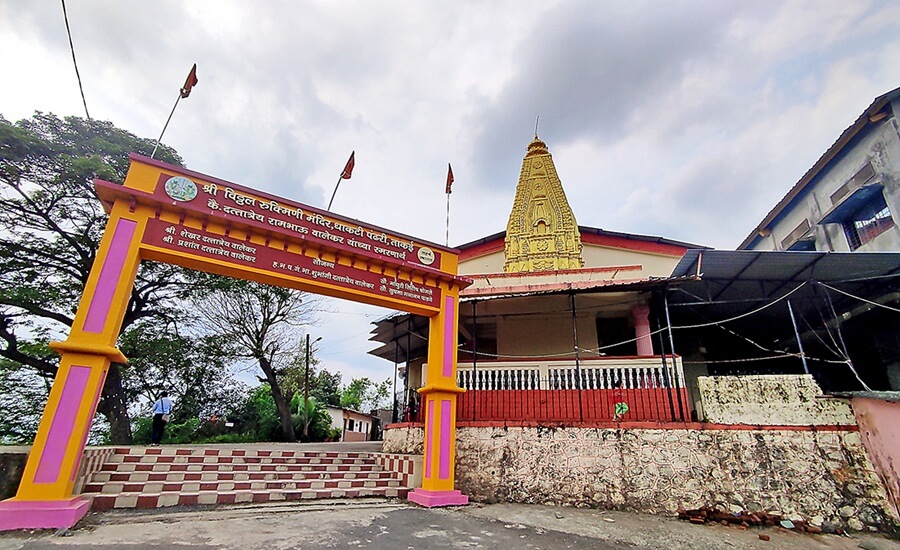
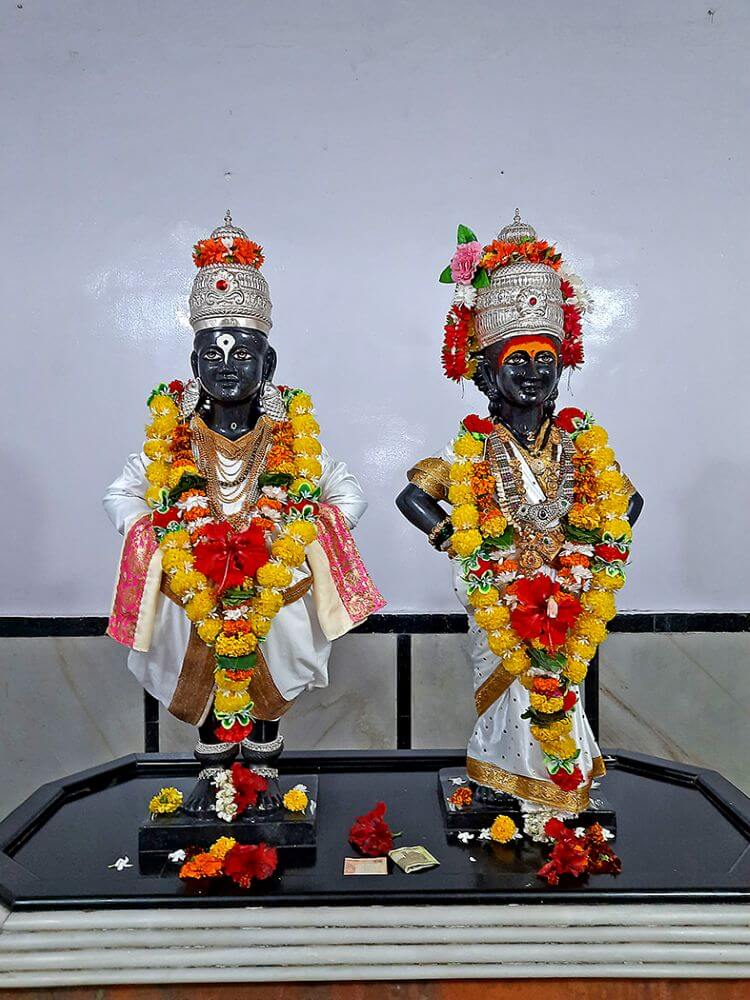
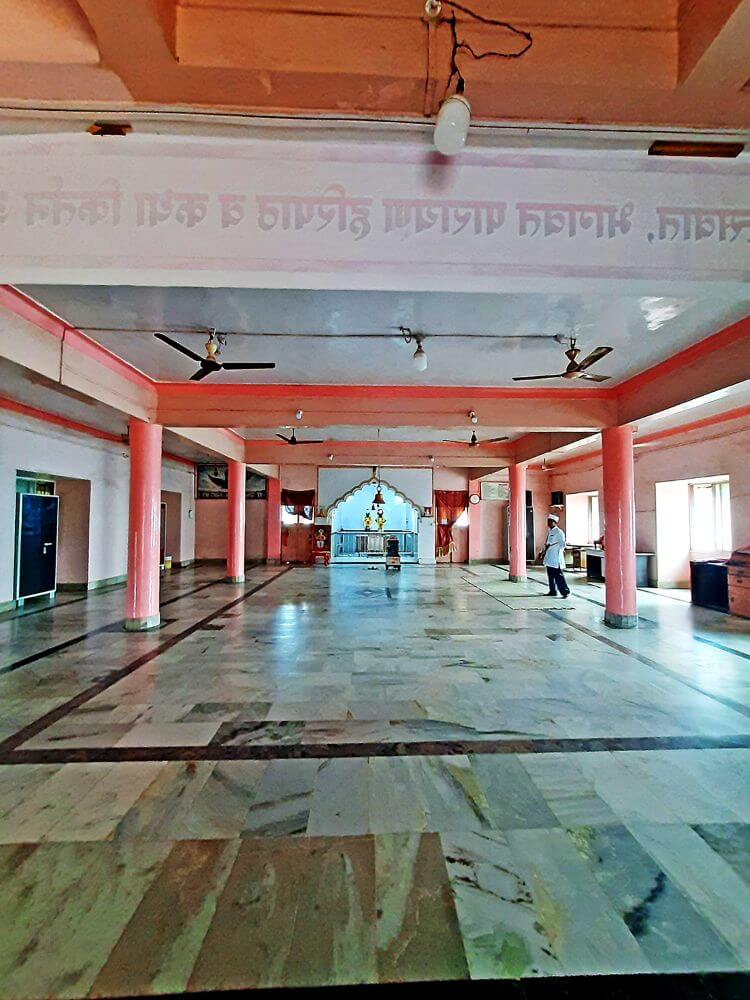
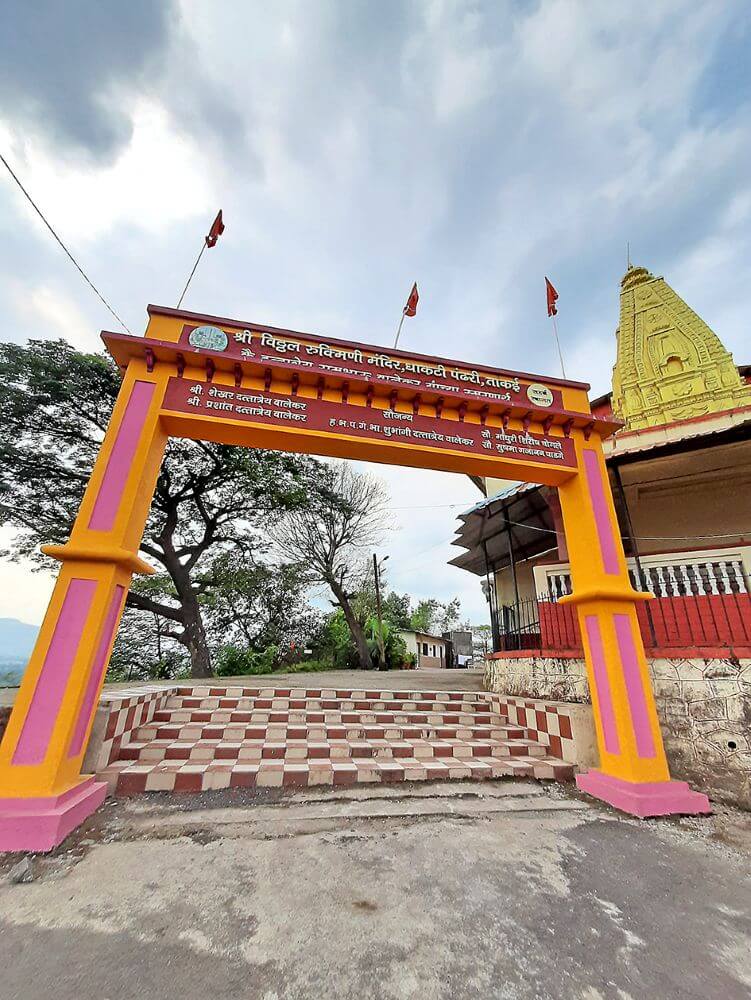
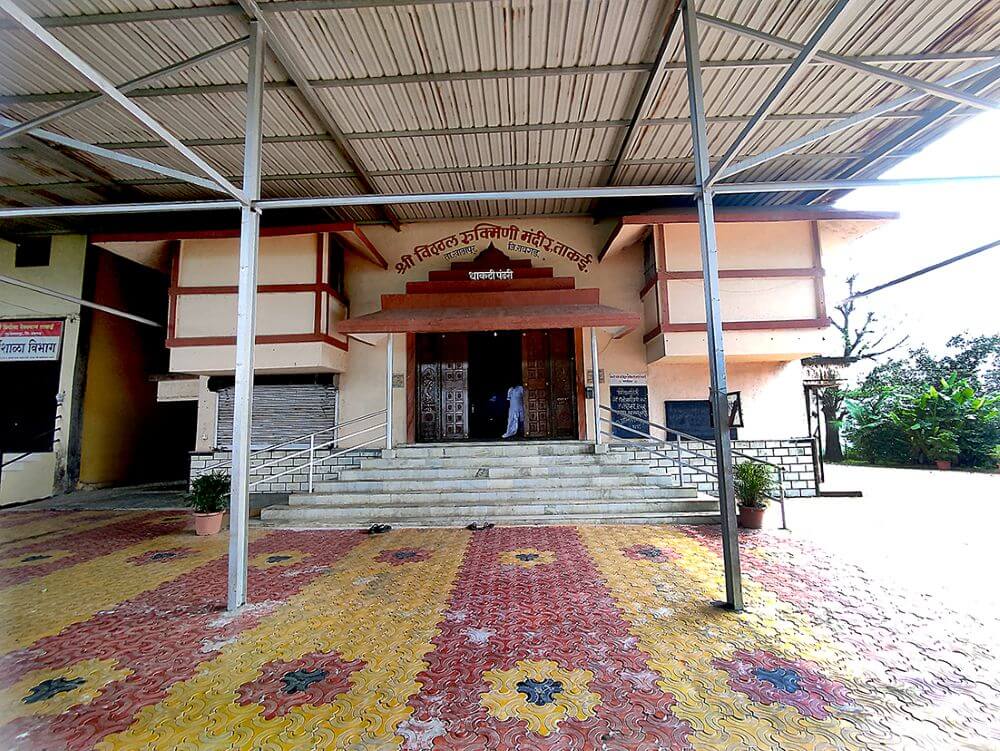
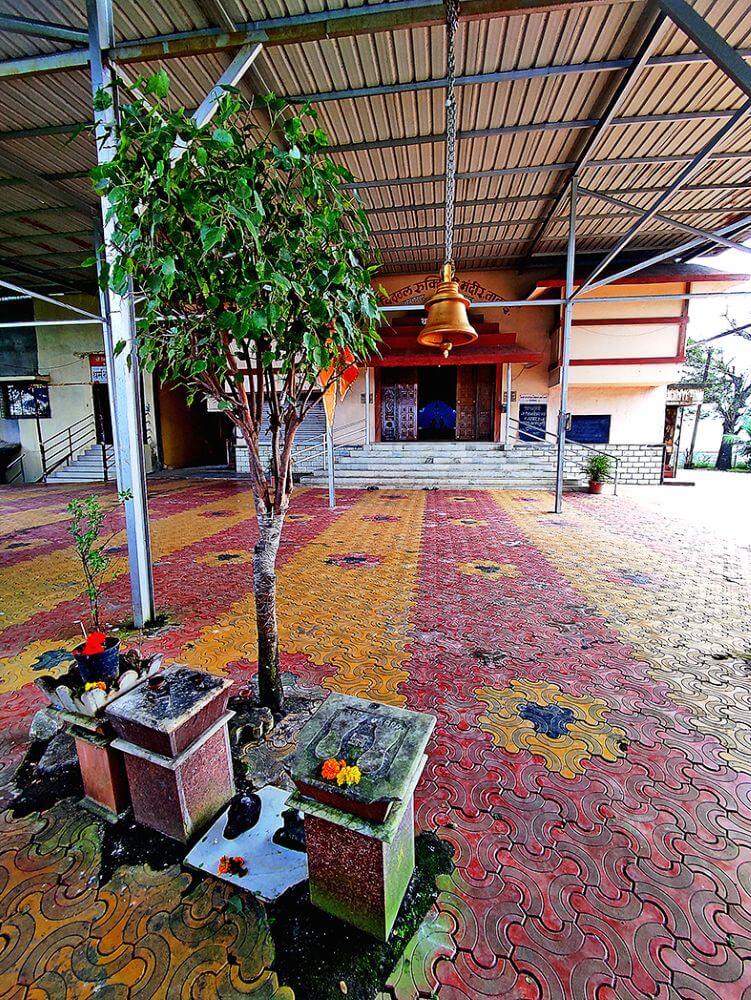
Devotees enter the temple courtyard through an ornate archway located on the plateau of the hill. In front of the main temple, a spacious mandap covered with a tin roof has been erected for the comfort of pilgrims and visiting Warkari Dindis. The main temple structure consists of a assembly hall (Sabhamandap) and a sanctum sanctorum (Garbhagriha). The grand Sabhamandap can accommodate 1,000 to 1,200 devotees at a time. Continuous, uninterrupted Veena devotional music (Akhand Veena-vadan) has been ongoing in this hall since 1986, for which six musicians have been appointed by the temple committee. Inside the sanctum sanctorum, placed upon a sacred Vajrapitha (stone pedestal), stand the three-foot-tall black stone idols of Lord Vitthal and Goddess Rakhumai, with their hands resting gracefully on their hips (katevar kar). Lord Vitthal’s idol is adorned with a silver crown, ear ornaments (Karna-kundale), and silver toe-rings, while Goddess Rakhumai wears a silver crown and divine neck ornaments.
A sacred legend associated with these idols states that Sant Tukoba once asked a few devotees of Lord Vitthal from this region to visit Pandharpur. When they arrived in Pandharpur, Tukoba entrusted them with the holy idols of Vitthal-Rakhumai that he had previously crafted. Later, on the auspicious occasion of Dasara, the consecration (Prana-Pratishtha) of these divine idols was performed here by the holy hands of Sant Tukobaraya Himself. From that year onwards, a grand fair began in the vast grounds in front of the temple. This fair is celebrated across Maharashtra as the ‘Bombalya Vithoba Yatra’ and carries a sacred tradition of over 350 years.
During the 15-day fair held after Kartiki Ekadashi, countless devotees from surrounding regions arrive carrying devotional flags (patakas) and leading Dindis. The whole atmosphere reverberates with the divine sound of Taal (cymbals) and Mridangam. On the eve of Kartiki Ekadashi, the divine Palkhi (palanquin) carrying the holy Padukas of Sant Dnyaneshwar Maharaj (Mauli) arrives at the residence of the late Dehu Kushaba Patil in Takai village. After the Patil family performs ceremonial worship of the Padukas, a Kirtan is held. Thereafter, the Palkhi circumambulates Takai village amidst joyous music and enters the Dhakti Pandhari Temple. On Ekadashi at dawn, following the Mahapooja and Kakad Aarti, the shrine opens for public Darshan.
The bustling market set up during this annual festival is very popular, particularly for the trade of cattle and dried fish, witnessing transactions worth crores of rupees. Apart from the main fair, the Beej Utsav is celebrated for nine days starting from Phalgun Shuddha Dashami, featuring Kirtans by renowned Kirtankars from across the state, attended by villagers from all neighboring areas. Another major annual festival is Shri Krishna Jayanti. During this 22-day grand celebration, sacred devotional programs including Kakada Aarti, Haripath, Bhagavat Parayan, and Kirtan are organized, along with the distribution of Mahaprasad to all devotees. On every Ekadashi, thousands of pilgrims visit this holy temple to seek divine blessings.
This sacred temple stands as a testament to deep spiritual devotion, ancient architectural grandeur, and rich local cultural traditions.
The sanctum sanctorum houses the divine idol consecrated according to ancient Vedic traditions, surrounded by serene courtyards and traditional temple architecture.
Navratri, Maha Shivratri, Annual Temple Jatra & Deepotsav
Compare and book flights, secure top-rated local hotels near the temple, hire reliable guides, and rent cars instantly.
Extend your pilgrimage by visiting other highly sacred temples located nearby.


Add ₹999 more to unlock FREE SHIPPING!
Your sacred cart is currently empty.
Shop Photo FramesFill in your delivery details below to place your order.
Add comment