
Add ₹999 more to unlock FREE SHIPPING!
Your sacred cart is currently empty.
Shop Photo FramesThe Vedganga is a tributary of the Panchganga River. It originates from a Gaumukh (cow-mouth spout) at Bhatwadi (Tambyachi Wadi). Enriching and bestowing prosperity upon numerous villages in the states of Maharashtra and Karnataka, it ultimately flows to meet the Krishna River. Because Vedic culture was nurtured along its banks, it became known as Vedganga. At Shengaon in Bhudargad Taluka, this river flows southwards (Dakshinabhimukh). Situated on the riverbank here is the renowned Ekmukhi Datta Temple. A revered center of devotion for countless faithful, this temple is believed to be the resting place (Shayansthan) of Lord Datta Maharaj and has been sanctified by the holy presence and stay of Param Pujya Vasudevananda Saraswati Tembe Swami. A unique feature of this temple complex is a small shrine containing an idol of Satyavan and Savitri.
According to legend, Lord Datta appeared in a divine vision to Balambhatji Paithankar, a devotee of Lord Datta from Hubli, revealing that His abode was at Shengaon on the banks of the Vedganga River. Thereupon, Balambhatji traveled from Hubli to Shengaon. He personally sculpted the idol and Padukas of Ekmukhi Datta Maharaj and established the shrine here on the riverbank. Subsequently, he constructed a stone Ghat in front of the temple. As Lord Datta used to rest (Shayan) here, the village came to be known as Shayangao, which over time evolved into the name Shengaon. Shri Tembe Swami used to rest here while traveling from Narsobachi Wadi to the Konkan region. The spiritual sanctity of this holy place has been further enhanced by the divine footprints of many realized souls (Siddha Purushas). Hence, this pilgrimage site is also known as Siddhatirtha. It is said that Sadguru Balumama also met his Guru, Mule Maharaj, at this very place. Within the riverbed here stands an ancient Shiva temple featuring a Shivlinga. Devotees and villagers firmly believe that the water flowing over the Shivlinga blesses the surrounding fields with a bountiful harvest.
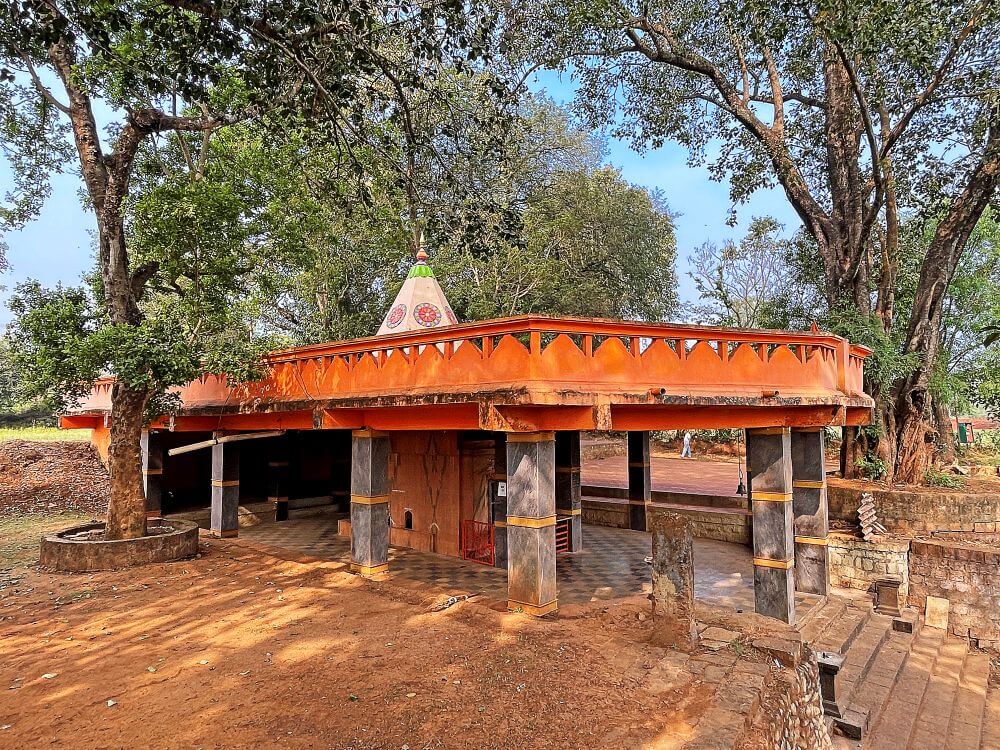
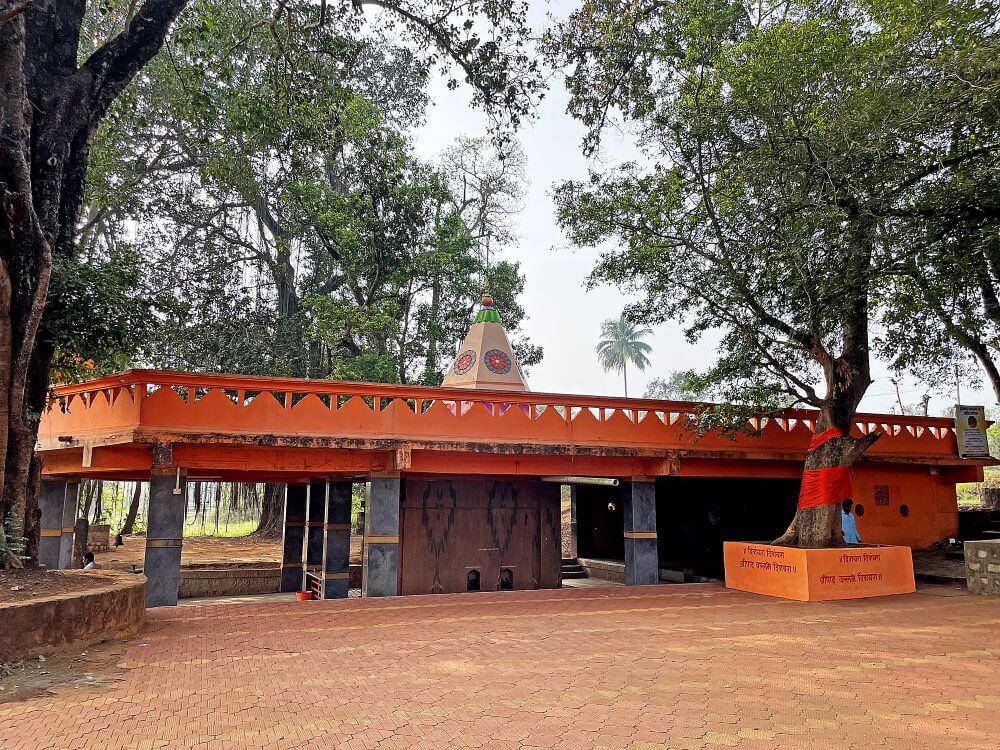
According to the villagers, this temple is believed to be approximately 500 years old. Approaching the temple from the village, one is greeted by a spacious courtyard. The entire courtyard is paved with interlocking paver blocks, significantly adding to the temple’s beauty. Built around the trees here are stone platforms (paar) where various religious ceremonies are conducted. Descending a few steps from here, one reaches the temple’s assembly hall (Sabhamandap) adjacent to the sanctum sanctorum (Garbhagriha). Situated slightly below ground level, the entrance of this temple faces the stone ghat on the riverbank. When coming towards the temple from the ghat, one ascends a flight of stone steps, flanked on both sides by Tulsi Vrindavans. The assembly hall is semi-open in design. At its center lies the enclosed sanctum sanctorum, which can be circumambulated (Pradakshina) directly from within the hall.
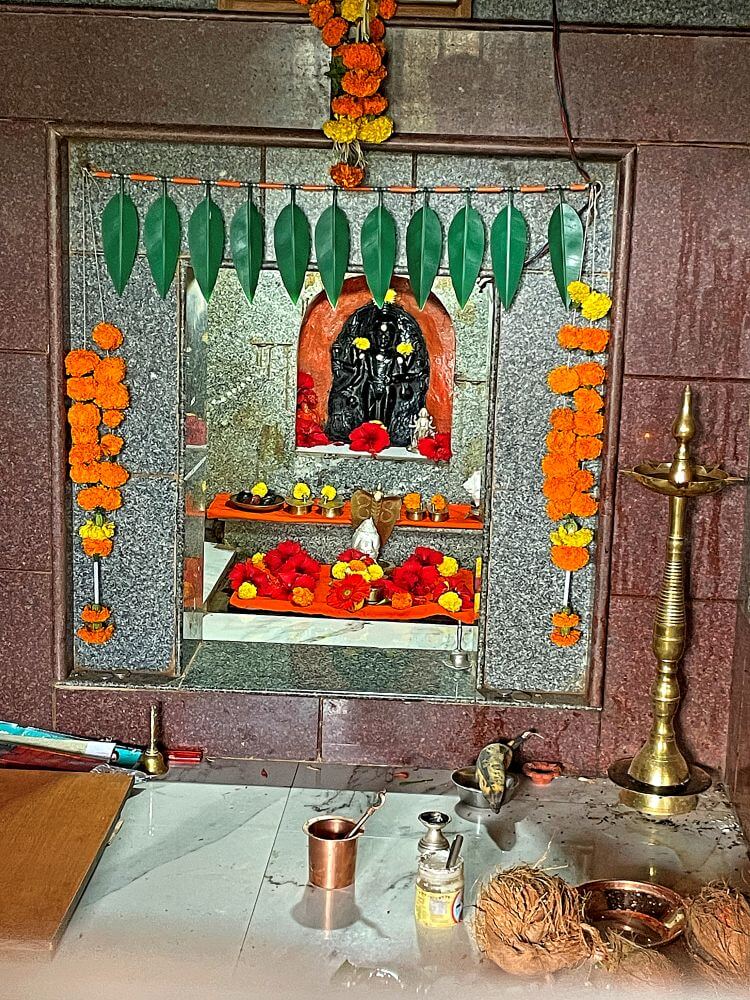
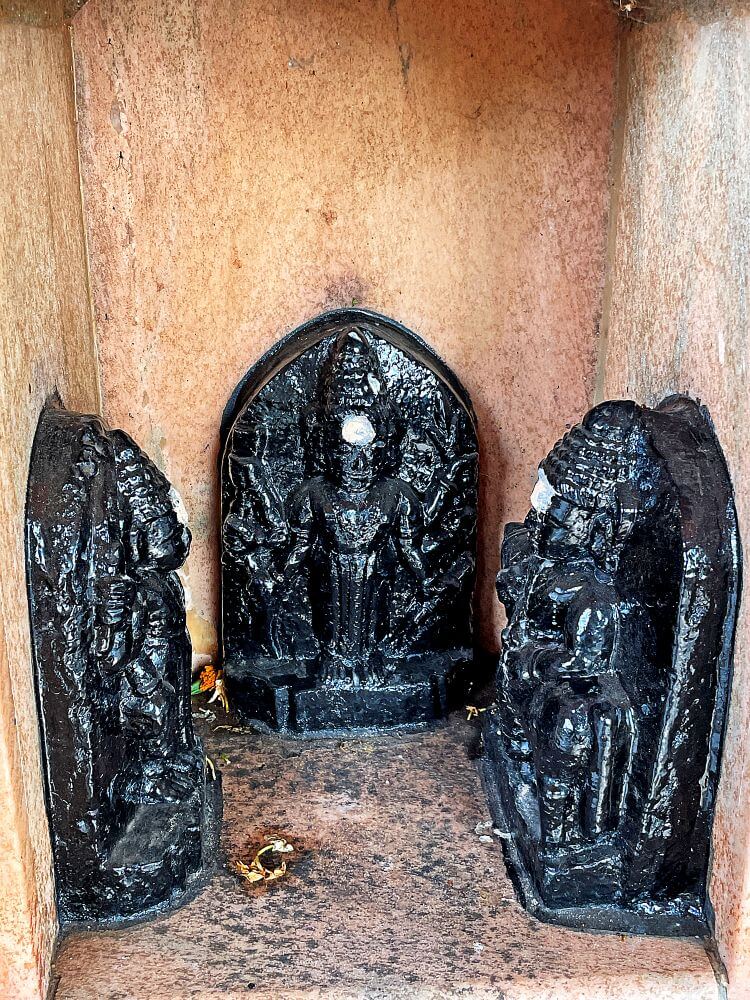
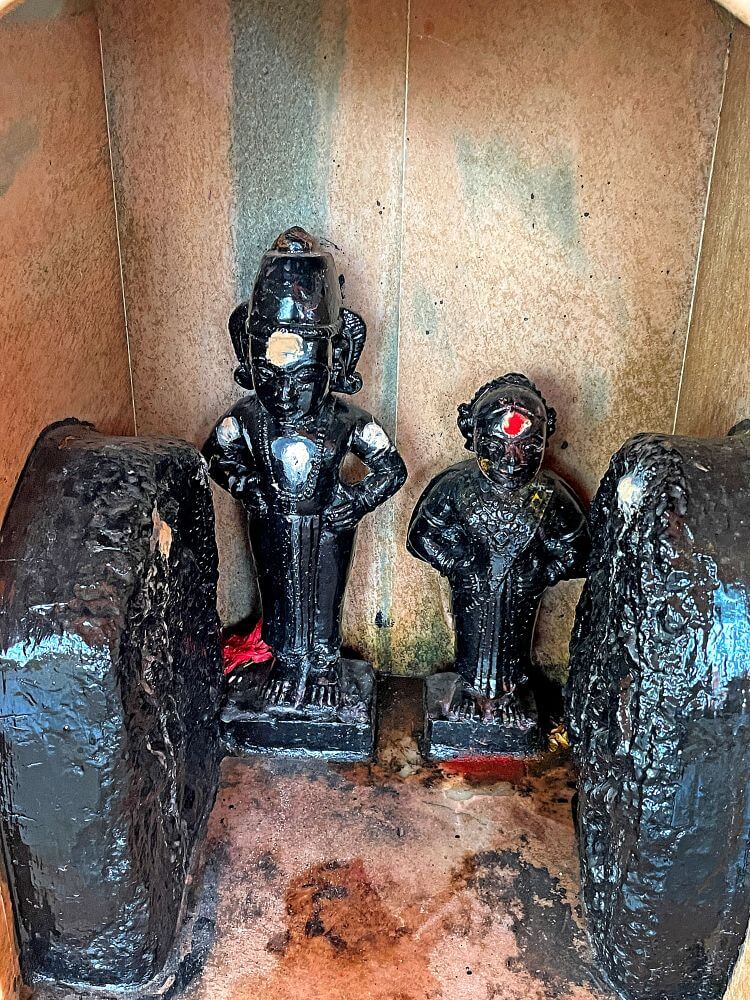
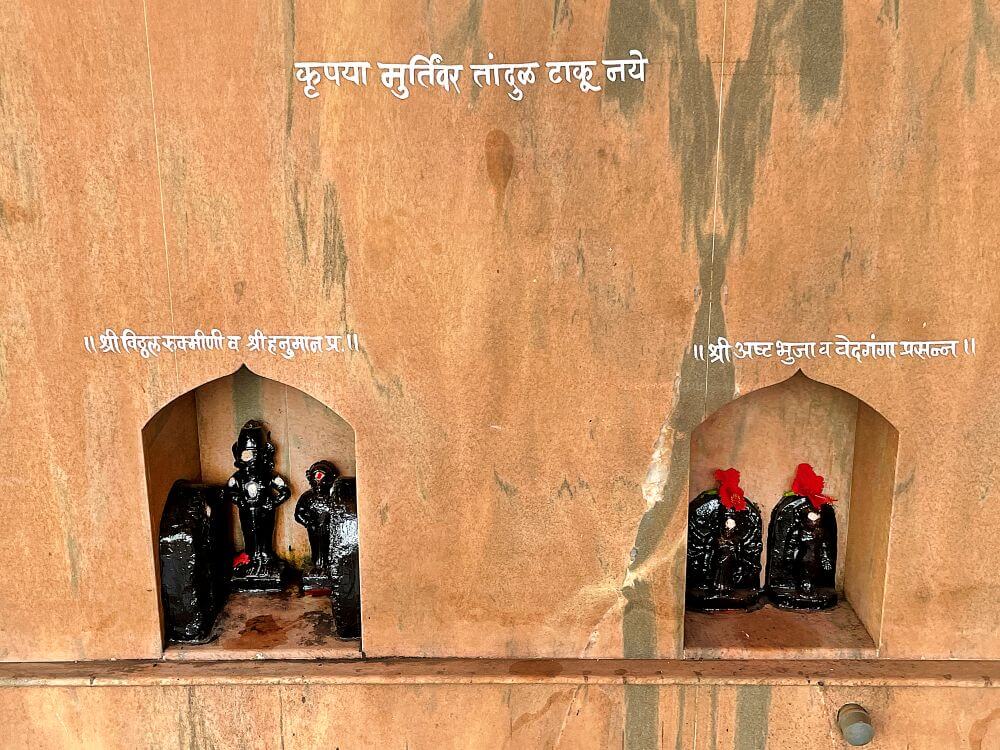
Above the entrance of the sanctum sanctorum is an idol of Lord Shiva. Inside the sanctum, enshrined on a Vajrapeetha, is the idol of Ekmukhi Datta Maharaj sculpted from fine black stone. Behind this main idol, in a wall niche (devakoshtaka), is a black stone idol of Kartikeya Swami. The outer walls of the sanctum sanctorum feature several wall niches. One of them houses the idols of Lord Khandoba, Goddess Mhalsa, and Goddess Banu. Another niche houses an idol of Kartikeya Swami. The rear wall of this niche features a large aperture, offering a direct view (darshan) of the Kartikeya Swami idol inside the sanctum. The next niche contains idols of Shanidev, Lord Shiva, and Lord Ganesha. In the niche on the adjoining wall, Goddess Ganga and Vedganga are enshrined. The subsequent niche houses idols of Vitthal-Rakhumai and Garuda-Hanuman. Further ahead within the assembly hall is the Ram Panchayatana shrine. Here, on a Vajrapeetha, stand black stone idols of Lord Rama, Lakshmana, Sita, and Hanuman, alongside local deities.
The roof-level walls of the temple are trimmed with parapets, featuring an octagonal spire (shikhara) at the center. Lotus flower motifs are intricately carved on the eight sides of the spire. A lotus replica also adorns the top of the spire, surmounted by an Amalaka and a sacred Kalash. In front of the temple lies a vast stone-stepped ghat leading down to the riverbed. Beyond the steps is an inscription recording that Appaji Narayan Patil constructed this ghat in 1896 AD. On one side of the temple, beneath an ancient banyan tree, stands a small Vat Savitri shrine. Flanked on two sides by guardian deities (Dwarapalas), the shrine houses a black stone idol of Satyavan and Savitri, depicting Savitri seated with the mortal body of Satyavan on her lap. Additionally, another small shrine nearby enshrines several sacred Padukas.
Annual festivals such as Chaitra Padwa, Dasara, Diwali, Datta Jayanti, Guru Dwadashi, as well as Tripurari Purnima and Kartikeya Swami Jayanti are celebrated grandly at the temple. Hundreds of devotees visit for divine darshan during these annual festivities. Religious programs including Datta Pujan, ritual recitation (Parayan) of the Guru Leelamrit, Bhajans, Kirtans, spiritual discourses (Pravachan), night vigils (Jagaran), and chanting (Namasmaran) are organized here. Mahaprasad is served to all visiting devotees on these occasions. The temple experiences larger congregations on Thursdays and full moon days (Purnima). On Purnima, Abhishek and Aarti are performed between 6:30 AM and 7:30 AM. Mahaprasad is distributed to devotees from 10:30 AM to 2:00 PM. Bhajans are conducted between 2:00 PM and 5:00 PM, followed by Aarti and the sacred Palanquin procession (Palkhi Pradakshina) from 7:00 PM to 8:00 PM.
This sacred temple stands as a testament to deep spiritual devotion, ancient architectural grandeur, and rich local cultural traditions.
The sanctum sanctorum houses the divine idol consecrated according to ancient Vedic traditions, surrounded by serene courtyards and traditional temple architecture.
Navratri, Maha Shivratri, Annual Temple Jatra & Deepotsav
Compare and book flights, secure top-rated local hotels near the temple, hire reliable guides, and rent cars instantly.
Extend your pilgrimage by visiting other highly sacred temples located nearby.


Add ₹999 more to unlock FREE SHIPPING!
Your sacred cart is currently empty.
Shop Photo FramesFill in your delivery details below to place your order.
Add comment