
Add ₹999 more to unlock FREE SHIPPING!
Your sacred cart is currently empty.
Shop Photo FramesAt the insistence of his mother Rukmini, the pioneer of the Bhoodan movement, Acharya Vinoba Bhave, translated the Bhagavad Gita from Sanskrit into Marathi and named it ‘Gitai’. Without altering the core essence and meaning of the Gita’s verses, he composed the 18 chapters. The Gitai Mandir, where this Gitai written by Vinoba was immortalized, is located in the Gopuri area near Wardha city. At this sacred site, the 710 verses of the Gitai are carved on stones brought from various parts of the country. Sheltered under the canopy of the open sky and shaped like a cow, this is the only temple of its kind in the world.
The Gitai Mandir was built not merely as a place of prayer, but to immortalize Gandhiji’s message of truth, non-violence, and compassion in architectural form. In one sense, it stands as a memorial to Gandhiji, Acharya Vinoba Bhave, and Jamnalal Bajaj, while in another, it is a visible manifestation of Karma Yoga and Sankhya Yoga as expounded in the Bhagavad Gita. Envisioned by Kamalnayan Bajaj, the son of Jamnalal Bajaj, the Bhoomi Pujan of this temple took place on 4th November 1964. The foundation stone of the temple was laid on 4th November 1969 by Khan Abdul Ghaffar Khan, known as the ‘Frontier Gandhi’, and its construction work commenced on 1st May 1977. The then Vice President of India, M. Hidayatullah, inaugurated the temple on 7th October 1980. Exactly 50 years prior to the day the temple was inaugurated, on this very date, Vinoba had commenced the writing of the ‘Gitai’.
The design and structure of the Gitai Temple are uniquely distinctive. When viewed from the front, it resembles a charkha (spinning wheel), whereas when viewed from the hill behind, one perceives it to be in the shape of a cow. The cow, which holds sacred significance in Indian culture, and the charkha, representing a means of eradicating poverty, are depicted here as symbols. The main entrance of the temple is designed like a Thavni (a sacred scripture stand). Since holy scriptures are traditionally read resting upon a scripture stand, the main entrance has been designed accordingly. …has come. Although this door is constructed using cement, it gives the appearance of being made of wood. While setting the cement for the door, Deodar wood was used to create the illusion of a wooden structure. A replica of the wheels of Arjuna’s chariot from the Mahabharata is carved on the main gate (Mahadarwaja). Each wheel has eight spokes. Upon entering through the doorway, one comes across a grand pillar. A Swastika is carved on the pillar, and its plinth is made of pink stone brought from Chunar in Uttar Pradesh. The square-shaped pillar is made of smooth, polished stone brought from Kuppam near Bengaluru. A shloka expressing Vinoba’s deep sentiments towards Gitai is inscribed on this pillar in his own handwriting. That shloka is as follows –
Gitai is my Mother, and I am her innocent child.
When I fall and weep, You tenderly lift me up into Your arms.
Similarly, Vinoba’s message of truth, love, and compassion has been engraved upon this pillar.
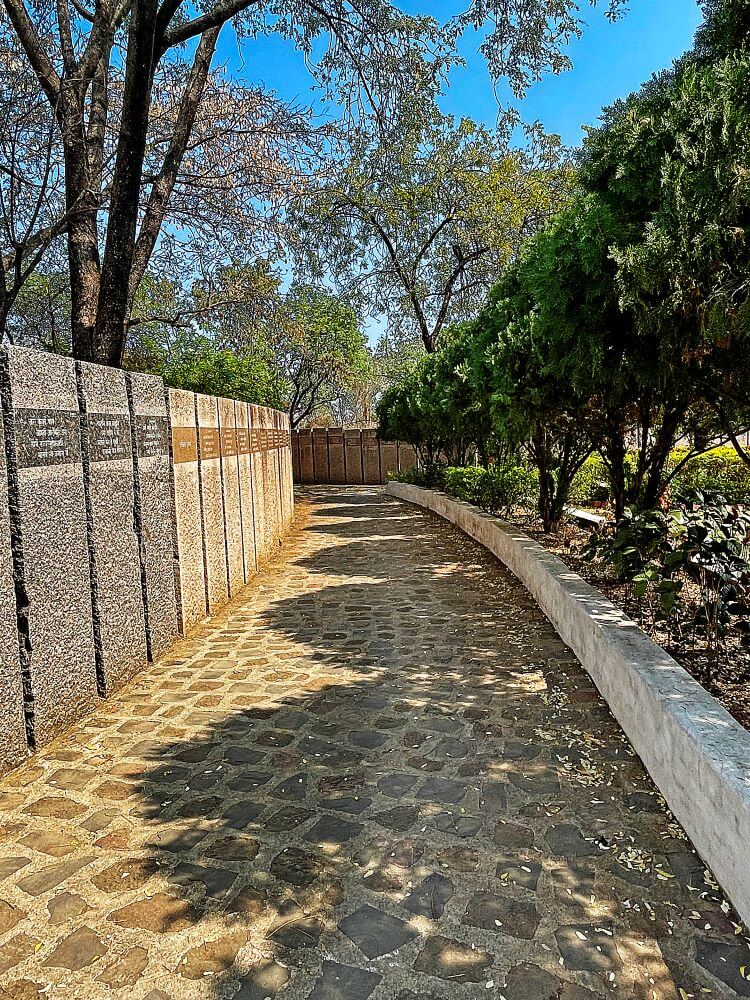
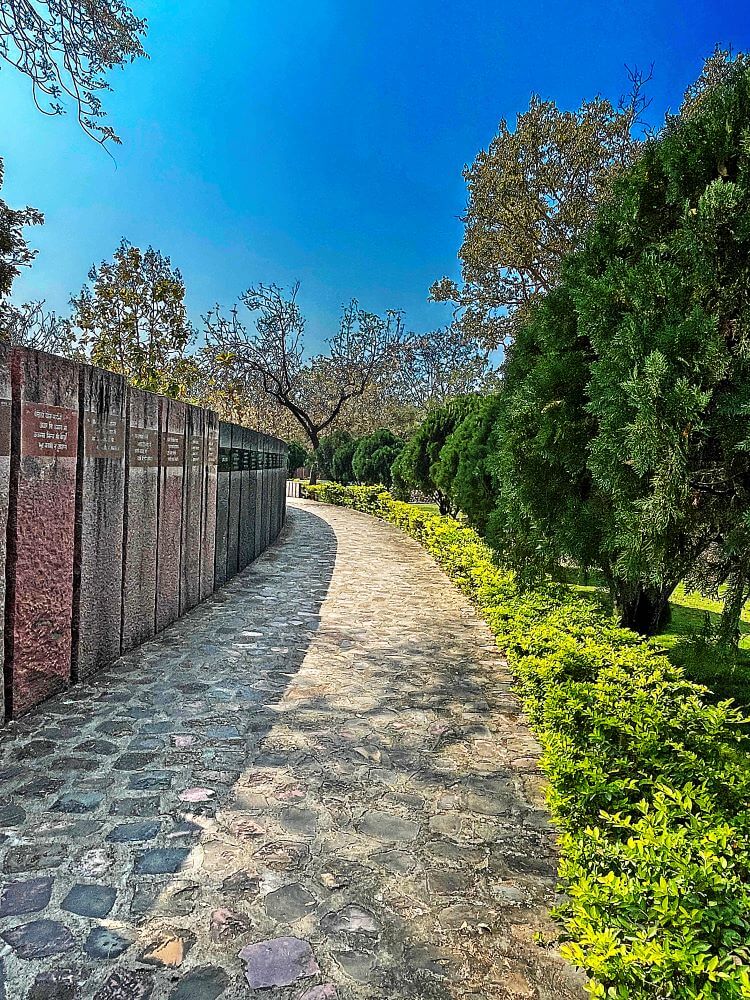
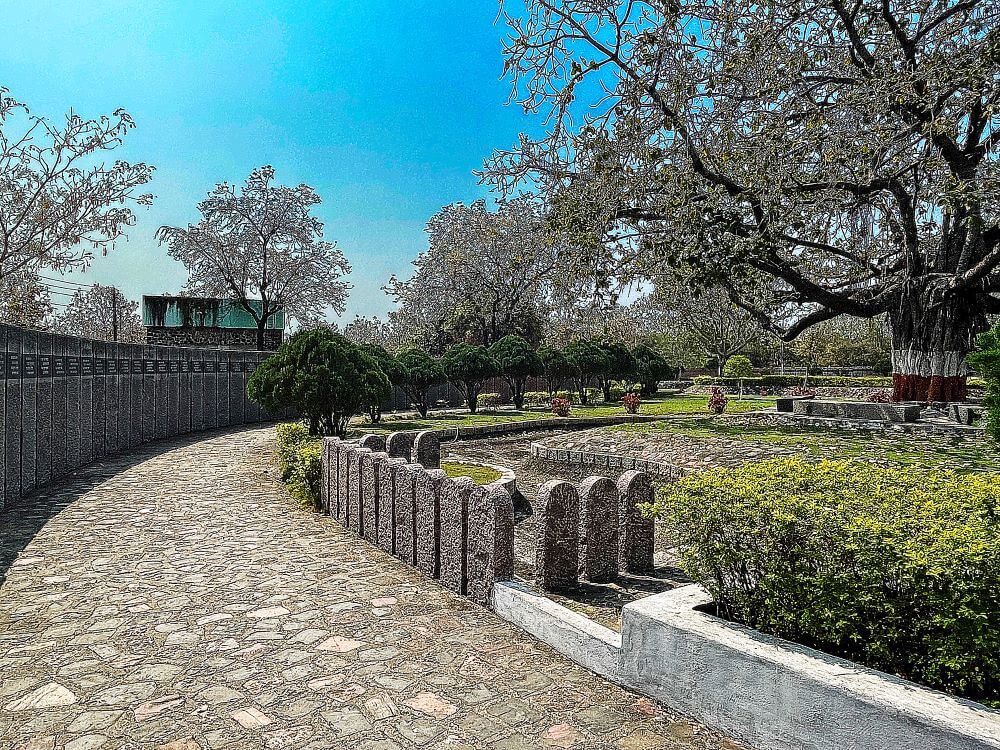
After descending about 25 steps, one comes to a tunnel two and a quarter meters high and five meters long. The tunnel has an arched entrance, and inside, as per the last wish of Kamalnayan Bajaj, the urn containing his sacred ashes is enshrined. Ascending 23 steps from there leads into the Gitai Mandir. Nearby is the foundation stone of the temple, laid by Khan Abdul Ghaffar Khan. An arrangement of massive stones set in a row forms the perimeter of the temple. The north-eastern section of the temple is shaped like a charkha, while the eastern section resembles the back of a cow. On the southern side, the cow’s tail and hind legs are depicted, while the south-western side shows the cow’s udder and front legs, and to the west, it takes the shape of a Gomukha.
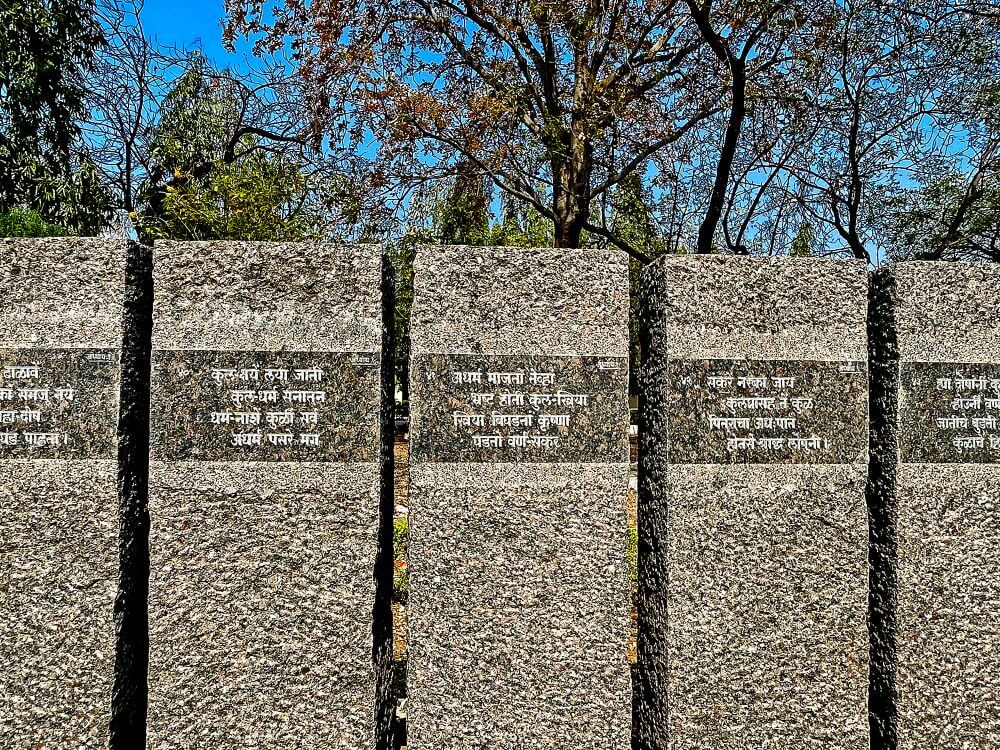
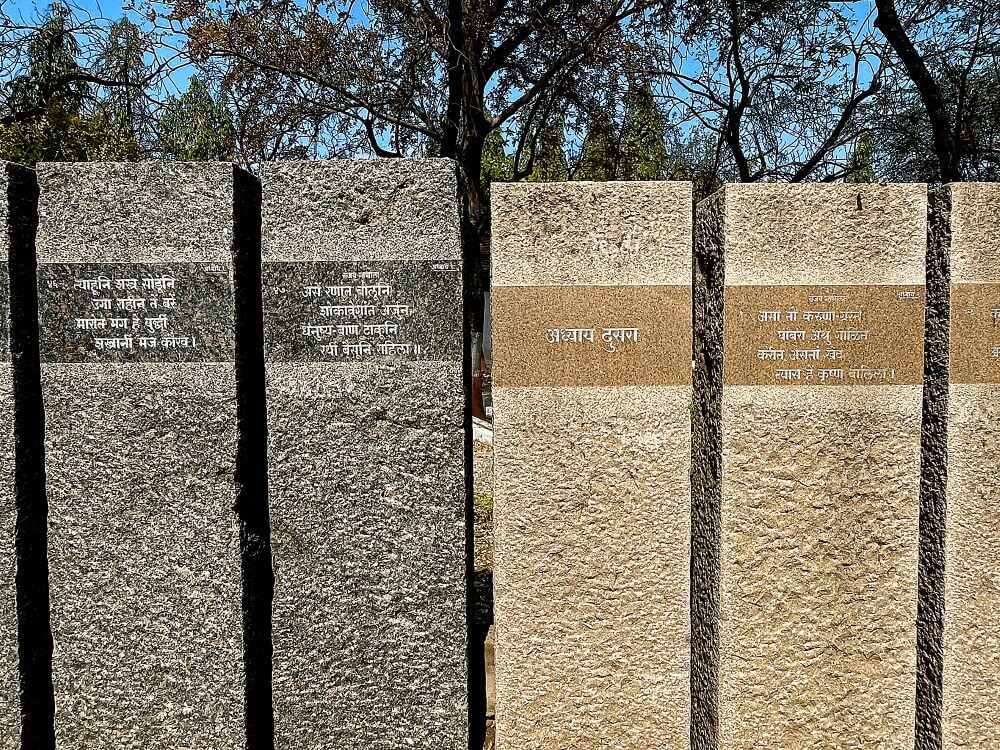
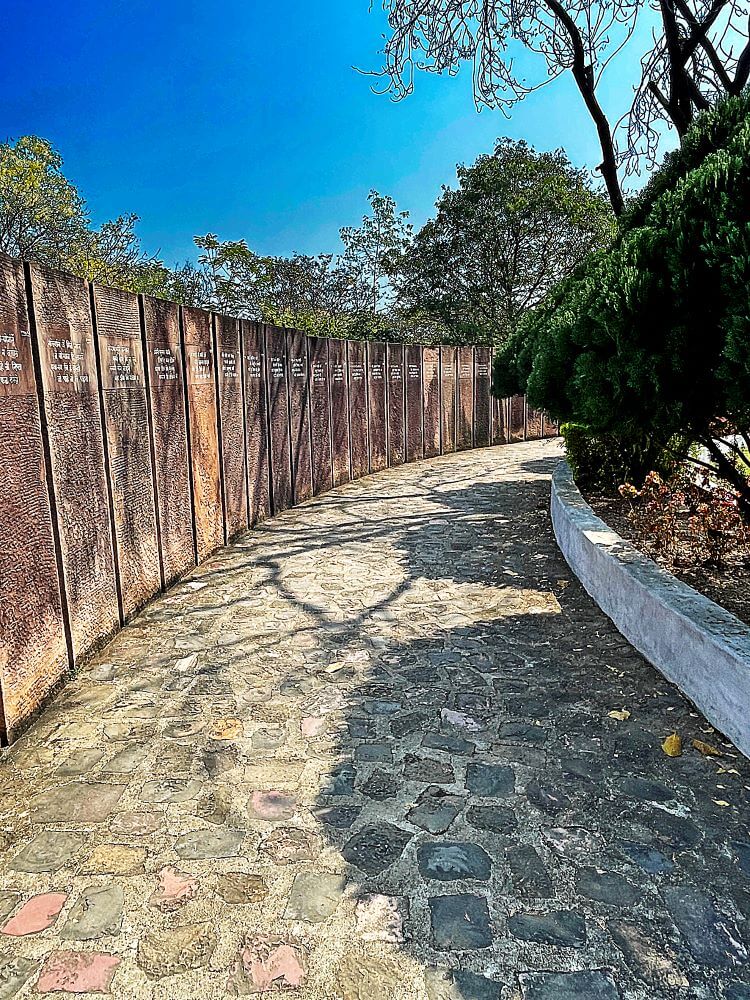
As Gitai is a rendering of the Bhagavad Gita, it comprises seven Adhikaranas (sections), 18 chapters, and 700 verses. In this temple, each verse of the Gitai has been carved on an individual stone. Thus, there are 700 stones inscribed with the verses. In addition, separate stones have been used: 18 to indicate the chapter numbers, seven for the Adhikaranas, two for the index, and one for the title ‘Gitai’. Furthermore, there is one stone on either side of the Adhikarana series and the Chapter series, and two stones near the moving entrance gate. Thus, the perimeter of the temple is formed by a row of a total of 732 stones. Measuring nine feet in height, two feet in width, and one foot in thickness, each stone weighs between 1,400 and 1,500 kilograms. The surface of every stone has been made smooth with the help of machinery and chemical treatment. There is a distance of 8 cm between two stones. The verses carved on these stones are so clear that they can be read even from a distance of 10 feet. The stones dedicated to the verses of a single Adhikarana They are at the same level. A paving of colored stones has been laid among all these stones. Harali grass has been planted in the spaces between the stones.
The verses of the first chapter here are carved in dark red granite (Vajratunda) stone. This section creates the impression of a cow’s horn. The verses of the second chapter are carved in red-colored Vajratunda stone brought from the Bengaluru region. A portion of this chapter is shaped like a cow’s horn, while from the 68th verse up to the fourth chapter, it resembles a spinning wheel (charkha). For the third chapter, grey-colored Vajratunda stones brought from the Bengaluru region have been used. The verses of the fourth chapter are carved in brown-colored Vajratunda stones brought from Tamil Nadu.
Pink sandstone from Chunar in Uttar Pradesh has been used for the fifth chapter. The second part of the Charkha begins from this chapter. For the sixth chapter, Vajratunda stones—white stones with black spots brought from Krishnam—have been used. The seventh chapter is inscribed on pink Vajratunda stones from Kuppam. From this chapter to the tenth chapter, the structure gives the impression of a cow’s back. Black Vajratunda stone from Kuppam has been used for the eighth chapter. For the ninth chapter, dark grey stone from Kuppam has been used. To ensure easy reading in sunlight, these carved letters have been given an aluminium coating.
The verses of the tenth chapter are carved in pink Vajratunda stones, while the verses of the 11th chapter are engraved in grey Vajratunda stones from Gandipet. This section is shaped in the form of a cow’s tail. For the 12th chapter, red sandstone brought from Karauli in Rajasthan has been used. From this chapter up to a part of the 14th chapter, it is crafted in the shape of a cow’s hind legs.
Grey Vajratunda stone has been used for the 13th chapter, hard basalt stone from Jotiba Hill near Kolhapur for the 14th chapter, and black Vajratunda stone from Cuddapah for the 15th chapter. For the 16th chapter, light pink Vajratunda stone with black specks has been used, which is in the shape of a cow’s belly. The final two chapters, the 17th and 18th, are carved on grey Vajratunda stones brought from Bengaluru, taking the shape of a cow’s front legs.
Within the temple premises stand the memorials of Jamnalal Bajaj, his mother Birdibai, his wife Jankidevi, and Mahatma Gandhi’s associate, Kishorlal Mashruwala. Water from a nearby well is circulated to create a replica of the sacred Trishuli River in Nepal. In Shanti Kuti, located in front of Gitai Mandir, a permanent exhibition has been set up in memory of Mahatma Gandhi, Vinoba Bhave, and Jamnalal Bajaj. The entire expense for this temple was borne by the Bajaj family.
Vinoba authored ‘Gitai’ in Wardha between 1930 and 1931. The first edition of this sacred book was published in 1932, while Vinoba was in Dhule Jail. Till date, over 268 editions of ‘Gitai’ have been published. Recitation examinations for Gitai are conducted in schools across Wardha district, and certificates are awarded to successful students. October 7th marks the anniversary of Gitai Mandir. Since 1979, thousands of students in Wardha gather on this day from 5:00 AM until the arrival of the sun’s rays for the collective chanting of Gitai. This divine tradition continues to this day. Adjacent to Gitai Mandir stands the Shanti Stupa, conveying the message of world peace and housing captivating idols of Lord Gautama Buddha.
This sacred temple stands as a testament to deep spiritual devotion, ancient architectural grandeur, and rich local cultural traditions.
The sanctum sanctorum houses the divine idol consecrated according to ancient Vedic traditions, surrounded by serene courtyards and traditional temple architecture.
Navratri, Maha Shivratri, Annual Temple Jatra & Deepotsav
Compare and book flights, secure top-rated local hotels near the temple, hire reliable guides, and rent cars instantly.
Extend your pilgrimage by visiting other highly sacred temples located nearby.


Add ₹999 more to unlock FREE SHIPPING!
Your sacred cart is currently empty.
Shop Photo FramesFill in your delivery details below to place your order.
Add comment