
Add ₹999 more to unlock FREE SHIPPING!
Your sacred cart is currently empty.
Shop Photo FramesThe historic city of Shrivardhan is well-known as the birthplace of Balaji Vishwanath, the first Peshwa of Chhatrapati Shahu Maharaj of the Satara royal family. The ancient temple of Kusamadevi in the village of Gaigothan near this city is a sacred place of deep faith for countless devotees. Kusamadevi is revered as the sister of Somjai Devi, the village deity of Shrivardhan. Kalbhairav here is considered to be the brother of both goddesses. Therefore, many devotees visit all three shrines on the same day. There is a traditional custom of making a vow to this goddess by tying a knot (kale lavun).
It is said that the ancient stone idol of Kusamadevi here dates back to the twelfth century. According to the temple legend, during the Mahabharata period, the Pandavas spent some time in exile in the dense forests of this region. During their stay here, they created several shrines for their personal worship. It is believed that this temple of Kusamadevi is the combined form of Mahakali, Mahalakshmi, and Mahasaraswati among those shrines. The goddess likely came to be named Kusamadevi as a deity associated with the flowers of the forest.
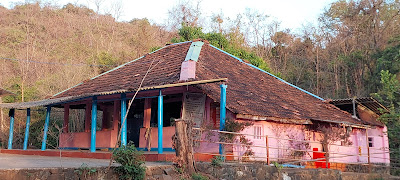
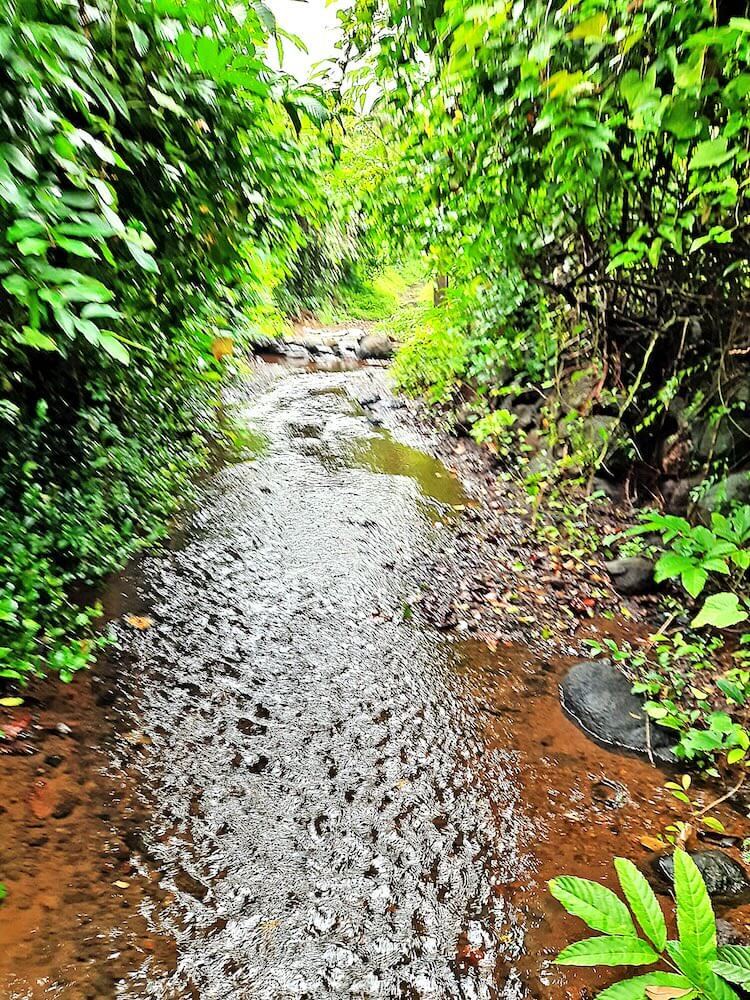
The temple is located in Gaigothan village, which is at a distance of three kilometers from Shrivardhan city while heading towards Diveagar along the coastal route. This temple lies hidden in dense greenery. To reach here, there is a road branching off to the right towards the hills near Gaigothan village. After traveling some distance by vehicle, the onward path becomes somewhat difficult. In the rainy season, one has to walk up to the temple through a flowing stream. This stream does not have much water; one can wade through it in just about a foot-span of water. If there is heavy rain, the water level is likely to rise somewhat. Even so, countless devotees keep visiting here. One has to walk further ahead through the water under arches formed by creepers and trees on both sides. This place is far away from the hustle and bustle of the city. Therefore, only the chirping of birds and the babbling sound of water flowing through the stream reach the ears.
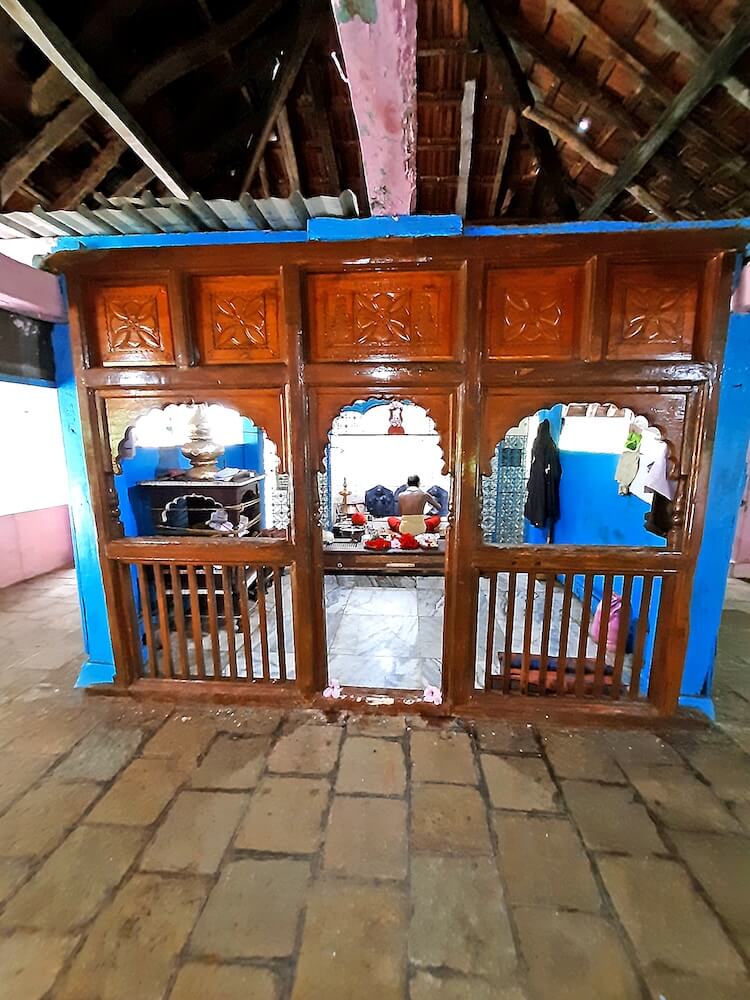
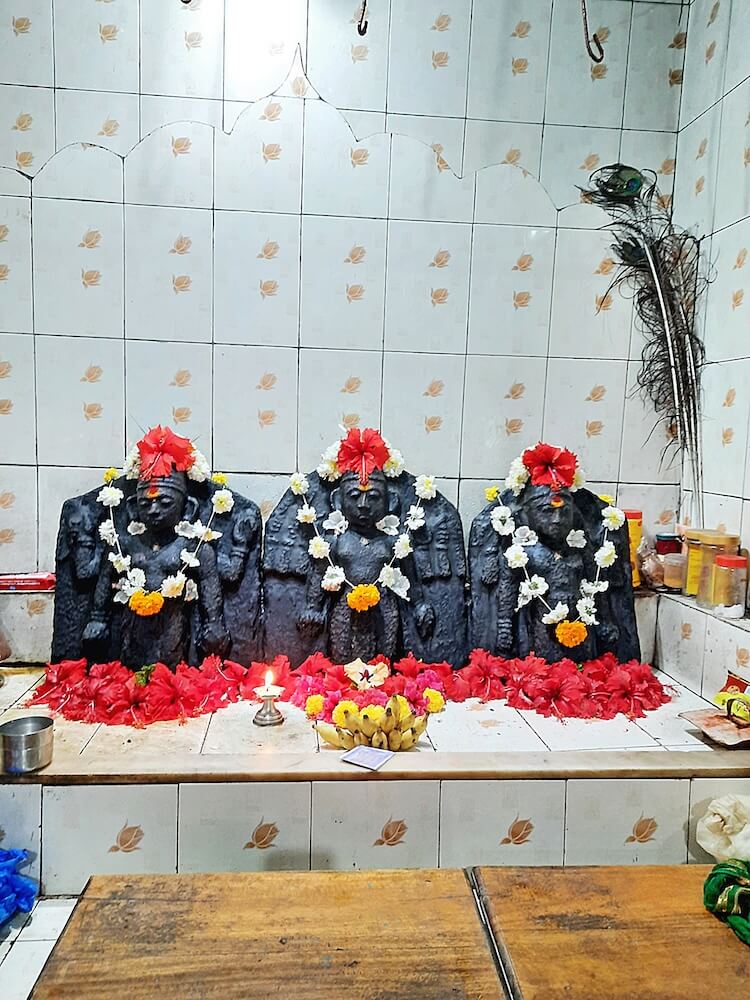
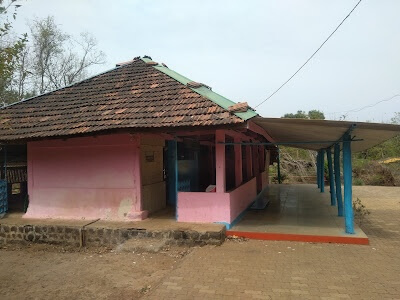
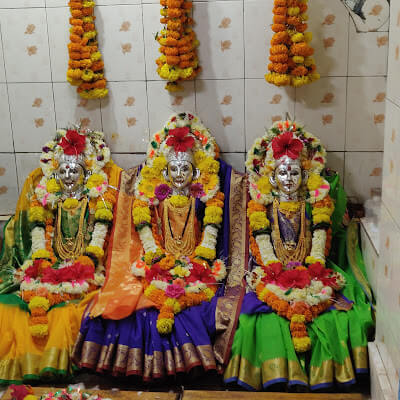
The temple courtyard is at a slightly elevated level and is paved with interlocking blocks. This courtyard has a natural boundary wall of bushes and shrubs. There is a Tulsi Vrindavan on a platform in front of the temple. This tiled-roof temple has a structure consisting of a spacious verandah, a sabhamandap (assembly hall), and a garbhagriha (sanctum sanctorum) in front of the main temple. A tin shed has been erected over this verandah for the convenience of devotees. The sabhamandap here is semi-open in nature. In the sabhamandap, there are four rows of four square pillars each. These wooden pillars stand on stone bases, and there are beams resting on the upper side of these pillars. Numerous brass bells are suspended from the ceiling here. In the middle of the sabhamandap are four wooden pillars connected by a scalloped arch and the entrance to the garbhagriha. The entrance on the front wall of the garbhagriha has iron-grated shutters. In the center of the garbhagriha, on a Vajrapitha (sacred pedestal), are two-foot-tall stone idols of Mahakali, Mahasaraswati, and Mahalakshmi. The carving of these idols is distinctive. All three of these goddesses are collectively addressed as Kusamadevi. During festivals, these idols are adorned with various ornaments and garments. After being decorated with specific types of flowers, the appearance of the idols becomes even more radiant. Near the temple is a small shrine with just a roof. On the Vajrapitha here is an idol of Lord Ganesha and a Shiva lingam beside it.
The annual grand chariot festival (jatrotsav) of this goddess is celebrated with great enthusiasm on Chaitra Shukla Dwitiya, which is the day after Gudi Padwa. On this occasion, the goddess is taken around the village in a palanquin procession. Thousands of devotees flock to the temple on this day to have the darshan of the goddess and fulfill their vows. During the ten-day festival of Sharadiya Navratra, programs such as homahavan (sacred fire rituals), bhajans, kirtans, and pravachans (religious discourses) are organized in the temple. Although the path leading to this temple is somewhat rugged, due to unwavering faith in the goddess, there is a bustling crowd of devotees every Tuesday, Friday, and on Purnima (full moon) and Amavasya (new moon) days. Since tourist destinations like the Shrivardhan coast and Diveagar are close by, many tourists also visit here for the darshan of the goddess. Devotees can have the darshan of Kusamadevi in this temple daily from eight in the morning to six in the evening.
This sacred temple stands as a testament to deep spiritual devotion, ancient architectural grandeur, and rich local cultural traditions.
The sanctum sanctorum houses the divine idol consecrated according to ancient Vedic traditions, surrounded by serene courtyards and traditional temple architecture.
Navratri, Maha Shivratri, Annual Temple Jatra & Deepotsav
Compare and book flights, secure top-rated local hotels near the temple, hire reliable guides, and rent cars instantly.
Extend your pilgrimage by visiting other highly sacred temples located nearby.


Add ₹999 more to unlock FREE SHIPPING!
Your sacred cart is currently empty.
Shop Photo FramesFill in your delivery details below to place your order.
Add comment