
Add ₹999 more to unlock FREE SHIPPING!
Your sacred cart is currently empty.
Shop Photo FramesShrivardhan is a beautiful town lost amidst a dense grove of coconut and betel nut trees, nestled between the vast sea to the west, the Tambadi hill to the north, and a creek to the south. Being the birthplace and Deshmukhi territory of Balaji Vishwanath Bhat, the Keshav-form Vishnu idols found in the Shrivardhan region point to the Shilahara rule over this area. There are many ancient temples in this town. One of the most famous among them and the pride of the town is the Lakshminarayan Temple here. This is a principal family deity (Upasya Daivat) of the Bhat-Peshwa family. Devotees have a firm faith that the deity here fulfils their prayers (Navas).
Looking at the black stone Dravidian-style Vishnu idol in the temple, it is said that this temple dates back to the twelfth century. During the reign of Sawai Madhavrao Peshwa, in the year 1775, this temple was renovated. A wooden inscription in Devanagari script regarding this is on a beam in the sabhamandapa (assembly hall). This confirms that the temple is ancient. In the year 1960, Shivshahir Babasaheb Purandare visited this temple. Observing the idols here at that time, he certified that they belong to the twelfth century. According to the Kolaba Gazetteer, Shrivardhan is mentioned as ‘Zifardan’ in the accounts of various European travellers. According to some scholars, the town may have been named Shrivardhan after the name of Sridhar-form Vishnu in the temple.
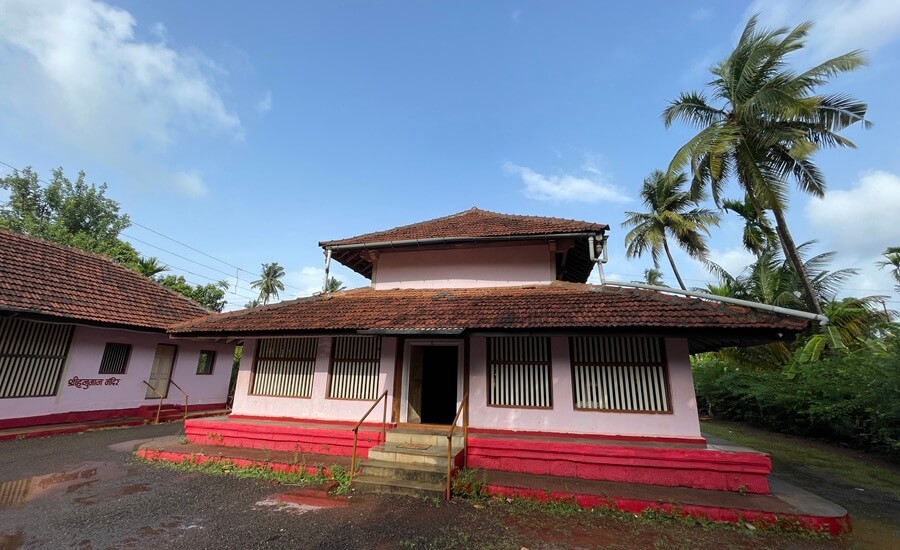
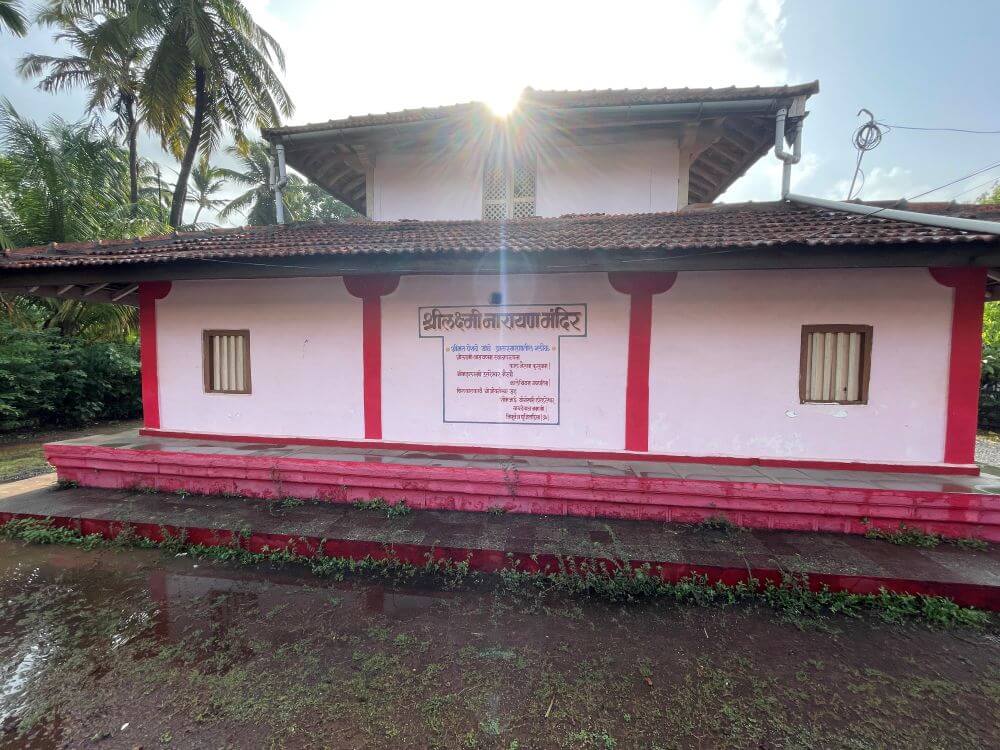
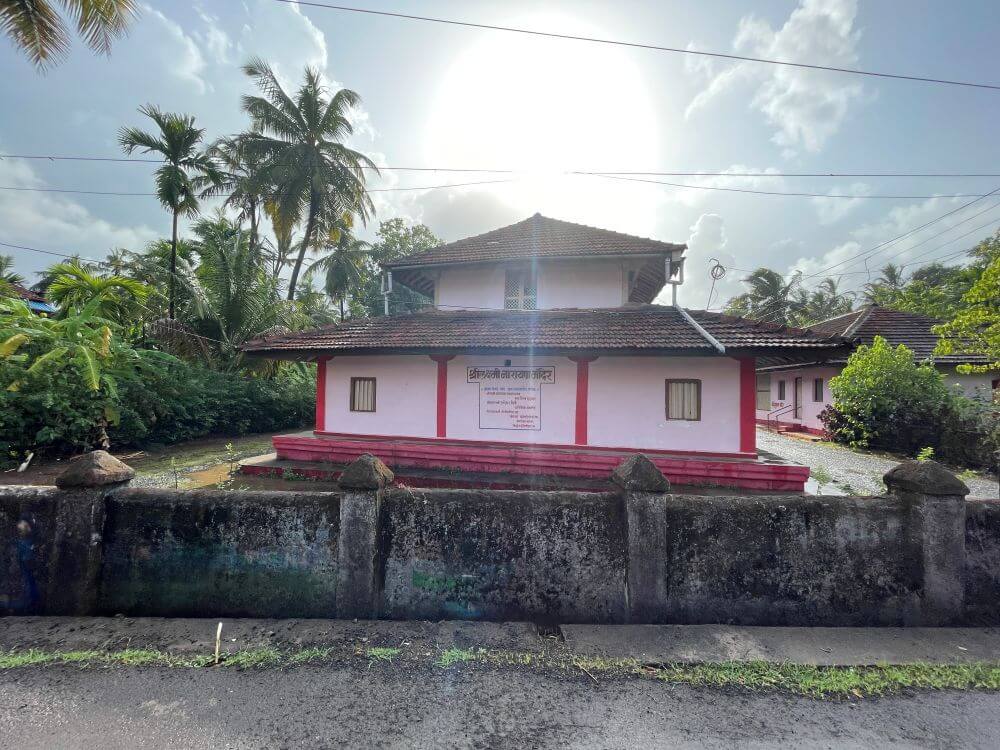
The temple is located alongside the road leading from the town’s ST bus stand towards Narayan Pakhadi. One enters the temple courtyard through the gateway of the surrounding compound wall. There are two meghadambaris (domed canopies) in front of the Lakshminarayan Temple. In one of them is the idol of Garuda and in the other meghadambari is the idol of Hanuman. The meghadambari housing the Hanuman idol is on a stepped pedestal . It features a dome-shaped spire and a modak-shaped kalash (finial). These idols of Garuda and Hanuman in the courtyard confirm that this temple belongs to Lord Vishnu.
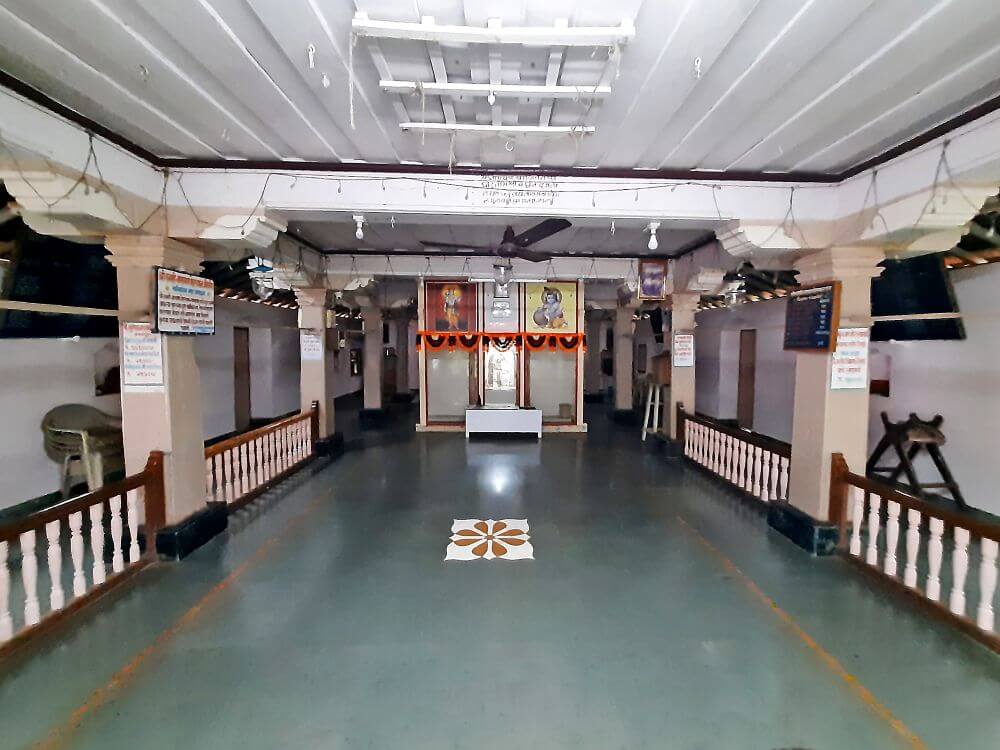
Comprising a sabhamandapa, antarala (vestibule), and garbhagriha (sanctum sanctorum), this double-storeyed tiled-roof temple stands on a three-foot-high plinth. There are railings on both sides of the steps leading from the courtyard to the sabhamandapa. The doorframes of the entrance have floral carvings and the entrance has carved wooden shutters. The enclosed sabhamandapa has windows for ventilation and sunlight. In the sabhamandapa, wooden pillars rest on square stone pillar bases. Above them are brackets, corbels, and beams. There is a wooden ceiling (takhtposhi) on the beams. Since the wooden pillars stand on stone bases, they are protected from termites and moisture, lasting much longer. There are two additional entrances on the right and left sides of the sabhamandapa.
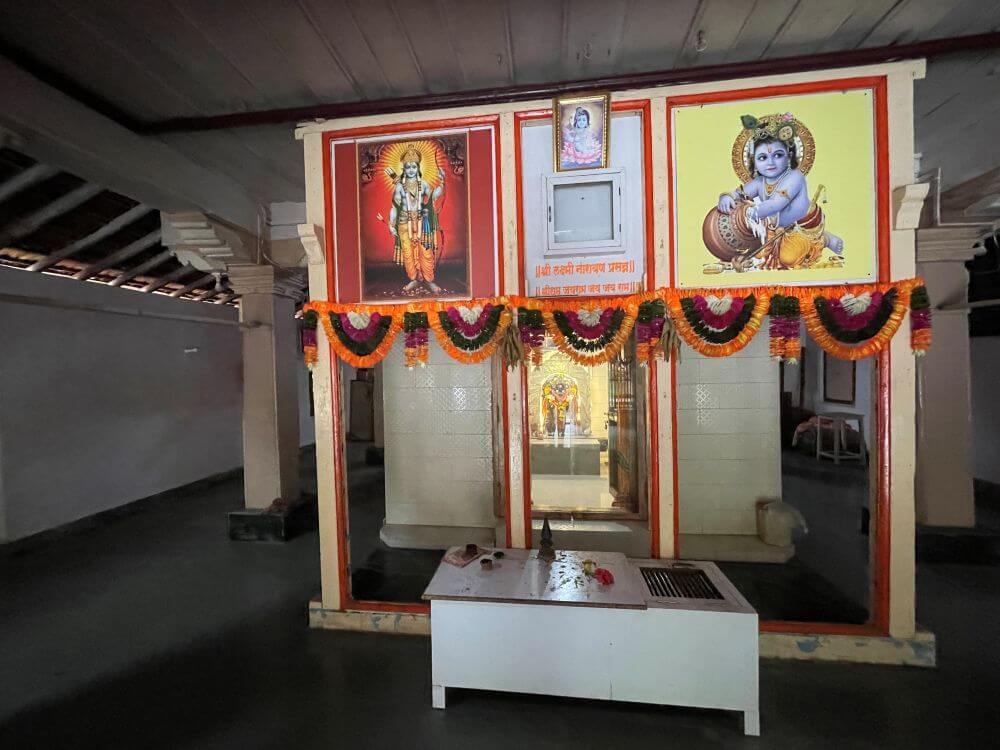
The antarala here is one step higher than the sabhamandapa. This antarala, which has a wooden railing, features wooden pillars. In the middle of the antarala is the garbhagriha with stone construction. Being higher than the antarala, the entrance to the garbhagriha has two steps. The doors of the entrance, fitted with stainless steel tubes, are transparent. Therefore, the darshan of the idols inside the garbhagriha can be easily had even through closed doors.
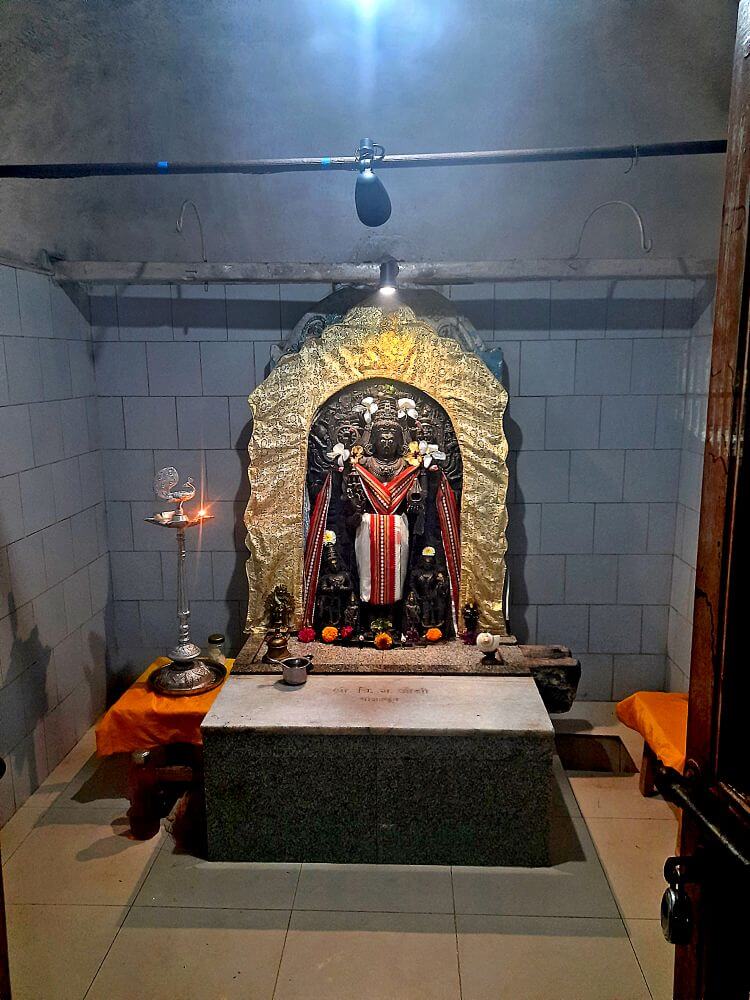
Inside the garbhagriha, on a high plinth, stands a two-foot-tall four-armed (Chaturbhuja) black stone idol of Lord Vishnu. The hands of the idol hold a lotus (padma), conch (shankha), discus (chakra), and mace (gada). Near the feet of this exquisite and well-proportioned idol are Garuda on one side and Lakshmi on the other. Here, because Goddess Lakshmi is present alongside the Sridhar-form Vishnu, the deity is addressed as Lakshminarayan. On both sides of the idol are sculptures of the Vaishnava door-guardians (Dwarapalas), Jaya and Vijaya. On the upper part of the back-slab (prabhavali) of the idol, a Kirtimukha is carved in the centre, and the Dashavatara (ten incarnations) are carved on both sides. The idol is adorned with fine garments and ornaments, and wears a crown on its head. The idol features exquisite carving. There is a circumambulation path (pradakshina marga) surrounding the garbhagriha. The garbhagriha of the temple is double-storeyed and has a tiled roof.
There is a record in the Kolaba Gazetteer that the Peshwa family members used to visit this temple. A shloka from the daily recitation of the Peshwas is inscribed on the outer wall behind the temple. It is as follows:
Shri Lakshminarayanam Sthana Purusham Kalabhairavam Kusumbama.
Shri Mahalakshmi Uttareshvara Bhairavokaleshriyam Ganapatim.
Kilakalakayai Shrijivaneshvarasaha Somajai.
Yogeshvari Harihareshvara Babadevam Devam Namami.
Nijapurvapuja Madhim.. Om..
Beside this temple is a Maruti (Hanuman) temple with a tiled roof. Wearing a crown on his head and golden ornaments on his body, this Maruti has a demon crushed under his feet. One hand of Maruti is resting on his thigh while the other is in a blessing posture (ashirvada mudra). Since this Maruti does not hold a mace in his hand, this mace-less (gadarahit) idol stands out as unique.
The main annual festivals of Ramnavami and Krishna Janmashtami are celebrated with great enthusiasm in the Lakshminarayan Temple. The Rama birth celebration takes place at twelve noon, while Krishna birth is celebrated at midnight. During both festivals, programmes such as bhajans, kirtans, and pravachans are organised in the temple. Cradle songs (palane) for the birth of Rama and Krishna are sung. Suth-sakhara (dry ginger and sugar powder) prasad is distributed. Every year on Vaishakh Shuddha Trayodashi, the death anniversary (punyatithi) of Thorle Bajirao Peshwa is celebrated in the courtyard of this temple. Daily abhishek and aarti take place in the temple. Devotees can have the darshan of Lakshminarayan in this temple every day from morning 6 to night 9.
This sacred temple stands as a testament to deep spiritual devotion, ancient architectural grandeur, and rich local cultural traditions.
The sanctum sanctorum houses the divine idol consecrated according to ancient Vedic traditions, surrounded by serene courtyards and traditional temple architecture.
Navratri, Maha Shivratri, Annual Temple Jatra & Deepotsav
Compare and book flights, secure top-rated local hotels near the temple, hire reliable guides, and rent cars instantly.
Extend your pilgrimage by visiting other highly sacred temples located nearby.


Add ₹999 more to unlock FREE SHIPPING!
Your sacred cart is currently empty.
Shop Photo FramesFill in your delivery details below to place your order.
Add comment