
Add ₹999 more to unlock FREE SHIPPING!
Your sacred cart is currently empty.
Shop Photo FramesCanacona is a taluka located in the southernmost part of Goa, near the Karnataka border. Legend has it that the taluka derives its name from the residence of the sage Kanva. The Mallikarjun Temple is situated in a spacious area in the beautiful village of Shristhal within this taluka. It is said that this temple, one of the oldest in Goa, houses a Swayambhu (self-manifested) Linga of Mallikarjun. There are more than sixty shrines of various deities within the temple complex. The temple is known for the tradition of celebrating unique tribal festivals such as Shisharanni and Viramel.
The legend of Mallikarjun is narrated in the 15th chapter of the Shrikotirudra Samhita of the ‘Shiva Purana’. It states that once, Shiva and Parvati asked their sons, Ganesha and Kartikeya, to circumambulate the Earth. While returning from the circumambulation, Kartikeya met Narada on the way. Narada told him that his parents had sent him away on a journey just to get his younger brother married in his absence. Hearing this, Kartikeya was enraged. He went to Mount Kailash, argued with his parents, and left for Mount Krauncha. When Shiva and Parvati went there to pacify him, Kartikeya moved elsewhere. Saddened, Shiva and Parvati assumed a luminous form and stayed there. That sacred Linga came to be known by the combined names of Mallika (Parvati) and Arjuna (Shiva).
In the ‘Shamipatra’ of the temple, Canacona is also referred to as Kanvapura, Kraunchakshetra, Kraunchapura, and Advat. Regarding the origin of the Mallikarjun shrine here, a legend says that in ancient times, a black cow belonging to a local farmer would go to a specific spot at the foot of the hill and release her milk. Once, the farmer had a vision of Mallikarjun in a dream, saying, “I am at that specific spot; bring me out.” He told the villagers, but they ignored him. Then, one night, all the villagers had the same dream. Only then did the villagers dig at the spot where the cow used to release her milk, where they found a Swayambhu Pindi. Later, a sage arrived in the village and identified the Shiva Pindi as Mallikarjun. The villagers then built a small temple for Mallikarjun. The temple is known by the grand title of ‘Mallikarjun Dev Advat Simhasanadhishwar Mahapati’. According to another legend, some families from Prachitgad near Shringarpur village in Ratnagiri district, Maharashtra, migrated to Canacona for certain reasons and built this temple for their presiding deity.
The Goa Gazetteer also contains a record of this temple. It states that the temple was built by Habbu Brahmins. According to the research paper ‘The Ultimate Reality and Meaning of the Siddhis of North Canara’ by Professor N. K. Kadetotad of the Department of Anthropology at Karnataka University, Dharwad, there are people of the Habbu Brahmin and Habbu Vokkaliga castes in Karnataka. This caste was formed through the intermingling of Habshi (Abyssinian) people who came here from Abyssinia with the local high-caste Brahmins and Vokkaligas. The presiding deity of these Habbu Brahmins, who speak a mix of Konkani and Kannada, is Mahadeva. The temple built by them in ancient times gradually fell into disrepair. It was later renovated in Shake 1700 (1778 AD). This is recorded in an inscription on the temple dome.
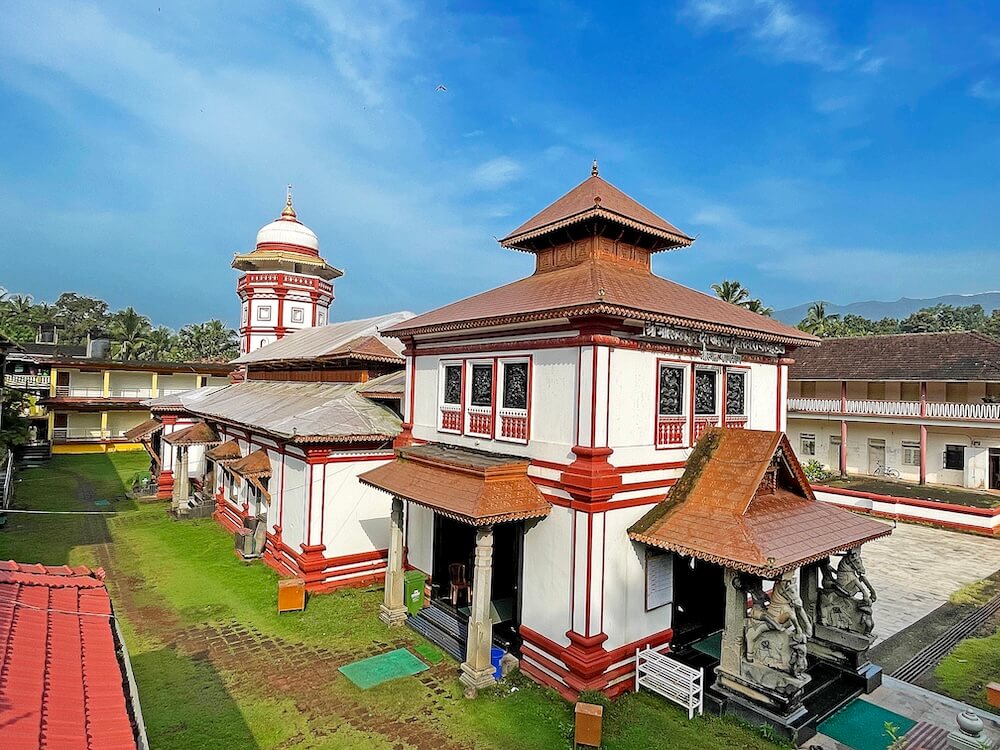
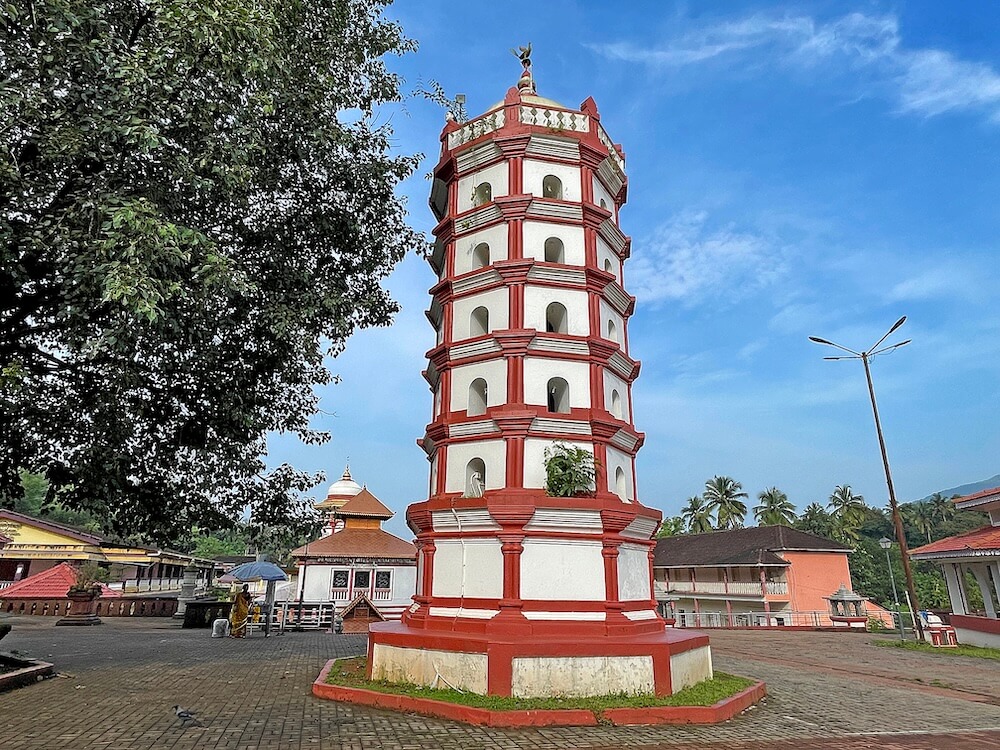
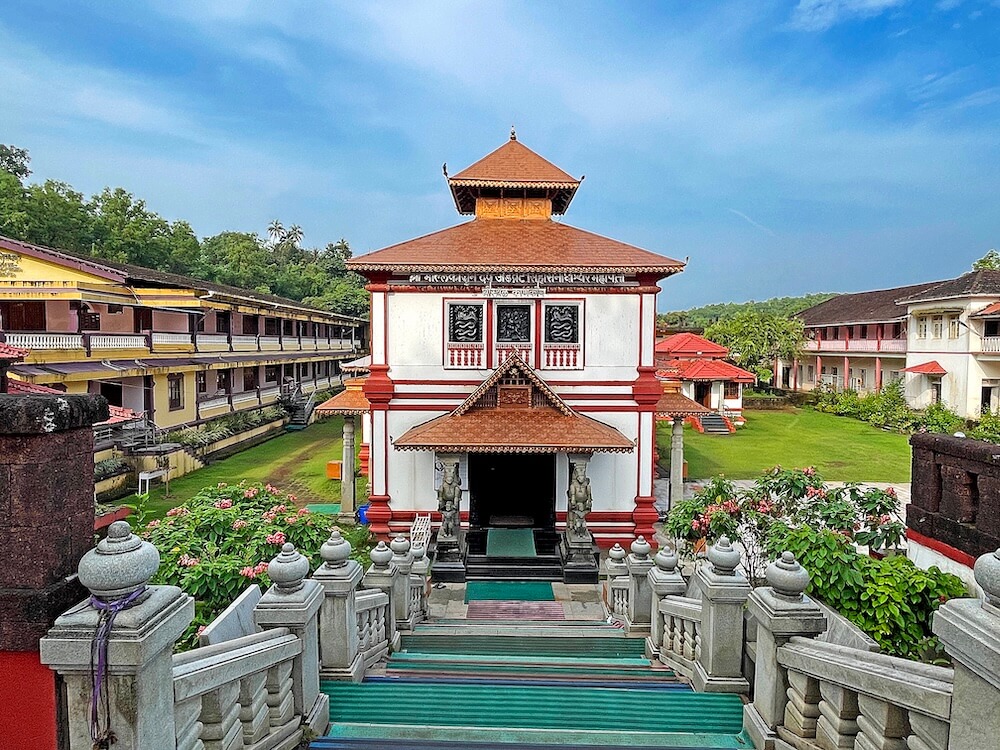
The temple is situated in a hollow area in a hilly region. One has to descend about 28 steps from a small entrance arch to reach the temple courtyard. There are many small and large shrines at different levels here. It is said that there are more than sixty idols (or shrines) of deities in this area. In the large courtyard in front, there is a large Peepal tree platform. In the center stands a magnificent seven-tiered octagonal lamp pillar (Deepastambha). Near it, on a high marble pedestal, is an equestrian statue of the folk deity Sasano. Sasano is a guardian deity, and this aspect is evident from the shield and sword held by the statue. Nearby is a Tulsi Vrindavan. One must descend another 25 steps from here to enter the main temple precinct. This stairway has sturdy marble railings on both sides.
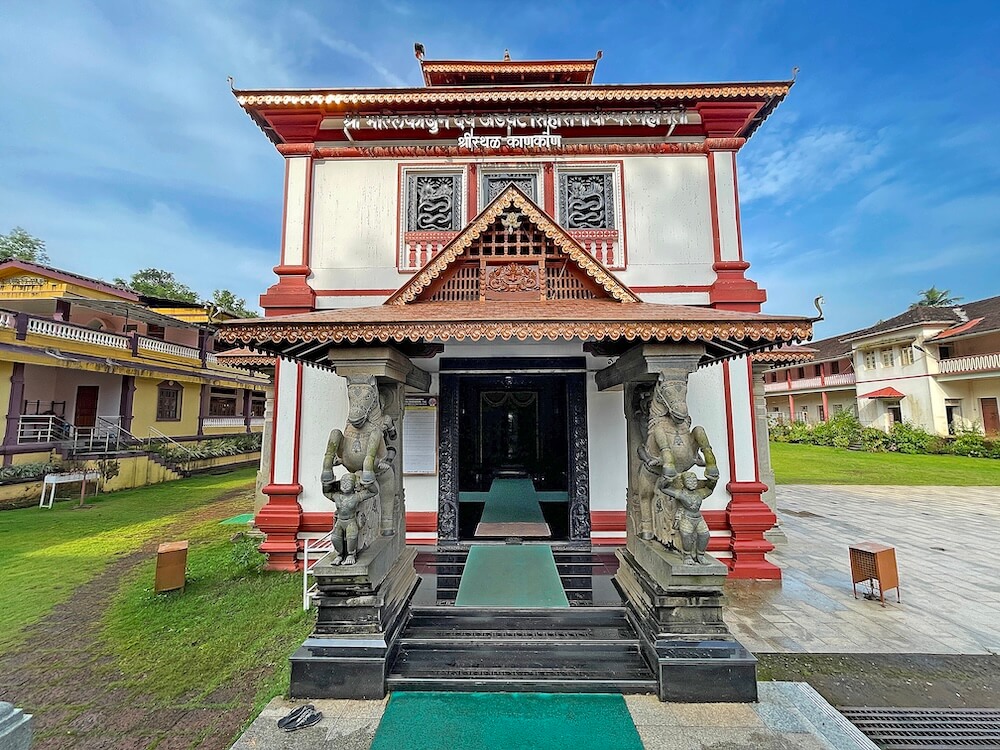
Built in the Goan architectural style, the temple structure consists of a Mukhamandapa (front porch), Sabhamandapa (main hall), Antarala (vestibule), and Garbhagriha (sanctum sanctorum). The two front pillars of the small Mukhamandapa feature large, carved sculptures of men on horseback. These unique sculptures depict a horse with its front legs raised, a servant holding the raised legs with his hands, a man riding the horse holding a large sword in one hand, and a small elephant figure below the horse.
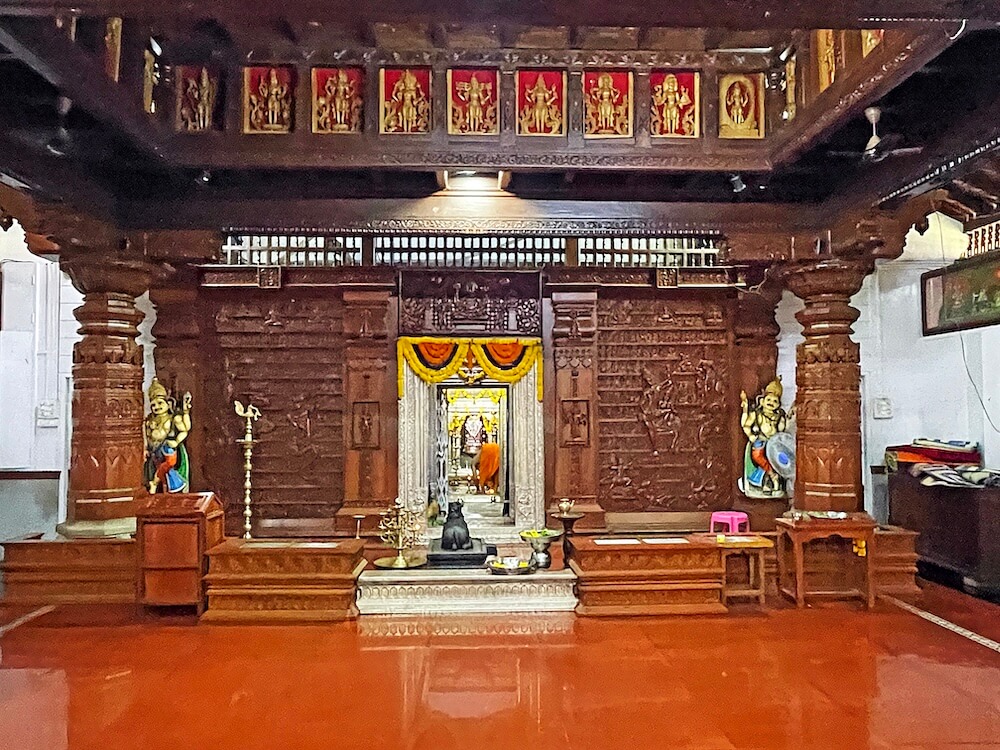
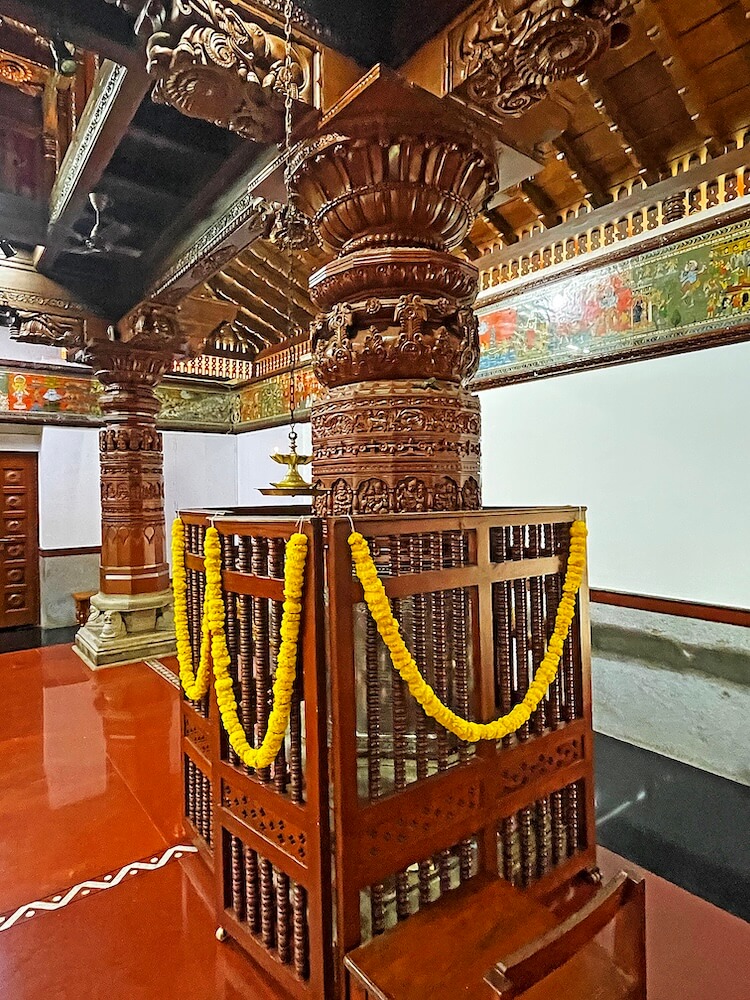
The doorway leading from the Mukhamandapa to the Ardhasabhamandapa is adorned with beautiful carvings. The ceiling here features intricate woodwork. Throughout the Sabhamandapa, from the ceiling to the walls and from the pillars to the front wall of the Antarala, one can see beautiful paintings, sculptures, and woodwork. The six wooden pillars in the Sabhamandapa are carved with scenes from the Puranas. Future predictions are made based on the floral patterns on one of these pillars. Ancient cloth paintings depicting Puranic scenes are displayed on the walls of the Sabhamandapa. There are idols of various deities in the niches near the ceiling. Small sculptures are carved onto the front wall of the Antarala. The image of Lord Shankara is placed on the lintel of the wooden door. The door of the Garbhagriha is framed with silver plating, and the Swayambhu Linga is installed inside. On the back wall of the Garbhagriha, there is an idol of Mallikarjun-Parvati within a silver arch.
To the right of the temple is a small temple of Nirakar in the Goan style. In this temple, the Nirakar is installed in the form of an ancient wooden pillar. This cylindrical pillar, decorated with floral patterns and topped with a modak-shaped crown, has carvings of Shiva, Parvati, Ganesha, and other deities. There are also small Shiva temples and temples for Bagilpaik, the guardian deities. Other temples include the Kashi Purush temple, Parashurama temple, and Vitthal Rukmai temple. There are two chariot houses in the area, which contain wooden chariots adorned with intricate carvings. A short distance from the lamp pillar is a grand Yajnashala (sacrificial hall). There is also a Pushkarini (temple tank) in the temple complex.
Various festivals are celebrated at the Mallikarjun Temple. On the occasion of Simollanghan during Vijayadashami, an ancient document is read. It mentions the ancient names of Canacona, such as Kanvapura, Kronchakshetra, Kronchapur, and Advat. On the occasion of the Shigmo festival, the Shirsharan-ni and Viramel festivals are celebrated here once every two years, alternating between them. The Shirsharan-ni festival takes place on Phalguna Shuddha Shashthi, while Viramel is held on Phalguna Shuddha Trayodashi. During the Viramel festival, १८ devotees (Gade) carry swords and, accompanied by the beating of drums, perform a circumambulation of the village and receive betel leaves and areca nuts. During this, war-like strikes are also performed. As the Viramel ritual is thrilling and intimidating, women are prohibited from witnessing it. Another highly significant festival at this temple is Shirsharan-ni. ‘Shirsha’ means head and ‘Ranni’ means cooking. In this festival, after several other rituals are performed, the shoulders of the Gade are pierced with sharp iron rods, which is known as ‘Gara’. These three individuals are made to lie on the ground, and their three heads are used to form a hearth. A fire is lit using Sissoo wood, a vessel is placed upon it, and rice is cooked in it. Devotees from across Goa as well as other parts of the country arrive in large numbers for these festivals.
Among other festivals, Mahashivratri is a night-long vigil featuring Bhajans, Kirtans, and Aarti. During the annual Jatra (fair), the idol of the deity is taken to Rajbag Beach, where the deity’s ritual bathing ceremony takes place. Devotees also bathe in the sea. A chariot procession is held during Ratha Saptami and Shigmo. On these occasions, food is donated and Prasad is distributed.
This sacred temple stands as a testament to deep spiritual devotion, ancient architectural grandeur, and rich local cultural traditions.
The sanctum sanctorum houses the divine idol consecrated according to ancient Vedic traditions, surrounded by serene courtyards and traditional temple architecture.
Navratri, Maha Shivratri, Annual Temple Jatra & Deepotsav
Compare and book flights, secure top-rated local hotels near the temple, hire reliable guides, and rent cars instantly.
Extend your pilgrimage by visiting other highly sacred temples located nearby.

Add ₹999 more to unlock FREE SHIPPING!
Your sacred cart is currently empty.
Shop Photo FramesFill in your delivery details below to place your order.
Add comment