
Add ₹999 more to unlock FREE SHIPPING!
Your sacred cart is currently empty.
Shop Photo FramesThe Parshuram Temple in Lote, located in the Chiplun taluka, is one of the prominent temples in the state, dedicated to Lord Parshuram, the creator of the Konkan land. Lord Parshuram is the sixth avatar among the ten avatars of Lord Vishnu and is considered a Chiranjeevi (immortal). Although there are many temples of Lord Parshuram across the country, the unique and primary significance of this ancient temple in Chiplun is that it is the only one where the trinity of Brahma, Vishnu, and Mahesh reside together. Devotees firmly believe that Lord Parshuram resides here eternally.
According to references in the Puranas, Lord Parashurama, the son of Sage Jamadagni and Mother Renuka, created the picturesque Konkan region by pushing the sea back by ๔๐๐ yojanas. Lord Parashurama rid the earth of tyrants ๒๑ times. Thereafter, he felt remorse for the mass destruction caused by his own hands. Driven by this sentiment, he decided to donate all the land he had conquered to Sage Kashyapa and proceed for penance. However, stating that he had no right to reside on the land he had donated, Sage Kashyapa instructed him to move towards the south. Following the guidance of Sage Kashyapa, he traveled towards the south. Enchanted by the scenic beauty of this region, Parashurama requested the ocean to grant him land to create a new world. However, when the ocean refused, an enraged Parashurama fired fourteen arrows into the Arabian Sea from the plateau of the Mahendragiri mountain. Consequently, the sea receded by five to six yojanas, revealing coral-rich red land. Parashurama named this region Konkan. Thereafter, he summoned sages and experts from various lands to cultivate the soil, brought cattle, determined which crops should be grown here, and established numerous settlements.
After declaring his sovereignty, Emperor Pulakeshin of the Chalukya dynasty established temples for three deities to the north of Chiplun in the year 570 CE for the Ashvamedha Yajna: Lord Parashurama as the Yajnapati, Vedavasini (Vindhyavasini) who embodies all four Vedas, and Kartikeya as the protector of the sacrificial land. The city of Chiplun was founded as a Yajnagrama for this sacrifice. To perform this Yajna, Rigvedi and Yajurvedi sages were brought by sea from South Gujarat. They later became famous as Chitpavans.
The legend of the temple states that about 800 years ago, a family with the surname Pankar lived in the village of Pedhe, situated at the foothills of Mahendragiri. In front of the idol currently in the temple, there is a protective covering for the holy sandals (Padukas). Beneath it lies a stone. It is believed that Lord Parashurama manifested upon this very stone. The Pankar family’s cow used to release her milk onto this stone. As she would not yield any milk upon returning home, the cowherd followed her. However, she would disappear upon reaching the base of the mountain. Believing that she was not an ordinary cow but Kamadhenu herself, at the very spot where she vanished The Kamadhenu temple was constructed. Furthermore, the stone from which milk flowed was revered as the abode of the Divine, and worship rituals were commenced there. Even today, devotees can visit and behold this temple.
At that time, no one knew that this place belonged to Lord Parashurama. According to the information received, Brahmendra Swami, the guru of Bajirao Peshwa, who arrived here in the sixteenth century, experienced this revelation. Originally from the Beed district, Brahmendra Swami was a devotee of Ganapati. Once, while in deep meditation, Lord Ganesha appeared to him in a vision, instructing him to come here and revealing that Lord Parashurama resides on the Mahendragiri mountain for penance. Following this vision, upon arriving here, he had a direct sighting of Lord Parashurama. Thereafter, he renovated this temple. After the Nawab of Janjira demolished it, in the year 1710, with the help of the Peshwas, he rebuilt this temple along with other temples in the vicinity. He was also the guru of Chhatrapati Shahu Maharaj of Satara. Of the Hindavi Swarajya Brahmendra Swami gave them a great deal of wealth for the struggle. Later, due to the insistence of the Chhatrapati and his advancing age, he went to Dhavadshi in Satara. After building a temple there, just like the Parashurama temple here, he attained Samadhi.
The renovation of this temple was carried out in the year 1993. At that time, Nanasaheb Atre, a devotee of Lord Parashurama from Solapur and a propagator of Agnihotra, expressed his willingness to donate new idols for the temple. After the Jalakarshan ritual for the idols of Kala, Kama, Parashurama, and Mother Renuka was performed, the reconstruction work of the temple commenced. Once the strengthening and beautification of the temple were completed, the Pranapratishtha of all four idols was performed.
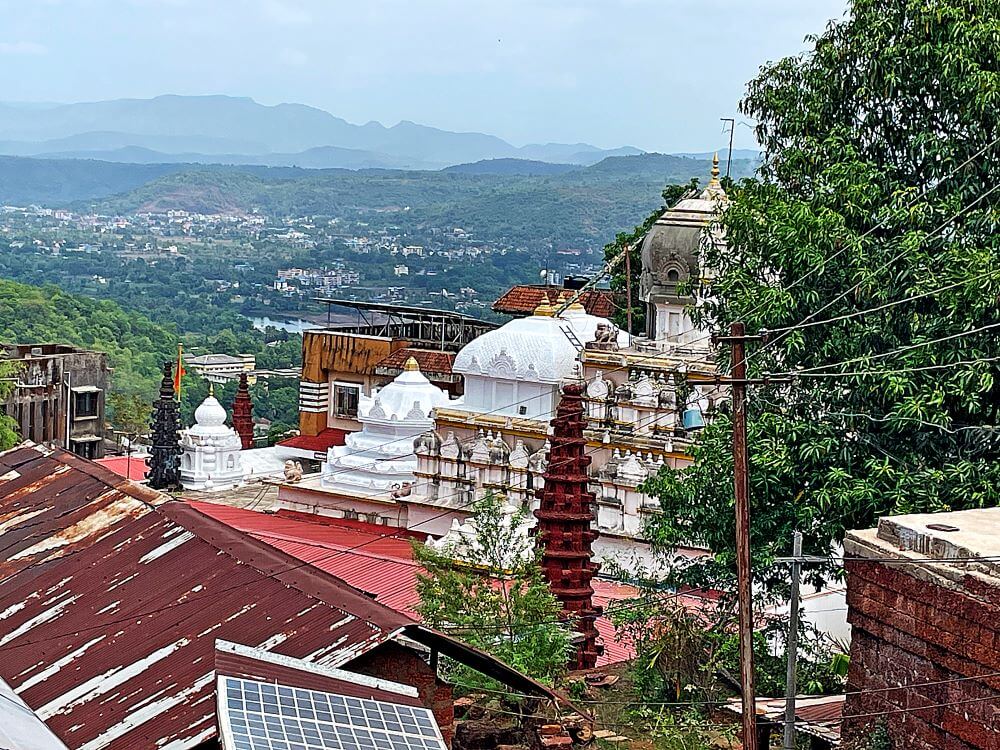
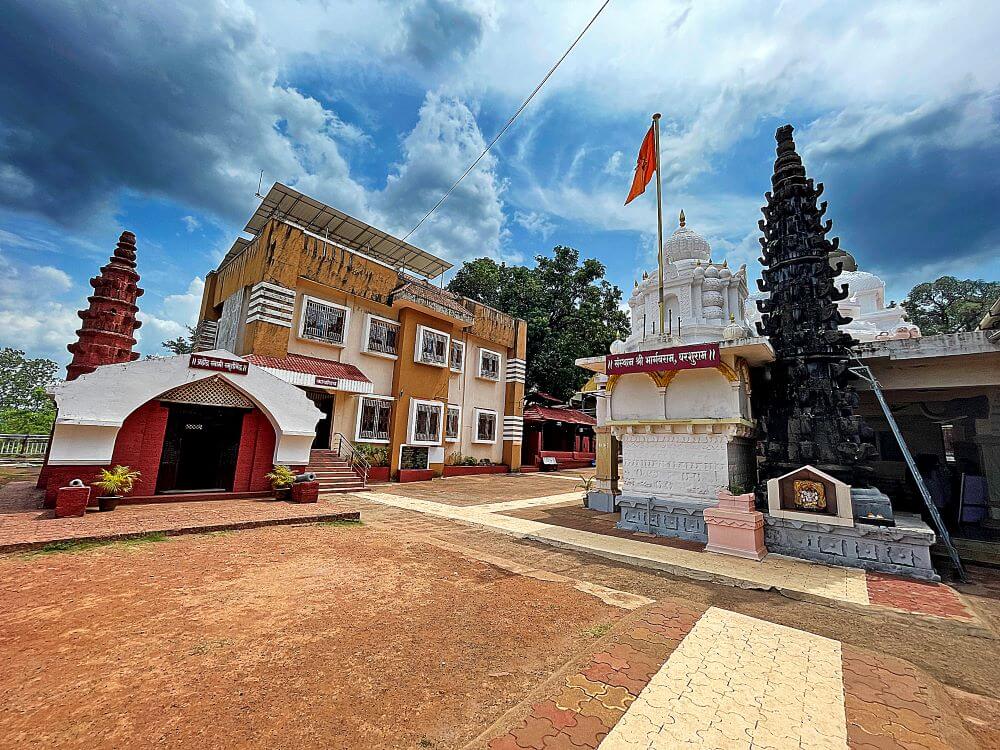
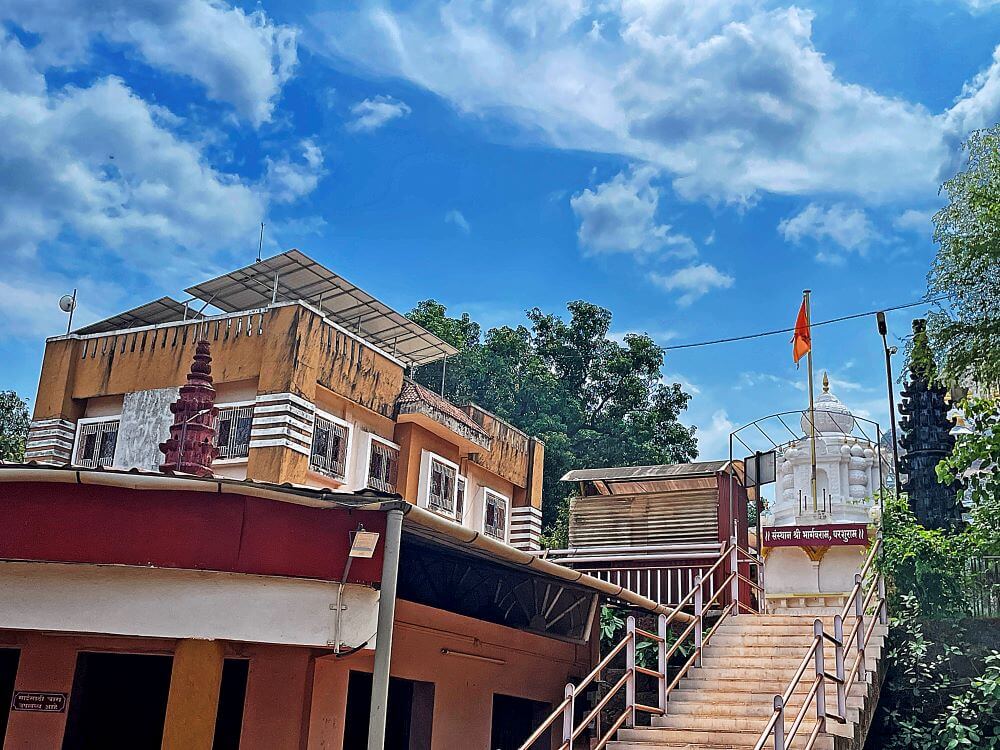
This temple is situated on a mountain in the Parshuram Ghat near Chiplun. The village where the temple is located is now known as Parshuram. One can reach the temple via a stone stairway (stepped path) built of laterite stone by Chandrarao More. The temple premises are enclosed by a large fortification wall, and there is a Nagarkhana (drum house) at the entrance. The courtyard is paved with laterite stones. Upon entering, one sees an ancient stone lamp pillar (Deepmal) as well as the temple of Siddhivinayak. Here, there is a marble idol of Lord Ganapati with a right-curved trunk, seated on a throne. In front of the temple is a south-facing Hanuman temple. It is said that this temple was built by Samarth Ramdas Swami, who used to visit the Parshuram temple for darshan. Near this temple, there is also a small idol of Garuda Raja, the vehicle of Lord Vishnu.
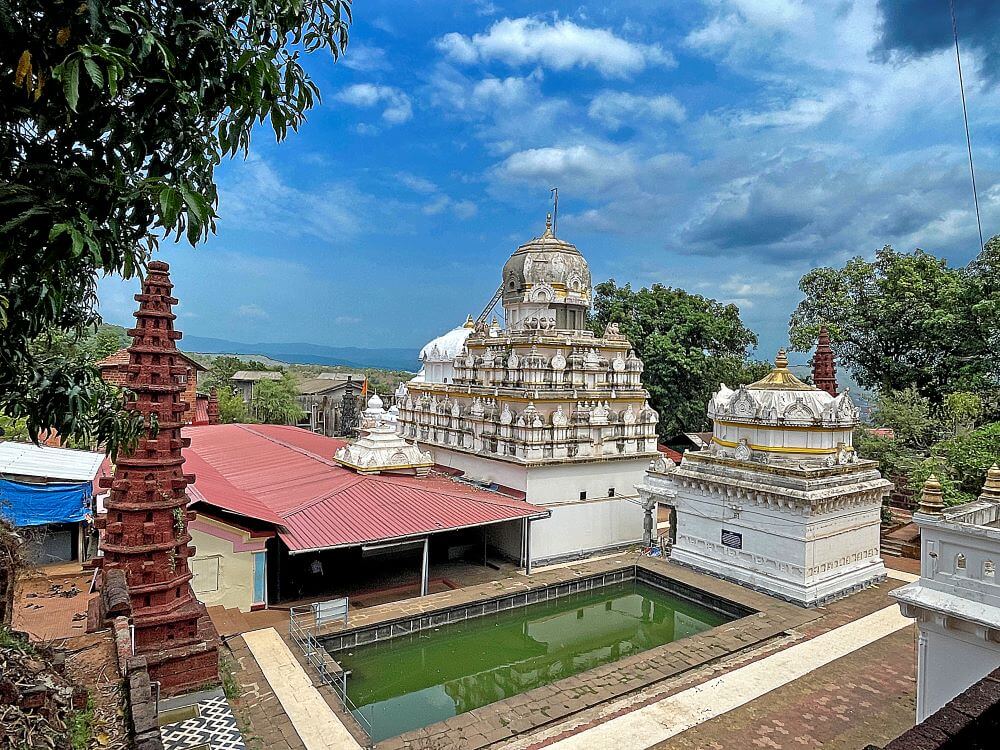
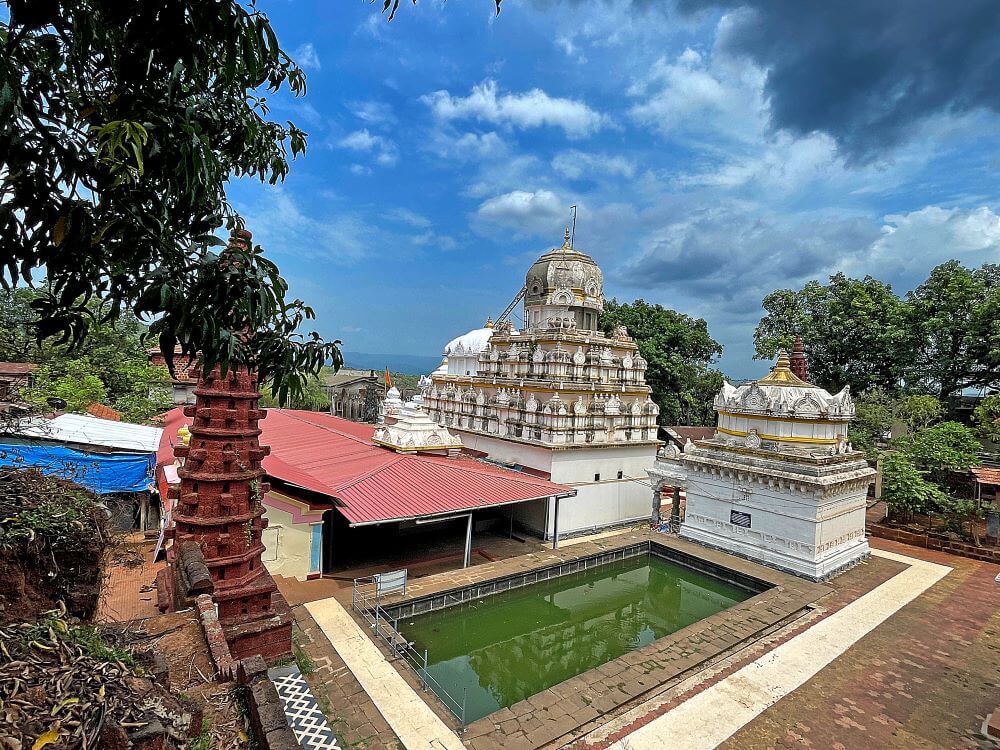
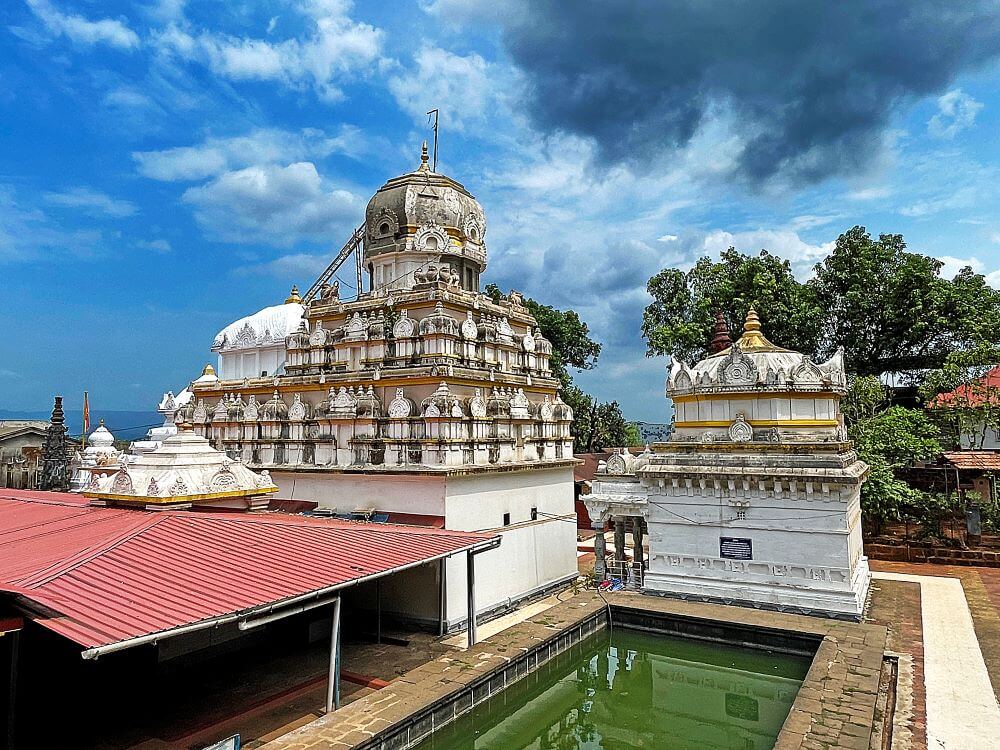
The artistry of the main temple reflects the influence of Mughal architecture. The structure of this temple consists of two assembly halls and a sanctum sanctorum. There are tall spires over both assembly halls as well as the sanctum sanctorum. Records indicate that Chhatrapati Shivaji Maharaj visited this place many times for darshan. He would also offer donations to the deity for the temple’s maintenance. Before his coronation, in the year 1661, Chhatrapati Shivaji Maharaj performed a grand worship here. was performed. At that time, Joshi Bhat officiated as the priest. An image commemorating that moment is placed outside the main assembly hall. The woodwork in the temple features exquisite craftsmanship. In the sanctum sanctorum, on a raised platform, there are idols carved from black stone, arranged from left to right, representing Kala, Parashurama, and Kama. The idol of Parashurama in the center is slightly taller than the other two. The four-armed Parashurama holds weapons including an axe, a bow, and an arrow in three of his hands, while one hand is in a gesture of blessing. The deity Kamadeva holds a staff and a water pot. The deity Kala holds an axe and a Bhruga. Behind each idol, there is a golden halo.
In the assembly hall adjacent to the sanctum sanctorum is the bedchamber of Lord Parashurama. There is a wooden cot and bedding here, upon which rest the holy sandals of Lord Parashurama. It is the firm belief of the devotees that Lord Parashurama goes to the Himalayas every morning for penance, returns in the evening, and uses this bedchamber at night.
Behind the temple are the shrines of Renuka Mata and Ganga Devi. The facade of the Renuka Mata temple features stone pillars with attractive carvings. The idol of Renuka Mata is serene and four-armed, with Vindhyavasini Devi seated beside her. Near the Renuka temple is the Banganga Kund. It is believed that to ensure a permanent water source on Mahendragiri, Lord Parashurama prayed to Mother Ganga and shot an arrow into the ground, creating a spring at the site of the current reservoir; hence, it is known as Banganga Kund. The water in this reservoir is sweet and never dries up. Many devotees toss coins into the reservoir for the fulfillment of their wishes. On the banks of this reservoir stands the temple of Mother Ganga. For many years, the local villagers have used this water for drinking. Near the temple are the Swayambhu Mahadeva and Vitthal temples.
Below the temple are the Goseva Kendra (cow shelter) and the Prasadalaya. Every day, from 11:00 AM to 2:00 PM, all visiting devotees are served dal-rice khichdi and shira as prasad. On Shravani Mondays, special fasting prasad is provided. Opposite the Prasadalaya is the Bhakta Niwas, which offers affordable accommodation for devotees. The temple premises also feature a Graha-bag (planetary garden) with various trees, a Yajna-vedi (sacrificial altar), and the Brahmendra Swami Memorial Center.
Like Chhatrapati Shivaji Maharaj, Sambhajiraje also visited this place frequently for darshan. There are records of Rajaram Maharaj staying here on several occasions. The Bhonsle dynasty of Satara still considers Lord Parashurama their family deity. Trikal Puja (worship three times a day) is performed in this temple, and festivals are held every month. Among these, the Parashurama Jayanti celebration on Akshaya Tritiya is the most prominent. During this three-day festival, held from Vaishakh Shuddha Pratipada to Tritiya, events such as Maha-puja, Abhisheka, Kirtan, Palkhi processions, and Maha-prasad are organized daily. A large fair is held here on Mahashivratri. Ram Navami, Hanuman Jayanti, Tripurari Purnima, and Navaratri are also celebrated with great enthusiasm. On Ashadhi Ekadashi, a large pilgrimage of the Koli community takes place here. It is the firm faith of the Varkaris that on Margashirsha Ekadashi, Lord Vitthal himself arrives at Mahendragad from Pandharpur; therefore, a large number of Varkaris from the surrounding areas gather on that day. About one hundred years ago, the Rajeshirke family of Vehele could not travel to Pandhari due to illness. At that time, Lord Vitthal appeared in a vision and promised, “I will come here for Parashurama darshan on the next Ekadashi.” Since then, the Dindi of the Rajeshirke family has been coming here for the Saptah.
Above the Parashurama temple on Mahendragiri is the Dattatreya temple. After the funeral rites of Jamadagni, the father of Parashurama, were performed at Mahur, Shri Dattaguru, who officiated as the priest, came to Mahendragiri to console Parashurama. This temple is built over a reservoir at the site of that meeting. In a cave near this temple, Brahmendra Swami used to reside. On the path to the temple is the shrine of Dhavji Maharaj, the village deity. Nearby is a Peshwa-era well known as ‘Dhavji’s Well’. Close to the temple is an Agni-mandir (fire temple) established by Gajanan Maharaj, a devotee of Parashurama from Shivapuri near Akkalkot.
The Shri Bhargavram Parashurama Sansthan has established a library and a medical service room for devotees near the temple. The library houses many books, including those detailing the life and works of Lord Parashurama.
This sacred temple stands as a testament to deep spiritual devotion, ancient architectural grandeur, and rich local cultural traditions.
The sanctum sanctorum houses the divine idol consecrated according to ancient Vedic traditions, surrounded by serene courtyards and traditional temple architecture.
Navratri, Maha Shivratri, Annual Temple Jatra & Deepotsav
Compare and book flights, secure top-rated local hotels near the temple, hire reliable guides, and rent cars instantly.
Extend your pilgrimage by visiting other highly sacred temples located nearby.


Add ₹999 more to unlock FREE SHIPPING!
Your sacred cart is currently empty.
Shop Photo FramesFill in your delivery details below to place your order.
Add comment