
Add ₹999 more to unlock FREE SHIPPING!
Your sacred cart is currently empty.
Shop Photo FramesIn the galaxy of saints who graced Maharashtra during the nineteenth and twentieth centuries, the name of the great yogi of Shegaon, Sant Gajanan Maharaj, is held in the highest regard. Having appeared in Shegaon at the age of eighteen, Gajanan Maharaj attained Sanjeevan Samadhi here in the year ۱۹۱۰. The Samadhi temple of Maharaj is situated at that very site. Devotees hold the firm belief that “The divine light of Maharaj remains invisible yet present at this very place.” Due to the cleanliness, orderliness, discipline, and efficient management, this temple attracts countless devotees.
The early life of Gajanan Maharaj remains unknown. Dasganu Maharaj, known as the ‘Mahipati of modern Maharashtra’, presented the biography of Gajanan Maharaj to the devotees through the holy text ‘Shri Gajanan Vijay’. This book was written by Dasganu Maharaj in ۱۹۳۹, twenty-nine years after the Sanjeevan Samadhi of Gajanan Maharaj. He composed this work at the request of Ramchandra Patil of Shegaon. Dasganu Maharaj wrote this text based on conversations with individuals who were in the company of Gajanan Maharaj, devotees who experienced his miracles, as well as prevalent stories and documents available in the ashram. For this reason, this text is considered authoritative. Who Gajanan Maharaj was originally and where he came from remains unknown. Many speculations are made regarding this; however, Dasganu Maharaj has clarified that there is no substantial evidence for any of them.
According to this text, Gajanan Maharaj first appeared in Shegaon on Magh Vadya Saptami, Shake ۱۸۰۰, February ۲۳, ۱۸۷۸. The story goes that on that day, a ritual ceremony for the son of Devidas Paturkar was taking place in Shegaon. Rows of people were being served food. At that time, Bankatlal Agarwal and Damodarpant Kulkarni were passing by. Suddenly, they saw a young man, wearing an old tattered garment, holding a chillum in his hand and a gourd vessel nearby, sitting and eating the leftover food from the leaf plates. This was the first sighting of Gajanan Maharaj in Shegaon. After this incident, Gajanan Maharaj moved away. He was seen again four days later. On that day, a kirtan by Govindbuva Taklikar was being held in the village. Bankatlal Agarwal and Pitambar, a tailor in the village, were on their way to listen to it. At that time, they saw Gajanan Maharaj again at the venue of the kirtan. That date was February ۲۶ or ۲۷, ۱۸۷۸. At that time, Gajanan Maharaj performed a miracle for Pitambar by creating crystal-clear water in a muddy stream, enough to submerge his gourd vessel. Seeing this, Pitambar became a devotee of Gajanan Maharaj.
On this very day, Govindbuva Taklikar had chosen a verse from the Hansa Gita for his kirtan discourse. He explained the first half of it. Thereafter, Gajanan Maharaj recited the second half. Hearing this, Taklikar Buva was astonished. He announced in his kirtan, “A priceless gem has arrived in your Shegaon; protect this jewel.” Taklikar Buva told the people that Gajanan Maharaj is Lord Pandurang himself and that they should serve him. Following this, Bankatlal took Gajanan Maharaj to his home. Gajanan Maharaj would always snap his fingers and chant the bhajan, “Gan Gan Ganant Bote”. According to some, he used to say “Gin Gin Ginant Bote”. However, it was from this that he came to be known as Gajanan Maharaj. People from far and wide began coming to Bankatlal’s house to seek his darshan.
He had a six-foot-tall slender physique, a sun-tanned reddish complexion, a body without clothes, and arms reaching his knees. His daily routine has been described by Dasganu: “Sometimes he would take a holy bath, sometimes he would go into the mud, and sometimes he would drink muddy water. He had a great love for the chillum, which he would use frequently, yet he had no attachment to it; it was merely a pastime.” In the third chapter, Dasganu Maharaj tells the story of a Gosavi who made a vow to offer ganja to Maharaj. The Gosavi gave ganja to Maharaj as the fulfillment of his vow. Thereafter, Dasganu Maharaj states, “Such was the custom of ganja that had formed at that place.” However, Maharaj did not become addicted to it. Sometimes he would recite fluent Vedic hymns. Sometimes he would observe silence. Once, he sang the composition “Chandan Chawal Belki Patiyan Prem Bhari” in various ragas. Maharaj often visited nearby villages. Many stories of the miracles he performed in those places have been recorded in the texts.
After residing in Bankatlal Agarwal’s house for some time, Maharaj went to live in a very ancient Maruti temple in the village. In those days, a prominent man in the village named Khandu Patil used to hold a grand festival at this temple. He had five brothers who used to mock Maharaj. Once, one of them challenged Maharaj to a wrestling match, but Maharaj humbled his pride. Later, these brothers once beat Maharaj with sugarcane stalks, but not even a single scar appeared on his body. Seeing this miracle, they all became devotees of Maharaj. After this, Maharaj lived for some time in the orchard of Krishnaji Patil, the youngest brother of Khandu Patil. It is said that in this orchard, Gajanan Maharaj gave darshan to a staunch devotee in the form of Samarth Ramdas Swami, and while in this orchard, Gajanan Maharaj humbled the pride of a Gosavi named Brahmagiri by sitting on a burning cot. Nearby, there was a temple of Shiva. Since a moneylender named Mote had renovated this temple, it was called the Mote temple. To its east was a barren plot of land belonging to a person named Sakharam Asolkar. A math was built for Maharaj on that land. This was the first math of Gajanan Maharaj.
With the passage of time, following the passing of Krishnaji Patil, Maharaj contemplated leaving Shegaon. His devotees pleaded with him, saying, “Stay anywhere, but do not leave the village.” To this, Maharaj set a condition: “I will stay in the village only if you provide me with a piece of land that is disputed and belongs to no one.” This put everyone in a difficult position. Such land was only available under government ownership, but as it was the British era, the devotees feared the British government would not grant land for such a purpose. Eventually, under Maharaj’s instruction, they submitted an application to the government for two acres of land. At that time, a British officer named Carey was stationed in Buldhana. He sanctioned one acre of land and stated that if the land was developed properly within a year, he would grant more. Following this, public donations were collected, and work on the Math began. Feeling that the work would not proceed correctly without his presence, Maharaj sat in a bullock cart and traveled from the old Math to the site. While departing, he sat on a cart loaded with sand. The cart driver was a gentleman from the Mahar community. When the driver stepped down from the cart, Maharaj told him, “For us Paramahansas, there is no such thing as ritual impurity.” In this way, through his own actions, Maharaj taught that one should not harbor feelings of untouchability. He went and sat at a specific spot there. To ensure that this spot would fall in the center of the Math, the administrators utilized a small portion of the adjacent land. At that time, a local resident complained about the encroachment on government land. Consequently, an officer named Joshi arrived to conduct an inquiry. Inspired by Gajanan Maharaj, Joshi declared that the fine imposed on the institution was incorrect, and the matter was resolved. The place where Maharaj sat at that time is where his Samadhi is located today.
Dasganu Maharaj has also described the story of the meeting between Gajanan Maharaj and Lokmanya Tilak on the occasion of the Shiv Jayanti program in Akola. Later, when Lokmanya Tilak was sentenced to imprisonment on charges of sedition, his associates sought help from Gajanan Maharaj. Maharaj told them, “Without the suffering of the virtuous, a revolution cannot occur.” He added that no matter how much they tried, Tilak would not be released. At that time, Maharaj gave a piece of bread (bhakri) to Tilak’s associate, Kolhatkar. He instructed him to have Tilak eat it, saying that through this, a great task would be accomplished by Tilak. The ‘Gajanan Vijay’ text states that because Tilak ate that bread, he was later able to write the ‘Gita Rahasya’ while imprisoned in Mandalay, Burma.
The text contains many such stories of various miracles performed by Maharaj in different parts of Vidarbha. Maharaj’s divine plays were profound. Through them, he imparted special teachings to the common people and his close devotees. Upon learning that a devotee named Mali Vithoba Ghatol was calling himself Maharaj’s chief disciple and harassing the common people, Maharaj punished him and drove him away. Through his life, he also gave a message of Hindu-Muslim unity. Dasganu Maharaj recorded this teaching in the ‘Gajanan Vijay’ text: “Hindus and Muslims are created by the same God. One should hold their own religion dearer than life, but one should also hold immense love for those of other faiths.” After realizing that his avataric mission was nearing its end, Gajanan Maharaj called all his devotees on the day of Ganesh Chaturthi and gave a signal that it was time for the ‘Ganpati to depart.’ Accordingly, in Shegaon, on the day of Shake 1832, Sadharannama Samvatsara, Bhadrapada Shuddha Panchami, Thursday, 8 September 1910, he consciously restrained his life force and took Sanjeevan Samadhi. This temple of Maharaj is situated in a vast area in Mahatma Jyotiba Phule Nagar.
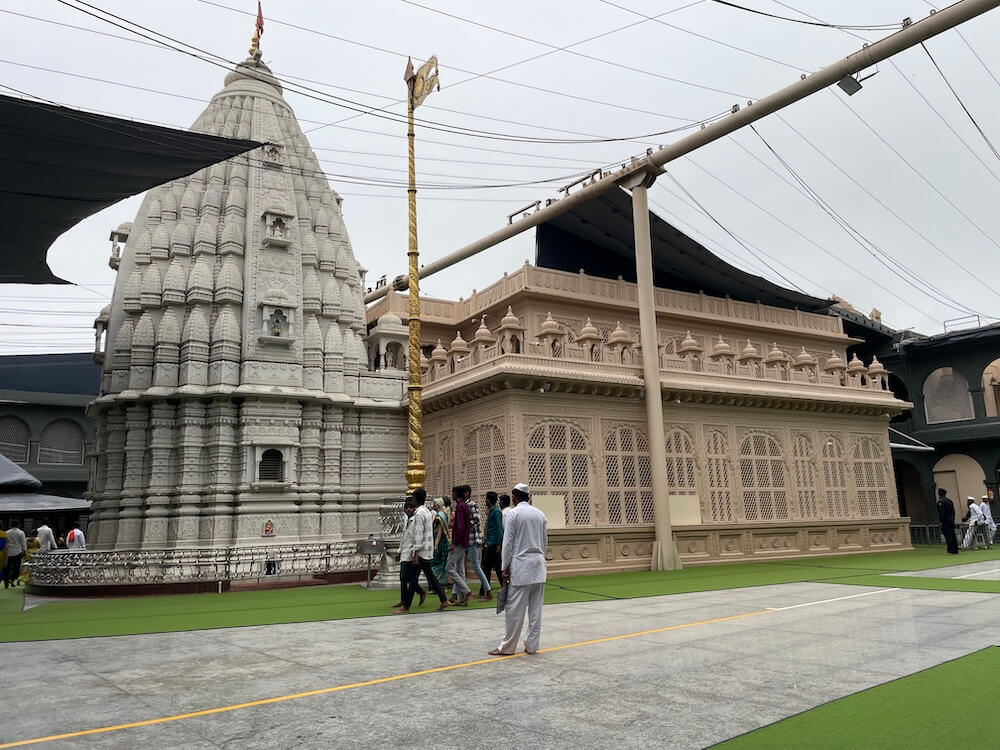
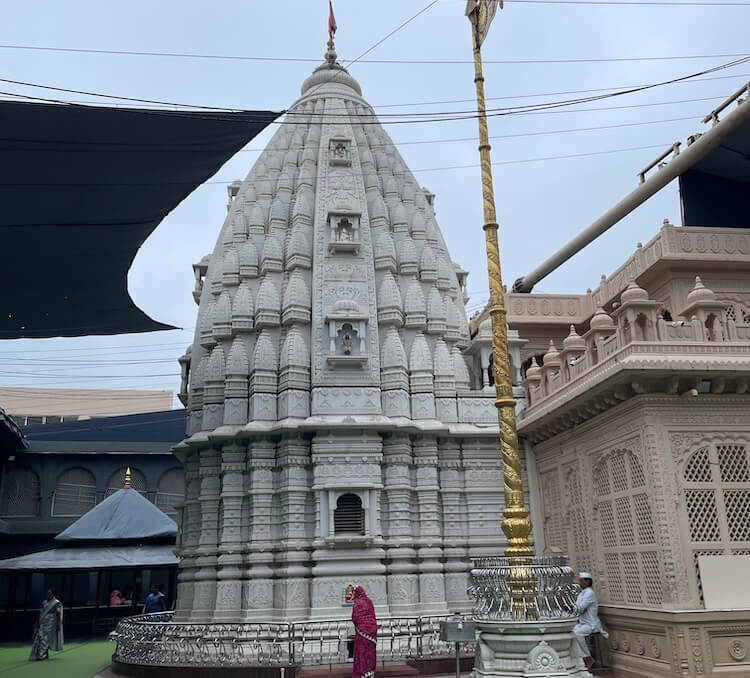
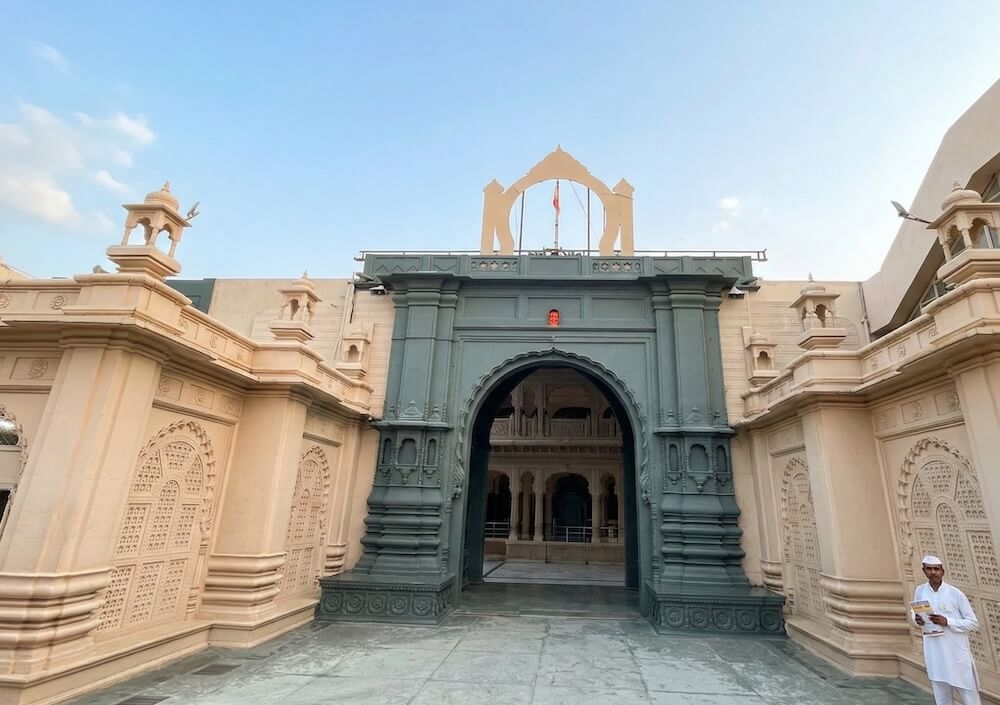
The temple premises feature an entrance gate crafted from sturdy stone, topped with a balcony featuring a railing. On both sides of the main gate, there are two smaller iron gates. Upon entering, there is a security post. From here, a roofed walkway leads along the building toward the main temple. There is another large entrance gate within the main temple complex. This area houses three important structures: the Samadhi site, Maharaj’s resting place, and the Mahaprasadalaya (great dining hall). The path to the Samadhi site is through a door to the right of the main entrance. The darshan queue area is equipped with seating, water, and facilities for tea, coffee, and milk at reasonable prices. There are separate rooms for breastfeeding mothers. At every stage of the darshan queue, volunteers are ready to guide the devotees.
Maharaj’s Samadhi is located in a cave. There are marble steps to descend. After entering this cave, the path turns left and then right. After passing through, one arrives in front of the Samadhi. Descending another 15-20 steps leads to Maharaj’s Samadhi site. Here, there is a large marble idol of Gajanan Maharaj. In front of the idol are Maharaj’s Padukas (footprints). While climbing back up the stairs, prasad of sugar-puffs and chironji is distributed. Upon reaching the top, one enters the Ram Mandir located at the Samadhi site. The pillars of this temple’s assembly hall are carved from stone. On the pillars, 21 paintings are displayed, each depicting an episode from a chapter of the ‘Shri Gajanan Vijay’ text. In front of the sanctum sanctorum is a small temple of Maruti. The sanctum sanctorum features a three-spired altar, which houses the pleasant idols of Shri Ram, Lakshman, and Sita.
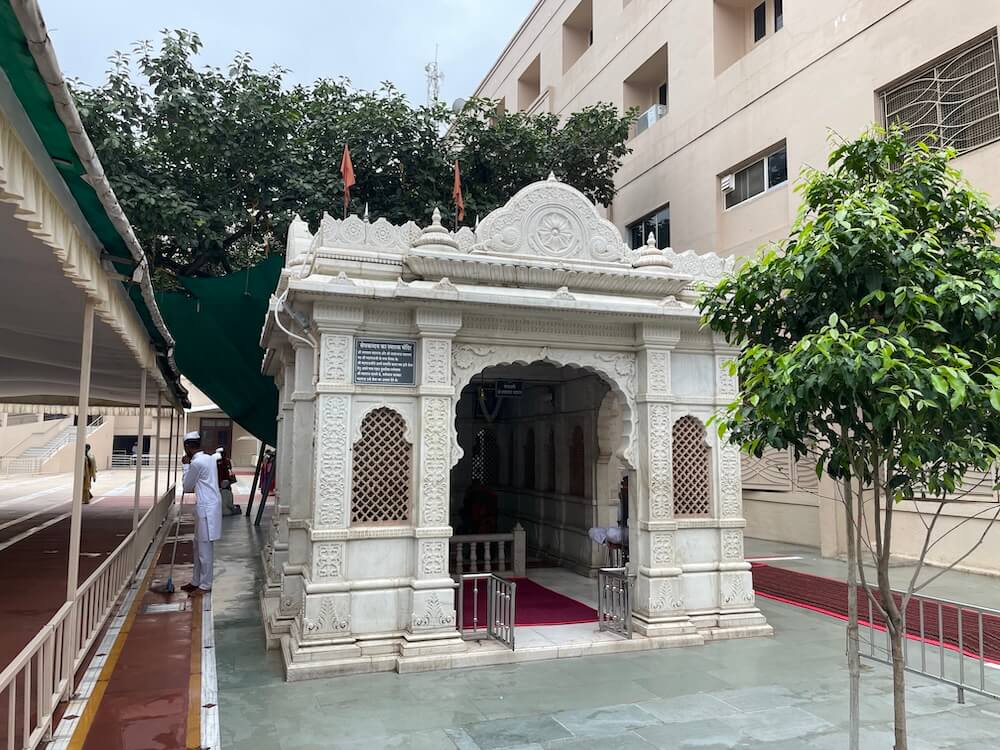
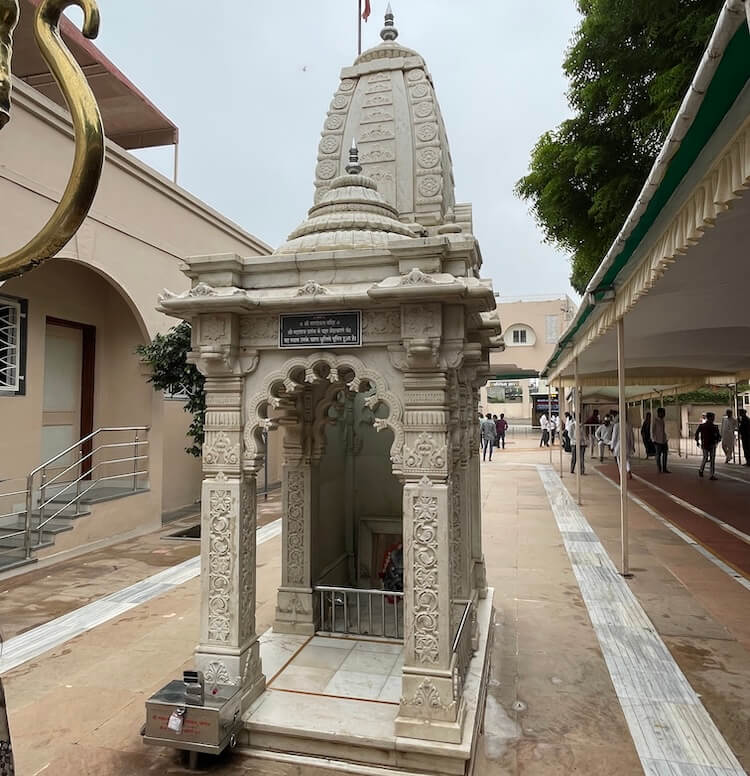
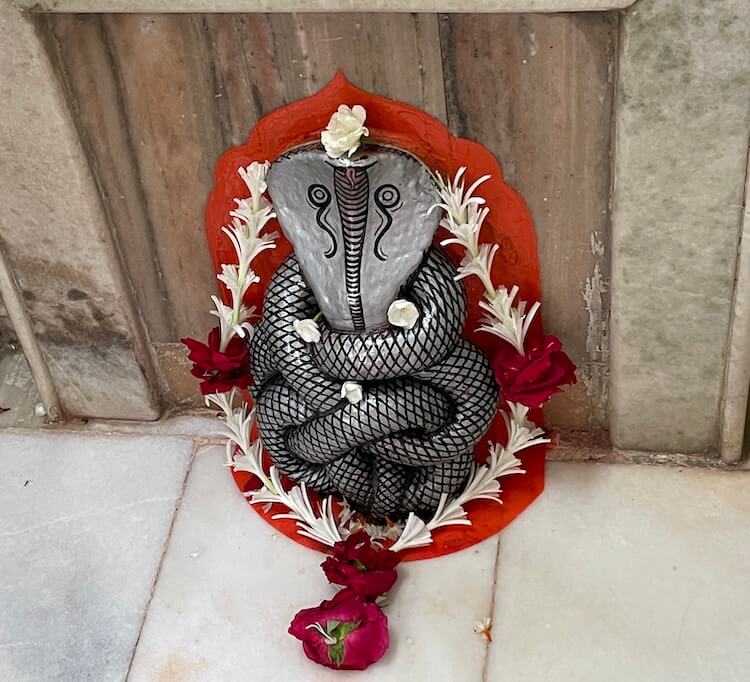
There is a circumambulation path (pradakshina marg) around the Samadhi temple. At the back, on the left side, stands a magnificent flagpole. Similarly, on the right side is the Yajna Mandap. Directly behind the main temple is Maharaj’s resting place and the Parayan Mandap. Here, after moving forward from the darshan queue, one gets the darshan of the Abhishek Padukas and the idols of Vitthal-Rukmini carved in black stone. In the resting place, there is an intricately carved teak wood divan. Upon it are placed the Maharaj’s seat, pillow, bolsters, and Padukas (sacred sandals). Devotees believe that the Maharaj still exists here in an invisible form and blesses everyone. In front of the resting place is the Parayan Mandap (scripture recitation hall). Within the temple premises, there is a large Audumbar tree. It is said that this tree has been here since the time of the Maharaj, and he used to sit beneath it to converse with his devotees. Near this Audumbar tree is a temple of the South-facing Maruti. Upon exiting from there, one finds the Nagadevta temple to the North. Behind the main temple are the Samadhi shrines of Balabhau Maharaj and Narayan Maharaj. It is believed that before taking Samadhi, the Maharaj had seated Balabhau on his throne, and after Balabhau took Samadhi, Gajanan Maharaj appeared to Narayan Maharaj in a dream, inspiring him to take charge of the Shegaon throne.
From five in the morning, auspicious music is played in the temple premises, and the day begins with the Kakad Aarti. From five-thirty to seven-thirty, the Shodashopachar Puja and Panchamrut Puja are performed. During this time, devotees can perform Abhishek on the Maharaj’s Padukas themselves or have the priests perform it at the Samadhi site. At eleven in the morning, Panchopachar Puja, Aarti, and the great offering (Maha-Naivedya) take place. After four in the afternoon, Dnyaneshwari discourses and Haripath are conducted. Every Thursday and on the tenth day (Dashami), the Palkhi (palanquin) procession circumambulates the temple at five in the evening. At sunset, the sound of clapping begins, and the Aarti commences with the blowing of the conch. From eight to nine at night, there is an hour of Bhajan and Panchpadi. Every Thursday, as well as on Dashami, Ekadashi, and festival days, Kirtan is held between eight and ten at night. The day concludes at nine-thirty with Panchopachar Puja and Shejarti.
Various festivals are celebrated here throughout the year. The seven-day Prakat Din Sohala (manifestation day celebration) from the first to the seventh day of the dark fortnight of Magh is celebrated with great enthusiasm. On the seventh day, Kirtan for the Prakat Dinotsav begins at ten in the morning, and the celebration takes place at twelve noon. The second major festival is Ram Navami, which occurs from the first to the ninth day of the bright fortnight of Chaitra. From the fifth to the ninth day, the Ramayan Swahakar is performed. On the ninth day, Kirtan is held at ten in the morning, and the Ram Janma (birth of Lord Rama) celebration takes place at twelve noon.
Gajanan Maharaj took Sanjeevan Samadhi on the day of Bhadrapad Shukla Panchami, also known as Rishi Panchami. In his memory, the Punyatithi (death anniversary) festival is celebrated starting from the first day (Pratipada). During this time, Ganesh Yag and Varun Yag are performed. A large fair is held in Shegaon at this time. A grand procession with elephants, horses, chariots, palanquins, and Dindis (devotional groups) circumambulates the town. Devotees participate in this, chanting the name of the Lord amidst the sound of cymbals and Mridangam. Hundreds of Dindis from across Maharashtra come to Shegaon for the festival. Thousands of devotees visit Shegaon for Darshan during these three festivals. Apart from this, the Palkhi circumambulates the temple on Ashadhi and Kartiki Ekadashi. A pilgrimage (Wari) also departs for Pandharpur. Many other festivals like Krishna Janmotsav, Hanuman Jayanti, Tukaram Beej, Dnyaneshwar Maharaj Sanjeevan Samadhi Sohala, Eknath Shashthi, Swami Samarth Maharaj Punyatithi, Das Navami, Shankaracharya Jayanti, and Nrusimha Jayanti are also celebrated here with great fervor.
The temple trust has a grand Prasadalaya (dining hall) where free meals are provided. Near the temple are Bhaktaniwas (pilgrim hostels) number one and two, which have 161 rooms for accommodation. A stone’s throw from the temple, in the Hatthikhana area, are four buildings of Bhaktaniwas numbers three to six, each four stories high. There are 417 rooms of various types there. Additionally, there are two pilgrim complexes located slightly further away from the temple, named Anand Vihar and Anand Sagar Visawa. Anand Vihar has 11 buildings with 677 rooms. This area features attractive sculptures, including the ‘Vithu Maza Lekurwala’ sculpture of Lord Vitthal, who carried all saints in his arms. The Anand Sagar Visawa complex has 597 rooms and 92 dormitory halls for individual pilgrims or for resting during the day. There is a fixed donation amount per day for accommodation based on the facilities in the room.
This sacred temple stands as a testament to deep spiritual devotion, ancient architectural grandeur, and rich local cultural traditions.
The sanctum sanctorum houses the divine idol consecrated according to ancient Vedic traditions, surrounded by serene courtyards and traditional temple architecture.
Navratri, Maha Shivratri, Annual Temple Jatra & Deepotsav
Compare and book flights, secure top-rated local hotels near the temple, hire reliable guides, and rent cars instantly.
Extend your pilgrimage by visiting other highly sacred temples located nearby.


Add ₹999 more to unlock FREE SHIPPING!
Your sacred cart is currently empty.
Shop Photo FramesFill in your delivery details below to place your order.
Add comment