
Add ₹999 more to unlock FREE SHIPPING!
Your sacred cart is currently empty.
Shop Photo FramesIn many cultures across the world, the Sun, a star, is revered as a deity and worshipped. Here, Sun worship is performed under various names such as Savitr, Vivasvat, and Pushan. The famous Gayatri Mantra from the Rigveda is dedicated to the deity Savitri, that is, the Sun. Since ancient times, many Sun temples have been built in India. Among them, the Sun temples at Konark in Odisha and Modhera in Gujarat are particularly famous. There is also an approximately 800-year-old Sun temple at Kasheli in Rajapur taluka of Ratnagiri district in the state of Maharashtra. Additionally, a historic Sun temple is situated at Bhuleshwar in Mumbai. The picturesque temple architecture and the Havan performed 365 days a year are the main features of this temple.
According to mythological tradition, the ‘Mag’ Brahmins who came from Shakadvipa, which is present-day Iran, brought Sun worship here. According to the story in the Samba Purana, Samba, the eldest son of Shri Krishna, was extremely powerful. Once, when Sage Durvasa came to meet Krishna, Samba laughed at him upon seeing his frail physique. Enraged, Durvasa cursed him, which caused Samba to contract leprosy. Then, Devarshi Narada advised Samba to perform Sun worship to be freed from the curse. No Brahmin here was willing to accept the priesthood for that worship. Therefore, Samba brought Sun-worshipping ‘Mag’ Brahmins from Shakadvipa here. In the 140th chapter of the Bhavishya Purana, it is stated that for the consecration of the Sun, Krishna’s son Samba brought 18 clans of Mags from Shakadvipa to Sambapura.
The earliest epigraphic reference to a Sun temple in India comes from Madhya Pradesh. A mention of a Sun temple being built at Mandsaur is found in a 5th-century Gupta-era stone inscription. Similarly, there is a mention in a copper plate grant that Mihirakula, a king of the Huna dynasty who emerged from China, built a Sun temple near Gwalior. Likewise, there is a 9th-century Sun temple at Tikamgarh as well. After the Gurjara-Pratiharas took control of the region in present-day Madhya Pradesh, Sun worship was encouraged here. The Gurjara-Pratihara kings were devotees of the Sun. The most famous king of this dynasty was Bhoja. Although he was a devotee of the Goddess, he adopted the title ‘Mihir’, which makes it clear that the Sun was his presiding deity as well. Historian V. K. Rajwade, in his essay ‘Who are the Mag Brahmins?’, mentions that Varahamihira, the author of ‘Brihatsamhita’ who lived in the city of Ujjayani in the Avanti country in 505 AD, was a Sun worshipper and his father’s name was Adityadasa. This makes it clear that Sun worship has been prevalent in India since ancient times.
There are several hymns about the Sun in the Rigveda. In one of the verses from a hymn composed by the sage Praskanva Kanva, the Sun is addressed: “You have risen with your full brilliance to destroy all diseases. May we never be subject to disease.” (Udgadayamadityo vishvena sahasa saha | Dvishantam mahyam randhayanmo aham dvishate radham || – Rigveda 1.50.13) From this, it is understood that the Sun has been considered a disease-destroying deity since ancient times. He is especially considered to be the one who removes skin diseases. The only major temple in Mumbai dedicated to this Suryanarayan is at Bhuleshwar, and the legend of this temple is linked to the Sun’s disease-healing power.
According to the thesis ‘A Cultural and Historical Case Study: The Oldest Sun Temple in Mumbai’ (‘Shodhkosh’, July 2024) by Jai Bhat, Assistant Professor of History at V. G. Vaze College, Mulund, this temple was founded by a generous merchant named Harijeevan Vasanji Maniyar. He was afflicted by a skin disease. In this illness, the cells known as ‘melanocytes’, which are responsible for skin pigmentation and provide protection from sunlight, are destroyed, leading to the appearance of white patches. This is called ‘Shwetakushtha’, or Vitiligo. The ‘Mag’ Brahmins brought Sun worship from original Persia, and among those Persians, there was a belief that leprosy was a punishment given by the Sun deity to a person for sins committed against Him. This fact was noted by the ancient Greek historian Herodotus. His spiritual guru advised Harijeevan Maniyar to perform Sun worship and build a temple to the Sun God to cure this skin disease. Accordingly, he started the construction of the temple here, but he passed away while the work was in progress. Later, in the year 1899, his wife completed it.
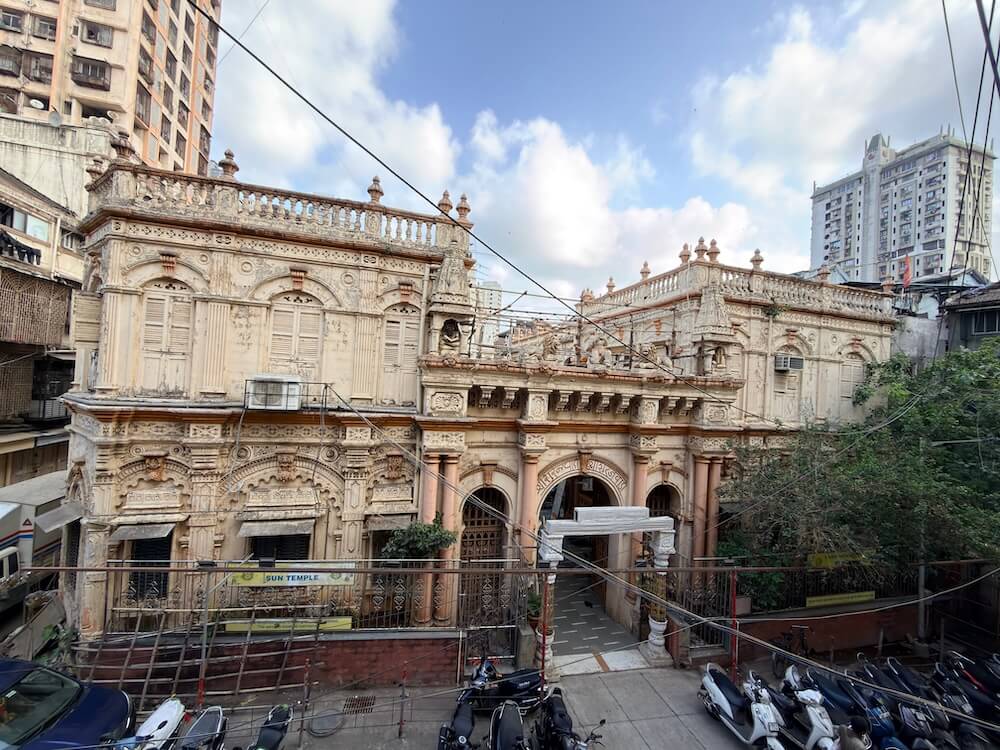
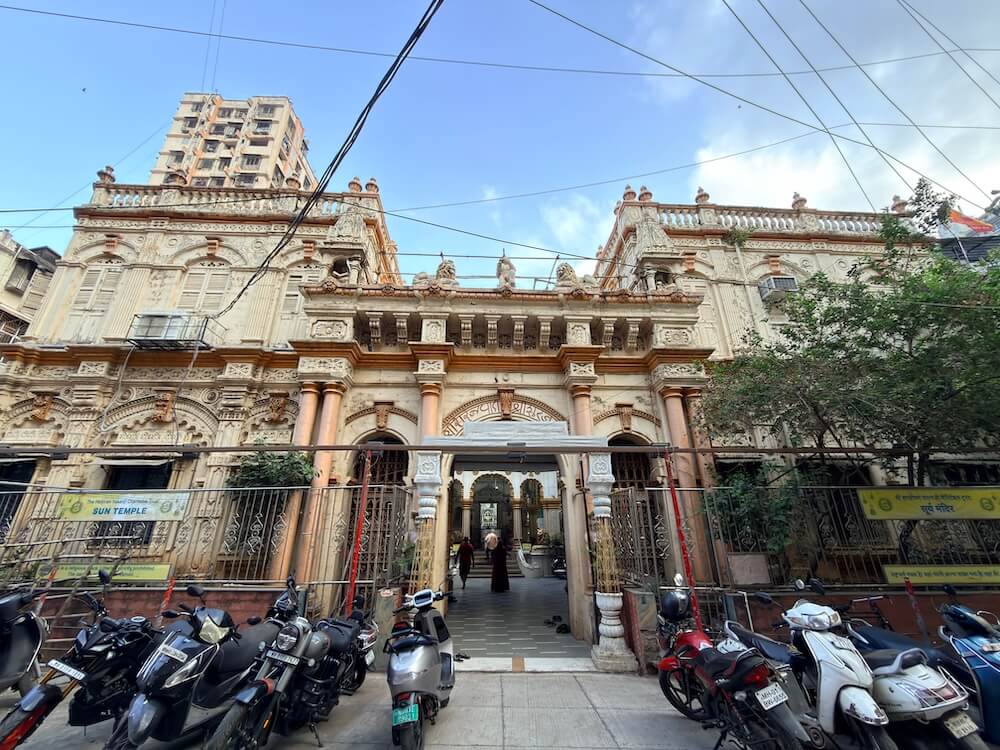
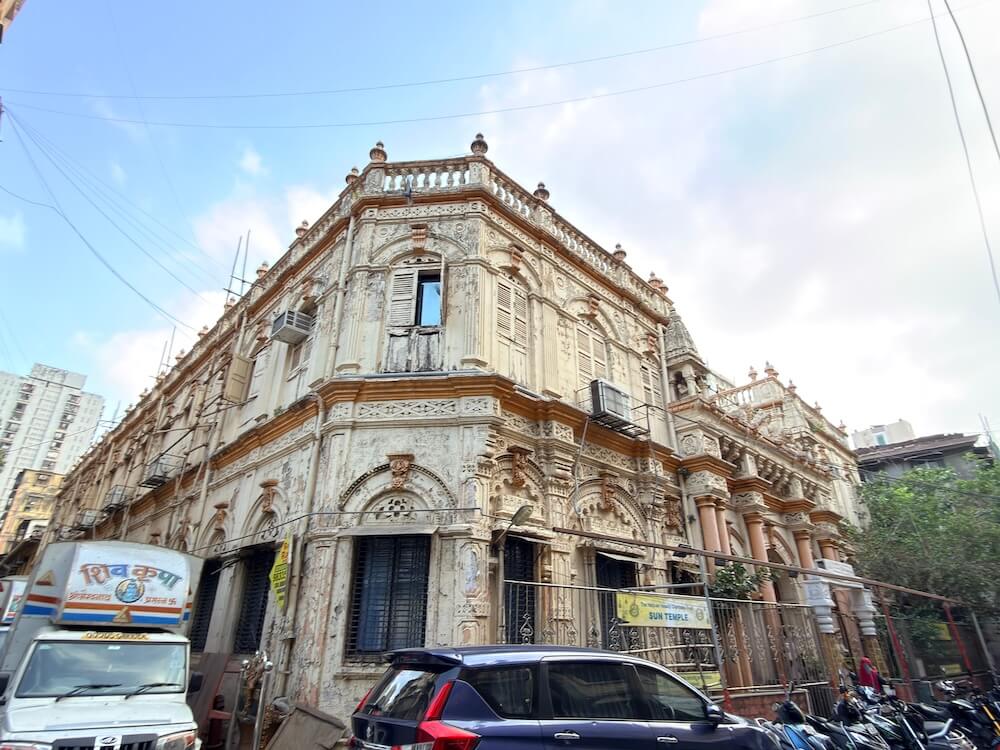
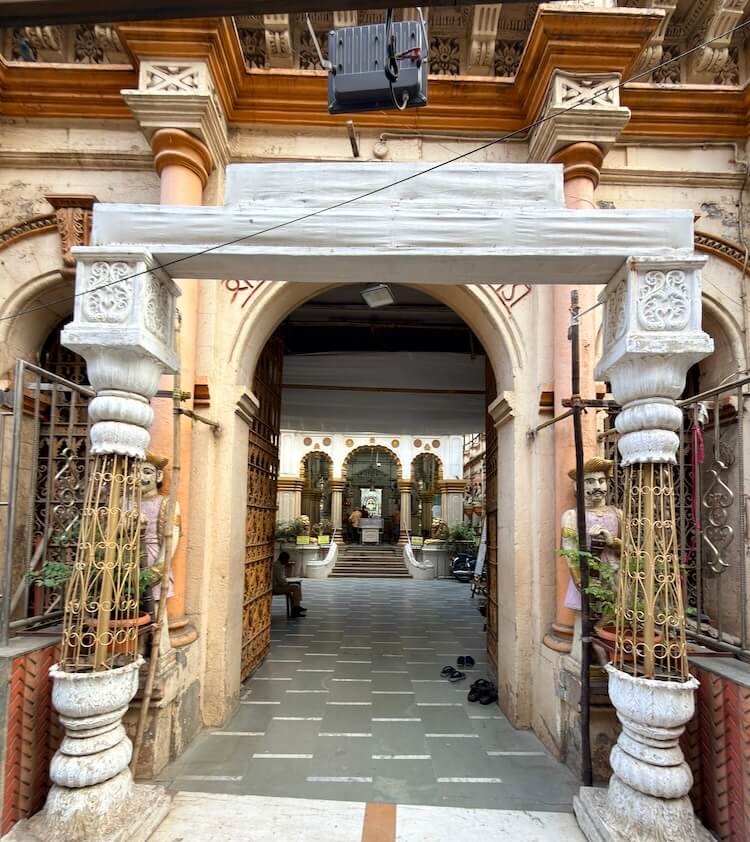
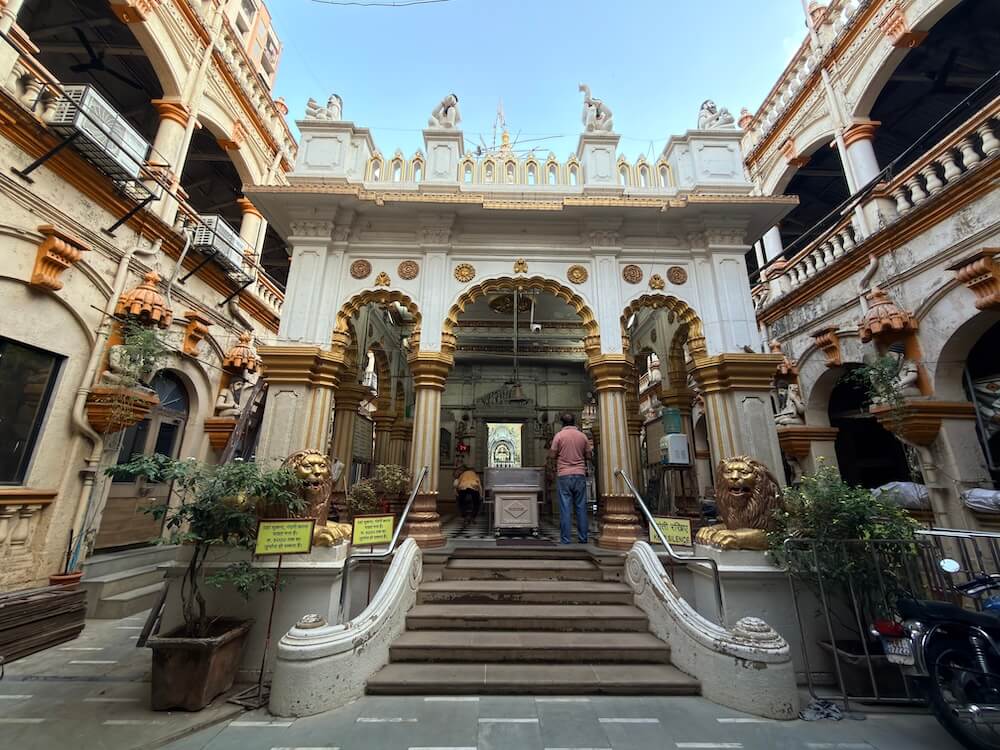
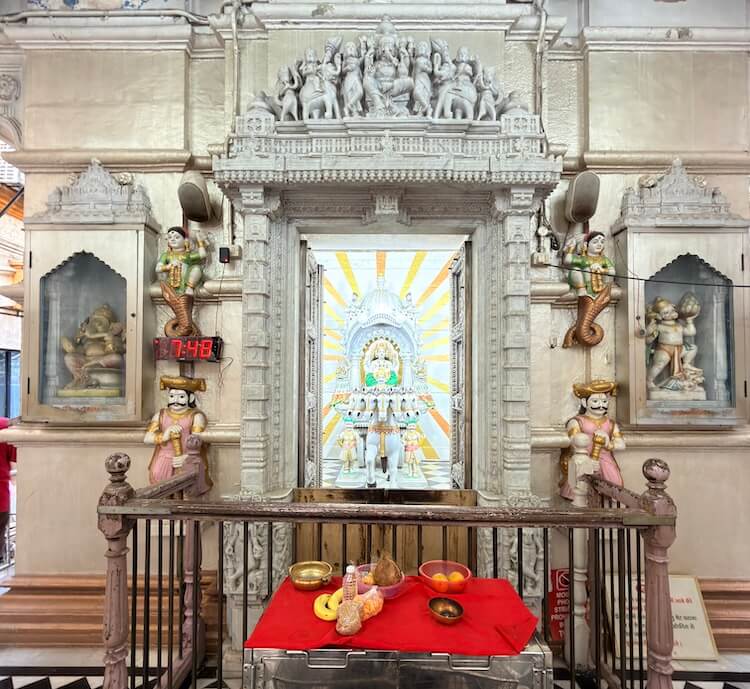
This temple is situated in a grand royal mansion named ‘Surajwadi’ near C. P. Tank, in the third Panjrapole Lane of Bhuleshwar. Tall columns in the Greek Revival style and grand arches in the Muslim architectural style are the features of the facade of this mansion. On the upper part of the arched main gate of the mansion, on the roof, there are two small shrines in the Gurjara-Rajasthani style. In the center, there is a sculpture of a Sun worshipper, and two lion statues are seated on its sides. From here, one enters the marble-paved courtyard of the temple. The buildings of this mansion surround the temple on all four sides. On the columns of the arches of the spacious verandas of these buildings, sculptures of sages in various postures are seated. The temple structure stands on a high plinth in the central courtyard of the mansion. The temple is structured with a Sabhamandap (assembly hall) and a Garbhagriha (sanctum sanctorum). One enters this Sabhamandap by climbing 6 steps. On the platform on the sides of the steps, there are two large lion statues painted in golden color. The Sabhamandap of the temple is of an open style. On the railings of the roof of the Sabhamandap, which has tall columns and arched gateways, there are also statues of sages in various postures. On the front wall of the temple’s sanctum sanctorum, the idol of Ganesha is consecrated in the niche on the left, while the idol of Hanuman is consecrated in the niche on the right. The entrance to the sanctum sanctorum is reminiscent of Chalukyan temple architecture. The doorway features a three-branched frame. On these intricately carved door jambs, figures of Vaishnava door guardians and attendants are sculpted in the lower sections. The threshold features a crescent-shaped stone, with Kirtimukhas on both sides of this stone. The idol of Ganesha is seated at the lintel of the frame. There is also a large sculpture of Ganesha in the upper section of the doorway. In this, Ganesha is in the center, flanked by Riddhi and Siddhi, along with sculptures of elephant-mounted and infantry attendants. On both sides of the entrance, on the lower part of the wall, are sculptures of staff-bearing door guardians in the Gurjara style, and above them are sculptures of attendants seated on fish-faced creatures.
Inside the sanctum sanctorum, the idol of Suryanarayana is consecrated on a pedestal.
The idol of the Sun, crafted in white marble, is extremely unique. Ancient iconography describes certain characteristics of Sun images. According to the ‘Brihatsamhita’, it is stated that the Sun should be depicted in ‘Udichyavesha’. Udichyavesha refers to the attire of the regions even further north than North India. Due to Persian or Iranian influence, the Sun in this attire wears a coat-like garment and boots on his feet. This is the only Hindu deity depicted wearing boots. It is said that the Vitthal idol in the Vitthal temple of Mangalwar Peth in Kolhapur wears sandals, but that is an ornament called ‘Padjalika’, and it is mistaken for footwear. Sun idols in Udichyavesha are found in North India. This Persian or Iranian influence is not seen in South Indian Sun images. In Southern Sun images, the hands of the Sun are raised to shoulder level, holding half-bloomed lotuses. They also have an ‘Udarbandha’ (waistband) around their waist. Importantly, the Sun does not wear boots here. South Indian Sun idols do not have ‘Arun’ and seven horses, whereas North Indian Sun idols are shown mounted on a chariot with seven horses.
Describing the Sun, Sage Kutsa Angirasa in the ‘Suryasukta’ (Rigveda 1.115), poetically imagined, “The Sun’s horses travel through a path that is auspicious and filled with golden light,” and “Dispelling darkness is the divine work of the Sun. When he removes his golden horses, the night spreads its black garments.” This concept was later reflected in iconography. During the Shunga period, the Sun’s chariot was shown with four horses, while in the Kushan period, it had two or four. The seven-horse Sun idols became popular primarily during the Gupta period. These horses were distinct. The Sun deity in this Bhuleshwar Sun temple is also mounted on a horse-drawn chariot. However, the chariot here is yoked to a single horse, which is depicted with seven heads. Arun is the charioteer of this chariot. In his hands, instead of reins, there is a serpent-rope. In this chariot, adorned with intricate carvings, sage figures, and peacock sculptures, is the four-armed Suryanarayana in a seated posture. Here, the Sun is wearing a long yellow garment. He has a golden crown on his head and a halo behind his head. On both sides of the Sun idol are the idols of his two wives, ‘Usha’ and ‘Pratyusha’, and below, near the horses, are the idols of two attendants in Kathiawadi attire.
There is a tall spire above the sanctum sanctorum, which also bears a golden finial. On the outer walls of the sanctum sanctorum are the idols of Brahma, Kalbhairav, Yama, Vishwakarma, Shiva, Agni, Vishnu, and Yajnanarayana.
Devotees can have the darshan of Suryanarayana in this temple between 6:00 AM and 12:00 PM and from 4:00 PM until sunset. Sun worship holds unique importance in this temple. For the last 20 years, 365 days a year, a ‘Trikal Havan’ (three-time ritual fire ceremony) is performed here at 6:00 AM, 11:15 AM, and one and a quarter minutes before sunset. Aarti is performed in the temple every day at 7:00 AM and 12:00 PM. Another specialty of this temple is that twelve Sankrantis are celebrated here over the twelve months of the year. They begin with Makar Sankranti. Following this, Kumbh, Meen, Mesh, Vrishabh, Mithun, Kark, Singh, Kanya, Tula, Vrishchik, and Dhanu Sankranti are celebrated. On the auspicious time (Punyakal) according to the Panchang of that day, rituals for Suryanarayana are performed here.
This sacred temple stands as a testament to deep spiritual devotion, ancient architectural grandeur, and rich local cultural traditions.
The sanctum sanctorum houses the divine idol consecrated according to ancient Vedic traditions, surrounded by serene courtyards and traditional temple architecture.
Navratri, Maha Shivratri, Annual Temple Jatra & Deepotsav
Compare and book flights, secure top-rated local hotels near the temple, hire reliable guides, and rent cars instantly.
Extend your pilgrimage by visiting other highly sacred temples located nearby.


Add ₹999 more to unlock FREE SHIPPING!
Your sacred cart is currently empty.
Shop Photo FramesFill in your delivery details below to place your order.
Add comment