
Add ₹999 more to unlock FREE SHIPPING!
Your sacred cart is currently empty.
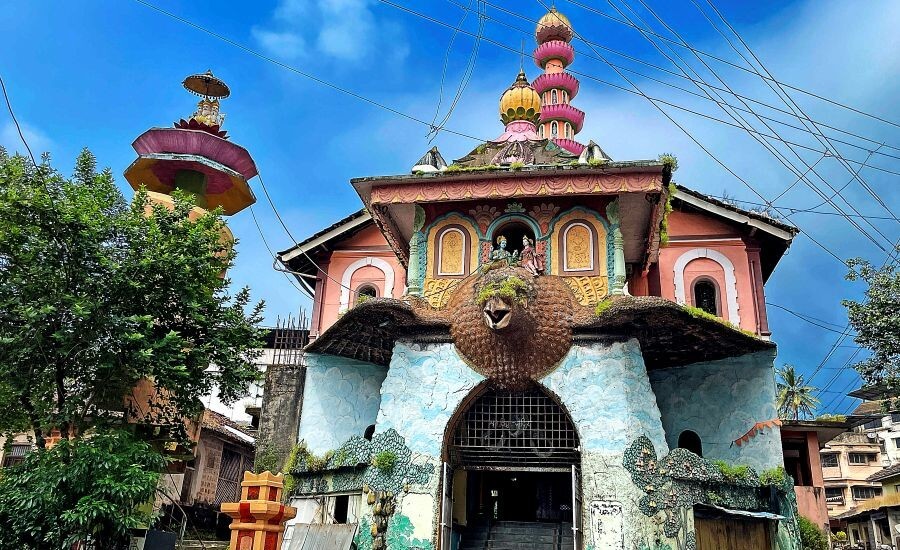
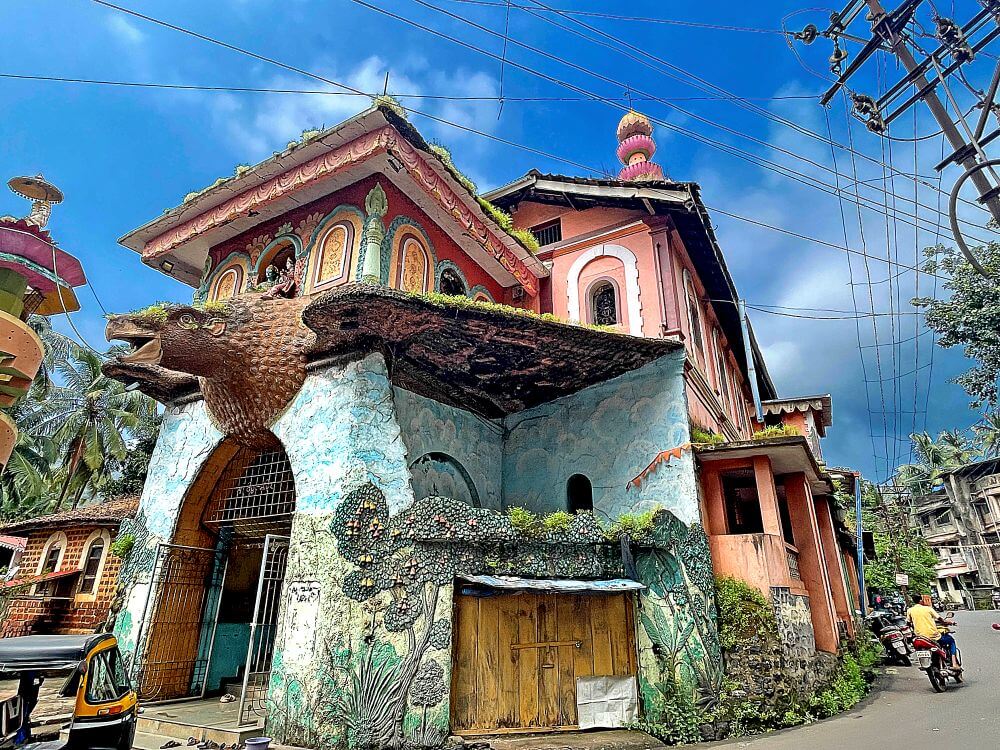
Shop Photo FramesThe Aparanta region, known as the Konkan land, has a long-standing tradition of Vitthal worship. The flag of the Bhagavata Sampradaya has been flying here since ancient times. In the ancient town of Sundarwadi, now known as Sawantwadi, stands this eighteenth-century Vitthal-Rukmini temple. Renowned as a ‘Prati-Pandharpur’ (a replica of Pandharpur), the temple is distinguished by its unique, towering spire that resembles a mountain peak. The facade of the temple is equally remarkable; its exterior architecture is designed in the likeness of the ‘Garuda Vimana’ (eagle-shaped chariot) mentioned in the life story of Saint Tukaram Maharaj.
There are references suggesting that the science of aeronautics existed in ancient India. In Sanskrit, the word ‘Vimana’ has seven meanings: 1. Disrespect, 2. Measurement, 3. An aerial vehicle, 4. A chariot or vehicle, 5. A horse, 6. A seven-storied mansion, 7. A palace. In architectural science, the structure above the main sanctum is called a ‘Vimana’. The Valmiki Ramayana contains references to the ‘Pushpaka’ aerial vehicle that flew through the skies, as well as palace-like Vimanas. In the seventh Sarga of the Sundara Kanda of the Valmiki Ramayana, while describing this Vimana, Valmiki refers to it as ‘Grihottamam’ (the best of houses). In the ‘Vaimanika Shastra’, composed by Pandit Subbaraya Shastry between the years 1900 and 1922 in the name of Sage Bharadwaja, four types of Vimanas are described: Shakuna, Sundara, Rukma, and Tripura. Mythological stories frequently mention various Vimanas that traveled through the skies, and the Garuda Vimana is one of them. This Vimana falls under the ‘Shakuna’ category, featuring wings like those of a bird at the bottom, with chambers above them, and a very tall pillar on top. The architecture of this temple is modeled after this type of Vimana.
Located in the bustling market of Sawantwadi, this three-storied temple has a wide and high entrance gate. The top of the gate is semi-circular, and above it, the roof is shaped like the king of birds, Garuda, with wings spread wide. The design features the face of Garuda with an open beak and vast wings spread on both sides, clutching a great serpent king in his talons. Above the wings is a large square chamber, flanked by sloping roofs resembling a porch. In the center of the chamber’s front wall is a window containing an idol of Lakshmi-Narayana. Above this chamber sits a seated spire decorated with floral petals. On the front side, there is a mace sculpture, and the spire is crowned with a large Amalaka and a Kalasha.
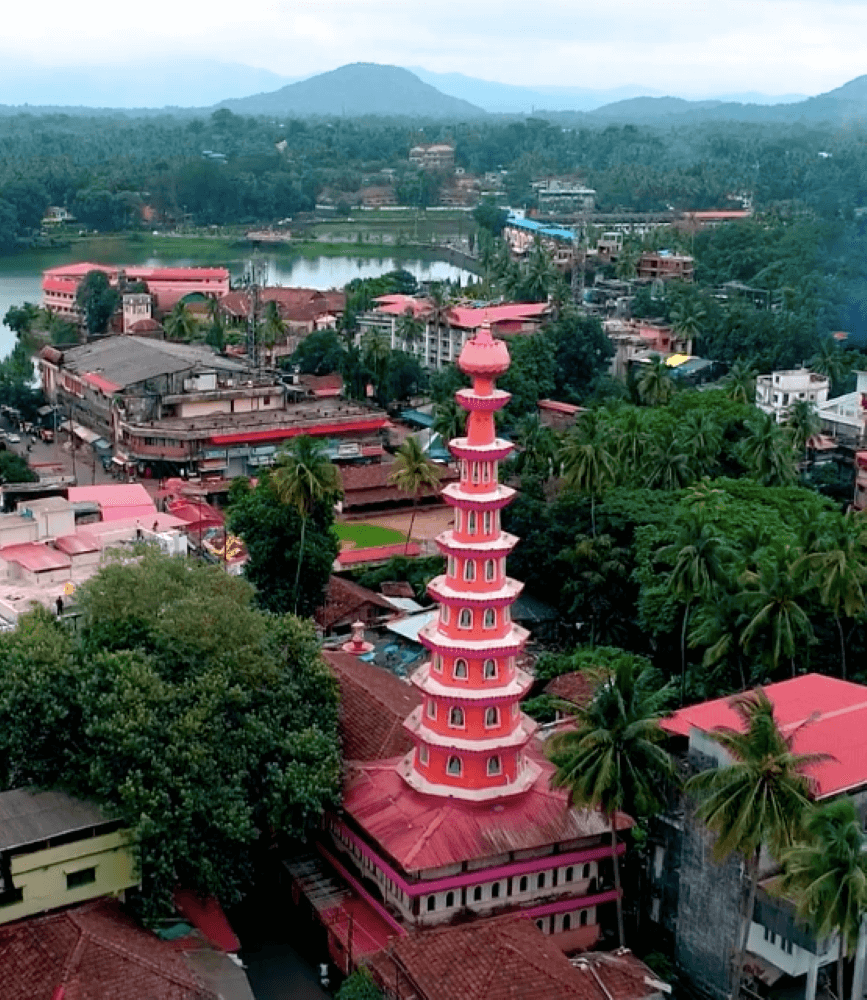
The towering spire above the sanctum, surrounded by sloping roofs on all four sides, is the main attraction of this temple. This spire consists of nine levels and stands at a height of 130 feet. The walls of the seven levels below the spire are carved with niches containing a total of 108 idols of deities. The ninth level features a cylindrical structure topped with an Amalaka and a Kalasha. This high spire and the Garuda-Vimana shape of the temple give it a distinct identity.
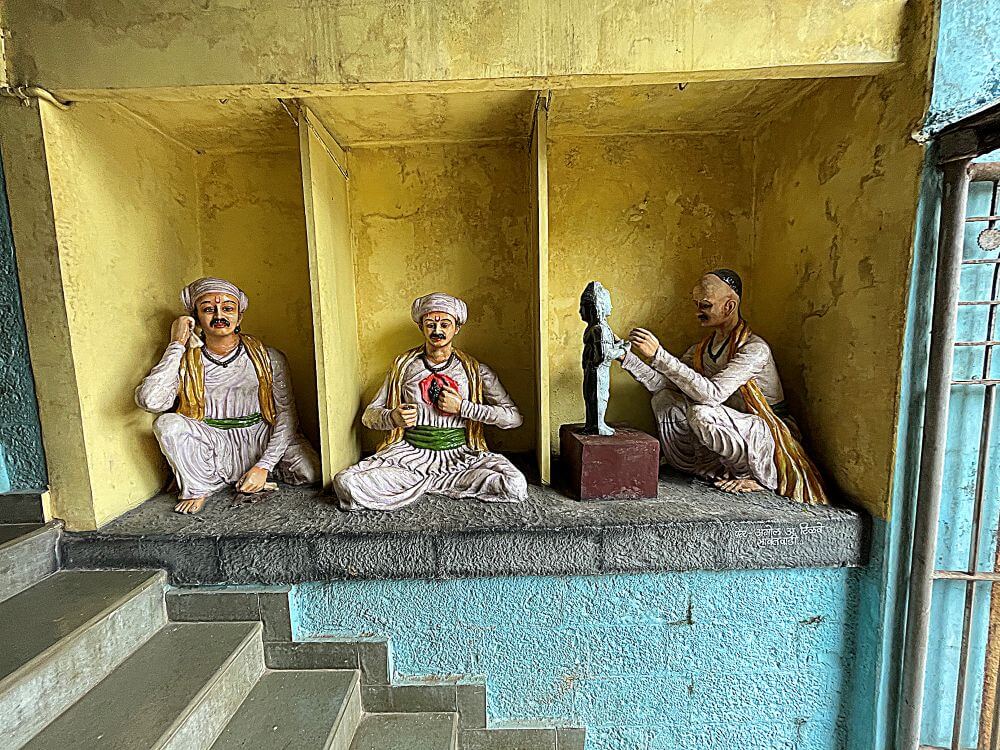
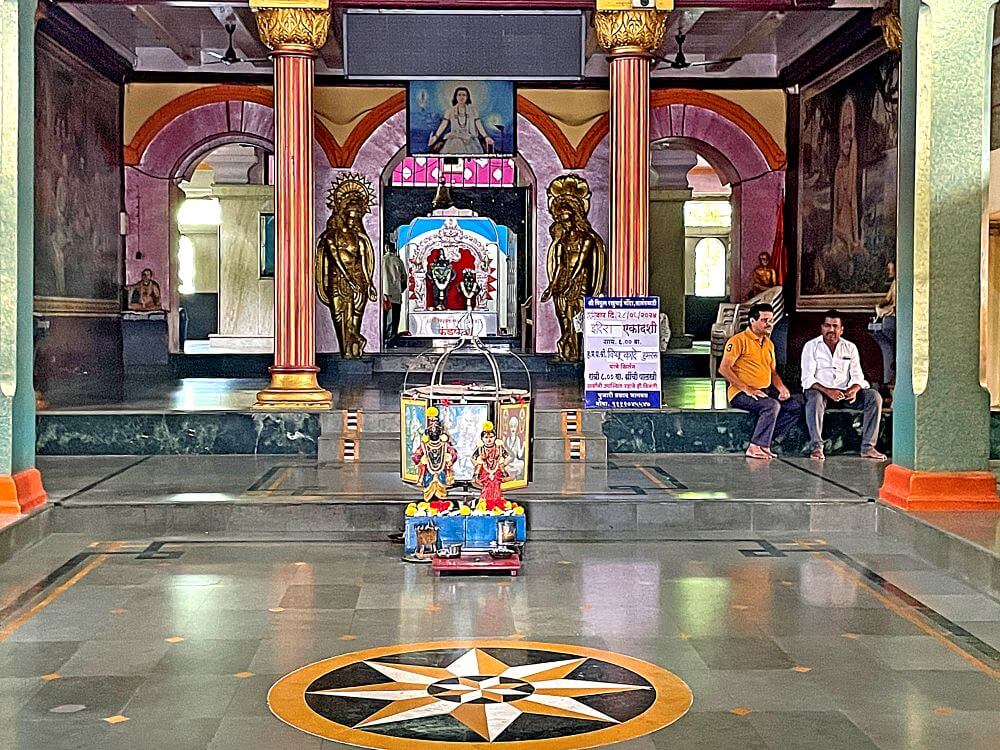
In front of the temple stands a tall, spiral pillar. At its summit, an idol of Lord Brahma is seated on a lotus, sheltered by a small canopy. There are steps to climb this spiral ‘Brahma-stambha’. Beside the pillar is a Tulsi Vrindavana. The temple layout consists of a Darshan Mandapa (viewing hall), Sabha Mandapa (assembly hall), Antarala (vestibule), and Garbhagriha (sanctum sanctorum). One enters the Darshan Mandapa by climbing two steps through an entrance adorned with stone murals of natural landscapes. In the niches on both sides of the Darshan Mandapa walls are beautiful idols of Saint Tukaram, Saint Eknath, and Saint Namdev. Additionally, there is a unique sculpture of the devotee Pundalik holding an idol of Lord Vitthal, who stands on a brick while Pundalik serves his parents by resting their heads on his lap. To reach the Sabha Mandapa from the Darshan Mandapa, one must climb nine steps. The entrance to the Sabha Mandapa features round pillars embedded in the walls on both sides, topped with elephant sculptures and an arched gateway. The walls of this arch are decorated with relief sculptures of peacocks, and the central keystone features the face of Lord Krishna.
The Sabha Mandapa of the temple resembles a mansion from the Peshwa era. It is an enclosed, two-storied structure. The central part is open up to the ceiling, with the upper floor designed like a balcony with railings on all four sides. This section is supported by six stone pillars. A large chandelier hangs in the center of the Sabha Mandapa. The floor of the central area is sunken, and upon entering, one sees a Homa-kunda (sacrificial fire pit) in the middle. In the assembly hall, one can see idols of Lord Surya-Narayana, Goddess Lakshmi, and various great saints and sages. To the front right are idols of Lord Ganesha, and to the left are idols of Lord Mahadeva. In front of these are small, beautiful idols of Vitthal-Rukmini. Climbing three steps from the Sabha Mandapa leads to the Antarala. Here, there is a painting of Chhatrapati Shivaji Maharaj receiving blessings from deities and saints, while on the other side is a beautiful painting of Swami Samarth. These paintings were created by the Sawantwadi artist Dada Malvankar. The second floor of the temple also houses sculptures of various saints and deities.
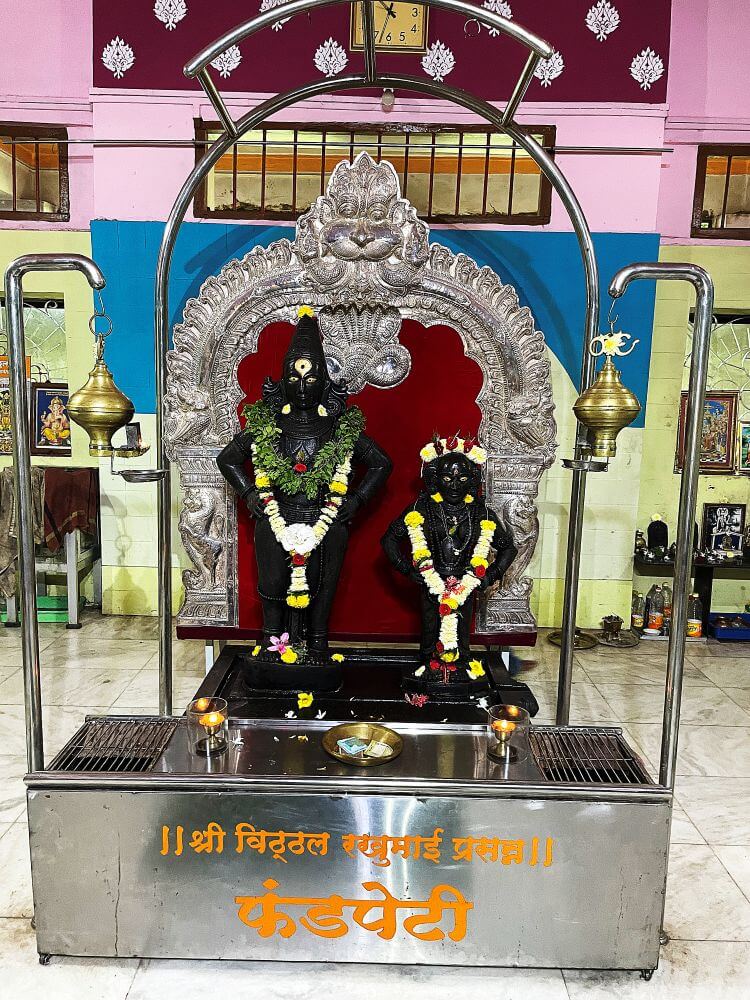
On both sides of the entrance to the sanctum sanctorum are large sculptures of gatekeepers (Dwarapalas), and an image of Saint Dnyaneshwar is placed above the door frame. In the center of the sanctum, on a Vajra-pitha (diamond pedestal), stand the stone idols of Lord Vitthal and Rukmini, carved from black stone with their hands on their hips. Both idols have golden eyes. Behind the idols is a beautifully crafted silver arch (Makhar). An inscription in the temple states that these idols were installed in the year 1859. There is a path from the Antarala to perform circumambulation (Pradakshina) around the sanctum. The niches along the circumambulation path contain idols of various deities, including the Dashavatara (ten incarnations) of Lord Vishnu. There are windows at regular intervals along this path, ensuring ample light and ventilation.
The history of this temple is said to date back to 1725, when it was built by a Warkari gentleman named Padgaonkar. He was a devout follower of Lord Vitthal and used to perform the annual pilgrimage (Wari) to Pandharpur. The temple was originally known as ‘Padgaonkar’s Vitthal Temple’ after him. Devotees believe this temple, which evokes the architecture of the Peshwa era, to be a living, awakened abode of the Divine. In the past, there was a princely state named Sawantwadi. In the eighteenth century, Khem Sawant III administered the state of Sawantwadi. This temple, originally established by the Padgaokars, was renovated by Khem Sawant through a generous endowment. The temple is also famous as the Pandharpur of Konkan.
In this temple, between 6:15 and 8:15 in the morning, the Aarti is performed following the recitation of Manache Shlok, Ramraksha, Dasbodh, and Suryagayatri, along with Homa-Havan and Sauryasukta. Thereafter, at 12:15 in the afternoon, Haripatha and Eknathi Bhagavata are recited, followed by Havan. At 6:15 in the evening, after the recitation of Haripatha, Bhagavad Gita, and Dnyaneshwari during the worship, all the deities are worshipped. On every Ekadashi, Haripatha is performed in the morning, afternoon, evening, and night, followed by Kirtan and the procession of the deities’ palanquin. On the Krishna Ashtami of every month and on Ashwin Shukla Dashami, Saptashati Havan is held in the morning. From Ram Navami until Hanuman Jayanti, Kirtan is held in the temple every evening. On the occasion of Ashadhi Ekadashi, an unbroken Harinama and Veena Saptaha are organized starting from Ashadha Shukla Dwitiya. The Bhajan competition held here during this time is a major attraction in the Konkan region. Bhajan troupes from Ratnagiri district, along with those from Sindhudurg district, participate in this competition.
This sacred temple stands as a testament to deep spiritual devotion, ancient architectural grandeur, and rich local cultural traditions.
The sanctum sanctorum houses the divine idol consecrated according to ancient Vedic traditions, surrounded by serene courtyards and traditional temple architecture.
Navratri, Maha Shivratri, Annual Temple Jatra & Deepotsav
Compare and book flights, secure top-rated local hotels near the temple, hire reliable guides, and rent cars instantly.
Extend your pilgrimage by visiting other highly sacred temples located nearby.


Add ₹999 more to unlock FREE SHIPPING!
Your sacred cart is currently empty.
Shop Photo FramesFill in your delivery details below to place your order.
Add comment