
Add ₹999 more to unlock FREE SHIPPING!
Your sacred cart is currently empty.
Shop Photo FramesAccording to the Puranas, Brahma is the first deity among the Trimurti—Brahma, Vishnu, and Mahesh. He is considered the creator of the universe. As per the Puranic narratives, the Creator first brought forth the cosmic waters and cast a seed into them. From this, a golden cosmic egg was formed. After a thousand years, the Creator Himself emerged from this egg in the form of Brahma. Although He is an important deity in Hinduism, His significance began to wane after the fifth century CE. There are only a few temples dedicated to Brahmadev in the country. One such renowned temple is located in Brahmakarmali, North Goa. This temple is the very reason the village bears this name.
The original idol of Brahmadev in Brahmakarmali was previously located in Karmali, Tisgaon, in the northern part of Goa. The legend associated with that temple recounts that Kadamba King Jayakeshi (the Second) went hunting in the forests of Karmali. Exhausted from chasing prey, he rested under a tree. In a semi-conscious state, he had a dream. In it, he saw three radiant forms: Brahmadev with four faces in the centre, Vishnu on the left, and Shiva on the right. Brahmadev declared, “I shall reside in your kingdom in the form of the Trimurti. I will manifest in a black stone here. Build My temple there.” Upon waking, the king commanded his soldiers to search for this stone in the vicinity. They found such a stone, and within it, the form of the Trimurti was visible. Sculptors were summoned, and by removing the superfluous parts of the stone, a beautiful idol of Brahmadev in His Trimurti form was crafted. A temple was then built at that very spot, and the idol was consecrated there.
It is said that the temple, erected in the twelfth century, was simple in design but grand. (This temple was destroyed by the Portuguese. Some of its remnants were found during excavations in Karmali.) As the Portuguese began their campaign of temple destruction in the Tiswadi region, the priests and devotees decided to migrate with the original idol of Brahmadev. They set off in a bullock cart, carrying the idol and essential items. While travelling through a dense forest in the Sattari region, evening fell, and they decided to halt by a stream. The bullock carts were unhitched, and the belongings were unloaded. That night, the deity appeared to the priest in a dream, saying, “We like this place.” However, thinking it might have been a mere illusion, the bullock carts were hitched again the next morning, and other items were placed in them. But the idol of Brahmadev, which had been placed on the ground, could not be lifted. It was then that the priests recounted the dream vision. Taking this as a divine sign, the devotees decided to consecrate Brahmadev at that very spot. The area was part of Nagargaon. However, because the idol of Brahmadev, brought from Karmali, was installed there, this area became known as Brahmakarmali. Gradually, this name became prevalent. This is considered a rare instance where the name of the original village where a deity’s temple was located also migrated along with the deity.
Towards the end of the sixteenth century, a temple was built in Brahmakarmali with the cooperation of local villagers and devotees of Brahmadev. In its initial phase, the temple was simple, with a wooden roof and stone walls. In the nineteenth century, locals improved the temple’s structure. After Goa’s liberation, in the nineteen seventies and nineteen eighties, the Archaeological Survey of India reinforced the temple walls. After renovations in the year two thousand, the temple attained its current form. It is said that there are approximately ten temples dedicated to Brahmadev across the country. Among these, three temples are considered particularly important: Pushkar (Rajasthan), Khedbrahma (Gujarat), and Brahmakarmali (Goa).
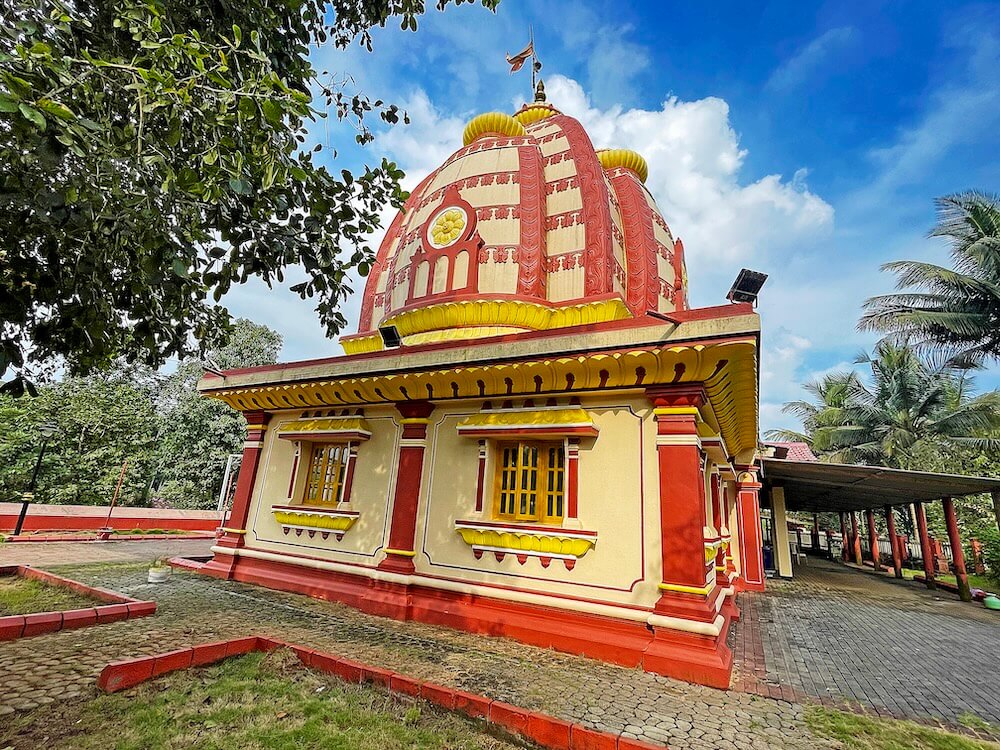
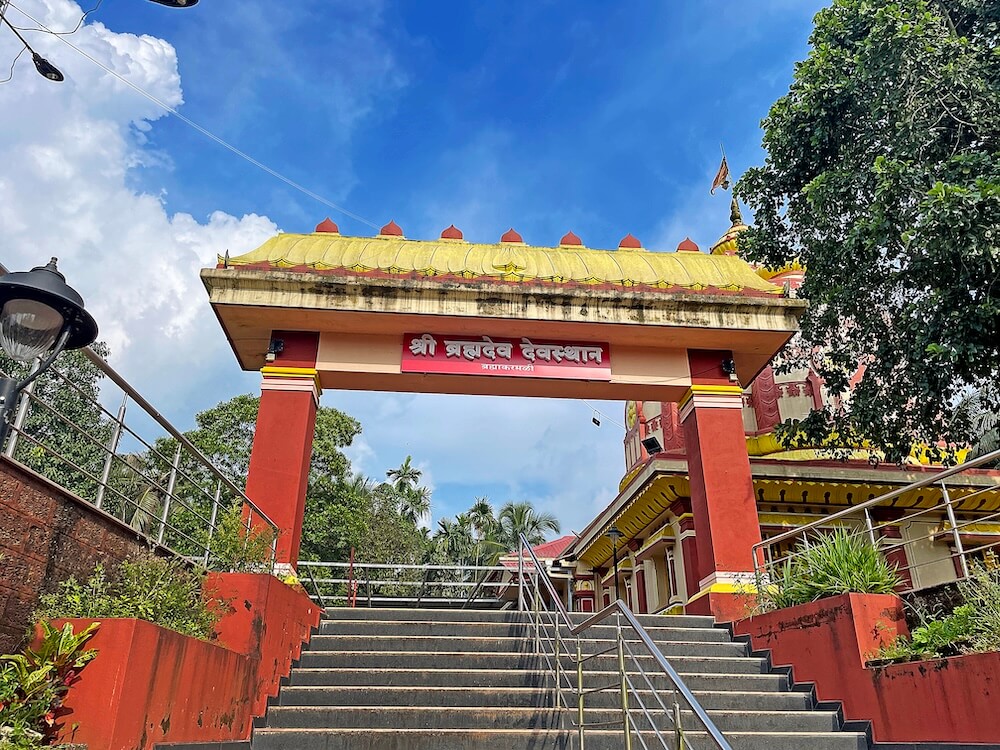
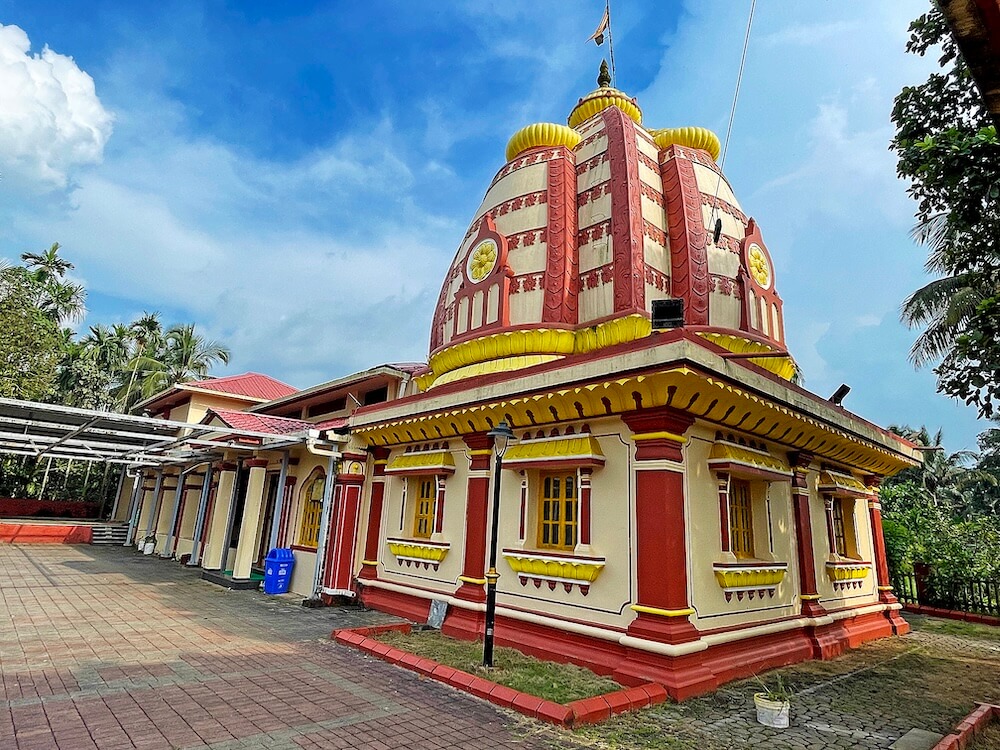
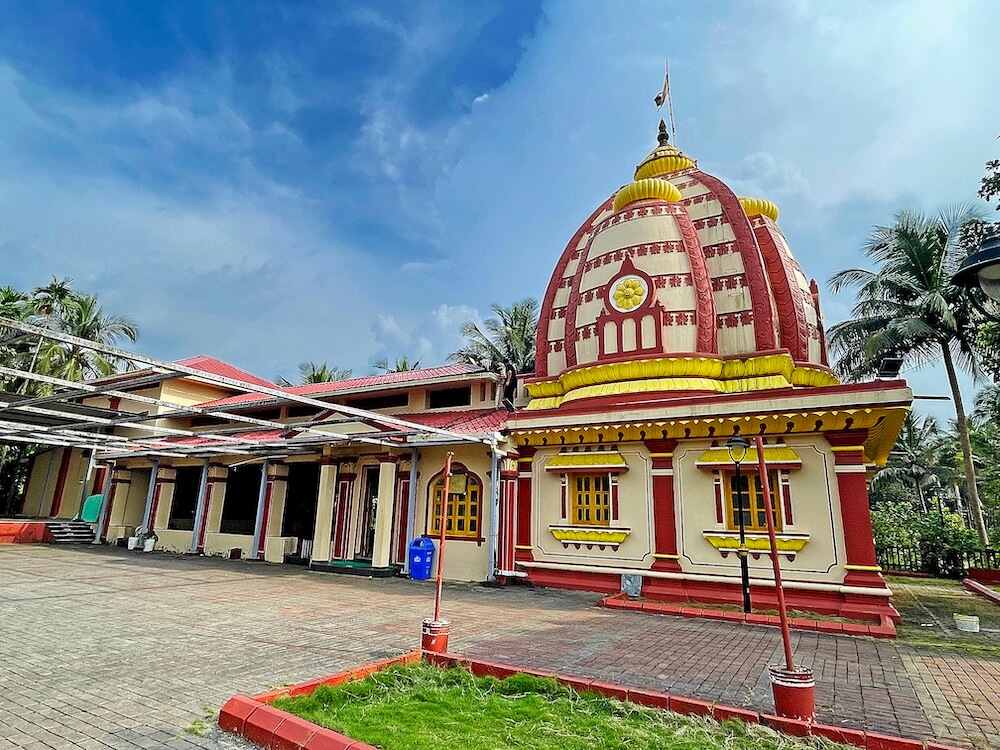
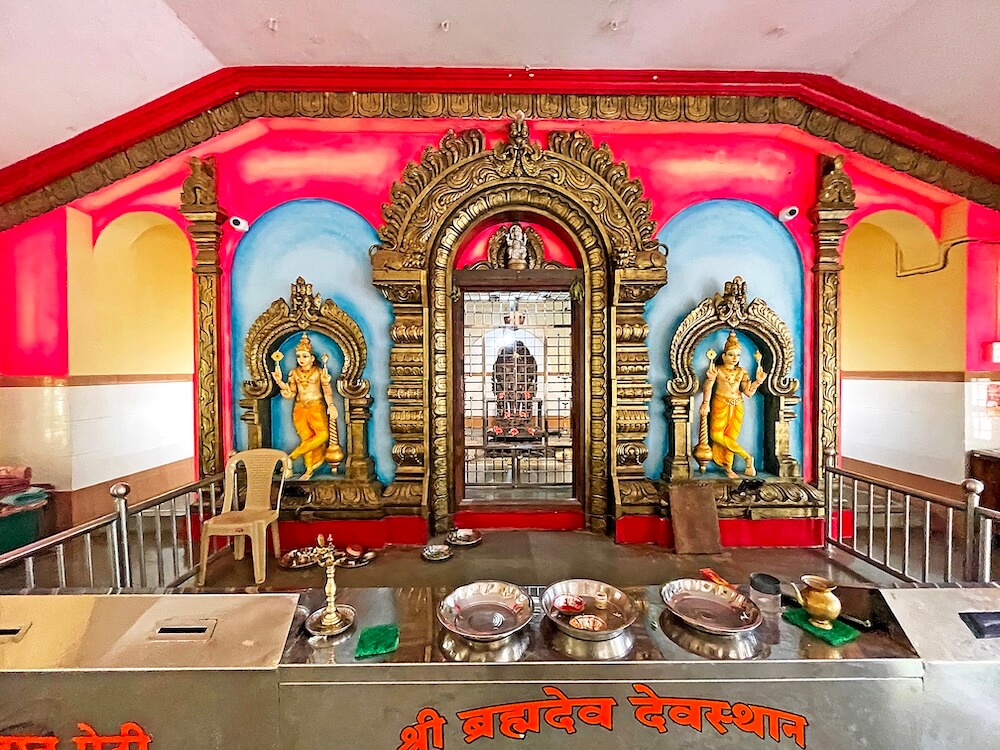
The temple complex is surrounded by an evergreen forest. There are natural springs in the vicinity, and a pond-like structure has also been created there. To reach the main courtyard of the temple from the road, one must ascend ten to twelve steps. In the courtyard, in front of the temple, there are a Tulasi Vrindavan and a Deepastambha (lamp pillar). Although the temple’s architectural style bears a Goan imprint, it also shows a blend of Dravidian and Nagara styles. The temple’s structure includes a hall with a platform, an enclosed sabhamandapa (assembly hall), an antarala (vestibule), and a garbhagriha (sanctum sanctorum) with a pradakshina marga (circumambulatory path). The antarala is a few inches higher than the sabhamandapa. In the antarala, on the facade wall of the garbhagriha, there are sculptures of mace-bearing dwarapalas (gatekeepers) on both sides. The doorframe of the garbhagriha features distinctive carvings. On the lalata-bimba (lintel) of the entrance, there is an idol of Ganesha.
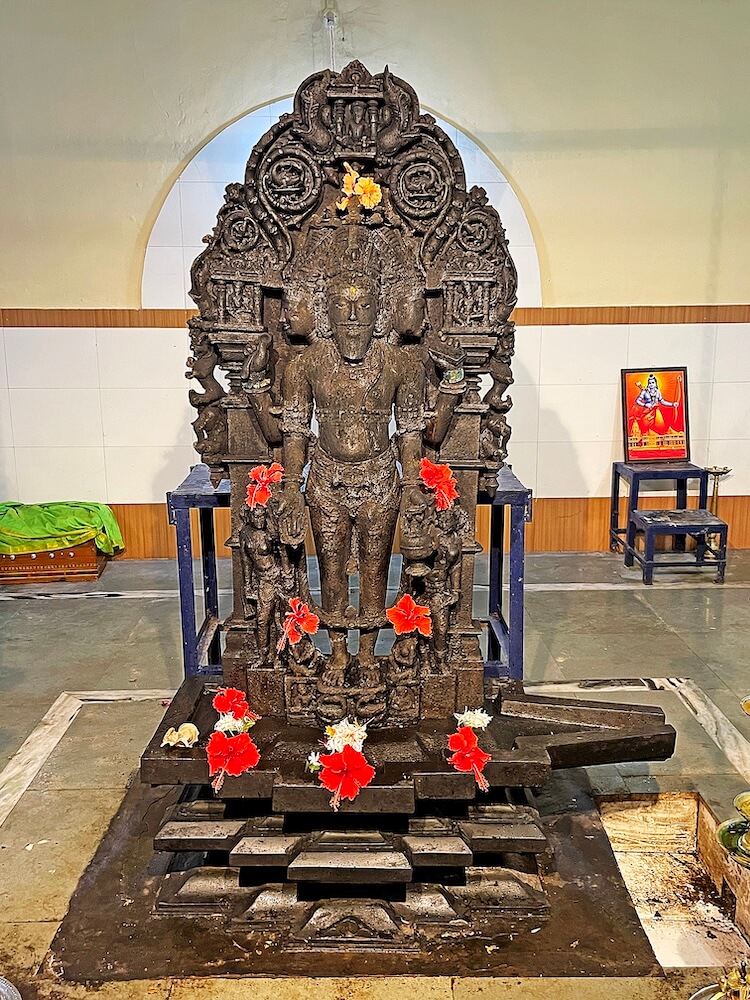
Inside the garbhagriha, one beholds the idol carved from black basalt stone. In fact, this idol has four faces. The fourth face can be seen from the pradakshina marga, from behind the idol, through a small opening. According to Puranic legend, Brahmadev was Panchaanan (five-faced); however, because he uttered inauspicious words about Shankara, Shankara had one of his heads severed by Kalabhairava. Hence, the idol of Brahmadev is Chaturmukhi (four-faced). It symbolises the four directions, the four Vedas, and so on. This ancient idol features distinctive carvings. At the feet of the idol, on both sides, Surasundaris (celestial beauties) are carved. In the upper right hand of this four-armed idol is a palli (spoon) used for offering oblations in a yajna, as Brahmadev is also considered a Yajna-devata (deity of sacrifice). Since He is the creator of the Vedas, the Vedas are in His upper left hand. In His lower right hand is an Akshayamala or Japa Mala (rosary), and in His left hand is a Kamandalu (water pot) filled with water. It is said that Brahmadev uses this Japa Mala for calculating time in each yuga. He is also the creator of all living beings. Life is not possible without water, which is why He holds a Kamandalu filled with water.
The main festival celebrated at the temple is, of course, Brahma Jayanti. This festival, celebrated for three days starting from Vaishakha Shukla Tritiya, includes Abhishek (ritual bathing), Trimurti Puja, Rath Yatra (chariot procession), Havan (fire ritual), and Annadaan (food donation). Devotees attend in large numbers for this. The Rath Yatra that takes place at this time parades through the entire village. On Mahashivaratri, Rudrabhishek and Jagaran (all-night vigil) are observed. Janmashtami is celebrated on Shravana Krishna Ashtami. At that time, the Utsava Murti (processional idol) of the deity is placed in a Jhulani (swing). Rasleela is also organised during this period. There is a fair on Kartik Purnima. The cattle market held during this fair is famous. Devotees can have Darshan of Brahmadev at this temple daily from six-thirty AM to twelve PM and from four PM to seven PM.
This sacred temple stands as a testament to deep spiritual devotion, ancient architectural grandeur, and rich local cultural traditions.
The sanctum sanctorum houses the divine idol consecrated according to ancient Vedic traditions, surrounded by serene courtyards and traditional temple architecture.
Navratri, Maha Shivratri, Annual Temple Jatra & Deepotsav
Compare and book flights, secure top-rated local hotels near the temple, hire reliable guides, and rent cars instantly.
Extend your pilgrimage by visiting other highly sacred temples located nearby.


Add ₹999 more to unlock FREE SHIPPING!
Your sacred cart is currently empty.
Shop Photo FramesFill in your delivery details below to place your order.
Add comment