
Add ₹999 more to unlock FREE SHIPPING!
Your sacred cart is currently empty.
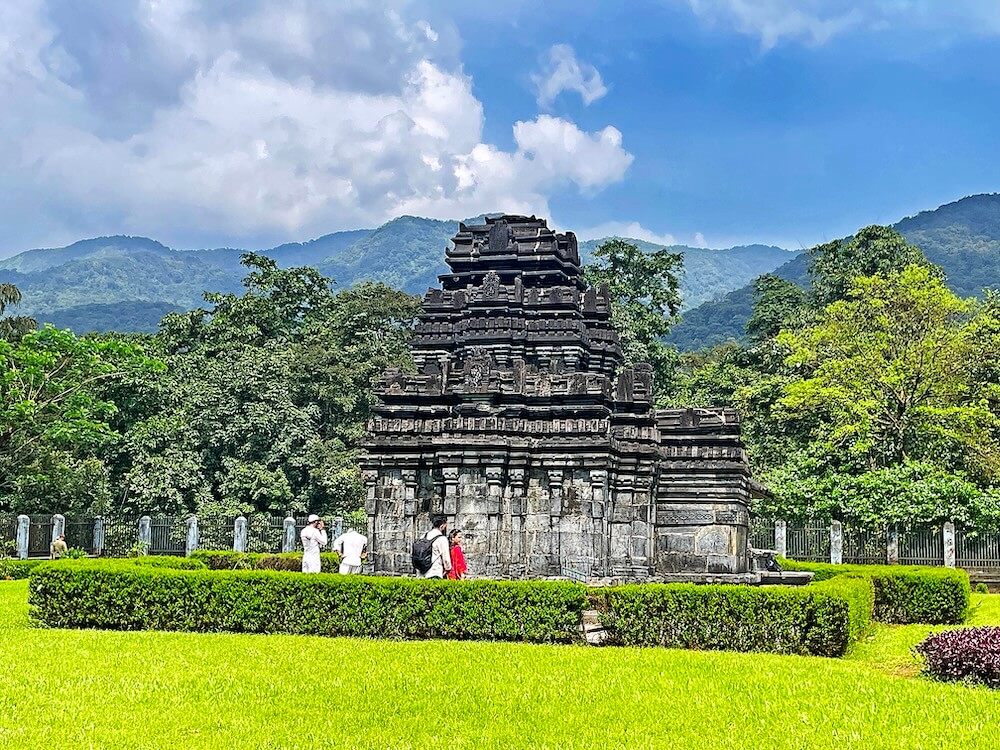
Shop Photo FramesThe Mahadeva Temple at Tambdi Surla is known as the oldest surviving and relatively well-preserved Shiva temple in Goa today. Built during the Kadamba period in the Hoysala-Chalukya architectural style, this temple enshrines a self-manifested (Swayambhu) Linga of Lord Mahadeva. Set in the picturesque and tranquil surroundings of the Bhagwan Mahaveer Wildlife Sanctuary, which is spread over an area of approximately २४० square kilometers, along with the nearby Tambdi Surla waterfall, this temple attracts devotees as well as tourists from across the country and abroad. The Archaeological Survey of India (ASI) has declared this temple as a national monument.
According to historians, the Mahadeva Temple dates back to the twelfth to thirteenth centuries. During this period, the Kadamba dynasty ruled this region. Saptakoteshwar Mahadeva was the presiding deity (Kuladaivata) of this royal dynasty. References to Saptakoteshwar are found in various other inscriptions, copper plates, and coins of the Kadamba dynasty dating from the twelfth century to the latter half of the thirteenth century. There is no record of which king of this dynasty built the Mahadeva Temple at Tambdi Surla. However, historians surmise that this temple must have been constructed during the hundred-year period between AD ११५० and १२५०. Shivachitta Permadideva, who ascended the throne in AD ११४७-४८ following the death of Kadamba King Jayakeshi II, and his chief queen Kamaladevi were staunch devotees of Lord Saptakoteshwar Shiva. According to a legend, they built this temple.
This legend recounts that Kadamba King Shivachandraditya (Shivachitta Permandi) once came to this forest for hunting. At that time, he suddenly beheld the Swayambhu Shiva Linga here. A variation of this story is that Shivachitta Permandi, while hunting in the forest, spotted the waterfall at Tambdi Surla. In the cascading water there, he perceived the fierce aspect of Shiva’s Tandava dance. Consequently, he ordered the construction of a Shiva temple at this spot. There are several other folk tales regarding this temple. One of them is that a tiger used to come here to drink the water of the Surla River. Its visits continued even after the temple was built. It is claimed that even today, a tiger comes at night to have darshan of the Lord and to drink water. Devotees also hold the sacred belief that a gigantic serpent resides in the sanctum sanctorum of the temple and guards the Shiva Linga.
This temple was built in a very dense forest and remote area. In her book ‘Culture and Religious Traditions in Temples of Goa’, Kamala Mankekar states that given the location of this temple, it must have been a center of spiritual practice for the Tantriks of the Shaiva sect in ancient times. Many temples in Goa suffered first from the Bahamani rule and later from the religious zealotry of the Portuguese. Countless temples were destroyed during that period. However, because this temple was located in a dense forest and lacked proper access routes, it escaped the vandalism of invaders and was preserved. Today, this temple is considered a national heritage.
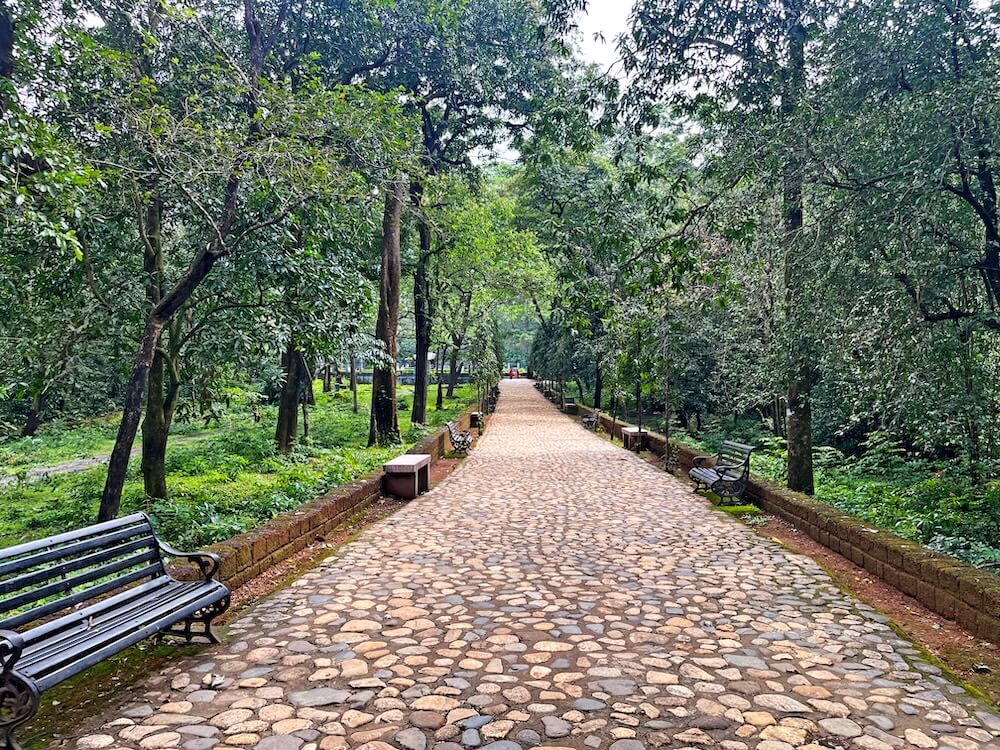
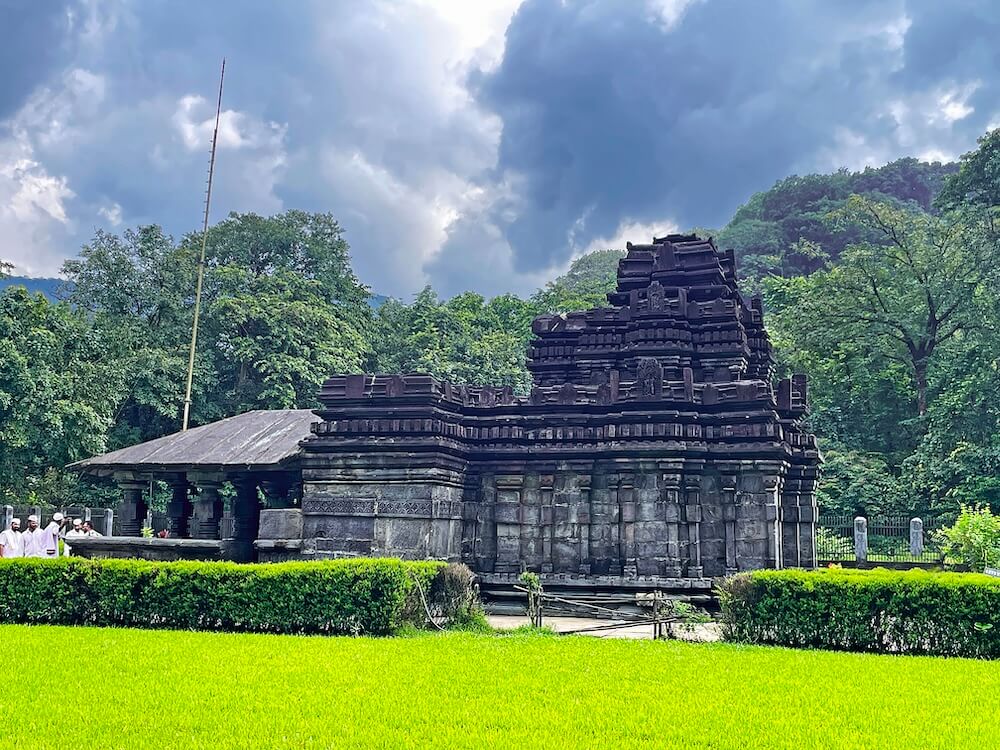
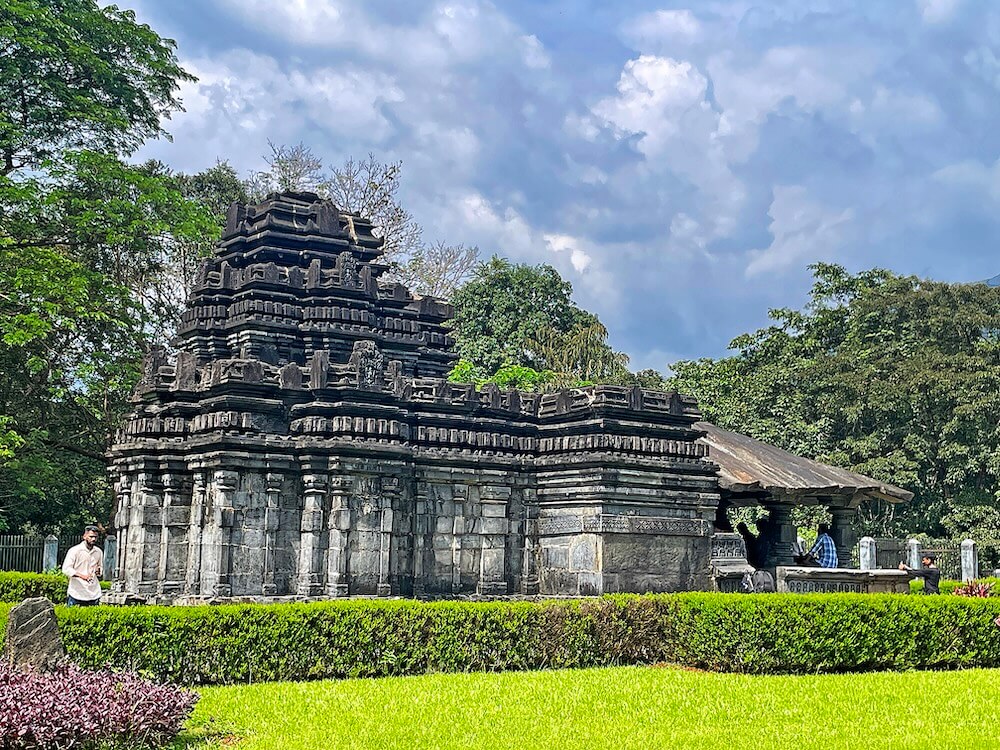
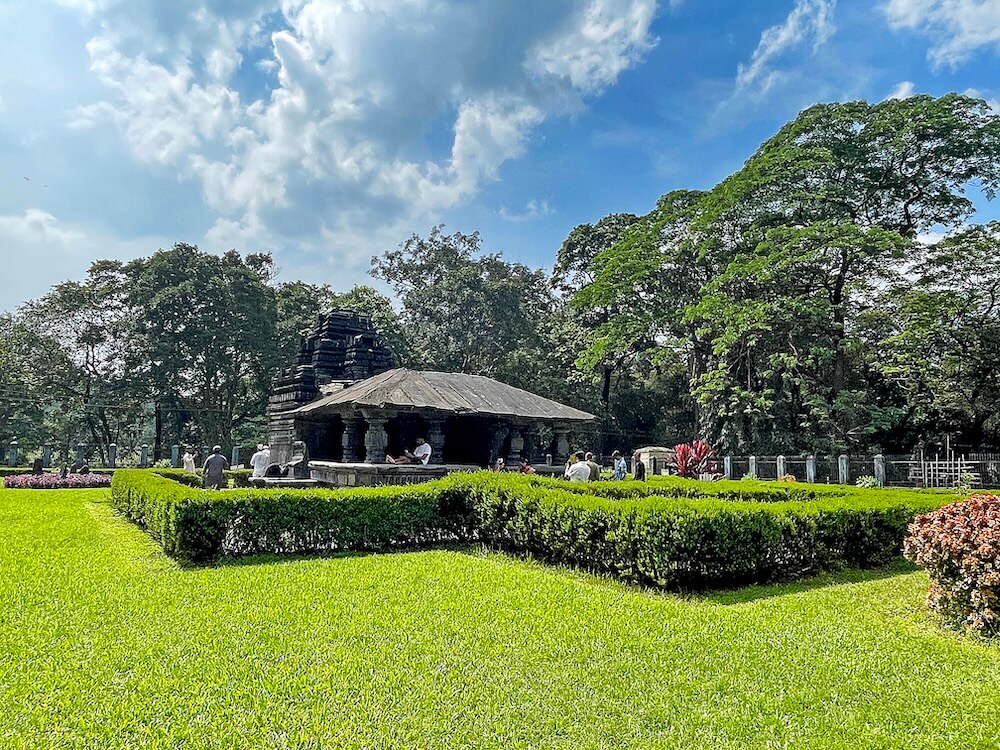
After parking vehicles at a distance from this temple nestled in the sanctuary, crossing a river bridge along the path, and proceeding further, one catches sight of this ancient black stone structure of the temple. Temples in Goa are generally built of laterite stone. However, this temple is carved out of black stone. This temple is erected upon a flat platform (Jagati). This east-facing temple has a structural layout consisting of a pillared hall (Mukhamandapa), an antechamber (Antarala), and the sanctum sanctorum (Garbhagriha). The Mukhamandapa has entryways from the front as well as the left and right sides.
The semi-open Mukhamandapa features a total of १४ pillars. The central four of these pillars feature intricate carvings. At the base of one of these pillars is a sculpture of an elephant king being crushed by a horse, which is considered a symbol of Kadamba rule. The upper portion of the pillar has a Naga-bandha style decoration. In the Naga-bandha decoration, a sculpture of an intertwined pair of male and female serpents is sometimes carved like a band. These four pillars also bear sculptural depictions of Shiva, Vishnu, Brahma, and their consorts Parvati, Lakshmi, and Saraswati, alongside Surasundaris and dancers in various dance poses. The back wall of the Mukhamandapa contains four carved niches, along with stone benches (Kakshasanas). In the center, on a circular pedestal (Rangashila), lies a fragmentary headless Nandi idol standing three feet tall. The ceiling of the Mukhamandapa is adorned with lotus flower carvings.
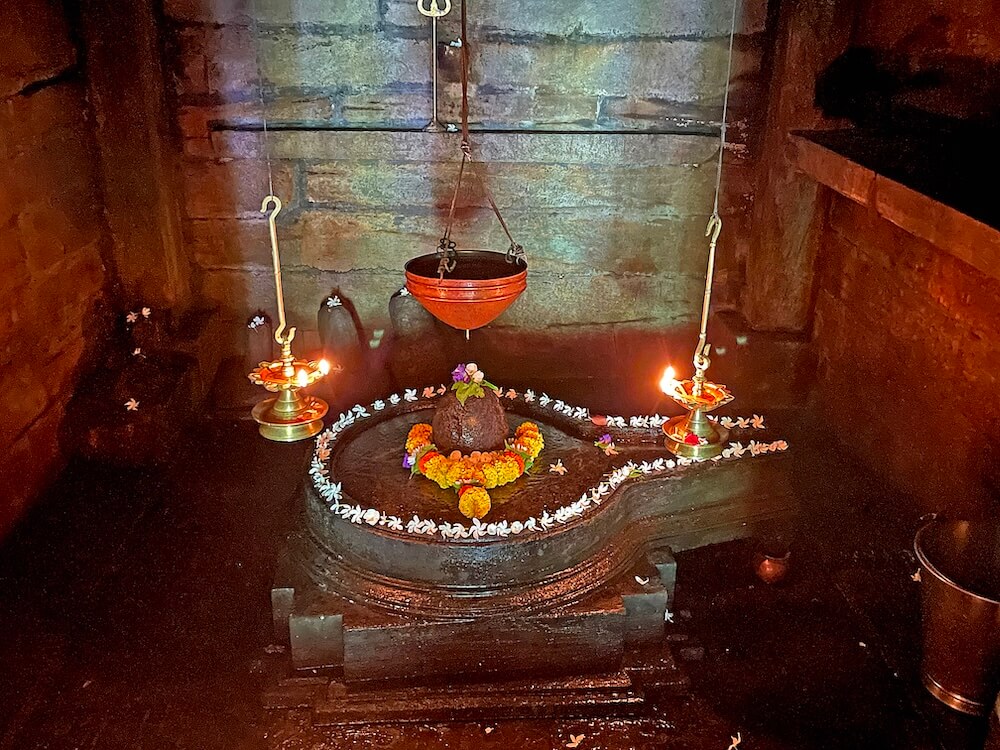
On both sides of the stone doorframe of the Antarala are carved stone lattice windows (Vatayanas). Large serpent sculptures (Naga-shilpas) are placed adjacent to these windows, leaning against the pillars. An image of Lord Ganesha is carved on the lintel (Lalatabimba) of the Garbhagriha’s doorframe. The self-manifested Shiva Linga is enshrined within the sanctum sanctorum, positioned at the center on a square stone water pedestal (Salunkha). It is said that natural linear formations resembling a serpent are visible on the Shiva Linga. No mask or ornamentation is placed on this Shiva Linga. It is said to be a tradition never to adorn the Swayambhu Linga. On certain days of the year, the rays of the rising sun fall directly upon this Shiva Linga. The outer walls of this temple do not feature extensive decorative carvings. The Mukhamandapa has a sloping stone slab roof. The Garbhagriha is surmounted by a complex, square-shaped tower (Shikhara) featuring carved niches on all four sides containing images of deities such as Brahma, Vishnu, and Mahesh.
The principal festival celebrated at this temple is Maha Shivaratri, during which an overnight vigil (Jagaran) is observed. Abhisheka and Rudrabhisheka are performed on the Shiva Linga, accompanied by devotional singing (Bhajan-Kirtan) and Aarti, in which hundreds of devotees participate. Other festivals include Shravana Somvara and special worship on Kartika Ekadashi. Devotees can visit the temple for Darshan daily from ८.३० AM to ५.३० PM.
This sacred temple stands as a testament to deep spiritual devotion, ancient architectural grandeur, and rich local cultural traditions.
The sanctum sanctorum houses the divine idol consecrated according to ancient Vedic traditions, surrounded by serene courtyards and traditional temple architecture.
Navratri, Maha Shivratri, Annual Temple Jatra & Deepotsav
Compare and book flights, secure top-rated local hotels near the temple, hire reliable guides, and rent cars instantly.
Extend your pilgrimage by visiting other highly sacred temples located nearby.


Add ₹999 more to unlock FREE SHIPPING!
Your sacred cart is currently empty.
Shop Photo FramesFill in your delivery details below to place your order.
Add comment