
Add ₹999 more to unlock FREE SHIPPING!
Your sacred cart is currently empty.
Shop Photo FramesThe Shri Chakradhar Swami Dnyanmandir is nestled on the banks of the Khelna River in Bhokardan city, Jalna district. Sarvadnya Shri Chakradhar Swami, the founder of the Mahanubhav sect, travelled across Maharashtra in the thirteenth century, spreading the message of devotion and non-violence. During this period, all the places sanctified by the touch of Swami’s feet have become pilgrimage sites for the followers of the Mahanubhav sect. The ancient ‘Bhogavardhan’ of Jalna district, which is today’s Bhokardan taluka, is considered significant in this regard. Among the two main places in this taluka that preserve the memory of Chakradhar Swami, this temple in Bhokardan city is considered paramount.
The history of this temple, sanctified by the touch of Chakradhar Swami’s feet, dates back to approximately the thirteenth century. The city of Bhokardan has an ancient history. From the Satavahana period itself, this city was famous as a prosperous trading centre. In the ancient inscriptions carved on the stupas at Sanchi, Bharhut, and Bhaje, this city is mentioned as ‘Bhogavardhan’. In the archaeological excavations carried out here in the year one thousand nine hundred and seventy-three by Nagpur University and Deccan College, remnants of a prosperous city from the Satavahana period, valuable Roman coins, and an exquisite ivory figurine of a woman were found. These ancient discoveries have proven Bhokardan’s international trade relations and historical importance. In such a prosperous area, the seeds of Mahanubhav sect’s philosophy were sown in the thirteenth century. Chakradhar Swami adopted the Marathi language for his teachings, which was easily understandable to common people, instead of Sanskrit. He commanded his disciples to write scriptures only in Marathi. This made spiritual knowledge accessible to the common populace of Bhokardan and its surrounding areas. Chakradhar Swami himself travelled extensively in this region for a long time. The places sanctified by his stay have been given importance in the principal texts of the Mahanubhav sect, ‘Sthanapothi’ and ‘Lilacharitra’.
An ancient legend connecting the history of this place to the Dvapara Yuga is recounted here. According to it, Bhokardan was formerly the capital of a demon named ‘Bhaumasura’ or ‘Ghumasura’. Ghumasura had obtained many boons by performing severe penance to Lord Shiva. With the power of these boons, he abducted sixteen thousand one hundred maidens. He imprisoned all these maidens in a deep cave on a hilltop here. To rescue them, Lord Krishna arrived here mounted on Garuda. Shri Krishna used his Sudarshan Chakra to slay Ghumasura and freed all sixteen thousand one hundred maidens from this prison. This cave is still known by the people as Bandikhana or Ghumasura’s cave. Near this area are the famous Tukai Caves from the eighth to the tenth century, belonging to the Rashtrakuta period. Chakradhar Swami, the founder of the Mahanubhav sect, resided for a long time in this peaceful and picturesque area on the banks of this historic river. For this reason, this place gained special recognition as a Dnyanmandir.
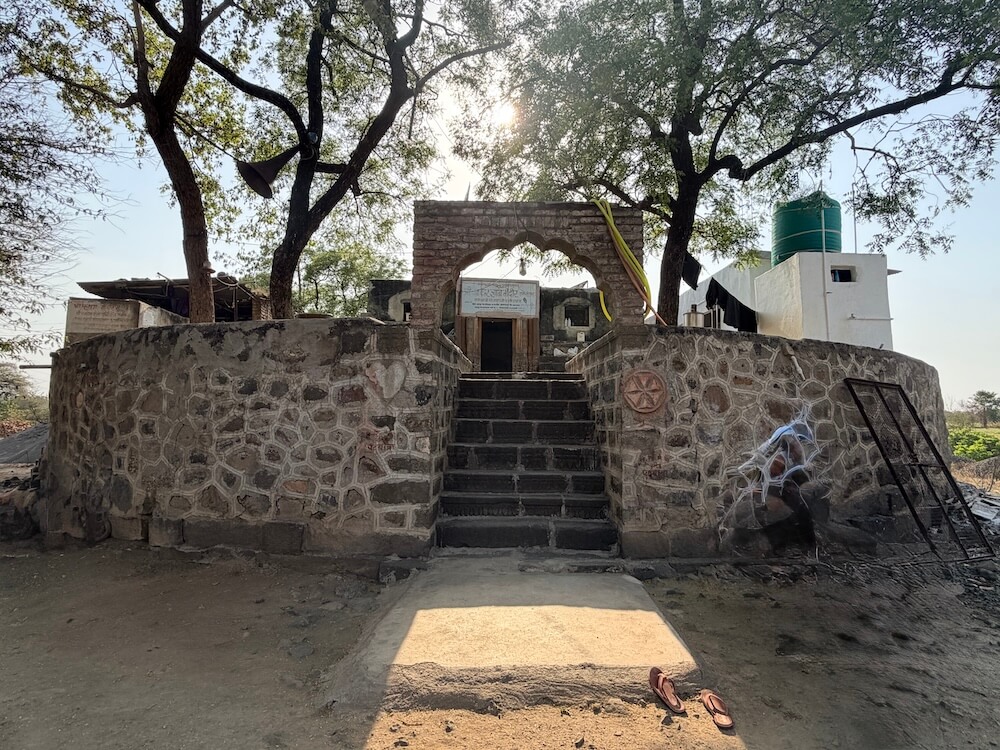
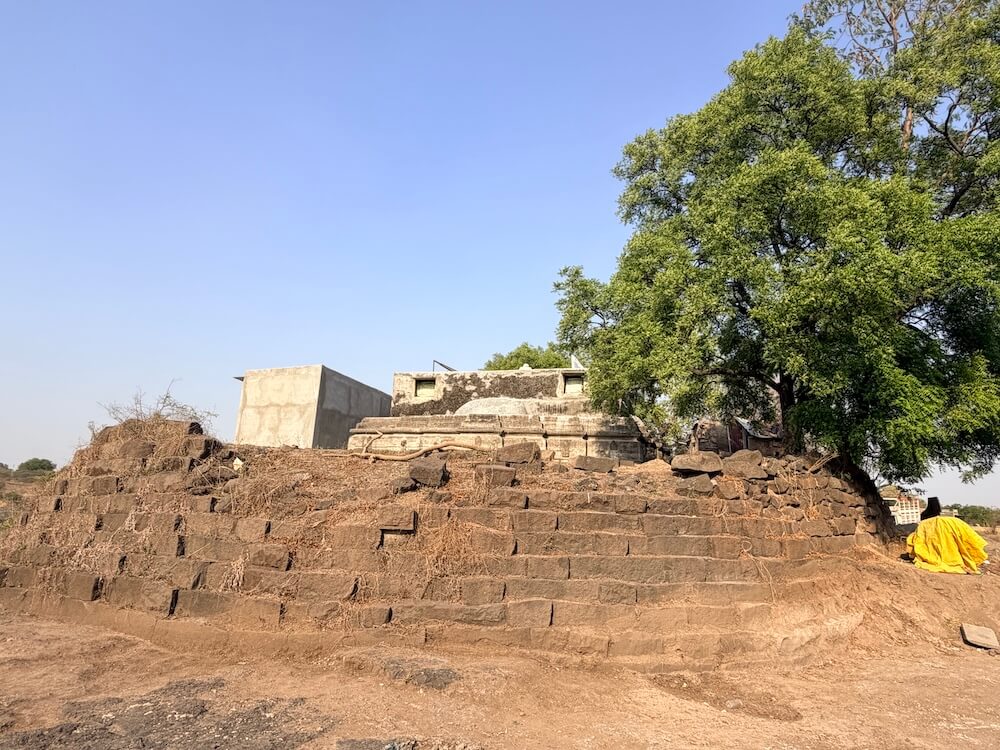
This temple is situated on the bank of the Khelna River, near Bhokardan village. In front of the temple, there is a spacious parking area for devotees’ vehicles. There are eight steps leading up to the entrance within the stone-built ramparts surrounding the temple, which is situated on a slight elevation. At the entrance, a welcoming arch with a mihrab-like torana greets the devotees.
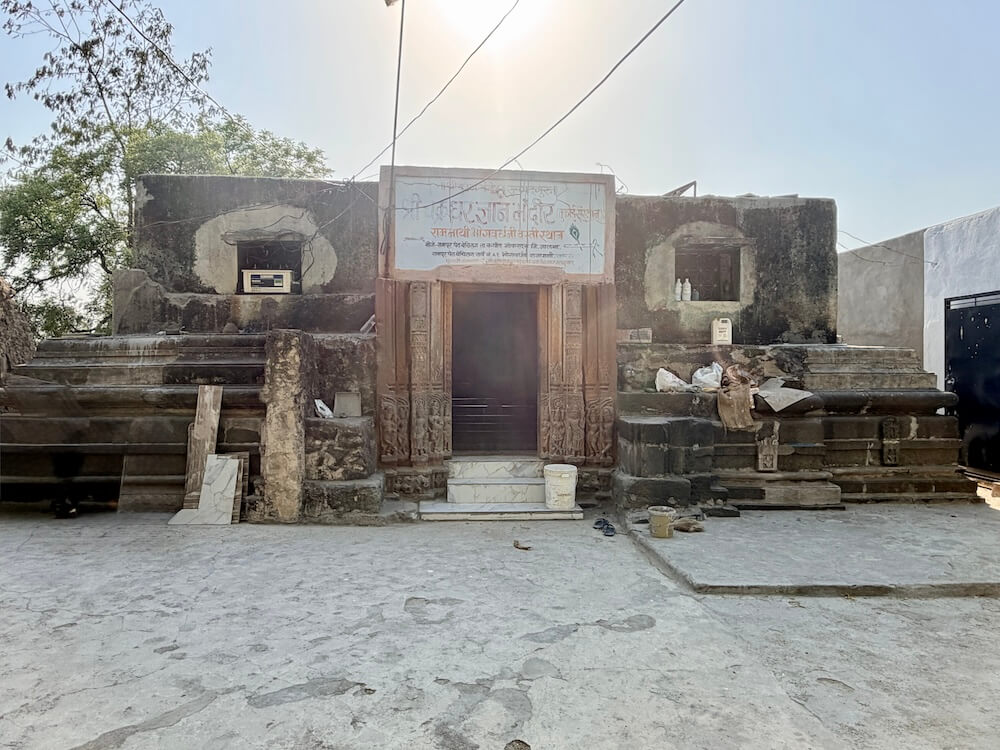
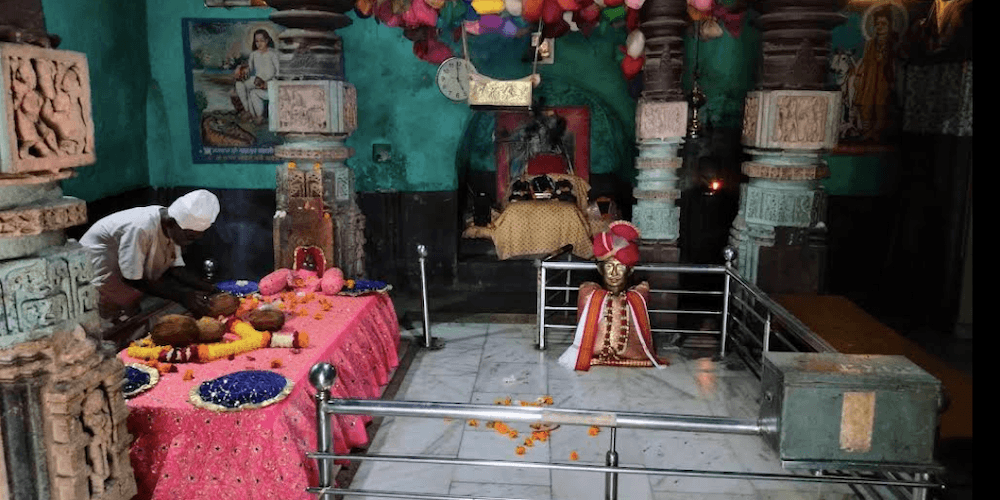
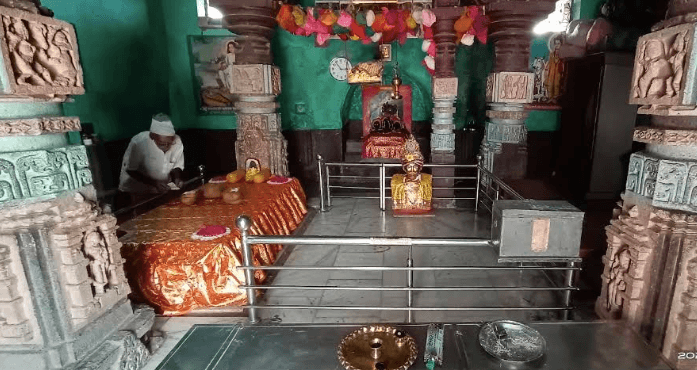
The temple’s structure comprises a sabhamandapa (assembly hall) and a garbhagriha (sanctum sanctorum). Half of the temple’s construction dates back to ancient times, while some parts appear new due to recent renovations. The entrance to the sabhamandapa is slightly elevated from the courtyard. Beautiful sculptures of dwarapalas (gatekeepers), Ganga, Yamuna, and Yakshas are carved on the five-branched entrance of the sabhamandapa. Various types of ornate doorframes, such as parnashakha (leaf branches), pushpashakha (flower branches), and stambhashakha (pillar branches), can be seen at this entrance. At the lower part of these doorframes, animal sculptures of gajaraja (elephants) and ashvaraja (horses) are carved. This sabhamandapa of the temple is enclosed. In its centre stand four ornate stone pillars. On the shafts of all four of these pillars, which stand on strong pillar bases, various geometric shapes such as squares, circles, hexagons, and octagons are carved. Diverse deities, surasundaris (celestial beauties), and composite designs are found carved on these pillar shafts. On the square panels of the pillars, sculptures depicting various mythological episodes from the Ramayana are meticulously portrayed. These include Lord Shri Rama aiming an arrow at the demon Maricha, the scene of the battle between Vali and Sugriva, Ravana setting Hanuman’s tail ablaze, the historic meeting of Hanuman and Shri Rama, and sculptures depicting scenes such as Shri Rama, Lakshmana, Janaki, and Hanuman seated in the royal court. At the top of the pillars are kani (brackets) and hastas (hands). Sculptures of nagaphani (cobra hoods) are carved on these hastas. An octagonal ceiling rests on the beam supported by these hastas, and a swing is suspended from it. In the sabhamandapa, Chakradhar Swami’s charanankit sthana, meaning the place sanctified by the touch of his feet, is preserved. Beside this spot is a brass idol of Swami. Beyond the sabhamandapa is the garbhagriha of the temple. On a vajra-pitha (diamond throne) within this garbhagriha, idols of Shri Krishna and other deities of the Mahanubhav sect are consecrated. Windows are provided in this enclosed sabhamandapa for light and ventilation.
Shri Krishna Janmotsav is considered the most important festival in this Dnyanmandir. During this festival, the utsava-murti (processional idol) of Shri Krishna is placed in the swing in the sabhamandapa, and the Shri Krishna Janma ceremony is celebrated with great enthusiasm. Precisely at midnight, the swing is ritually worshipped, and prasad is distributed to all the assembled devotees. On the second day of the festival, Dahi Handi is broken, and a grand feast of Kalya Mahaprasad is organised. Chakradhar Swami’s Jayanti Utsav is also celebrated with devotion in this temple. Additionally, festivals such as Dattatreya Jayanti, Akshaya Tritiya, Dussehra, and Diwali are celebrated. During festival days, continuous recitations of the Mahanubhav sect’s scriptures, ‘Lilacharitra’ and ‘Bhagavad Gita’, are performed in the temple. During this period, bhajans and kirtans of Chakradhar Swami are sung in the temple. On the occasion of all major festivals, Mahaprasad is organised on a large scale in the temple. On every Thursday, Ekadashi, Purnima, and Amavasya, there is a crowd of devotees coming for darshan at the temple. This temple is open to devotees from six o’clock in the morning to nine o’clock at night.
This sacred temple stands as a testament to deep spiritual devotion, ancient architectural grandeur, and rich local cultural traditions.
The sanctum sanctorum houses the divine idol consecrated according to ancient Vedic traditions, surrounded by serene courtyards and traditional temple architecture.
Navratri, Maha Shivratri, Annual Temple Jatra & Deepotsav
Compare and book flights, secure top-rated local hotels near the temple, hire reliable guides, and rent cars instantly.
Extend your pilgrimage by visiting other highly sacred temples located nearby.


Add ₹999 more to unlock FREE SHIPPING!
Your sacred cart is currently empty.
Shop Photo FramesFill in your delivery details below to place your order.
Add comment