
Add ₹999 more to unlock FREE SHIPPING!
Your sacred cart is currently empty.
Shop Photo FramesThere are three categories of revered deities: Vedic deities, Puranic deities, and historical deities. The fascinating legends surrounding these deities often arise from folklore or the miraculous deification of history. Most of these legends serve to highlight their deeds. The category of historical deities includes the siblings Jakamma and Daridev, members of a royal family who sacrificed their lives for the sake of peace. The temple of Jakamma Devi is located in Maharashtra (Muchandi, Tal. Jat), while the temple of Daridev is in Karnataka (Kanamadi, Tal. Tikota). These two temples are situated 100 meters apart from each other.
The legend regarding these temples states that in ancient times, in a royal family, there were two siblings named Ishwar (Daridev) and Jayanti (Jakamma Devi). As Jayanti was peace-loving, she was against war. Therefore, she had taken a vow from her brother never to engage in war. For the sake of his sister’s vow, he established friendly relations with neighboring kings. However, once, a neighboring king attacked King Ishwar. To retaliate, Ishwar had to wage war. He emerged victorious in the battle. But, feeling deeply saddened that her brother had broken the vow given to her, Jakamma took *Jalasamadhi* (submerged herself in water). The Jakamma Devi temple is located at this very spot. Grieved by the loss of his sister, Ishwar rode his horse into the opposite mountain and disappeared into the valley (*dari*). Because of this, he came to be known as Daridev.
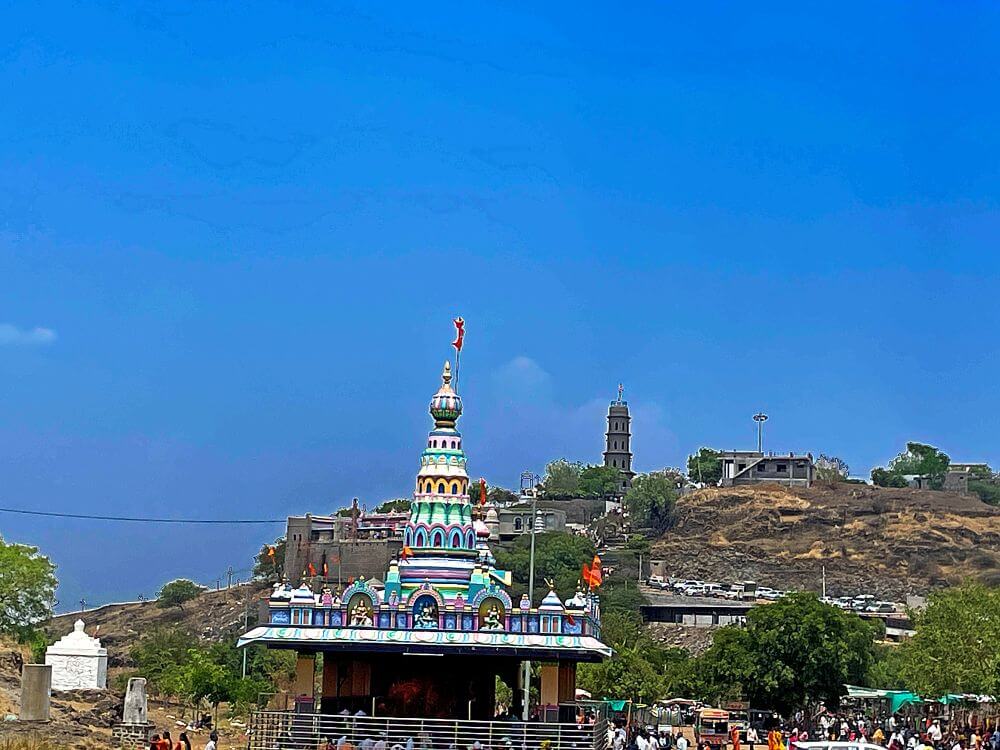
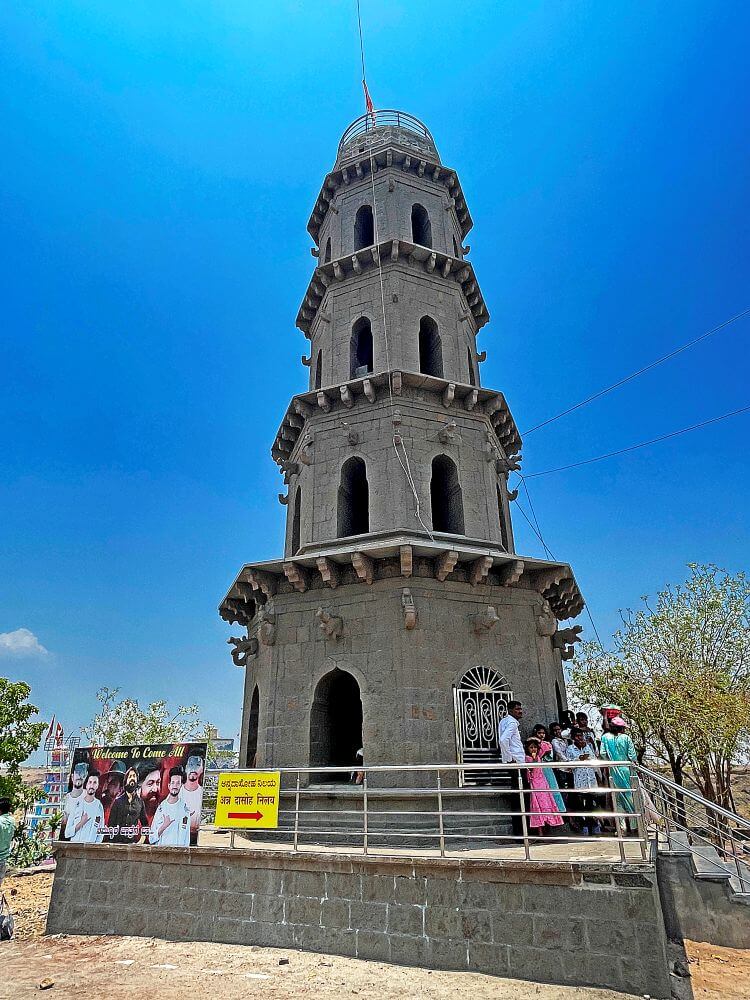
The temples of Jakamma Devi and Daridev date back to the post-Bahmani era, approximately 400 years ago. It is said that Narayan Savkar, a gold and silver merchant from Pune, built these temples after his prayers were answered. A river flows near the Jakamma Devi temple at the foothills. There is a spacious parking lot in front of the temple and shops selling worship materials in the vicinity. As one proceeds from here towards the temple, there is a platform in the paved courtyard with a stone *Deepmal* (lamp tower) about thirty feet high.
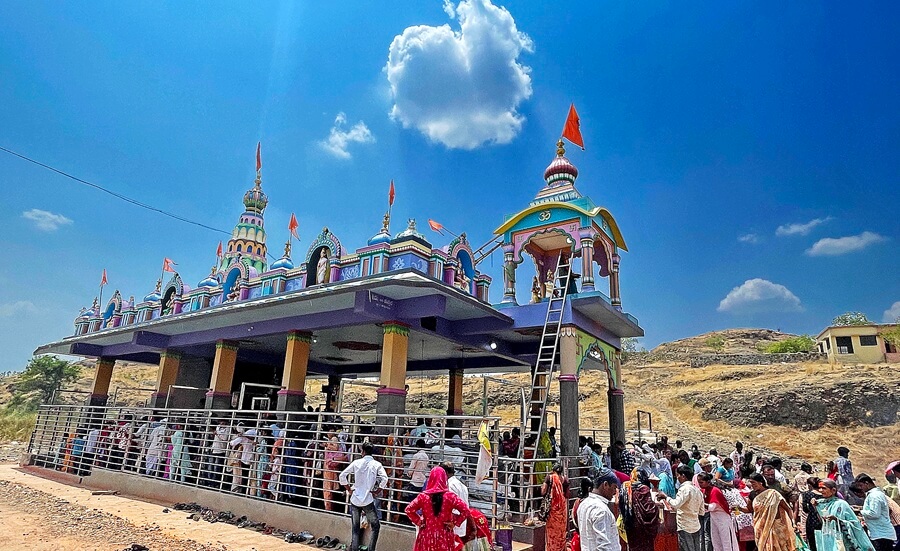
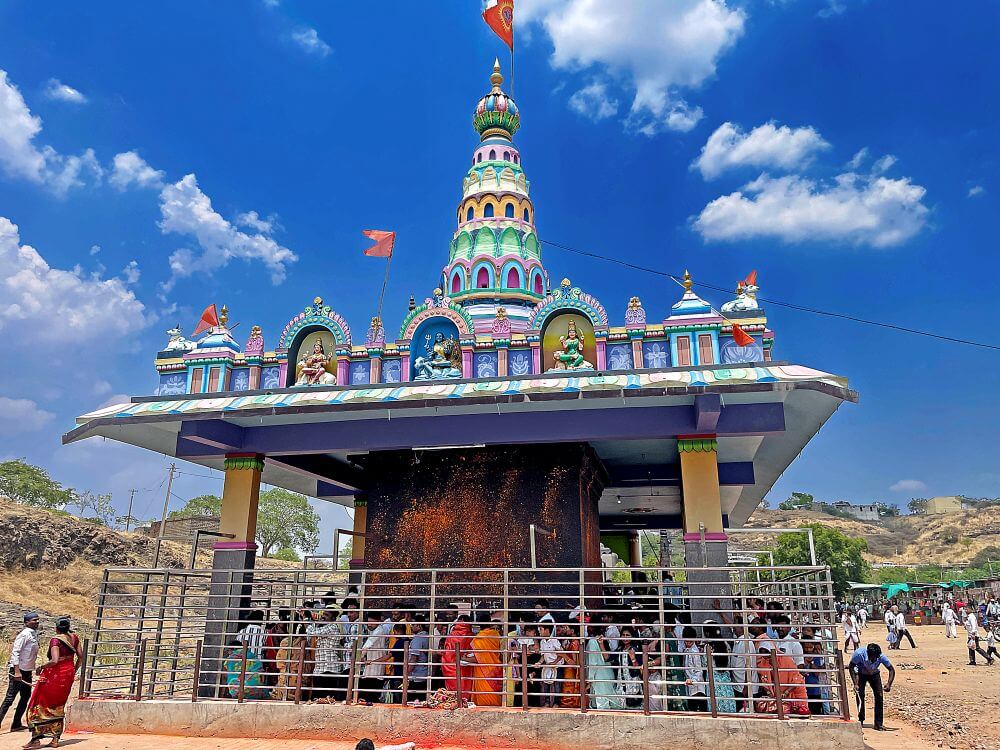
The structure of the Jakamma Devi temple consists of a *Mukhamandapa* (front porch), *Sabhamandapa* (main hall), and *Garbhagriha* (sanctum sanctorum). The *Mukhamandapa* and *Sabhamandapa* were built in recent times, while the *Garbhagriha* is ancient. The *Mukhamandapa* features two circular, ornate pillars connected by an arched lintel, supporting the roof. On the roof of the *Mukhamandapa*, there is a *Meghadambari* (canopy) with four ornate pillars, a *Shikhara* (spire), and a *Kalash* (finial), housing the idol of Jakamma Devi.
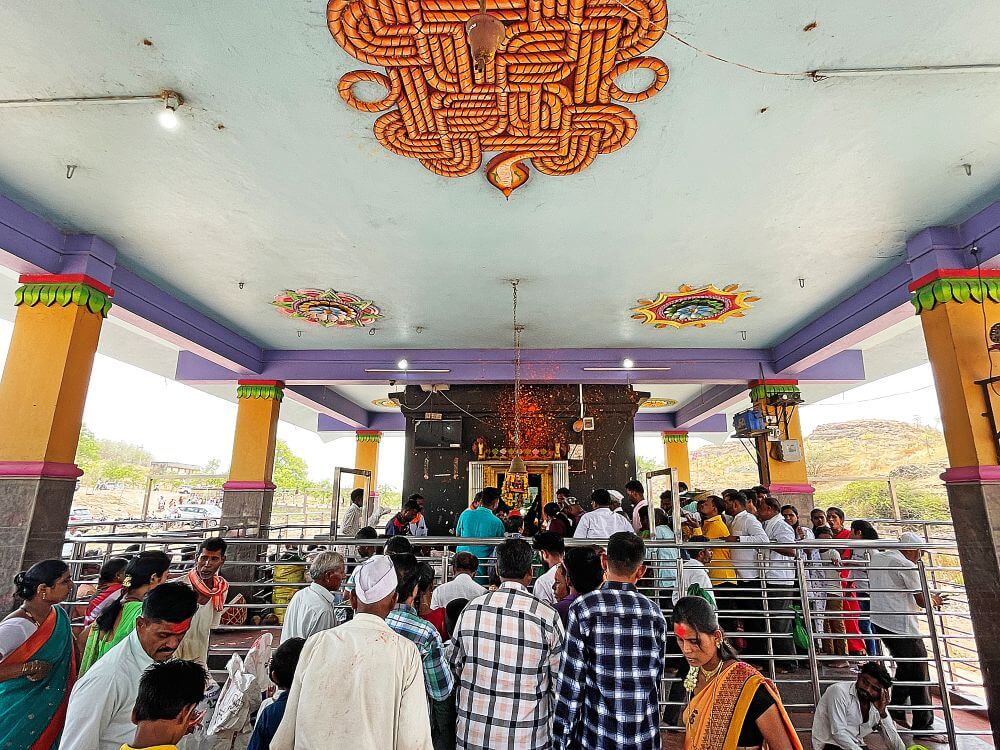
The open-style *Sabhamandapa* of the temple has ten square, ornate pillars supporting the roof. The ceiling is decorated with lotus flower motifs. Brass bells and cradles offered as vows are hung from the ceiling. All pillars are connected to each other by arched lintels. Stainless steel railings have been installed around the *Sabhamandapa* to manage the *darshan* queue in such a way that one first circumambulates the *Garbhagriha* before arriving in front of the entrance for *darshan*. On the door jambs, at the bottom, are the four-armed Bhairava *Dwarapalas* (gatekeepers), with floral and creeper carvings above, and an idol of Lord Ganesha at the *Lalatbimba* (center of the lintel). The *Torana* (arch) features horse-head sculptures on both sides and floral carvings in the center. The *Mandarka* (ceiling panel) features lotus flower carvings. The idol of Jakamma Devi is placed on a *Vajrapitha* (diamond pedestal) inside the *Garbhagriha*.
The ceiling of the *Sabhamandapa* has a *Bashingi* (ornamental) railing on all four sides. The niches within it contain idols of various deities. The roof of the *Garbhagriha* has a five-tiered circular *Shikhara* that tapers towards the top. It also features niches containing idols of various deities. At the apex of the *Shikhara* is an *Amalaka* topped with a *Kalash*. There is a bridge to cross the riverbed on the road leading from the Jakamma Devi temple to the Daridev temple. The temple on the hilltop has a fort-like fortification from the foothills. The fortification includes a two-story entrance gate about forty feet high. On the upper floor of the entrance is a *Nagarkhana* (drum house), and its roof features animal sculptures at all four corners. In the center is a dome-shaped *Shikhara* with a *Kalash* atop its *Amalaka*. This temple bears the imprint of Bahmani-era architecture.
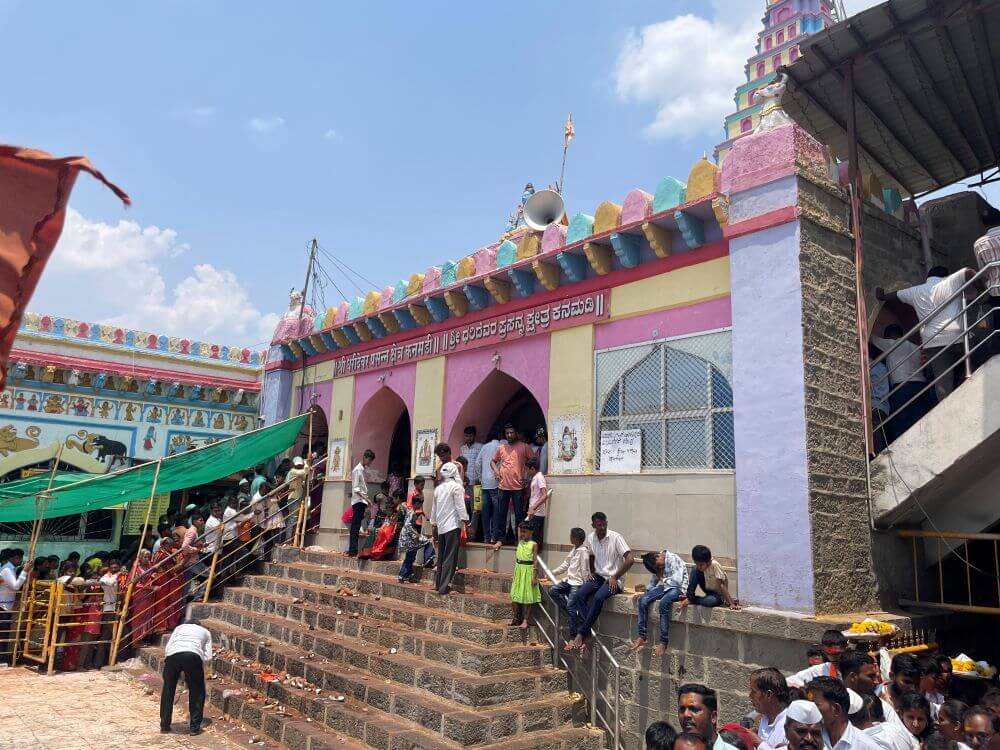
There are about 135 steps built of carved stone from the foothills to the temple. Vows are made to break a coconut on each of these steps. In front of the Daridev temple, there is a *Sabhamandapa* with four pillars. Inside the *Sabhamandapa*, in front of the entrance to the *Antarala* (vestibule), is a brass horse. The front wall of the *Antarala* is covered with gold plating, featuring *Dwarapala* sculptures and other carvings. Beyond the *Antarala* is the *Garbhagriha*, and it is said that the back wall of the *Garbhagriha* represents the back of the deity. Legend has it that Daridev disappeared into the valley through this very wall. Here, the back of the deity is worshipped. The deity’s mask is kept in a *Makhar* (shrine). On the *Vajrapitha*, there is a golden idol of the deity riding a horse on the right and a silver idol riding a horse on the left. A five-hooded serpent holds a canopy over the golden idol. The deity is adorned with fine garments and ornaments.
In front of the temple is the *Samadhi* shrine of Narayan Sonar, who built this temple. There are many buildings in the temple courtyard. They are used as *Bhaktaniwas* (pilgrim lodging), *Dharmashala* (rest house), and shelter rooms. In the courtyard, there is a four-story watchtower about sixty feet high on a platform.
An eight-day annual fair is celebrated in the Jakamma and Daridev temples from *Chaitra Purnima* to *Chaitra Vadya Ashtami*. During this time, the *Palkhi* (palanquin) procession of the deities from both temples is celebrated amidst the sound of drums and the throwing of *Gulal*. During the fair, thousands of devotees from Maharashtra, Andhra Pradesh, and Karnataka come for *darshan* and to fulfill their vows.
This sacred temple stands as a testament to deep spiritual devotion, ancient architectural grandeur, and rich local cultural traditions.
The sanctum sanctorum houses the divine idol consecrated according to ancient Vedic traditions, surrounded by serene courtyards and traditional temple architecture.
Navratri, Maha Shivratri, Annual Temple Jatra & Deepotsav
Compare and book flights, secure top-rated local hotels near the temple, hire reliable guides, and rent cars instantly.
Extend your pilgrimage by visiting other highly sacred temples located nearby.


Add ₹999 more to unlock FREE SHIPPING!
Your sacred cart is currently empty.
Shop Photo FramesFill in your delivery details below to place your order.
Add comment