
Add ₹999 more to unlock FREE SHIPPING!
Your sacred cart is currently empty.
Shop Photo FramesVakhari is the village where all the palkhis (palanquins) coming to Pandharpur for Ashadhi and Kartiki Ekadashi have their final halting place, and where the final ringan ceremony takes place. Situated near the holy pilgrimage town of Pandharpur, this village is home to many spiritual sites. The Lakshmandas Maharaj Temple is one of the most uniquely revered shrines among them. Lakshmandas Maharaj was a saint of the Warkari sampradaya belonging to the nineteenth century. His samadhi shrine at Vakhari, along with the temples of Ganpati and Dattapaduka established by him, are places of profound reverence for countless devotees.
The village of Vakhari has a history dating back to prehistoric times. The great researcher Damodar Dharanand Kosambi stated in his book ‘Myths and Reality’ that the origins of the annual pilgrimages to Pandharpur must lie in a pre-agricultural society. In prehistoric times, Vakhari was the final destination of this pilgrimage. Over time, this pilgrimage acquired the hues of devotion to Lord Vitthal. The current form of the Pandharpur wari palkhi procession was attained in the nineteenth century. In the year 1832 AD, the great Vitthal devotee Haibatbaba Arfalkar gave a disciplined structure to the palkhi wari. The palkhis coming from across Maharashtra still gather first at Vakhari. Prayers and worship are offered here, followed by a grand ringan ceremony. Thus, Vakhari holds an important place in the pilgrimage festivities of Pandharpuri.
Lakshmandas Maharaj arrived in this village in the early nineteenth century. The Bairagi lineage of the Maharaj originally hailed from Satara. His father’s name was Tulsidas. This family was associated with the Nimbark sampradaya. Nimbark is a sect within the Vaishnava tradition that follows the philosophy of Dvaitadvaita (dualism-non-dualism). Known by names such as Kumar, Hansa, and Sanakadi, the founder of this sampradaya, Nimbark, was a Telugu Brahmin. Scholars do not have a unanimous consensus regarding his era; it is believed that he lived between the seventh and eleventh centuries. Lakshmandas Maharaj inherited the Vaishnava devotion of Nimbark from his family. It is said about him that he was Ajandubahu (whose arms reached down to his knees). His attire consisted solely of a pancha around his waist and an uparna (stole) on his shoulders. He spoke with a slight stutter. On rare occasions, he would partake in food. In accordance with his guru’s instructions, he came and settled in Vakhari, residing here in a leaf-hut. Every day, waking up early in the morning, he would go to Pandharpur for the darshan of Lord Vitthal.
It is said that Shahu Maharaj granted him a large plot of land in Vakhari. This 45-acre land is known as ‘Maharajancha Mala’ (the Maharaj’s orchard). This site features a well dug by the Maharaj, along with a right-trunked Ganpati idol and the padukas of Dattatreya established by him. It is also believed that Lakshmandas Maharaj had received the grace (anugraha) of Lord Dattatreya.
Lakshmandas Maharaj attained Samadhi on Jyeshtha Shukla Dwitiya, Shake 1829, corresponding to 1907 AD. It is said that Brahmachaitanya Gondavlekar Maharaj from Gondavali was present at his funeral procession. There is a legend about the Maharaj that he kept a cow and would never partake in food without first feeding her grass. After the Maharaj passed away, this cow let out a loud bellow, participated in the funeral procession, and breathed her last on the very same day the Maharaj passed away. A memorial dedicated to this cow is located near the Samadhi temple of the Maharaj.
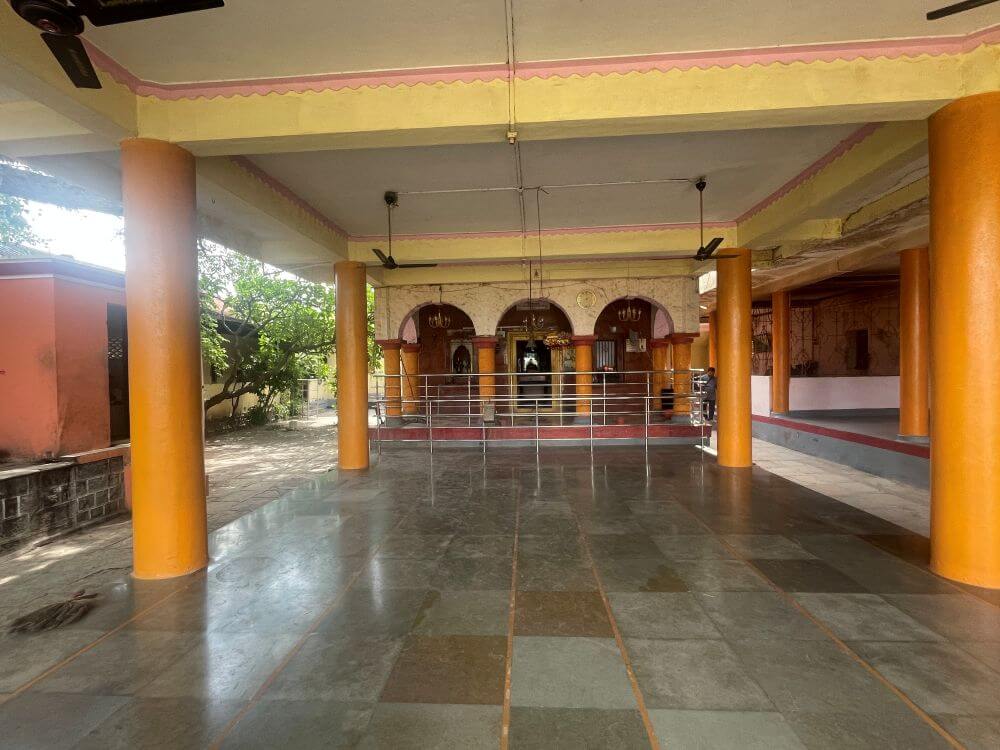
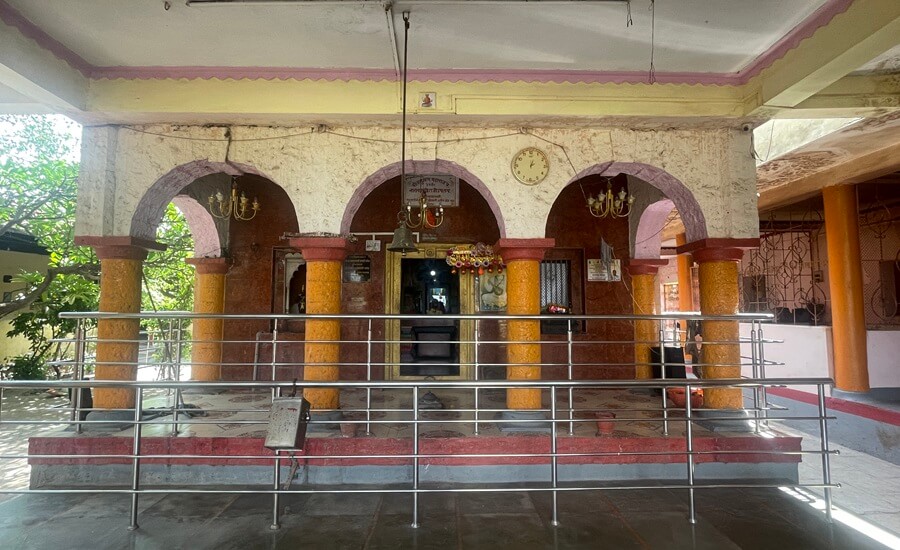
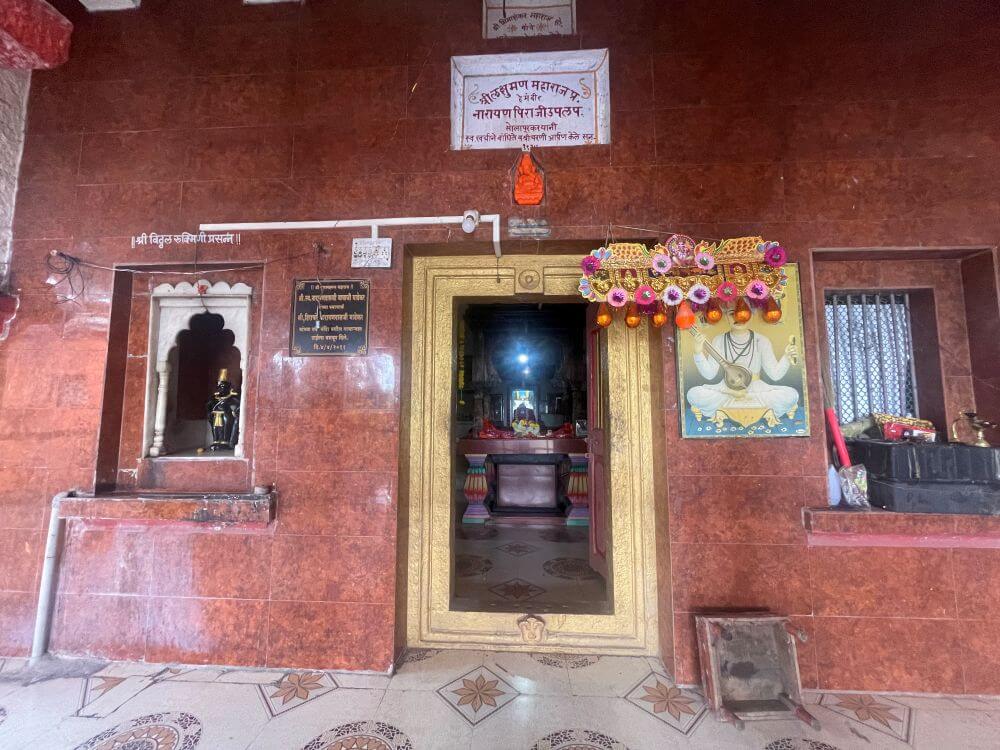
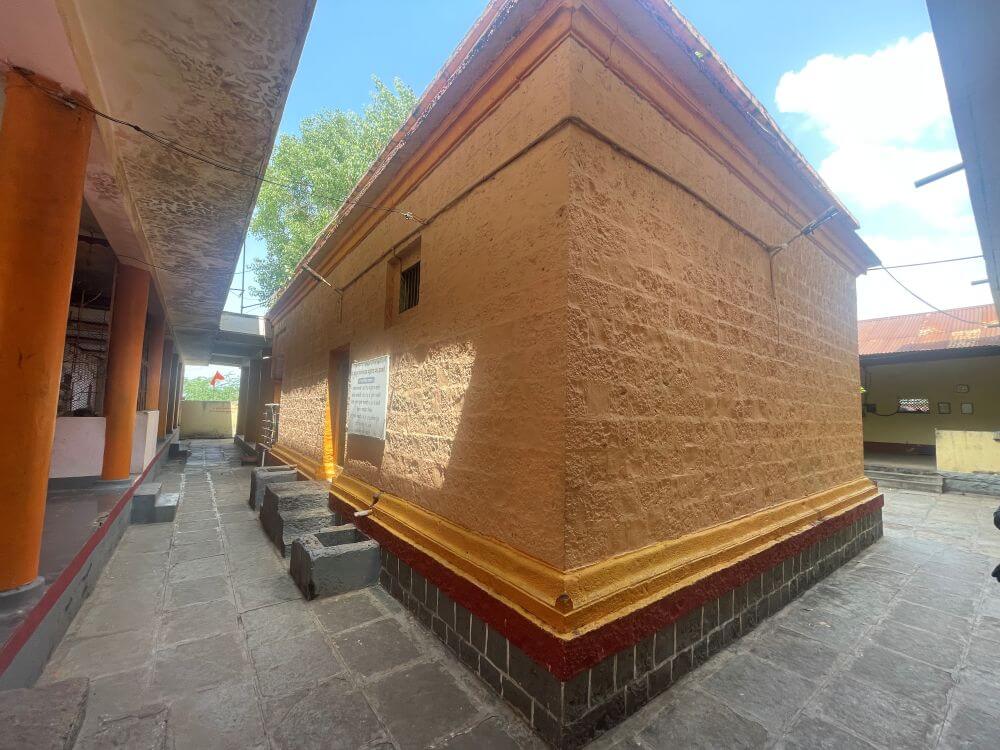
Centrally located in Vakhari, this temple is enclosed by a boundary wall. One enters the temple courtyard through the gateway in this wall. Along the inner side of the fortification wall in the courtyard are verandahs (ovaryas) which are used as bhakta niwas (devotee lodgings) and dharmashala. The architectural structure of this Samadhi temple consists of a sabhamandap (assembly hall), an antarala (vestibule), and a garbhagriha (sanctum sanctorum). The sabhamandap has four circular pillars on each side. Further ahead, in front of the antarala which is at a higher elevation than the sabhamandap, there is a stainless steel safety railing. There are circular pillars connected to each other by semi-circular arches. In the antarala, on the floor, there is a tortoise sculpture (kasav shilp), followed by a serpent sculpture (naga shilp) holding up the tortoise’s mouth. In the antarala, on the front wall of the garbhagriha to the left of the entrance, there are idols of Vitthal-Rakhumai in a devakoshta (wall niche).
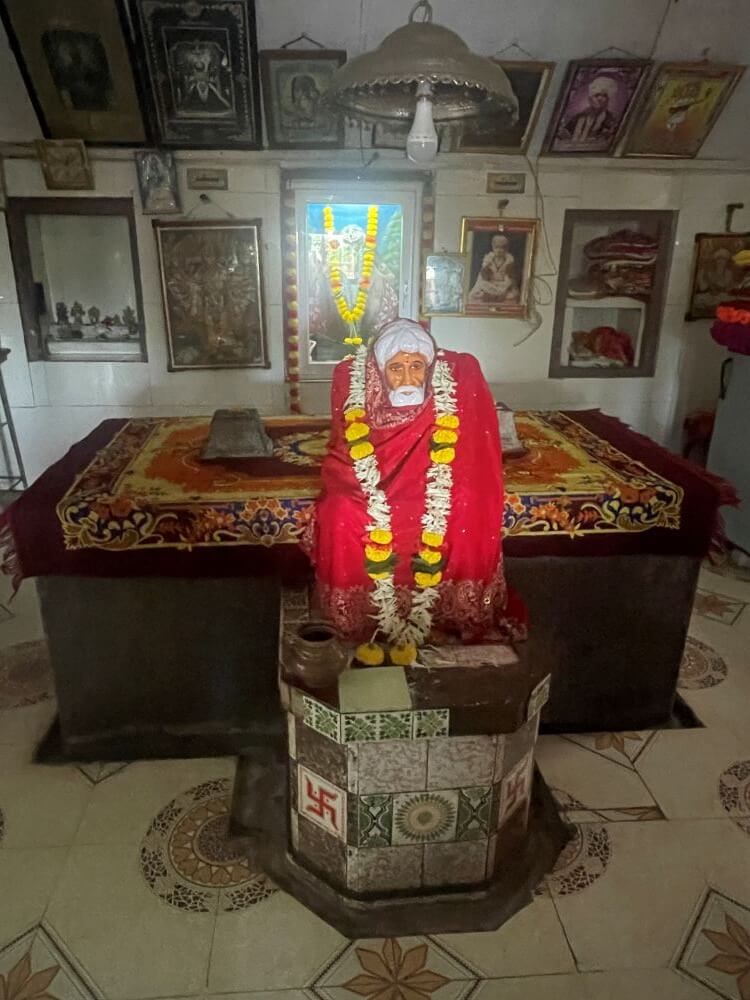
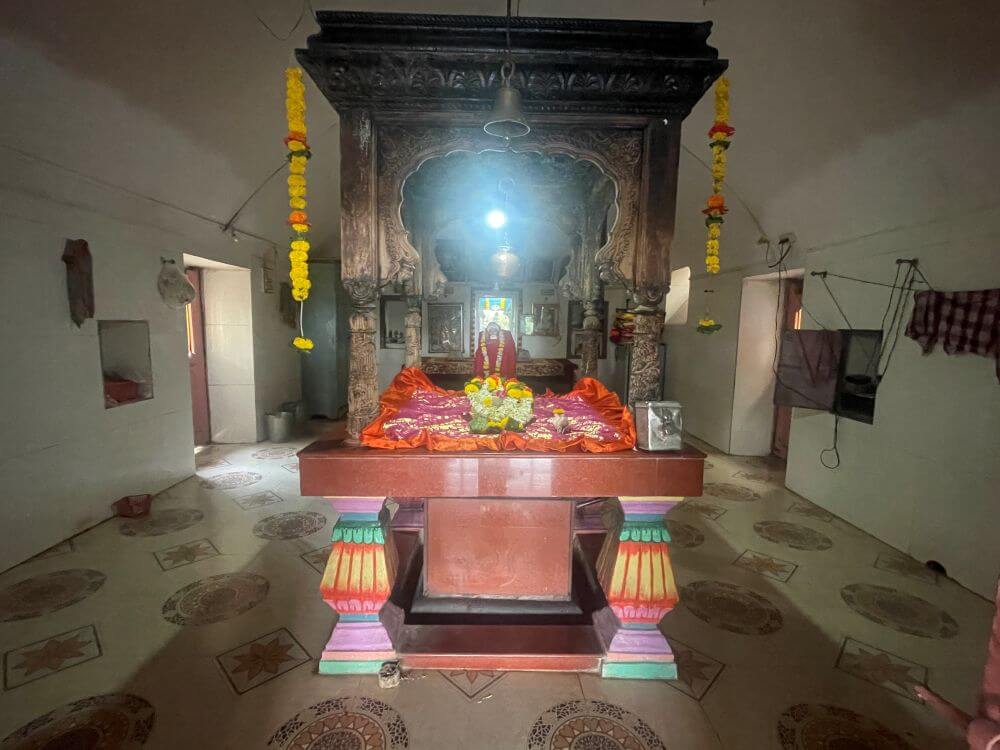
The door frames (dwarashakha) of the garbhagriha feature vertical stripe carvings, and the lalatbimba (central lintel piece) features a chakra design. There is a Kirtimukha on the mandaraka (threshold block). Directly opposite the entrance inside the garbhagriha is the samadhi pedestal (chauthara). In the center of the pedestal is the shirpashan (headstone), and at all four corners are ornamented pillars connected to each other by arched brackets. Behind the pedestal, on a vajrapitha, is the meditative idol of Lakshmana Maharaj. Behind this idol is another samadhi pedestal bearing two headstones. There are doors on the left and right sides to exit the garbhagriha. In a small temple situated in front of this main temple, there are idols of Narasimha tearing apart the belly of Hiranyakashipu and Sri Dattatreya.
Every Thursday, rituals including Abhishek in the morning, Pravachan in the afternoon, and Haripath along with Aarti in the evening are held here. Festivals such as Datta Jayanti, Janmashtami, Narasimha Jayanti, as well as the Punyatithi (death anniversary) of the Maharaj, are celebrated at the temple. During these times, devotees flock from cities such as Pandharpur, Mumbai, Pune, and Nagpur. Mahaprasad is served here during the festival periods. Special kirtan saptahas are organized here during the Ashadhi and Kartiki Wari seasons.
Various social welfare activities are undertaken under the auspices of the Lakshman Maharaj Temple Trust. Food distribution (annadan) for the poor and needy, distribution of notebooks for students, health camps, and relief work during natural calamities are regularly carried out.
This sacred temple stands as a testament to deep spiritual devotion, ancient architectural grandeur, and rich local cultural traditions.
The sanctum sanctorum houses the divine idol consecrated according to ancient Vedic traditions, surrounded by serene courtyards and traditional temple architecture.
Navratri, Maha Shivratri, Annual Temple Jatra & Deepotsav
Compare and book flights, secure top-rated local hotels near the temple, hire reliable guides, and rent cars instantly.
Extend your pilgrimage by visiting other highly sacred temples located nearby.


Add ₹999 more to unlock FREE SHIPPING!
Your sacred cart is currently empty.
Shop Photo FramesFill in your delivery details below to place your order.
Add comment