
Add ₹999 more to unlock FREE SHIPPING!
Your sacred cart is currently empty.
Shop Photo FramesMarathwada holds a unique place on the rich cultural and spiritual map of the state of Maharashtra. Known as the land of saints and sages, this region is dotted with many ancient temples that bear witness to the history and advanced architecture of their time, alongside their religious significance. One such temple is situated in the village of Gangamasla in Majalgaon taluka, nestled within the riverbed of the Godavari. This temple at Gangamasla is known as the ‘Prati Moreshwar Temple’ (Replica Moreshwar Temple) due to its name and mythological resemblance to Mayureshwar, the primary seat among the Ashtavinayakas located in Morgaon, Pune district.
The legend of Moreshwar Ganpati states that in ancient times, a demon named Sindhu wreaked havoc on Earth. When this suffering reached the devotees and even the gods, they all prayed to Ganpati. Ganpati mounted a peacock and slayed the demon Sindhu, which is why this Ganpati came to be known as Moreshwar. There are many temples of this Moreshwar across the country. Another name for this Ganesha is Bhalchandra. It is believed that the Moon performed penance here to please Ganesha and established Him at this site, which is why He is called Bhalchandra.
Ganpati is the family deity of the Peshwas. Haripant Phadke was a highly astute politician and a brave general during the Peshwa era. He was considered the right-hand man of Nana Fadnavis and played a major role in organizing the Maratha Empire. Haripant Phadke himself was a great devotee of Ganesha. Many temples in Maharashtra bear witness to his devotion. Historical evidence confirms that he built the Phadke Ganpati temple in Raviwar Peth, Pune, and the assembly hall (sabhamandap) and drum house (nagarkhana) of the Siddhtek temple, one of the Ashtavinayakas. While on a campaign in Marathwada or overseeing the administration of this region, he built this temple at this ancient site between the years 1770 and 1790. According to a local legend, while Madhavrao Peshwa was heading to war, his elephant got stuck in the river silt at this spot. He then made a vow to renovate the Moreshwar Ganpati temple located in the riverbed, and his elephant safely emerged from the silt. Consequently, Madhavrao Peshwa built this stone temple in the Maratha architectural style.
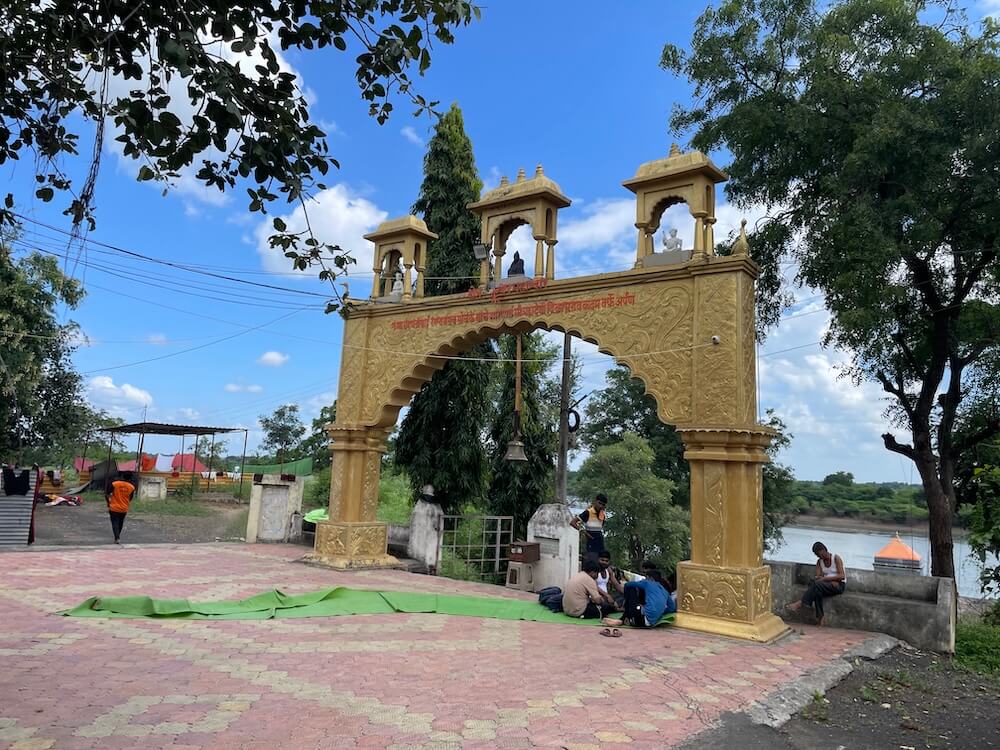
The village of Gangamasla is on the border of Beed and Parbhani districts. The Godavari River flows through a wide channel here, and the temple is situated on a high ground (river island) in the middle of this channel. Near the village, on the banks of the Godavari, is the entrance to the temple. In the courtyard covered with paver blocks in front of the entrance, there are shops selling worship materials and food items. On both sides of the entrance, there are two platforms with ornate pillars. On the balcony of this entrance, there are three arched canopies (meghdambari) containing deity idols. There are peacock sculptures on both sides of the balcony. The entire entrance is covered with metal sheets adorned with floral patterns.
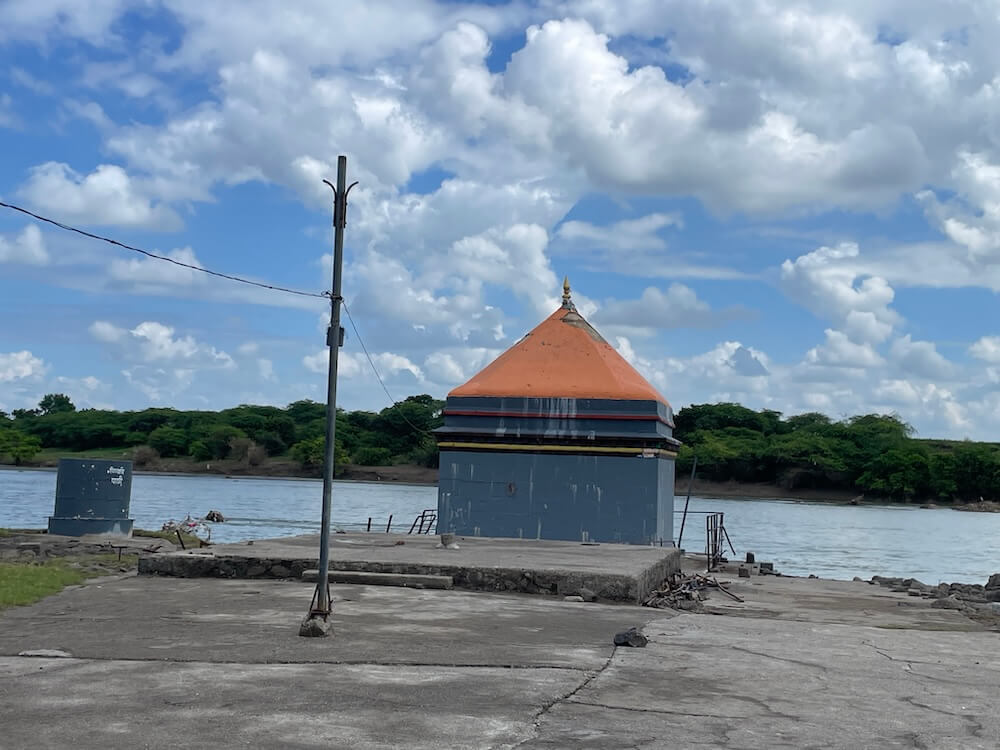
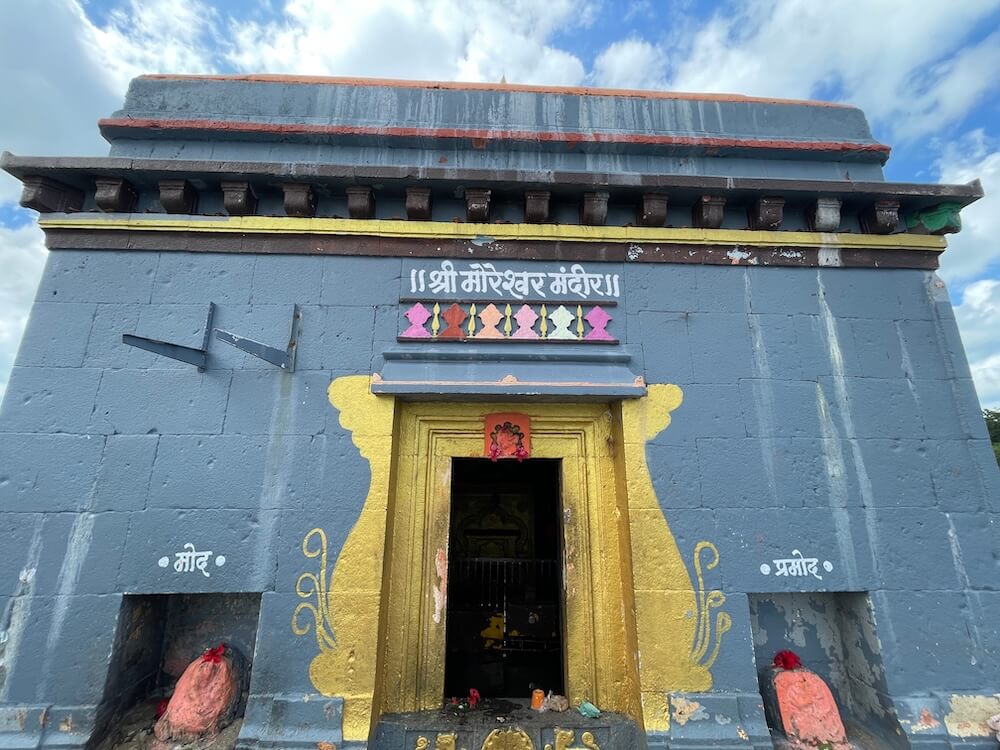
On the path from the entrance to the temple, one must first descend 45 steps and then walk through the riverbed. There are iron safety railings on both sides of the steps. The temple stands on a stone platform. The entrance of the temple faces the riverbed. The platform has about seven steps on the side facing the river. A section of the platform, about five feet wide in front of the entrance, is a few inches deep. In the center here is a tortoise sculpture. In the front wall of the temple, on both sides of the entrance, there are niches containing ancient vermilion-smeared idols. The door frames are carved with vertical patterns, while the lintel features a Ganesha sculpture. The ceiling of the mandapa has a wheel in the center with lion sculptures on both sides.
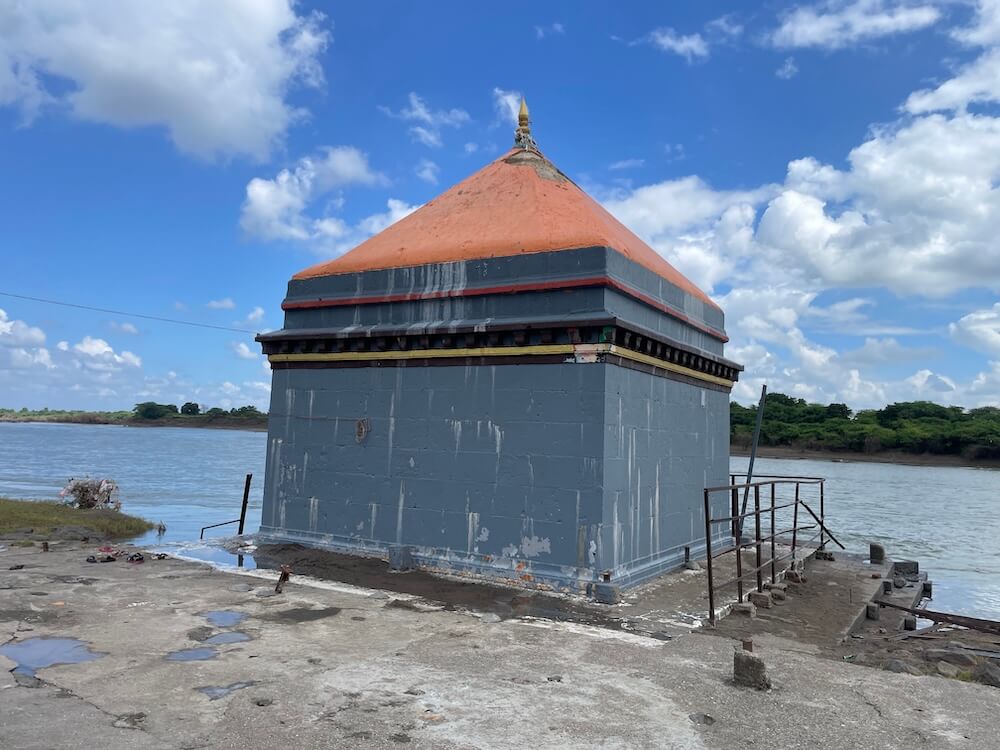
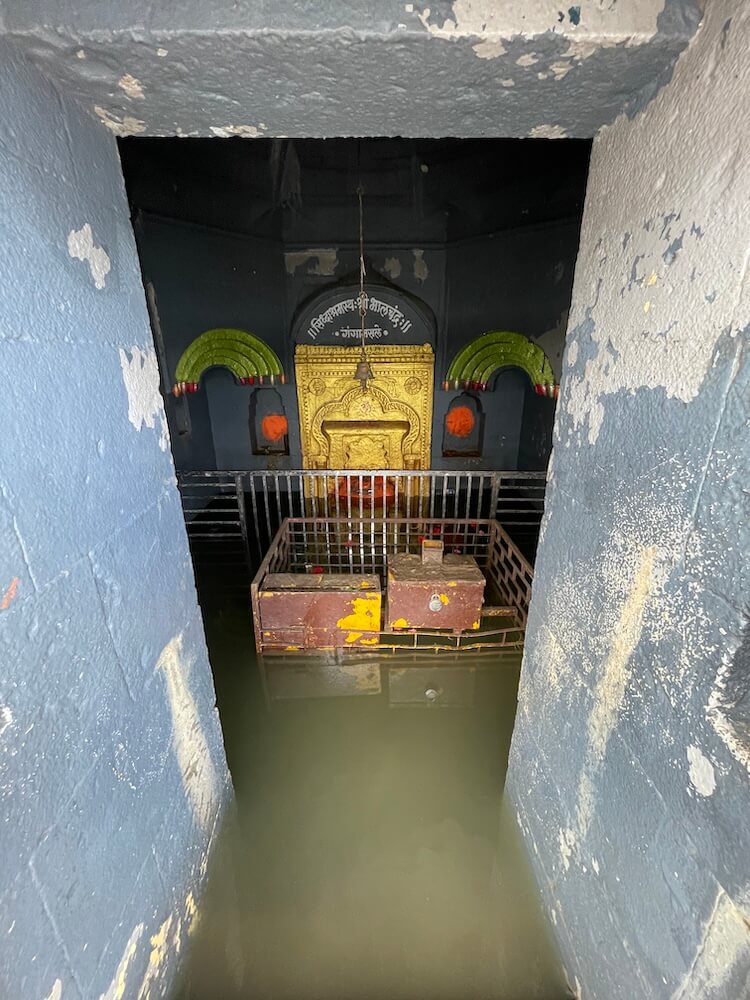
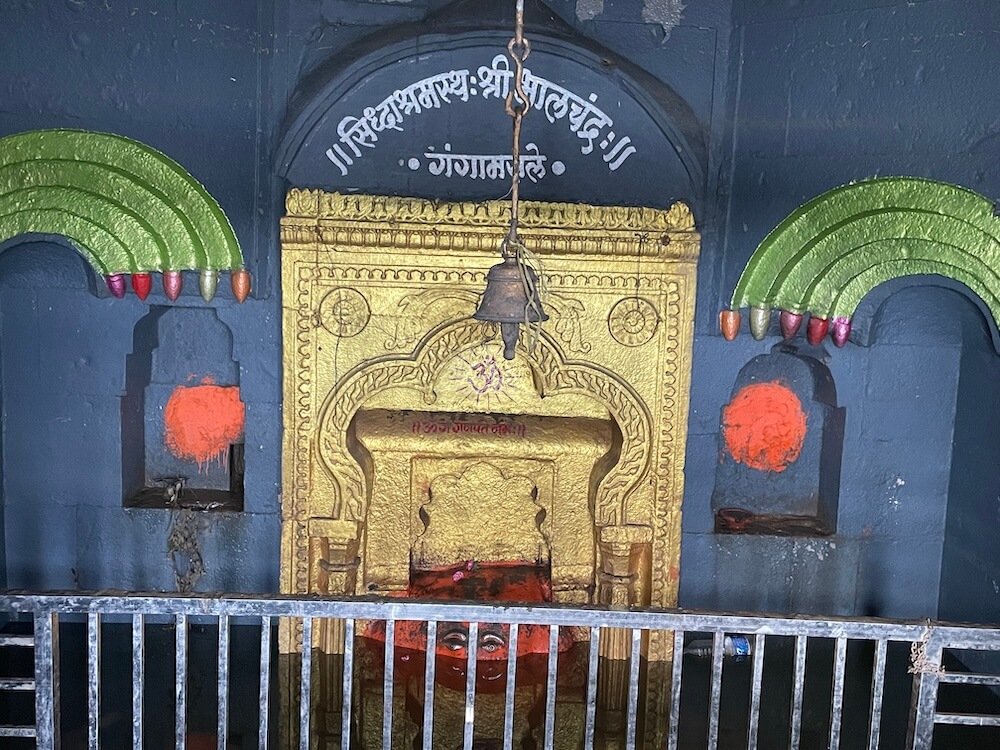
The interior of the temple is deeper than the entrance. There are three steps to descend inside. The temple has niches in all four walls containing idols of various deities. In all four corners of the temple, there are semi-circular small arches. Inside the temple, against the back wall on a vajrapitha (throne), is the self-manifested (swayambhu) stone idol of Ganesha, smeared with vermilion. The eyes, trunk, and the crescent mark on the forehead of the idol are made of silver. This idol is seated in a carved stone archway (makhar). The archway has ornate pillars on both sides and a decorative arch (toran) above. There are wheel patterns in both corners of the toran. The roof of the temple is supported by the walls. This roof is created by circular stones placed one above the other. There is a circular pattern on the ceiling. The temple roof has a square sloping spire (shikhara). The spire is topped with a finial (kalash) and a flag (dhwajapataka).
Many temples in the country are located on the banks of rivers. Building a temple inside the flow of a river, in the middle of the channel, is architecturally a very challenging task. This is the greatest feature of this temple at Gangamasla. This temple is in the middle of the Godavari’s flow. Therefore, when the river floods during the monsoon, the lower part of the temple and often the area up to the sanctum sanctorum go underwater. Yet, this temple has stood firm against natural disasters for many centuries.
On Magh Shuddha Chaturthi, also known as Tilkund Chaturthi, the birth anniversary of Ganesha, or Ganesh Jayanti, is celebrated with great enthusiasm. At this time, thousands of devotees from the surrounding areas come for the darshan of the deity and to fulfill their vows. The temple is illuminated and the premises are decorated for the occasion. Programs such as bhajans, kirtans, music, and mahaprasad are organized in the temple. As long as the riverbed is dry, there is a large crowd of devotees at the temple during Chaturthi, Tuesdays, and other festivals. The riverbed, which is bone-dry in summer, fills up completely in the monsoon, and the temple goes underwater. Therefore, the Ganesh Utsav in the month of Bhadrapada and any Chaturthi or other festivals during the monsoon are not celebrated in the temple.
This sacred temple stands as a testament to deep spiritual devotion, ancient architectural grandeur, and rich local cultural traditions.
The sanctum sanctorum houses the divine idol consecrated according to ancient Vedic traditions, surrounded by serene courtyards and traditional temple architecture.
Navratri, Maha Shivratri, Annual Temple Jatra & Deepotsav
Compare and book flights, secure top-rated local hotels near the temple, hire reliable guides, and rent cars instantly.
Extend your pilgrimage by visiting other highly sacred temples located nearby.


Add ₹999 more to unlock FREE SHIPPING!
Your sacred cart is currently empty.
Shop Photo FramesFill in your delivery details below to place your order.
Add comment