
Add ₹999 more to unlock FREE SHIPPING!
Your sacred cart is currently empty.
Shop Photo FramesIn Hindu Dharma, the worship of celestial bodies and stars holds extraordinary significance. During every auspicious occasion, the Navagrahas are worshipped. Many temples also house a dedicated space for the Navagrahas. Among these planets, the planet Shani holds special importance. The tradition of Shani worship is extremely ancient. Apart from major temples such as Thirunallar in the state of Tamil Nadu, Indore in Madhya Pradesh, Pratapgarh in Uttar Pradesh, and Shani Shingnapur in Maharashtra, there are many ancient and famous Shani temples across the country. One such temple is located in the village of Shanimandal in the Nandurbar district. It is the firm belief of devotees that having darshan here brings an end to the period of Shani Sade Sati.
The legend of the temple states that a discussion on the nine planets was underway among great scholars in the court of the noble Emperor Vikramaditya. When the significance of the planet Saturn was being explained, Vikramaditya mocked Lord Shani. Lord Shani, who was traveling through the sky, heard this and, filled with rage, arrived at the court in his celestial chariot. Saying, “I am entering your zodiac sign,” he departed from there. From that time, the period of Sade Sati began for Vikramaditya. During this period, Vikramaditya once came to the market in Ujjain to purchase horses. At that time, Shani Dev appeared before him in the guise of a horse trader. The horse with the trader
Liking it, he asked for the price. At that moment, the seller said, “First sit on the horse and see, then pay the price.” As soon as Vikramaditya sat on it, the horse departed from there at the speed of wind. It brought the king to a dense forest in this region and left him there, then vanished. Because of this, Vikramaditya had to spend the night in the dreadful forest. At that time, he realized that the wrath of Shani Dev had begun.
After somehow carving a path through the dense forest, Vikramaditya arrived at the village where the temple is currently situated and began working in a shop. Even there, he was falsely accused of stealing a pearl necklace belonging to the shopkeeper’s daughter. Consequently, King Chandrasena of that region punished Vikramaditya by severing his hands and feet. Even in that condition, he began working at an oil mill. Vikramaditya was a master of music. Once, in the middle of the night, Vikramaditya, lying motionless in the darkness, sang the Deep Raga, which caused all the lamps in the kingdom to light up. When King Chandrasena’s daughter learned of this, she expressed her desire to marry Vikramaditya. She was willing to marry him even though he lacked hands and feet. During that time, as Vikramaditya’s period of Sade Sati was coming to an end, Lord Shani Dev was pleased and asked Vikramaditya to seek a boon. At that moment, Vikramaditya requested that He should never inflict such suffering on anyone else in the future, and further requested Him to stay right there so that devotees could have His darshan. Lord Shani Dev restored the King’s body to its original state and returned his glory to him. Accepting Vikramaditya’s request, Lord Shani Dev agreed to reside there. Due to the presence of Lord Shani Dev, this village came to be known as Shani Mandhal. Over time, a Shani temple was built at this location. It is believed that having darshan here ends the Sade Sati of Shani, which is why this temple is known as Sade Sati Muktidham. It is known as a ‘Shaktipeeth’.
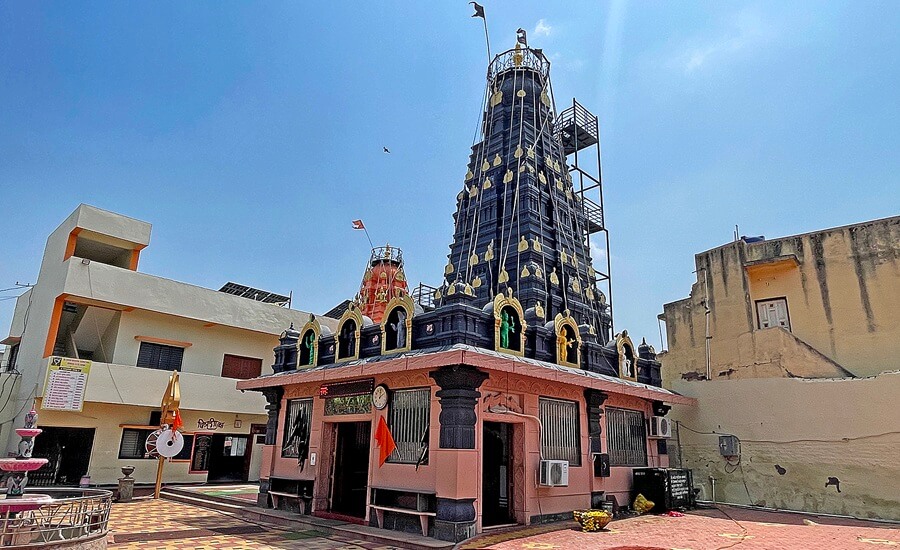
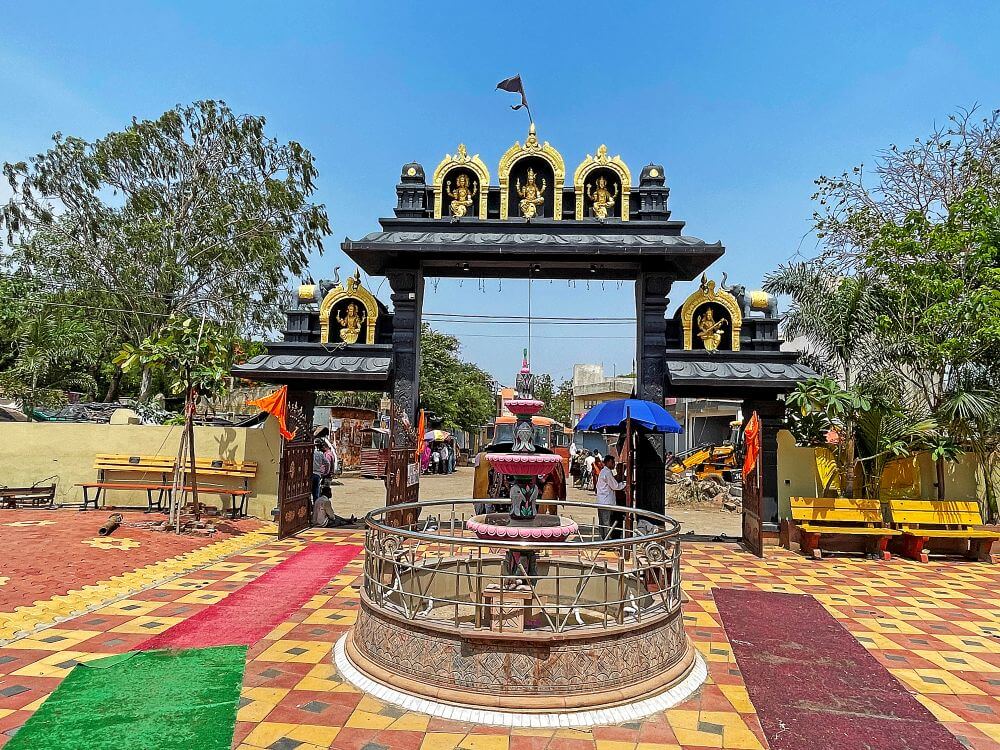
This temple, which is seven hundred to eight hundred years old, attained its current form following a renovation carried out a few years ago. In many places, women are not permitted to enter the sanctum sanctorum of Shani Dev or are prevented from touching the idol. However, there are no such restrictions for women in this temple. It is a unique feature of this place that women are granted access right up to the Vajrapitha of Shani Dev. Located in the heart of Shanimandal village, this temple is enclosed by a boundary wall. One enters the temple courtyard through a large gateway in this wall. On both sides of this entrance stand gatekeepers dressed as traditional heralds. On the canopy of the gateway, there are three South Indian-style pavilions containing idols of Saraswati, Parvati, and Kalika.
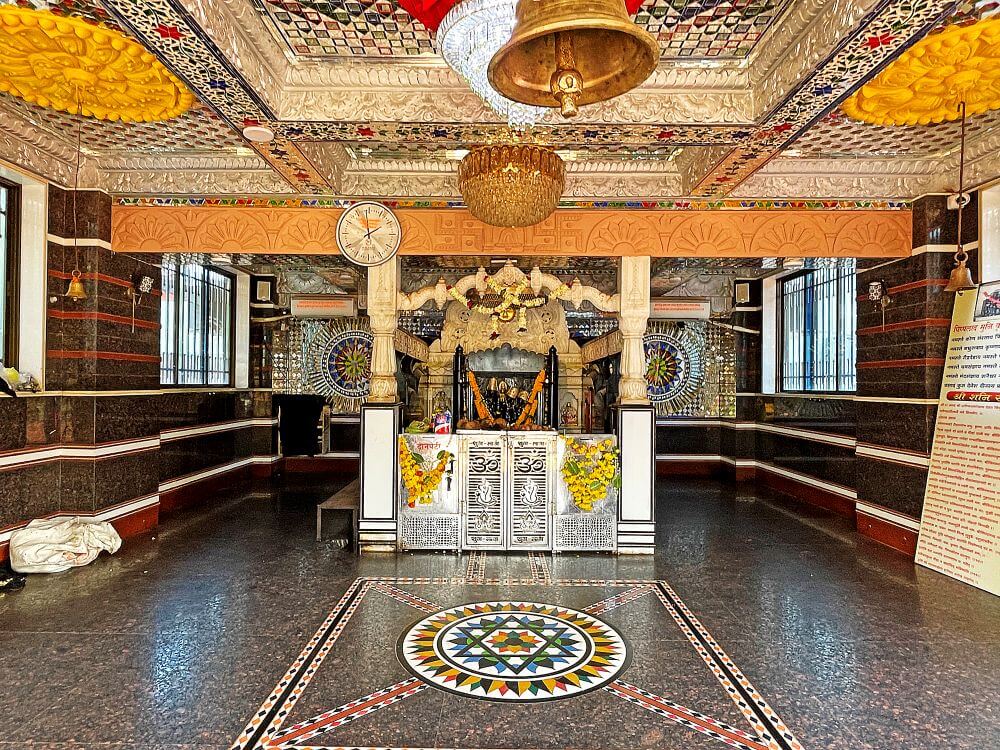
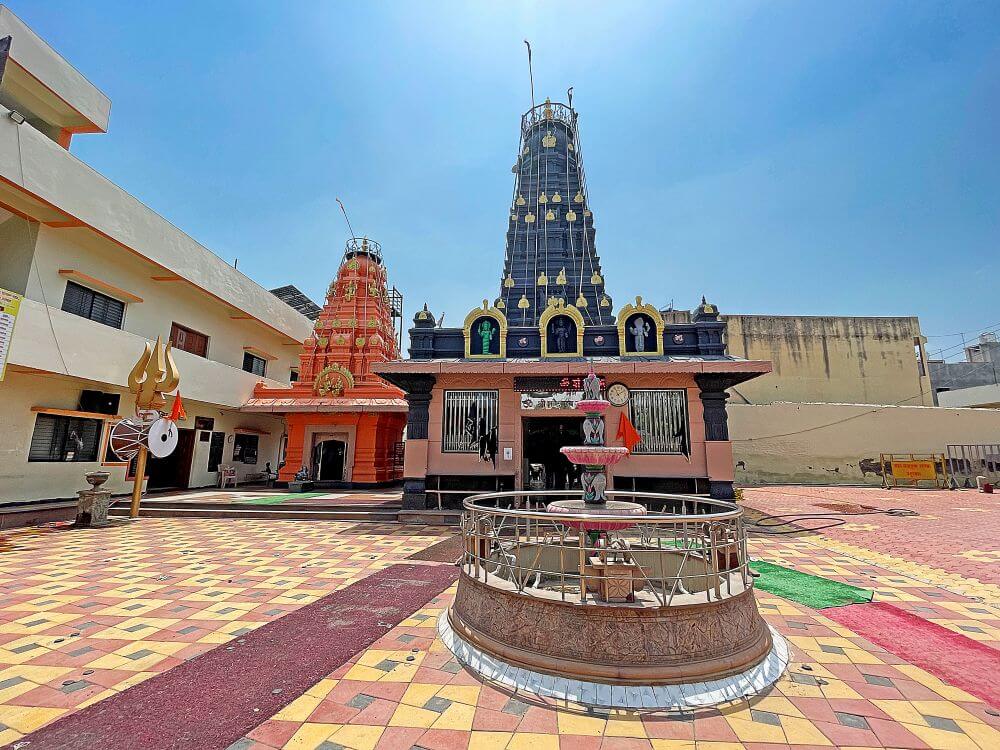
The temple courtyard is paved with paver blocks. Between the main entrance and the center of the temple, there is an ornate circular fountain enclosed by a railing. The entrance to the temple, which is slightly elevated from the courtyard, leads into an enclosed assembly hall (sabhamandap). There are several windows here to allow for light and ventilation. The walls of the assembly hall feature beautiful paintings, and the ceiling area is adorned with colorful glasswork. In the assembly hall, a marble idol of Lord Ganesha is placed on a pedestal against the wall.
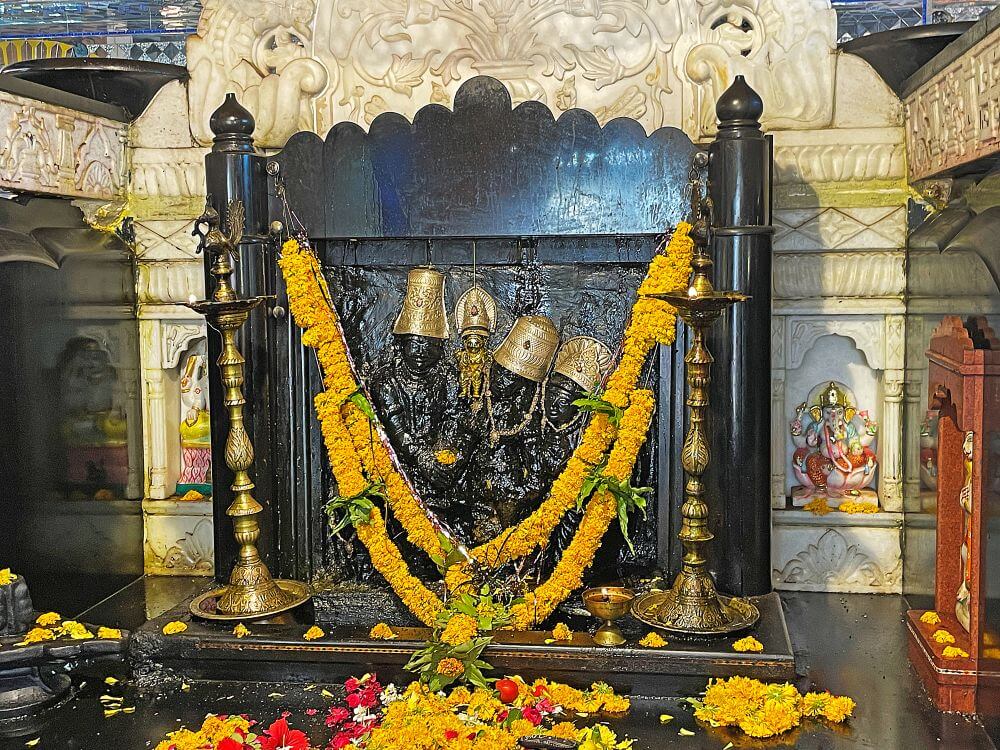
Further ahead in the sanctum sanctorum, upon a diamond throne within a marble shrine, resides the idol of Lord Shani Dev along with his powers, carved from black stone. This is a unique idol of Shani Dev, depicted in a family-oriented form accompanied by a small child and three women. Garments and ornaments are intricately carved onto the idol. In the marble arch behind the idol, there is a golden image of Lord Surya Dev in the center. To the right of the diamond throne, in a niche, are the idols of Lord Hanuman, and to the left are the goddesses Tapi and Narmada, depicted with their respective mounts, the fish and the crocodile. There is a circumambulation path around the sanctum sanctorum. The walls and ceiling here are adorned with glass inlay work.
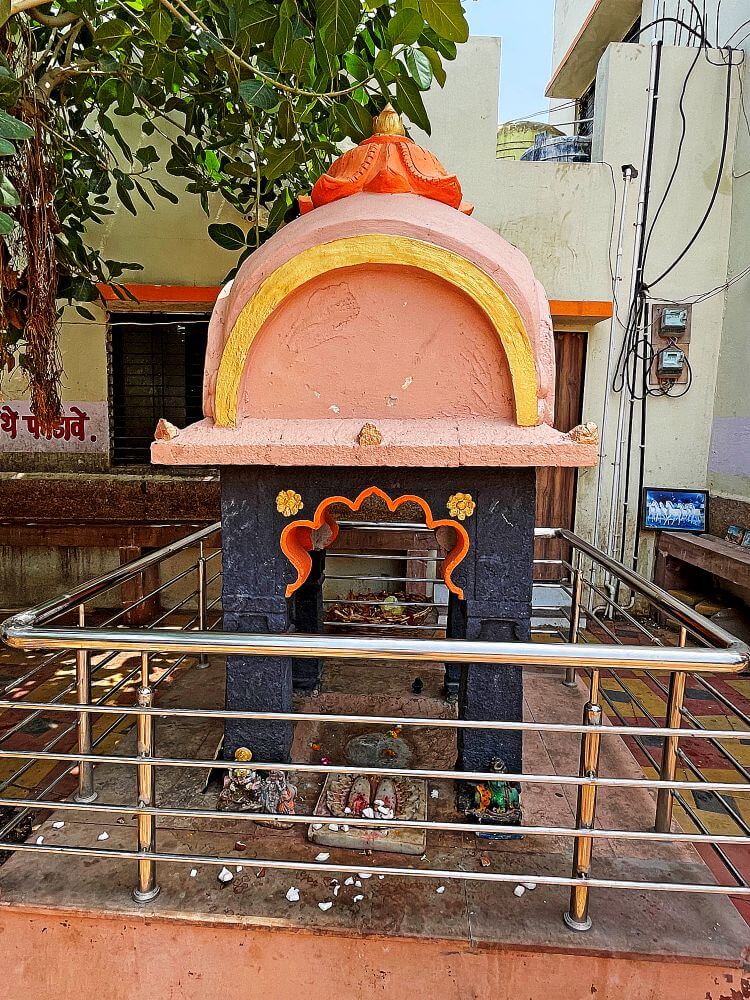
There is a parapet on all sides of the temple roof. In the niches located on this parapet, there are idols of various deities. At the four corners of the parapet, there are small spires with finials atop them. Above the roof of the sanctum sanctorum, there is a Nagara-style spire featuring a structure of progressively smaller steps, along with several subsidiary spires. At the pinnacle of the main spire, there is an octagonal stupika topped with a golden finial. Adjacent to this temple is a temple dedicated to Lord Mahadeva. In front of the Mahadeva lingam here, there is a stone lamp known as a ‘Malta’.
At the Shani temple, Shanishchara Jayanti is celebrated on Vaishakh Amavasya, and a fair is held on Shani Amavasya (when Amavasya falls on a Saturday). On these occasions, thousands of devotees from the three states of Maharashtra, Gujarat, and Madhya Pradesh arrive here to seek the blessings of the deity and to fulfill their vows.
This sacred temple stands as a testament to deep spiritual devotion, ancient architectural grandeur, and rich local cultural traditions.
The sanctum sanctorum houses the divine idol consecrated according to ancient Vedic traditions, surrounded by serene courtyards and traditional temple architecture.
Navratri, Maha Shivratri, Annual Temple Jatra & Deepotsav
Compare and book flights, secure top-rated local hotels near the temple, hire reliable guides, and rent cars instantly.
Extend your pilgrimage by visiting other highly sacred temples located nearby.


Add ₹999 more to unlock FREE SHIPPING!
Your sacred cart is currently empty.
Shop Photo FramesFill in your delivery details below to place your order.
Add comment