
Add ₹999 more to unlock FREE SHIPPING!
Your sacred cart is currently empty.
Shop Photo FramesThe name Nirmal means clean and pure. This pilgrimage site is located near Shurparaka, also known as Sopara, which was the capital of Aparanta, the Konkan region, from 1500 BCE to 1300 CE. In the Skanda Purana, it is stated, “Siddhipitham tatha khyatam nirmalam tirthamuttamam,” meaning this is one of the most excellent and accomplished pilgrimage sites among all sacred places. According to mythological beliefs, one who recites sacred verses here and remains free from sins attains seven crore times the merit. The Jagadguru Shankaracharya Swami Temple is situated in this sacred region.
In the scripture ‘Nirmal Mahatmya’, a legend regarding Nirmal is narrated, stating that during the Treta Yuga, an Asura named Vimal resided on the banks of the Vaitarna River. He used to harass the sages living there. Witnessing his growing atrocities, Parashurama waged a war against him and defeated him. Thereafter, the repentant Vimalasura performed severe penance here. Pleased with his devotion, Lord Shiva granted him the boon of liberation from death and a sacred water source on the Tungar mountain. Shiva told him that if he ceased harassing the Brahmins, he would have no fear from anyone in the three worlds. However, after some time, Vimalasura began harassing the Brahmins again. Consequently, Shiva asked Parashurama to restrain him once more. Each time Parashurama would sever his limbs, they would regenerate due to the grace of Shiva.
Ultimately, Parashurama, with the assistance of Shankara, achieved victory over Vimalasura. Parashurama forgave the surrendered Vimalasura and installed a Shivling at the spot where he fell, naming it Vimaleshwar. Due to the name Vimal, and because Parashurama sanctified the place by slaying Vimalasura, this site began to be known as Nirmal. This Vimaleshwar Along with the temple of Mahadeva, the place of Nirmal is renowned due to the temple of Shankaracharya, the great preceptor of the Sanatana Vedic Dharma.
Regarding the Shankaracharya Swami Temple, there is a legend that in ancient times, King Jalauka invited Adi Shankaracharya here to propagate the Vedic religion. Jagadguru Shankaracharya visited this pilgrimage site in 497 BCE. He attained Samadhi here on Utpatti Ekadashi in the month of Kartik in 504 BCE. Following this, King Jalauka built this Samadhi temple of Shankaracharya here. According to the tradition of the Acharyas, Adi Shankaracharya was born in 507 BCE, that is, in the sixth century BCE. It is said that the King Jalauka who built the Shankaracharya temple here was the son of Emperor Ashoka. His era is the third century BCE, and according to the poet Kalhana’s text ‘Rajatarangini’, he was the King of Kashmir. There is a gap of three centuries between the eras of Adi Shankaracharya and Jalauka. Furthermore, according to the Kanchi Peeth, the Samadhi site of Adi Shankaracharya is in Kanchipuram. Therefore, it is said that this temple must belong to a Shankaracharya who lived after Adi Shankaracharya.
In the १८८२ ‘Gazetteer of the Bombay Presidency’, Volume १४, it is also mentioned that this temple should belong to the ‘religious descendants’ of Adi Shankaracharya. According to some scholars, this temple belongs to Vidyaranya, the twelfth Shankaracharya of the Sringeri Pitha. The lifespan of Vidyaranya is from १२९६ to १३८६ CE. Vidyaranya played an important role in the establishment of the Vijayanagara Empire. He was the advisor to the brothers Harihara and Bukka, who founded this empire. Legend has it that he attained Samadhi at this very place. According to the ‘Gazetteer of the Bombay Presidency’, Shankaraji Keshav Phadke, a Sardar of the Peshwas who displayed his valor in the Vasai campaign, built eight temples in Nirmal around the year १७५० CE. The Shankaracharya Swami Temple is one of them. During the year 1882, an annual grant of 42 pounds, which was equivalent to 421 rupees at that time, was provided to this temple by the British government. This makes it clear that the current temple here is approximately two hundred and seventy-five years old.
This temple in the village of Nirmal is situated on a hill. Stone steps have been built to reach the temple premises. Apart from this, there is also a motorable road to reach here. For the convenience of the devotees, a small flat area has been provided midway along this stairway. On both sides of that space stand two ancient lamp pillars. As one reaches the hill, the grand structure of the temple is visible right in front. There is a large courtyard surrounding the temple. Here, on a large pedestal made of carved stone, stands a magnificent lamp tower.
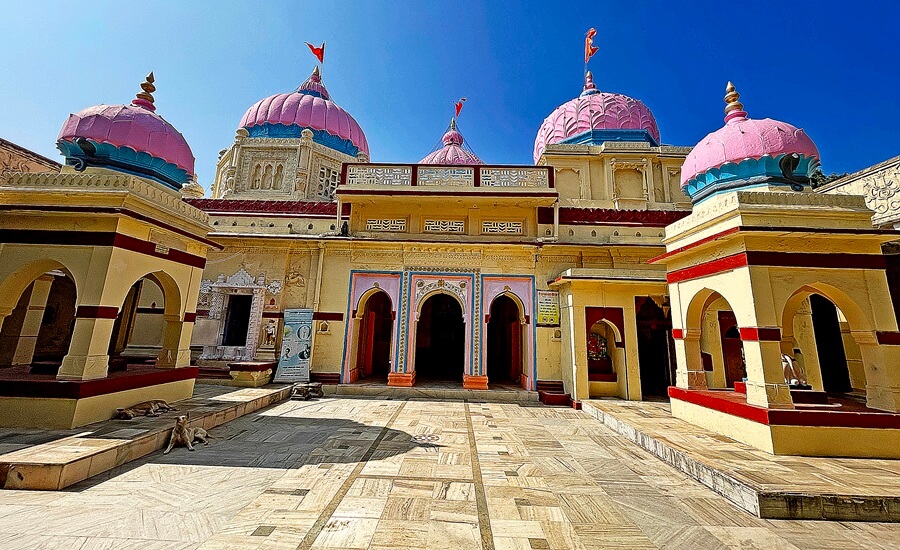
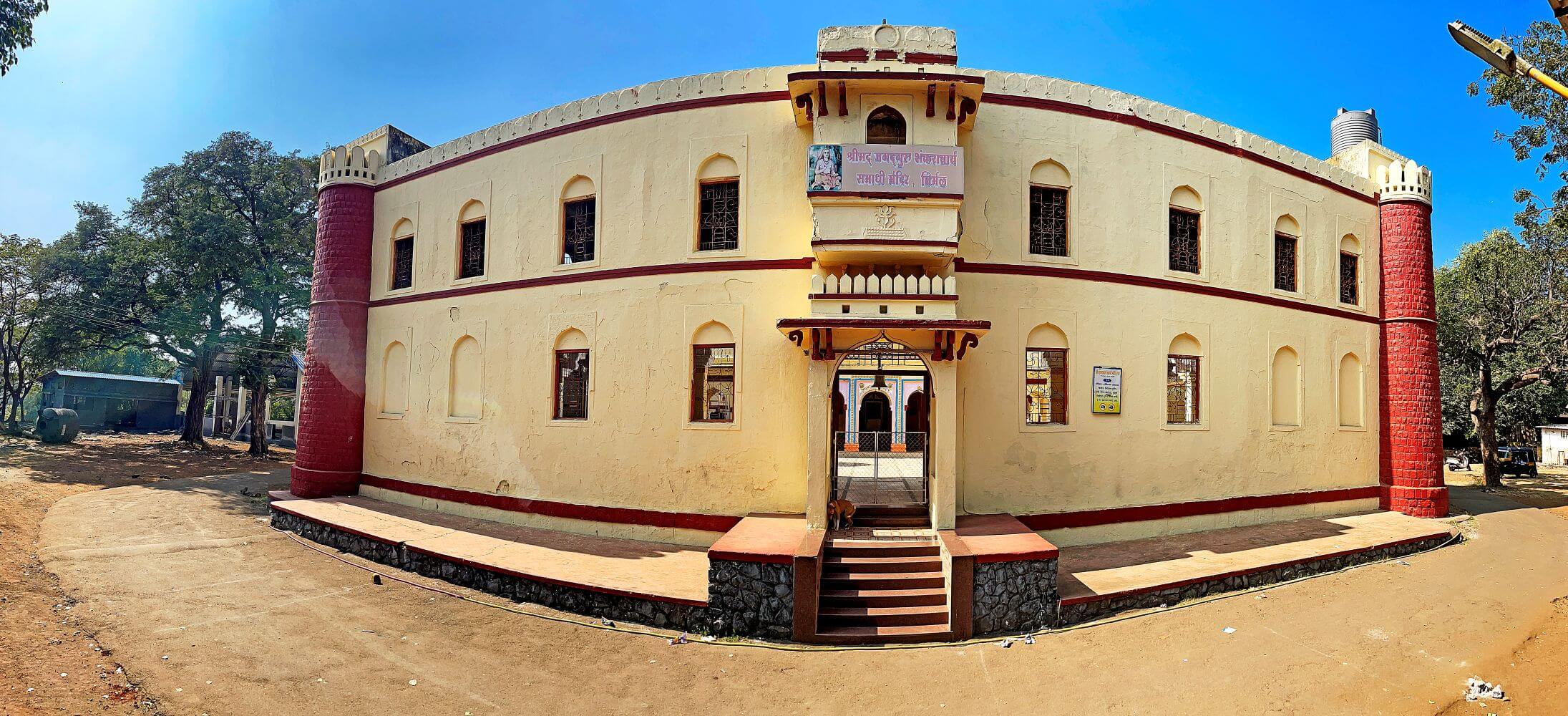
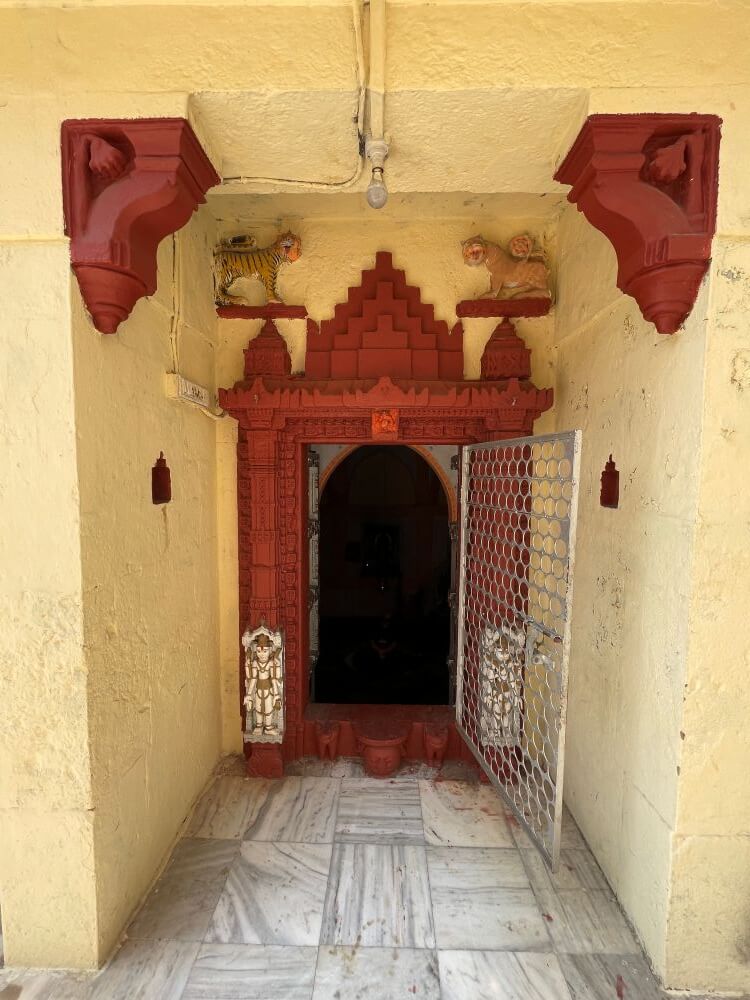
The temple architecture here resembles a fortress. The exterior of the temple features a tall, two-storied wall with windows, turret-like structures on both sides, an entrance in the center, a small arched porch in front of it, and a balcony-like structure above. One ascends six steps to enter the porch and from there, enters the main courtyard of the temple. There are covered corridors on all four sides of the courtyard. The main temple structure stands in the center. Here, there is the Shankaracharya Samadhi Temple, a Shiva temple, and also a Vishnu temple. These three temples are adjacent to one another. The temples have dome-shaped spires. Of these, the two side domes are larger, and the central dome is relatively smaller. There are Amalakas and Kalashas atop the domes.
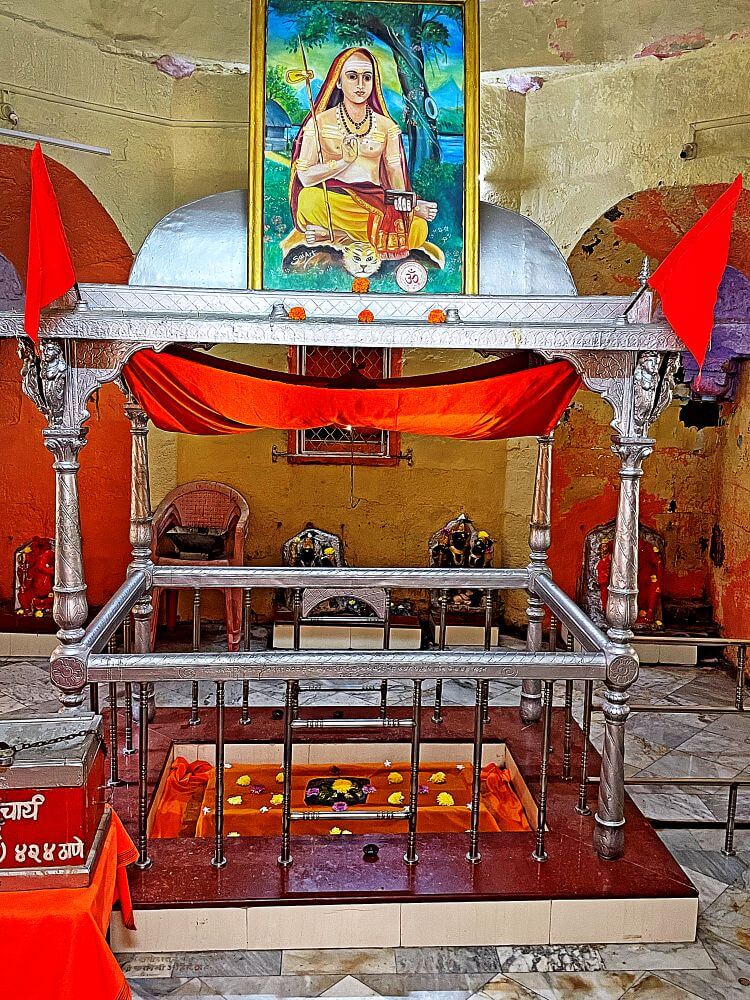
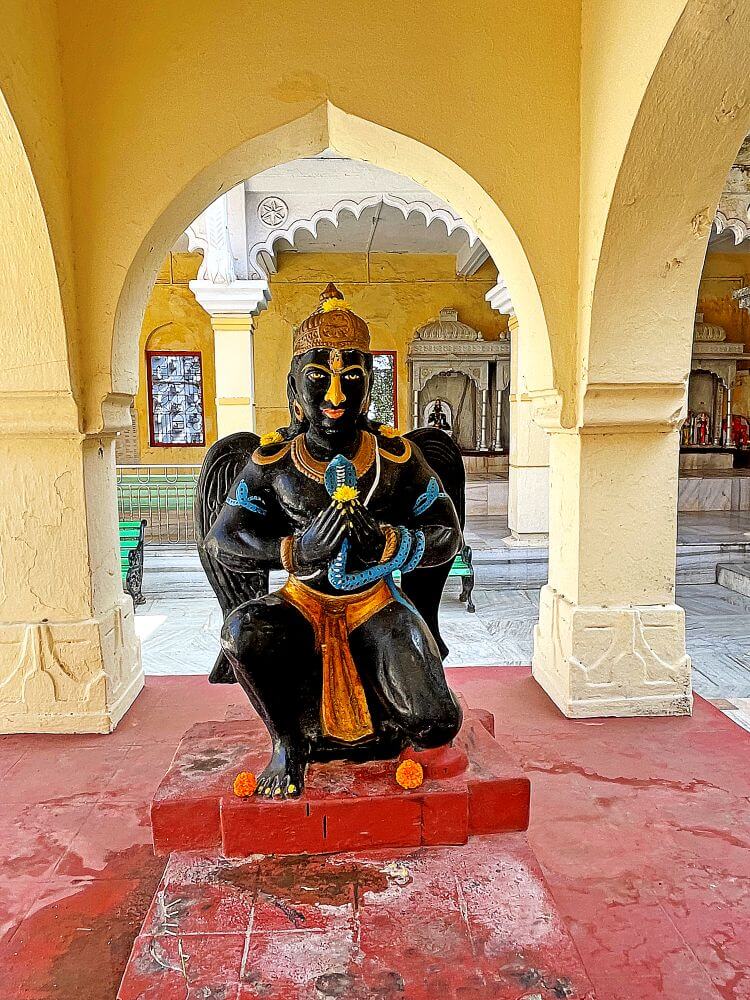
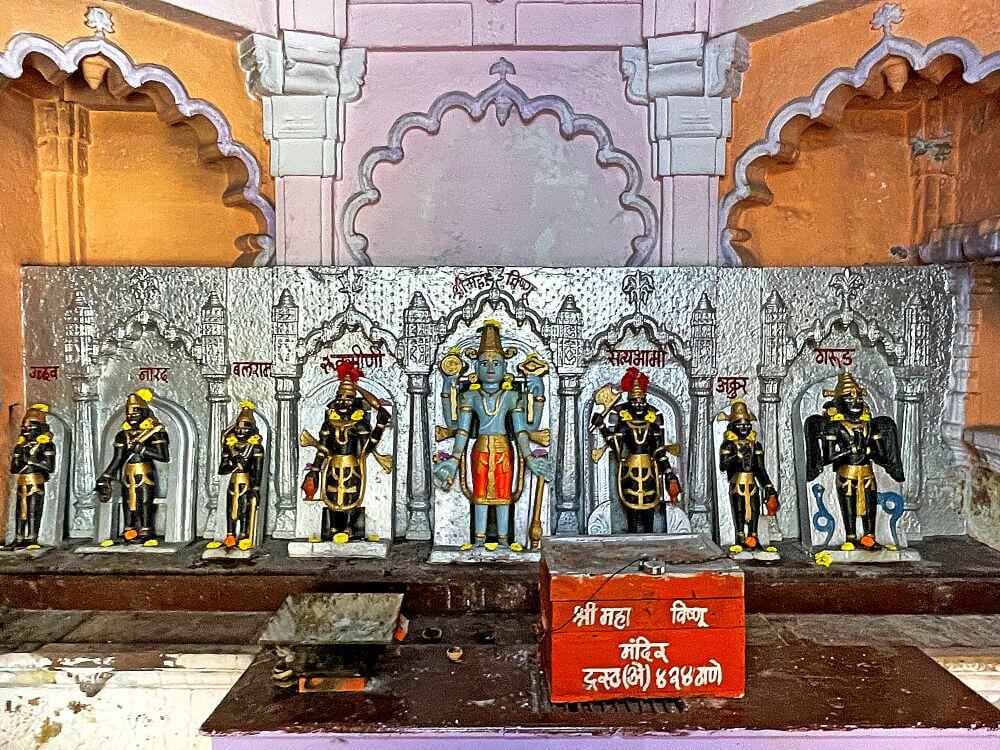
In front of the main temple are the Garuda Mandapa and the Nandi Mandapa. Within them are stone idols of Garuda and Nandi. In the central sanctum sanctorum of the temple lies the Samadhi shrine of Shankaracharya Swami. In the sanctum sanctorum of the Vishnu temple located here, there is an idol of Maha Vishnu in the center. To the left of this idol are the idols of Satyabhama, Akrura, and Garuda, and to the right are the idols of Rukmini, Balarama, Narada, and Uddhava.
A grand fair is held here on the occasion of Kartiki Utpatti Ekadashi. This fair is famous as the Nirmal Yatra. In the past, it used to last for a month, but now it spans fifteen days. During the fair, countless devotees come to this temple for darshan. It is said that this fair has a tradition spanning many years. The fair festivities commence at dawn on Utpatti Ekadashi with abhishek and puja. On Dwadashi, at twelve forty-five past midnight, the palanquin of Shankaracharya Swami departs to seek the blessings of Goddess Sueshwari, located in the vicinity. After circumambulating the Nirmal Lake, it returns to the temple. The Sueshwari temple is also illuminated with lamps everywhere. The palanquin is welcomed throughout the village with rangolis drawn at various places.
This sacred temple stands as a testament to deep spiritual devotion, ancient architectural grandeur, and rich local cultural traditions.
The sanctum sanctorum houses the divine idol consecrated according to ancient Vedic traditions, surrounded by serene courtyards and traditional temple architecture.
Navratri, Maha Shivratri, Annual Temple Jatra & Deepotsav
Compare and book flights, secure top-rated local hotels near the temple, hire reliable guides, and rent cars instantly.
Extend your pilgrimage by visiting other highly sacred temples located nearby.


Add ₹999 more to unlock FREE SHIPPING!
Your sacred cart is currently empty.
Shop Photo FramesFill in your delivery details below to place your order.
Add comment