
Add ₹999 more to unlock FREE SHIPPING!
Your sacred cart is currently empty.
Shop Photo FramesGoddess Ekvira, the manifestation of Adishakti, is revered as the mother of the heroic Parashurama, who was the creator of the Konkan region and the sixth incarnation of Lord Vishnu. The sacred text *Nirmal Mahatmya* also mentions Ekvira as the mother of Parashurama. Renuka and Ekvira are forms of Adimaya Parvati, who has assumed numerous incarnations for the sake of her devotees. Among the many sacred abodes of Goddess Ekvira in Konkan, the deity situated on a rock in the creek at Kalamb in Vasai Taluka is revered as *Swayambhu* (self-manifested) and *Jagrut* (a living divine presence). Devotees hold a deep belief that this Goddess fulfills all earnest desires and answers vows.
This Swayambhu shrine of Goddess Ekvira is located at the border of Nirmal, Kalamb, and Waghori villages to the west of Nalasopara city. Although a grand temple of Goddess Ekvira stands here today, several years ago, this area was part of the creek. In the mud of the creek lay a massive rock. For many years, the local residents worshipped this rock as divine. The local fishermen (*Koli* community) would offer prayers to this rock before heading into the creek for fishing. They held a firm belief that worshipping this black rock blessed them with a rich catch. Furthermore, local devotees repeatedly experienced the divine presence and miracles (*prachiti*) of this shrine; however, as the sacred site was situated in the creek waters, worship and rituals could only be performed during low tide.
It is said that around 1990, the local villagers decided to initiate an annual festival for this holy shrine. On the very first day of the festival, Goddess Ekvira appeared in a dream vision to a noble gentleman of the village and revealed, “The rock that all devotees have been worshipping for years is my sacred site. For years, I have endured the harsh sun, rain, and the pounding waves. Therefore, I now need shelter. Construct my temple at this spot.” Following this divine vision, it became widely recognized that this holy place belonged to Goddess Ekvira. From then on, annual festivals began to be celebrated here. However, since the area was not suitable for holding festivals or constructing a temple, the villagers decided to create a land embankment extending from Kalamb village through the creek water to the rock. After completing the land reclamation, initially, a small temple was built over the rock using palm fronds, roof tiles, *karvi*, and *kud* (reed walls), just as indicated by the Goddess. But with the growing number of devotees and the large crowds attending during festivals, that small structure proved inadequate. Thus, a few years ago, preserving the original divine rock intact, the villagers erected a grand temple through public contributions and voluntary labor (*Shramdaan*).
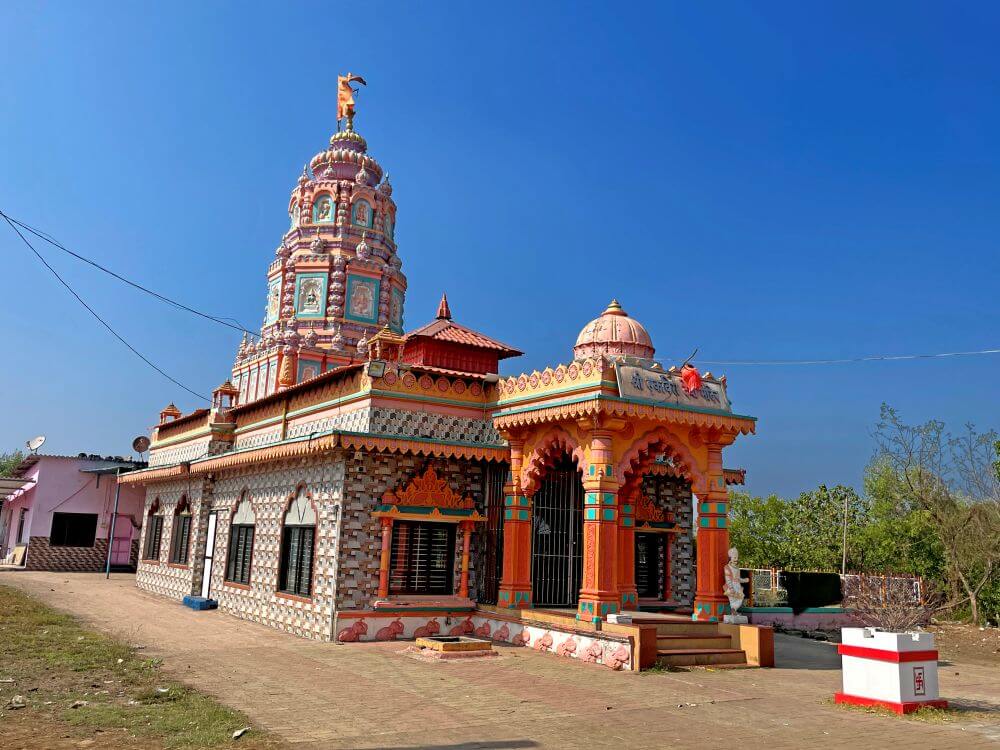
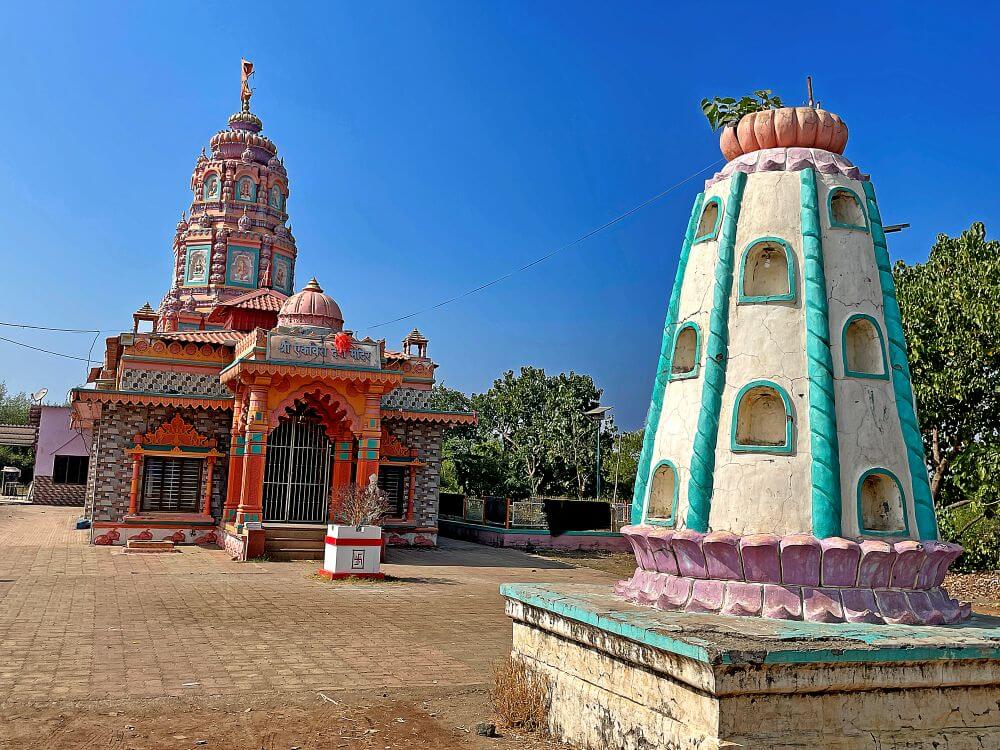
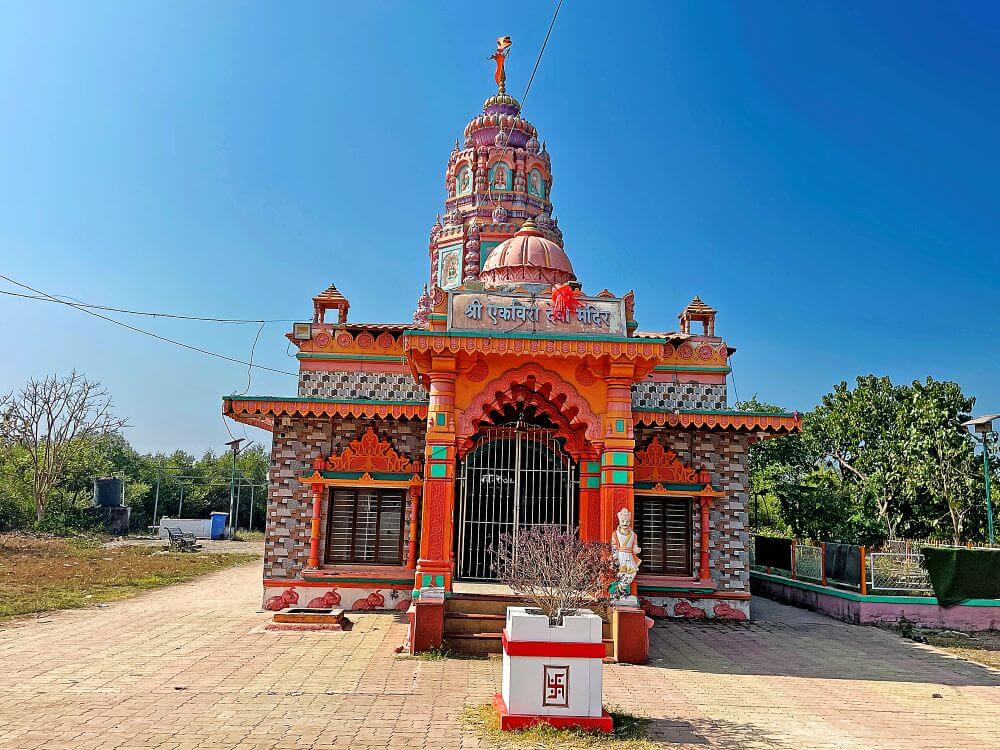
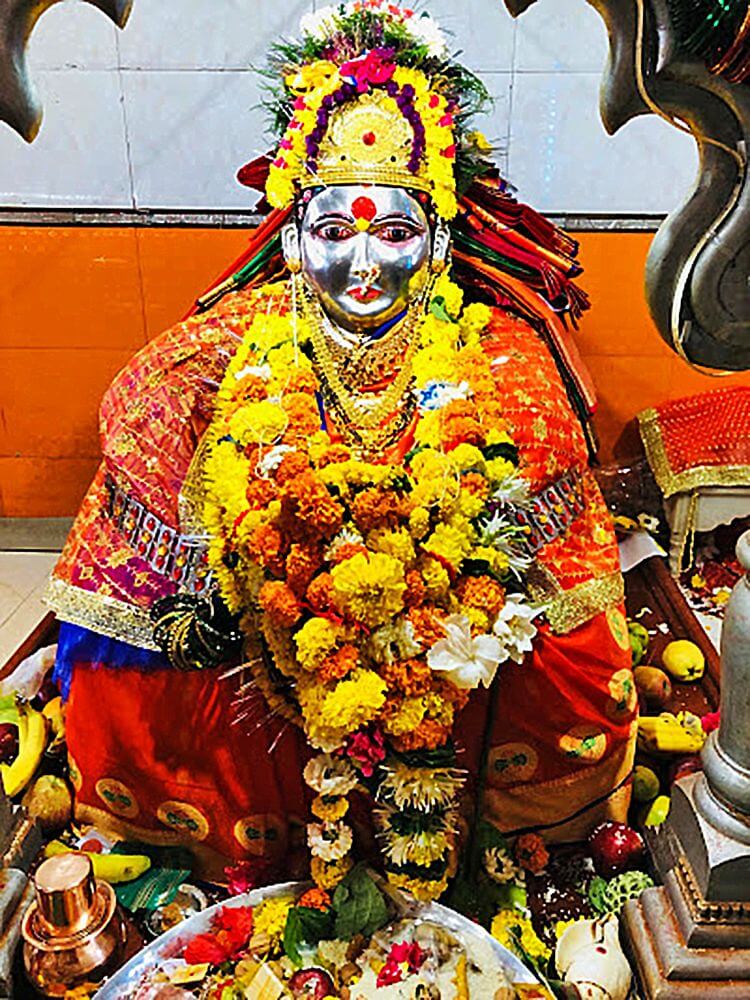
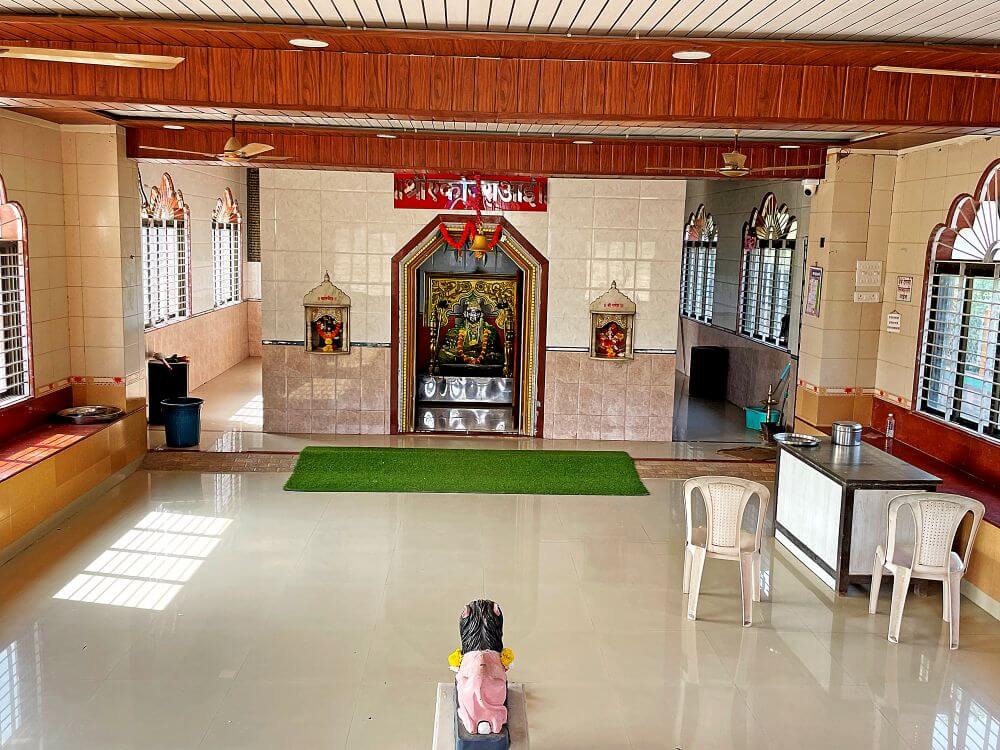
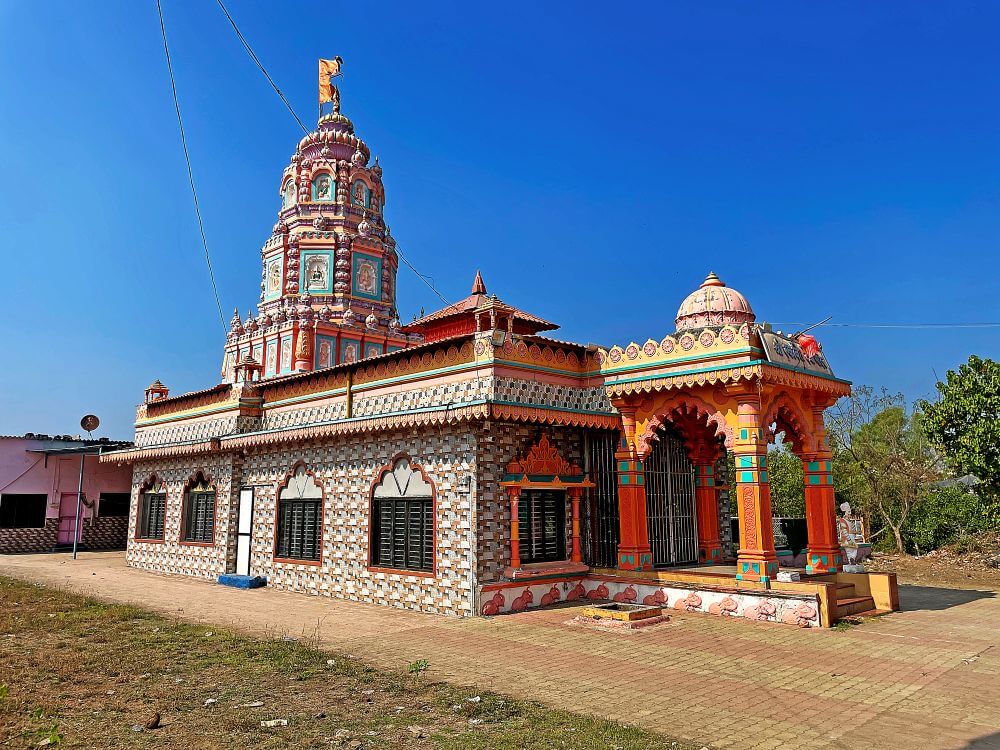
Situated on the creek bank outside Kalamb village, the Ekvira Devi Temple is surrounded by mangroves on three sides. The temple stands out beautifully amidst the lush greenery of these mangroves. In front of the temple stands a *Deepmaal* (lamp tower) and a *Tulsi Vrindavan*. Due to the unique architecture of the Deepmaal, it appears as though it stands inside a blooming lotus on a raised plinth. The temple comprises a *Mukhamandapa* (entrance porch), a *Sabhamandapa* (assembly hall), and a *Garbhagriha* (sanctum sanctorum). The Mukhamandapa of the temple rests on four pillars. Figures of *Dwarapalas* (door guardians) stand near the front two pillars. Above this open-style Mukhamandapa is a domed *Shikhara* topped with a *Kalasha* (finial). The Sabhamandapa here is an enclosed hall. In the center of the Sabhamandapa sits an idol of a lion, the sacred mount (*vahana*) of the Goddess, and further ahead, leaving space for a *Pradakshina* (circumambulation) path, is the entrance to the Garbhagriha. On the front wall of the Garbhagriha, in the left niche (*devakoshtaka*), resides an idol of Kalbhairav, and to the right is an idol of Lord Ganesha. Inside the sanctum, Goddess Ekvira is seated within a golden shrine (*makhar*) placed upon a *Vajrapitha*. The Goddess is adorned with a crown, a sacred mask (*mukhavata*), and exquisite ornaments. Numerous royal elephants (*Gajaraja*) are carved along the lower portion of the temple’s outer walls, creating an impression that these mighty elephants are upholding the weight of the temple. The spire above the sanctum features several niches housing idols of various deities and revered saints.
The Ekvira Devi Temple is a venerated shrine for devotees from various communities including the Koli, Agri, Bhandari, Daivadnya Brahmin, CKP, and many others. The Shri Ekvira Devi Seva Samiti organizes various religious and social programs at the temple throughout the year. Every year, a grand fair (*Jatra*) takes place on Chaitra Shuddh Ashtami, which is considered one of the largest annual fairs in Vasai Taluka. On this occasion, a large number of people from the Koli and Agri communities across Mumbai, Thane, and Palghar districts gather here. The Ashwin Shuddh Navratri festival is also celebrated here with great grandeur, turning the entire area into a vibrant festive fair. During these nine holy days, *Mahaprasad* and *Bhandara* (community meal) are served to visiting devotees by the temple committee. As this shrine is known to be *Jagrut* (divinely active), many devotees arrive daily to fulfill their vows (*navas*). Upon the fulfillment of their prayers, devotees offer traditional gold and silver ornaments to the Goddess.
This sacred temple stands as a testament to deep spiritual devotion, ancient architectural grandeur, and rich local cultural traditions.
The sanctum sanctorum houses the divine idol consecrated according to ancient Vedic traditions, surrounded by serene courtyards and traditional temple architecture.
Navratri, Maha Shivratri, Annual Temple Jatra & Deepotsav
Compare and book flights, secure top-rated local hotels near the temple, hire reliable guides, and rent cars instantly.
Extend your pilgrimage by visiting other highly sacred temples located nearby.


Add ₹999 more to unlock FREE SHIPPING!
Your sacred cart is currently empty.
Shop Photo FramesFill in your delivery details below to place your order.
Add comment