
Add ₹999 more to unlock FREE SHIPPING!
Your sacred cart is currently empty.
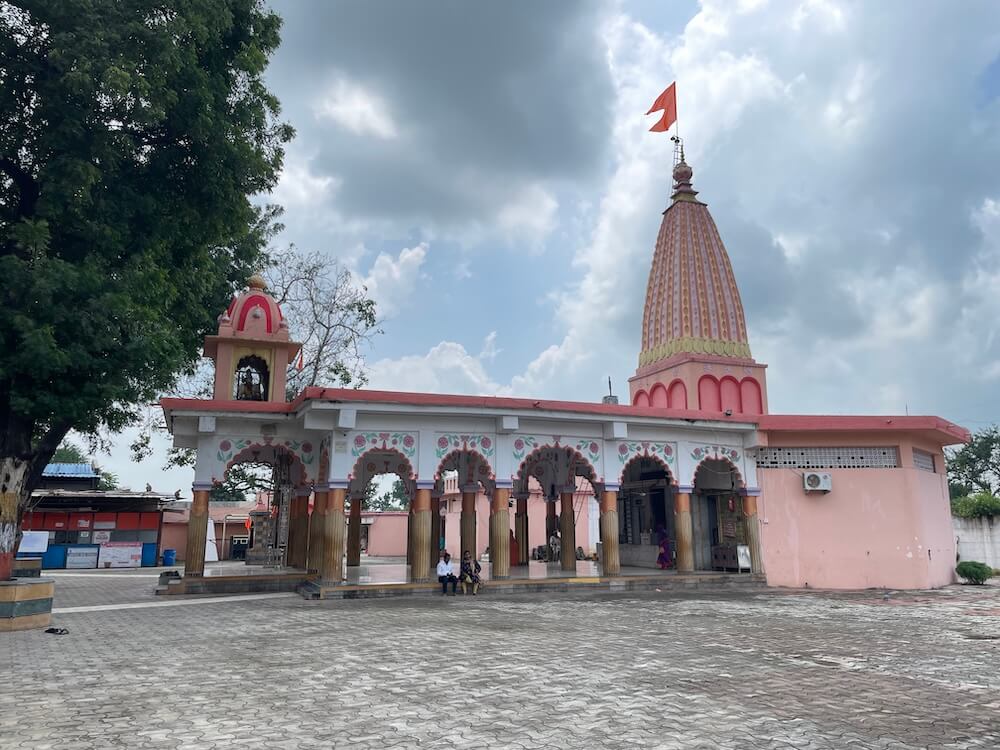
Shop Photo FramesThe ancient temple of Siddheshwar, the presiding deity of Risod village, is situated along the Risod-Loni road. This temple has a history spanning 800 years. Saint Amardas Maharaj used to perform penance in this temple, which is built in the Hemadpanti architectural style. Devotees firmly believe that through the power of his penance, Amardas Maharaj alleviated the troubles of many devotees and that he still rushes to the aid of his devotees even today. The death anniversary of Amardas Maharaj and Mahashivratri are the most significant festivals celebrated at this temple. During these festivals, thousands of devotees gather here.
In the Shaiva tradition, one who achieves spiritual progress through self-realization, gains control over their consciousness, becomes one with Shiva, and attains divine powers is known as a Siddha. Saint Dnyaneshwar referred to the Nath tradition as the Siddha-panth. Eighty-four Siddhas are mentioned in the Nath tradition. The God of these Siddhas is Siddheshwar. In the scripture ‘Kalpasamuha Samhita’, it is stated, ‘Where there is Lord Siddheshwar, there is spiritual attainment.’ Many temples of such a Siddheshwar exist in Maharashtra as well as Karnataka. The Siddheshwar temple at Risod is one of them. Here, Siddheshwar is worshipped in the form of a Shiva Linga. The exact history of the establishment of this temple is unknown. However, according to some scholars, the period of the temple’s establishment dates back to the twelfth century.
The words ‘Magardhaj 700’ are inscribed on one of the pillars of the temple. Based on this, an estimation of the temple’s founding period has been made. According to scholars, there are many sub-sects within the Nath tradition of the Shaiva denomination. The Dhwaja is one such sub-sect. Makaradhwaja was a Nath Yogi belonging to the Dhwaja sect. Some scholars also speculate that he was the head of a Shaiva monastery in Ratanpur, Chhattisgarh. Ratanpur is a small village today, but in the eleventh century, it was the capital of the Kalachuri dynasty. This city was founded by the Kalachuri King Ratnadeva (first). During the reign of King Jajalladeva (first) of this same dynasty, Yogi Makaradhwaja’s monastery was located in Ratanpur. The period of Jajalladeva is considered to be from 1095 to 1120 CE. Based on this, it is estimated that Makaradhwaja lived around this time.
The inscription ‘Magardhwaj 700’ found in the temple at Risod has also been discovered on the pillars of some temples in Chhattisgarh and Madhya Pradesh, on the pedestals of idols, and even on Shiva Lingas. In some places, it is inscribed as ‘Jogi Magardhwaj 700’. The mystery of this number 700 still remains. It refers to the disciples in their monastery. Some estimate that this should be the number. Yogi Makardhwaja lived during the time of Jajalladeva, that is, in the twelfth century. Based on this, it is conjectured that the Siddheshwar Temple of Risod must also belong to the same period. During the tenth and eleventh centuries of the Common Era, this region was ruled by the Chalukyas of Kalyani. In the year 1049 CE, the Chalukya monarch Ahavamalla Someshwara (I) ascended the throne. Shiva, Vishnu, Mahalakshmi of Kolhapur, and Kartikeya were the principal deities worshipped by the Chalukyas. Many temples were constructed during their era. There is also a Siddheshwar Mahadeva temple at Kothali Budruk, located about 90 km from here. According to the legend of its local significance, that temple was built in the year 1060 CE, which is during the reign of Ahavamalla Someshwara (I). From this, it is also speculated that this temple belongs to the Chalukya period.
Within the premises of this temple lies the Samadhi Mandir of Saint Amardas Maharaj. In the Washim Gazetteer, he is referred to as Amarnath. It is said that he arrived here from the Betul region of Madhya Pradesh in the nineteenth century. According to available information, a Brahmin couple lived in a village in the Betul area. He was a devotee of Lord Shiva. One day, the Brahmin’s wife had a divine vision. In her dream, Lord Siddheshwar Mahadev told her that the son who would be born to her would be a devotee of Lord Shiva. Accordingly, in the year 1853, Amardas Maharaj was born to this Brahmin couple. How and exactly when he came to Risod from there remains unknown. He resided here in the Siddheshwar temple. Many devotees used to come to seek his blessings, with the faith that their wishes would be fulfilled through his grace. He attained Samadhi on 6 September 1945.
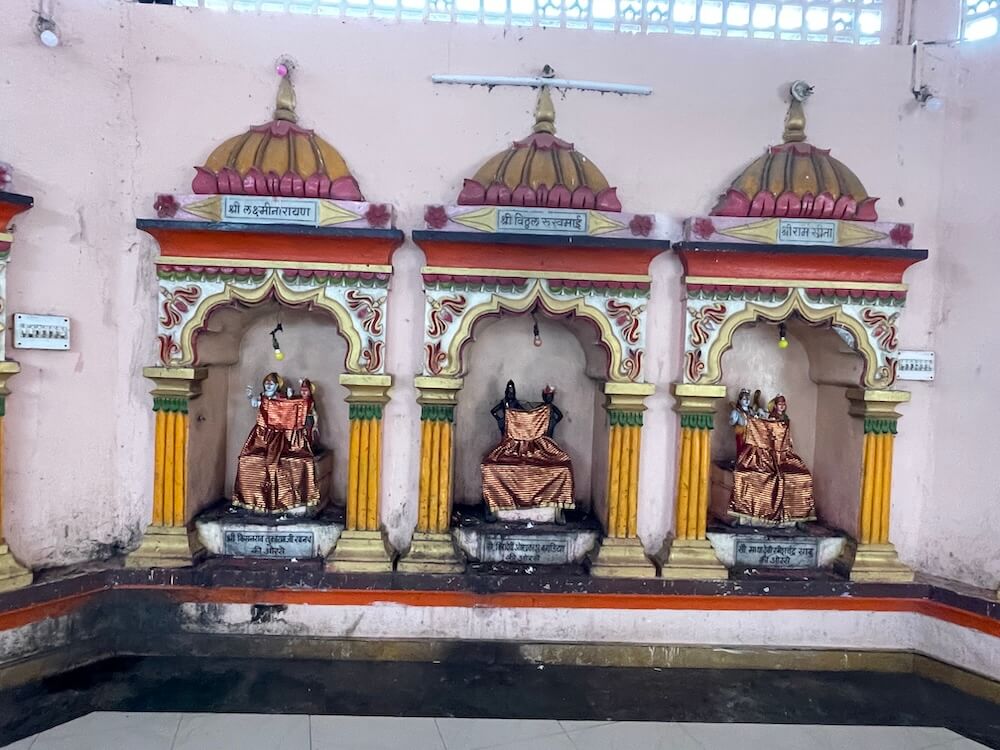
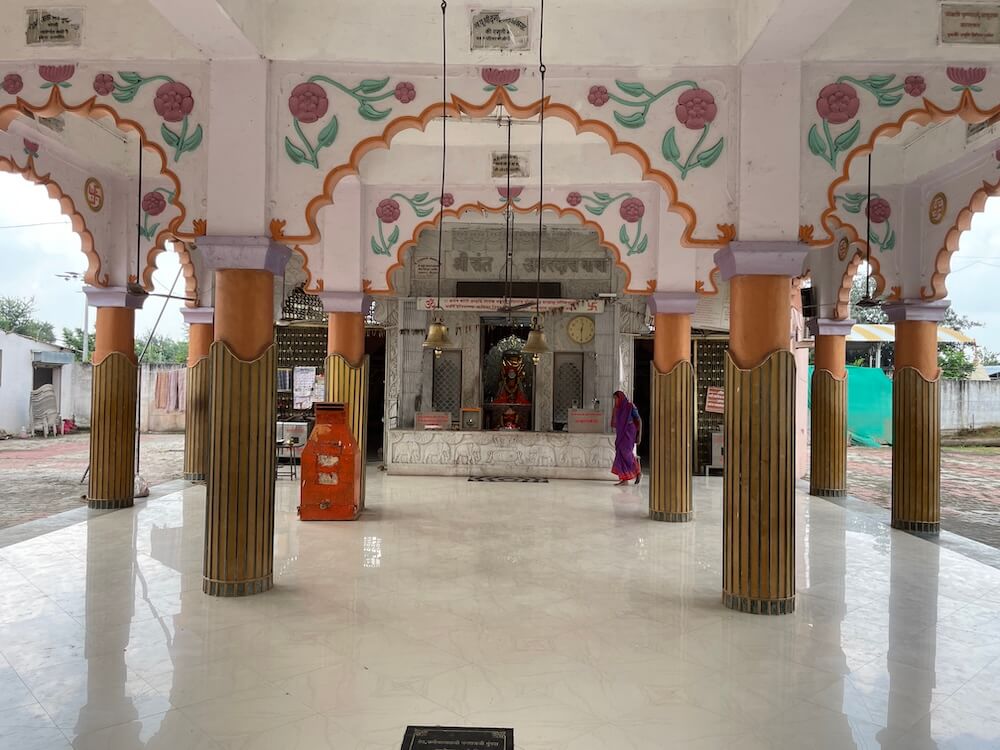
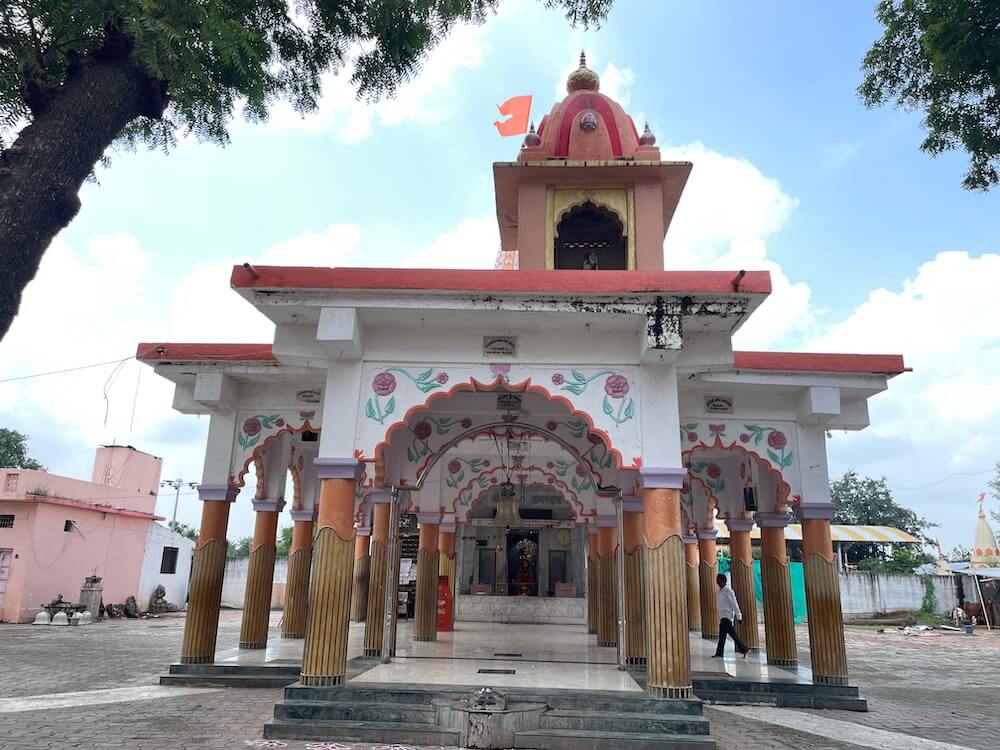
The Siddheshwar Temple and the Samadhi Temple of Saint Amardas are situated in a spacious and picturesque area near the Ganga Maa Garden here. The temple premises feature a grand arched entrance. After walking some distance inside from this path, there is another large entrance built in a modern style. Directly ahead from here, one can see the magnificent temple of Maharaj Amardas, constructed in a modern architectural style. The structure of this temple consists of a Mukhamandapa (front porch), a Sabhamandapa (main assembly hall), and a Garbhagriha (sanctum sanctorum). There is a tall spire (shikhara) above the Mukhamandapa. The Mukhamandapa, with its arched pillars, and the Sabhamandapa are open in design. On the lower part of the facade of the Garbhagriha, on a marble wall resembling a small ledge, are carvings of elephants and auspicious kalash (sacred pots). The facade of the temple is adorned with intricate carvings in marble stone. On both sides of the main entrance to the sanctum sanctorum, there are marble latticed windows. Inside, a silver mask of the Maharaj is consecrated upon his Samadhi shrine. A large crown rests upon the head of this mask. Around the neck, several garlands of Rudraksha beads, dear to Lord Shiva, are adorned. Behind the Samadhi shrine, on an ornate pedestal inlaid with silver foil, sits the idol of Amardas Maharaj, dressed in saffron robes and wearing a turban on his head. A silver canopy is placed over the head of the idol. Behind it is a beautifully carved silver halo. Above the sanctum sanctorum of the temple, there is a spire that tapers towards the top on all four sides. In place of the Amalaka, there is a pagoda-like structure topped with a large Kalash. Adjacent to the sanctum sanctorum within the temple, idols of various deities are enshrined in beautifully decorated niches, including Ganpati, Saraswati, Mahalakshmi, Durga Devi, Santoshimata, Shankar, Gajanan Maharaj, Renukacharya, Ramdevbaba, Dattatreya, Shri Krishna, Shri Ram-Sita, Lakshmi-Narayan, and Vitthal-Rukmini.
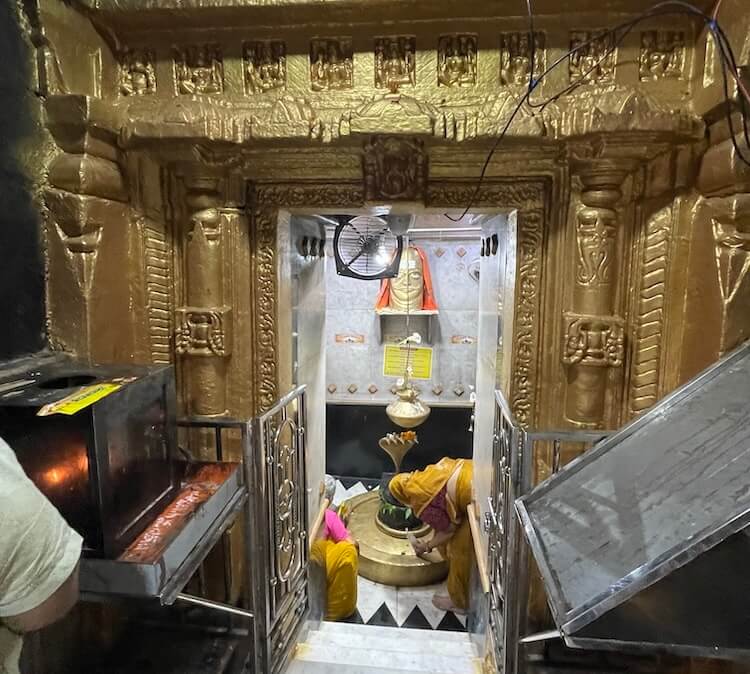
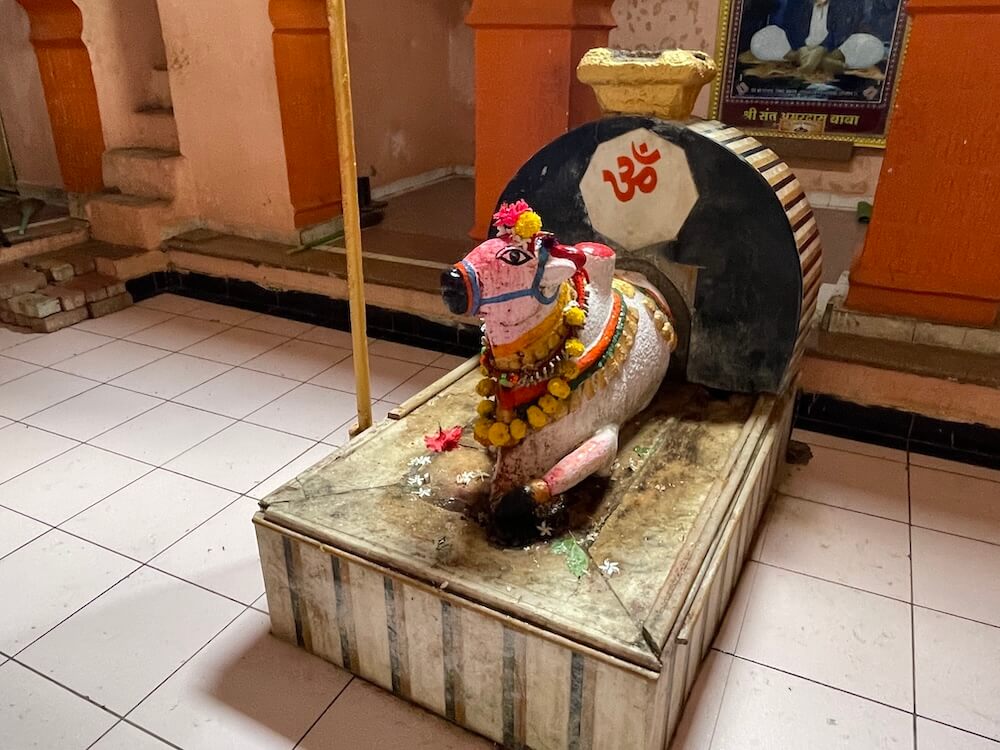
The ancient temple of Siddheshwar Mahadev is located just a few steps away from the Samadhi Mandir of Saint Amardas Maharaj. There is a tin shed in front of the temple. To the left of the temple entrance, a large photograph of Amardas Maharaj is placed in a grand marble shrine. The stone entrance of this ancient Siddheshwar temple is highly distinctive. The reason for this is the Sati-shila (memorial stone) located on its right doorjamb. According to scholars, this is not the original entrance; it was constructed by assembling the remains of another temple, which is why this Sati-shila is visible on it. On the lintel of this doorway, there is a sculpture of Lord Ganesha at the lalata-bimba position. The temple has a large, modern-style, yet cloister-like assembly hall (sabhamandapa). Here, an ancient stone idol of Nandi is seated on a marble platform. Behind it is a large photograph of Saint Amardas Maharaj. It is said that the Maharaj used to sit here for meditation. In a niche in the corner directly in front, an idol of Lord Ganesha is seated, while an idol of Lord Hanuman is in another niche. From here, the original part of the ancient temple begins. At the entrance, there are large stone benches on both sides. Further ahead is the original assembly hall of the temple. In this assembly hall, supported by carved, dressed pillars, a queue for darshan has now been created by installing steel pipes. The ceiling of this assembly hall is decorated with Kirtimukhas carved into stone squares. This Kirtimukha, which is usually inscribed as a minor sculpture on the doorjambs of temples, is also seen carved on the ceilings of some Chalukya-era temples. Based on this, it can be estimated that this Siddheshwar temple belongs to the Chalukya period. On the lower part of one of the pillars in the assembly hall, the letters ‘Magardhaj 700’ are inscribed. There is a small antarala (vestibule) in front of the sanctum sanctorum (garbhagriha). The stone doorjambs of the sanctum entrance, as well as the door pillars on the sides, feature ornate carvings. A sculpture of Lord Ganesha is carved on the lintel at the lalata-bimba position. Above it, on the architrave, are sculptures of the Saptamatrikas. These Matrikas are usually in groups of seven or eight; here, there is a group of eight, along with a sculpture of Lord Ganesha. The sanctum sanctorum is relatively small. Inside, on the floor, is a large Pindi of Siddheshwar. The Shalunka of this Pindi has a brass covering, and in the center is a tall stone Linga. Above it, a five-hooded serpent deity has raised its hood. On the back wall, there is a brass mask of Siddheshwar.
In the premises of the Siddheshwar temple and Saint Amardas Samadhi Mandir, there is a Draupadi Kund built of stone. Here, there is also a stone Nandi and a Shivling. There are many Shivlings in the vicinity of this temple. Similarly, there are small temples of Lord Hanuman and Lord Dattatreya. There is also a Bhakta Niwas (pilgrim lodging) and a Goshala (cow shelter) here.
A grand fair is celebrated on the death anniversary of Amardas Maharaj on Shravan Amavasya and on the day of Mahashivratri. During these festivals, a Palkhi (palanquin) procession of Amardas Maharaj is taken out. Additionally, Harinam Saptah and Mahaprasad are also organized.
This sacred temple stands as a testament to deep spiritual devotion, ancient architectural grandeur, and rich local cultural traditions.
The sanctum sanctorum houses the divine idol consecrated according to ancient Vedic traditions, surrounded by serene courtyards and traditional temple architecture.
Navratri, Maha Shivratri, Annual Temple Jatra & Deepotsav
Compare and book flights, secure top-rated local hotels near the temple, hire reliable guides, and rent cars instantly.
Extend your pilgrimage by visiting other highly sacred temples located nearby.


Add ₹999 more to unlock FREE SHIPPING!
Your sacred cart is currently empty.
Shop Photo FramesFill in your delivery details below to place your order.
Add comment