
Add ₹999 more to unlock FREE SHIPPING!
Your sacred cart is currently empty.
Shop Photo FramesPandharpur is the capital of Lord Vitthal, the ‘Bap-Rakhumadevivaru’, whom the saints have called ‘Chovisanvegala’ (the one distinct from the twenty-four incarnations of Vishnu). Pandharpur is the main center of Maharashtra’s religious culture and the eternal source of inspiration for its devotional tradition. For twenty-eight yugas, this Mother Vithoba has been standing here with hands on her hips. Because of this abode of Vithoba, this region is called the Vaikuntha of the earth. Saint Namdev Maharaj has sung the glory of this place in the words, ‘Pandhari was created first, then the city of Vaikuntha’. The banner of the Bhagavata Sampradaya flutters proudly from this very Vitthal temple.
There are three Sthala Puranas that tell the greatness of Vitthal and Pandharpur. One of them is the Panduranga Mahatmya in the Skanda Purana, the second in the Padma Purana, and the third in the Vishnu Purana. Among these, the Skanda Panduranga Mahatmya dates back to before Hemadripandit, that is, before the emergence of Saint Dnyanoba. In the Panduranga Mahatmya, this region is referred to by the names Pandurangakshetra, Pundarikakshetra, or Paundarikakshetra, while in various inscriptions, the names Pandurangapur, Paundarikakshetra, Pandari, and Pandaripur have appeared. In the inscription of the Hoysala dynasty’s Veer Someshwar Yadav, Pandharpur is mentioned as ‘Pandarage’ in both Kannada and Sanskrit languages. Renowned researchers like R. Chintaman Dhere believe this to be the original name of this region. The Panduranga Mahatmya in the Skanda Purana mentions the temple here and states that this region is half a yojana in length and one kos in width.
According to the fifth volume of the ‘Bharatiya Sanskriti Kosha’, the first mention of Pandharpur is in the copper plate of the Rashtrakuta king Avidheya from the year 515 CE, under the name ‘Pandarangapalli’. Concrete information regarding when the establishment and worship of the Vitthal temple here began is unavailable. However, based on epigraphic and literary evidence, the antiquity of this place and the temple dates back to the first half of the sixth century. An inscription known as the ‘Pandharpur Inscription, Vitthaldev’ has been found in the area known as ‘Bayakanchi Bari’ in front of the western gate of the Vitthal temple. This inscription is currently in the office of the ‘Director of Archives’ in Mumbai. It records the year and date as ‘Saumya Samvatsara, Shalivahan Shake 1111’ (1189 CE). It states that ‘while the great emperor Yadav Bhillam was reigning, the Mahajans, the deity’s family, and Mudrahasta Vitthaldev Nayak all together built this small temple’. It also invokes the curse of Vitthal upon anyone who causes harm to the temple. The next inscription mentioning the village and the deity is from 1237 CE (Shake 1159). It is located in the sixteen-pillared hall (Solakhambi Mandap) of the temple. It states that the Hoysala Yadav Veer Someshwar donated a village for the daily offerings (angabhoga) of Vitthal. The inscription known as the ‘Chaurayanshi Inscription’ contains the names of those who made donations to the temple. This list dates from 1273 to 1277 CE. It also includes the names of the Yadav king Ramchandradev and Hemadripandit. Notably, along with individuals from Marathwada and Karnataka, a name like ‘Konkancha Mahusud’ is also found. Overall, the history of this temple can be summarized as: a small temple was built here in 1189. In 1237, the Hoysala Yadav king Veer Someshwar donated a village in Karnataka to this temple. In 1273, the Yadav king Ramchandradev and his minister Hemadripandit took the initiative to expand the temple. By 1303 CE, this temple had become quite large. Thereafter, the temple was renovated and expanded many times. During the period of Muslim invaders, especially during the raids of Afzal Khan and later Aurangzeb, the temple suffered damage. It is said that different parts of this temple were constructed in the 16th, 17th, and 18th centuries.
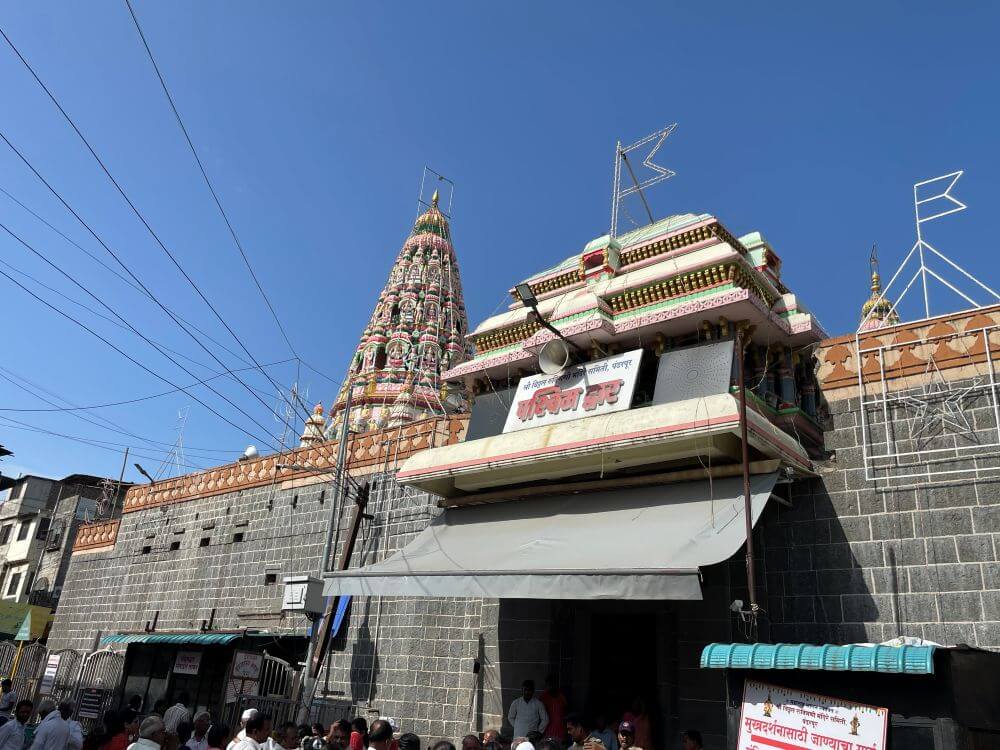
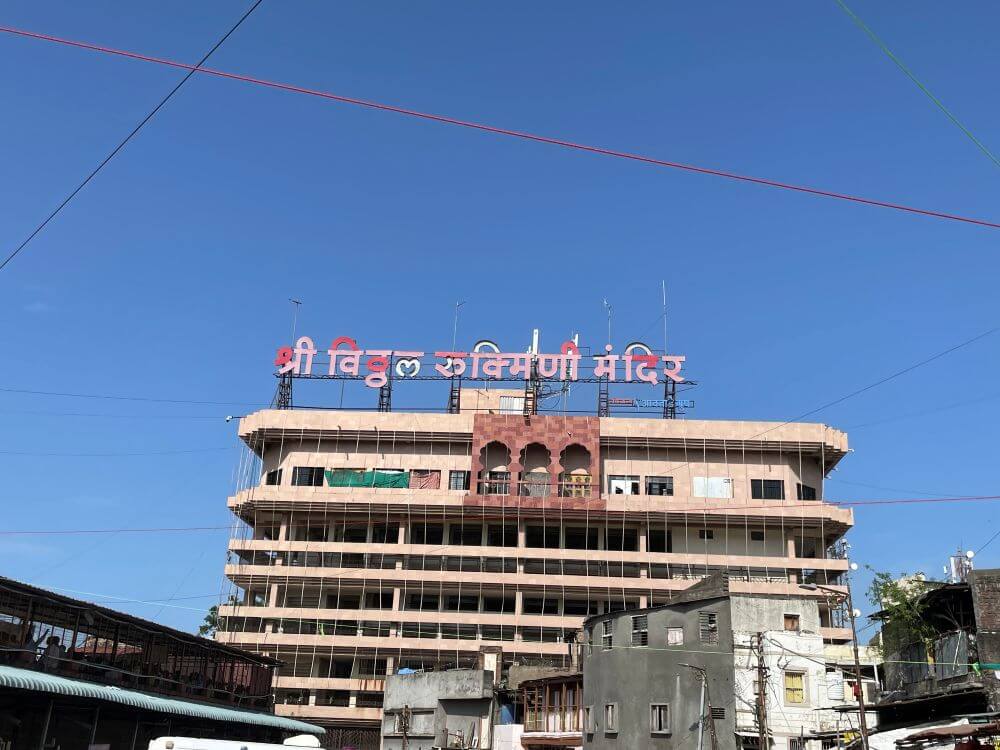
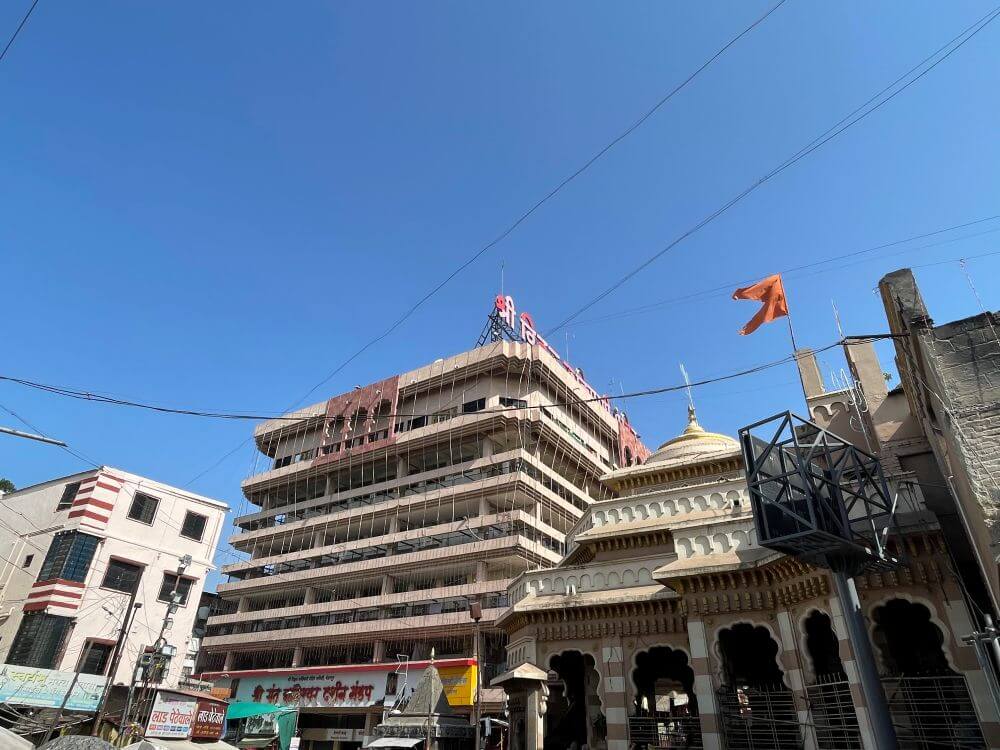
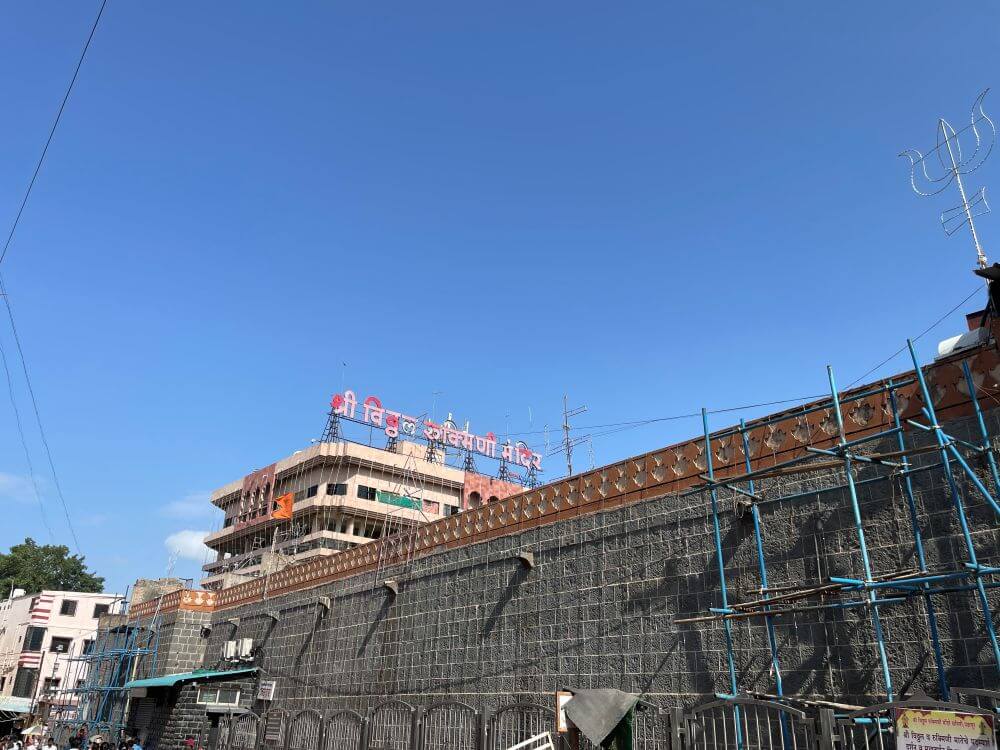
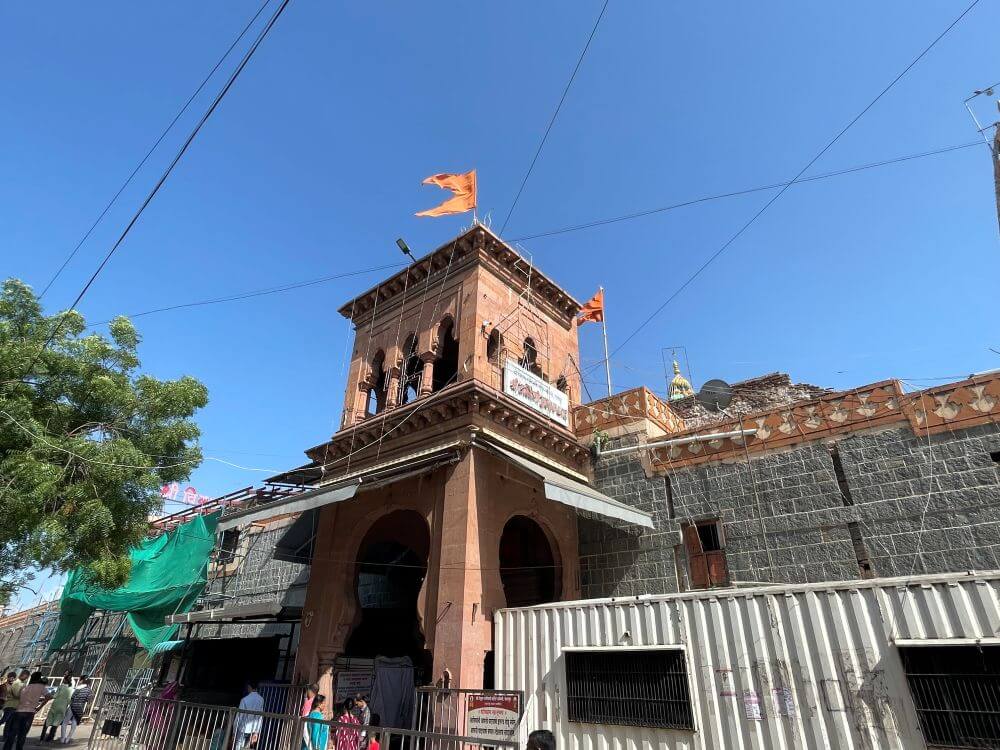
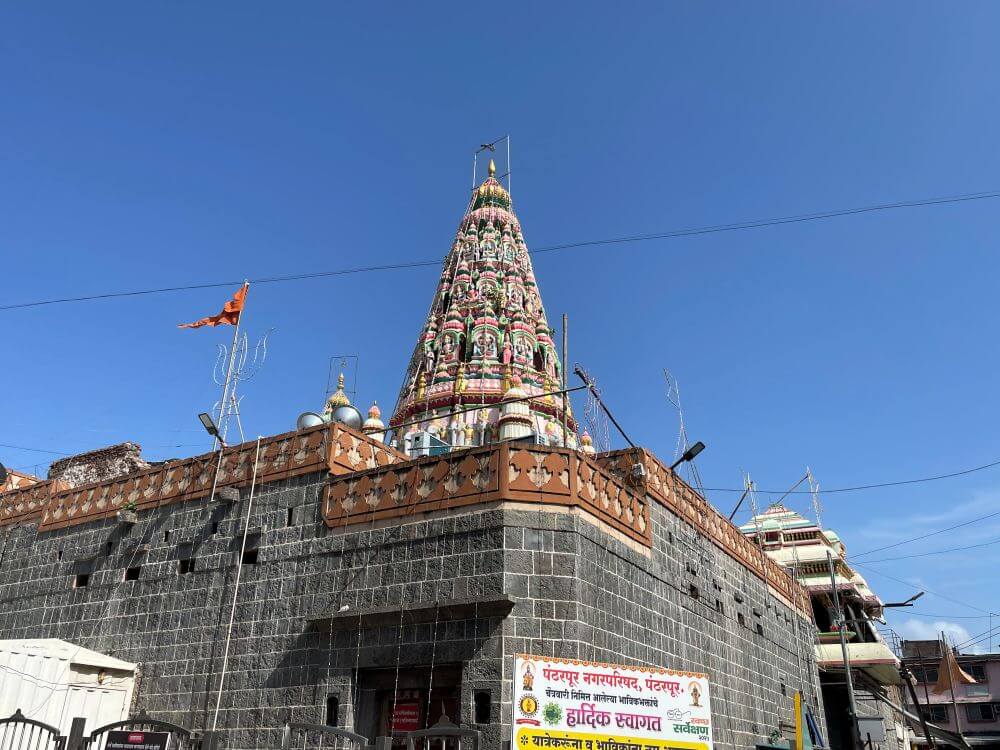
This temple is situated on a high ground in the central part of Pandharpur city. This area has been referred to as Vitthal Tekdi (Vitthal Hill) since ancient times. The temple, which faces east, is 117 meters long from east to west and 58 meters wide from south to north. The western part of this temple is called the Gad (fort). The temple has three gates from the east: Namdev Payari, the Purushanchi Bari door, and the Tartari door. Besides these, there are a total of nine doors: two on the south, one on the west, and three on the north.
The eastern gate of the temple is called the Mahadwar or Namdev Payari. The name ‘Sant Namdevachi Payari’ (Saint Namdev’s step) was given because Saint Namdev took Samadhi on the first step of this gate. This step is covered with a brass sheet. To the right of the step is a brass mask of Namdev. The Warkaris believe that the Samadhi of 14 members of Saint Namdev’s family, including himself, is at this very spot. Near this step is also the Samadhi of Saint Chokhoba. Climbing five steps from the Namdev Payari, one enters the entrance hall (Pravesh Mandap). It is said that there are idols of 33 crore deities in this hall. In front of the entrance hall is the Ganesh Mandap. There are galleries on both sides of this hall, which is supported by five arches. In one of the last galleries, there is a large idol of Ganesha. Above the Ganesh Mandap is the Nagarkhana (drum house). All the construction here is made of stone and is very sturdy.
From the Ganesh Mandap, one enters the main hall. This is also called the Cultural Hall (Sanskritik Mandap). There is a teak wood ceiling above this hall. In this 45-foot-high hall, there are two 30-foot-high lamp pillars (Deepmalas). In this hall, there are the Samadhis of Saint Bodhlebuva, the great poet Pralhadbuva Badve, and Kanhoba Haridas, as well as a seven-foot-high idol of Maruti. It is said that this Maruti idol was installed by Samarth Ramdas Swami. Every day at dawn, during the Kakad Aarti, the Aarti written by Kanhoba Haridas is sung here. The descendants of Kanhoba Haridas perform singing service before Vitthal during the morning worship and recite the Panchpadi in front of the Vitthal chariot on Ashadhi and Kartiki Ekadashi.
From the main hall, one enters the Treasury Hall (Khajina Mandap). In the center of this hall is a large bell donated by the Peshwas. On this European-made bell, ‘VENTVRAFES 1636’ is inscribed. To the left of the Treasury Hall is the Ornament Room (Alankar Griha). Beyond the Ornament Room is the sixteen-pillared hall (Solakhambi Mandap). This hall stands on sixteen stone pillars. On these pillars, there are 64 sculptures depicting scenes from the Mahabharata. In addition, there are many sculptures of Garuda, Nagas, a warring king, Vyasa, elephants, goddesses, and lotuses. Some of these sculptures have become faint and unclear. In this hall, there are symbolic Samadhis of Saint Tukaram Maharaj and Vyasa Narayan. One of the pillars in this pavilion is covered with silver plating. It is famous among devotees as the ‘Garudkhamb’. It is also known as the ‘Purandardas Khamb’ because the saint Purandardas from Karnataka sat near this very pillar to sing hymns of devotion to Vitthal. Records indicate that this sixteen-pillared pavilion was built in 1802 by the wealthy Daundkar of the Shenvi community.
One enters the four-pillared pavilion from the sixteen-pillared pavilion. Two elephants are carved near the door of this pavilion, which is why it is also called the Elephant Door. All temple servitors enter through this door. Furthermore, the materials for worship and the grand offering (Maha-Naivedya) are brought in through this same door. The resolve for the devotees’ grand worship (Maha-Puja) is also taken here. On one side of the four-pillared pavilion is the Lord’s bedchamber. It is opened at the time of the Shejarati (night prayer). Inside, there is a silver bed with pristine white mattresses and pillows. There is a tradition of walking on footcloths while bowing in reverence when entering the bedchamber during the Shejarati.
In front of the four-pillared pavilion is a wooden railing, and beyond that is the entrance to the sanctum sanctorum. The entrance to the sanctum sanctorum is covered with silver plating. It is said that this door was once very small. On 30 April 1953, following the suggestion of the country’s first Prime Minister, Pandit Jawaharlal Nehru, the lower threshold was removed and the door frame was widened, thereby resolving the difficulties faced by devotees. One enters the sanctum sanctorum through this door. Inside the sanctum, there is a three-foot-high, ornate silver pedestal (Vajrapitha). Two cows are carved on both sides of this pedestal. In the center stands the beautiful three-and-a-half-foot-tall black stone idol of Vitthal, the beloved deity of millions of devotees, with His hands resting on His hips. This idol is adorned with original carved ornaments, including a tall, crown-like headgear, makara-shaped earrings, and a necklace of Kaustubha gems. On the left and right chest, there is a small hollow and a circular mark, which are referred to as ‘Shrivatsalanchhan’ and ‘Shriniketan’. Both upper arms are adorned with armlets and wristbands. Vitthal wears a three-layered waistband. Chhatrapati Shivaji Maharaj, Shahu Maharaj of Satara, and the Peshwas of Pune have often offered many ornaments to this Vitthal. These ornaments are made of diamonds, pearls, rubies, and gold. The Lord is adorned with these jewels on days such as Chaitra Shuddha Pratipada, Kartik Shuddha Pratipada, Bhau-beej, Dussehra, Navratri, Gokul Ashtami, and Ram Navami. Every devotee who comes for darshan can place their head on Vitthal’s feet. Notably, until the year 1873, devotees were allowed to embrace the Lord’s feet. In his book ‘Shri Vitthal and Pandharpur’ (1953), historian G. H. Khare records that in 1873, a Bairagi came for the darshan of Pandurang and threw a stone at the Lord’s feet, damaging the idol. Since then, the feet have been reinforced from behind, and now one can only place their head on the feet, not embrace them.
The spire (Shikhara) above the sanctum sanctorum of the Vitthal temple is relatively simple. This three-tiered spire features eight turrets. The first tier contains sculptures of elephant riders, horsemen, and Varkaris absorbed in devotional singing. The tier above it features idols and sculptures of Ganesha, Shakambhari, Narasimha, Garuda, Maruti, Shri Krishna, and the Gopis. Additionally, idols of Saint Tukaram, Samarth Ramdas, and Chaitanya Mahaprabhu are also on the spire. At the pinnacle of the spire is a golden finial (Kalash). The height of this spire from the ground to the finial is 48 feet. This spire, built in the Maratha architectural style, was constructed in 1830 by the Bhor State.
Behind the sanctum sanctorum of the Vitthal temple is a large assembly hall (Sabhamandap) of the Rukmini temple. Records show that this assembly hall was built by Chandulal, the Diwan of the Nizam. In recent times, beautiful decorations have been added to this hall. Oil paintings depicting various episodes from the Rukmini Swayamvar have been installed here. In the sanctum sanctorum, there is an idol of Mother Rukmini in black stone on a pedestal. Upon leaving after taking darshan of Rukmini, one finds the temples of Satyabhama and, adjacent to it, Rahi. These idols are also made of stone. Daily rituals are performed for Satyabhama and Rahi just as they are for Mother Rukmini. Devotees can take darshan of Vitthal-Rukmini in the temple daily from 4:00 AM to 11:00 PM. The daily rituals in the Vitthal temple are conducted according to Vedic traditions. There has been no change in the daily rituals, from waking the Lord to the Shejarati, for the past 200 years. Every morning, the Kakad Aarti takes place.
After the Aarti, a puja is performed with yogurt, milk, butter, honey, and sugar. Then, the Lord is anointed (Abhishek). After the Naivedya and Aarti, the darshan of Vitthal is opened to the devotees. Following this, there is the Panchamrut Puja, Madhyanha Puja (at 12:00 PM), Aparanha Puja (between 3:00 PM and 4:00 PM), Dhuparti (at 7:00 PM), and the Shejarati at 11:00 PM. This Shejarati lasts for one to one-and-a-half hours. Besides this, many festivals like Ashadhi and Kartiki Ekadashi, Maghi and Chaitri Ekadashi, Janmashtami and Dahi Handi, and Tulsi Vivah during Diwali are celebrated here with great enthusiasm. A grand pilgrimage (Maha-Yatra) is held here on Ashadhi and Kartiki Ekadashi. According to Professor Sadanand More, a scholar of saint literature, the tradition of the Ashadhi and Kartiki Wari has existed since at least the thirteenth century. The Wari is mentioned in the 71st line of the inscription on the eastern part of the beam in the sixteen-pillared pavilion. This inscription dates back to 1237, and the mention of the Wari in it is the oldest. Even today, palanquins of various saints from different parts of Maharashtra come here for the darshan of Pandurang during this period. Notably, Justice Ranade provided a list of palanquins passing through Pune. Furthermore, a description of Pandhari written in 1920 records that the palanquin of Kabir used to come here from North India.
This sacred temple stands as a testament to deep spiritual devotion, ancient architectural grandeur, and rich local cultural traditions.
The sanctum sanctorum houses the divine idol consecrated according to ancient Vedic traditions, surrounded by serene courtyards and traditional temple architecture.
Navratri, Maha Shivratri, Annual Temple Jatra & Deepotsav
Compare and book flights, secure top-rated local hotels near the temple, hire reliable guides, and rent cars instantly.
Extend your pilgrimage by visiting other highly sacred temples located nearby.


Add ₹999 more to unlock FREE SHIPPING!
Your sacred cart is currently empty.
Shop Photo FramesFill in your delivery details below to place your order.
Add comment