
Add ₹999 more to unlock FREE SHIPPING!
Your sacred cart is currently empty.
Shop Photo FramesThe final battle of Chhatrapati Shivaji Maharaj’s life, in which he personally fought with his sword, took place in the Sangamner area during the looting of Jalna. Bhalwani is the ancestral village of Sardar Sidhoji Naik-Nimbalkar, who displayed immense valor and attained martyrdom in this battle. The historical mansion (wada) of the Nimbalkars, spread over three acres in this village, remains a center of attraction for many history enthusiasts today. In this same village stands the ancient temple of Shakambhari Devi, a place of faith for countless devotees. This Goddess, who is the family deity (kuldevata) of the Chalukya dynasty, is also known as Banashankari.
The original seat of this Goddess is at Badami in the Bagalkot district of Karnataka. According to mythological legend, a drought lasting one hundred years once struck the Tilakvan region of Badami. At that time, the Goddess brought water from the netherworld (patala) and used it to cultivate trees, shrubs, and vegetables. Seeing this, demons began to destroy the area. The Goddess then mounted a tiger and, accompanied by her nine crore companions, marched against the demons and annihilated them. Because the Goddess created vegetables from her own body and saved lives by bringing water from the Haridratirtha in the netherworld, she was named ‘Shakambhari’ (meaning one who sustains through vegetables). Since she resided in the forest, she also acquired the name Vanshankari or Banashankari.
The Skanda, Padma, and other Puranas contain stories of Banashankari Devi slaying demons named Durgamanasur and Shambhasur. This Goddess is also recognized as an incarnation of Parvati. As described in the Bhagavata Mahapurana, Goddess Parvati performed severe penance to attain Lord Shiva. During this period, she took the form of a Bhil woman and consumed nothing but green vegetables, which is why she was named Shakambhari. In the seventh century, the Chalukya kings built a magnificent temple at the original site of the Goddess in Badami, Bagalkot district, Karnataka. The Chalukyas of Badami worshipped Banashankari in her form as Shakti. Regarding how this Goddess came to Bhalwani, the legend goes that a supreme devotee of the Goddess from Bhalwani used to travel to Badami every year to seek the blessings of Banashankari, or Shakambhari Devi. Due to old age, it became impossible for him to undertake that difficult journey. The Goddess then appeared to him in a dream and said, “Do not trouble yourself to come to me; I shall come to you.” The very next day, he found a stone idol of the Goddess. Worship of the Goddess began at that spot, and in time, the temple of Shakambhari Devi was erected there.
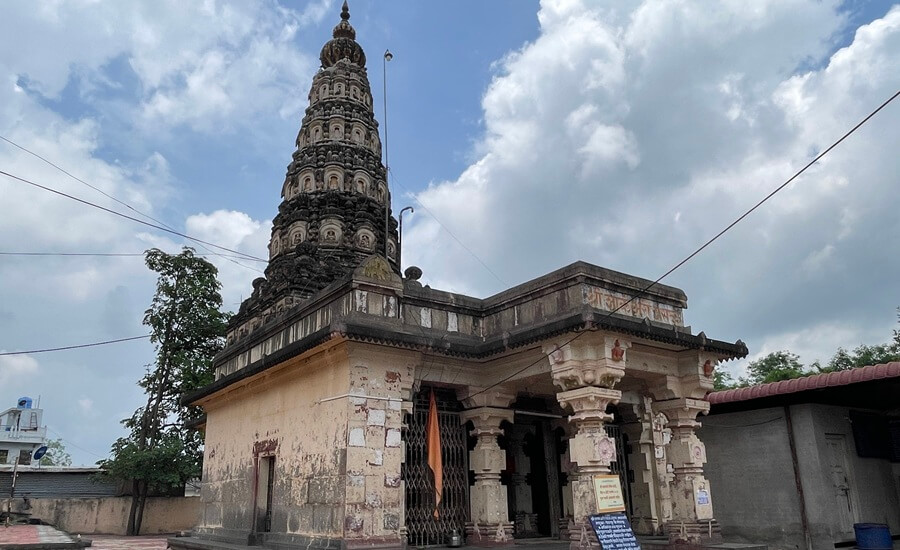
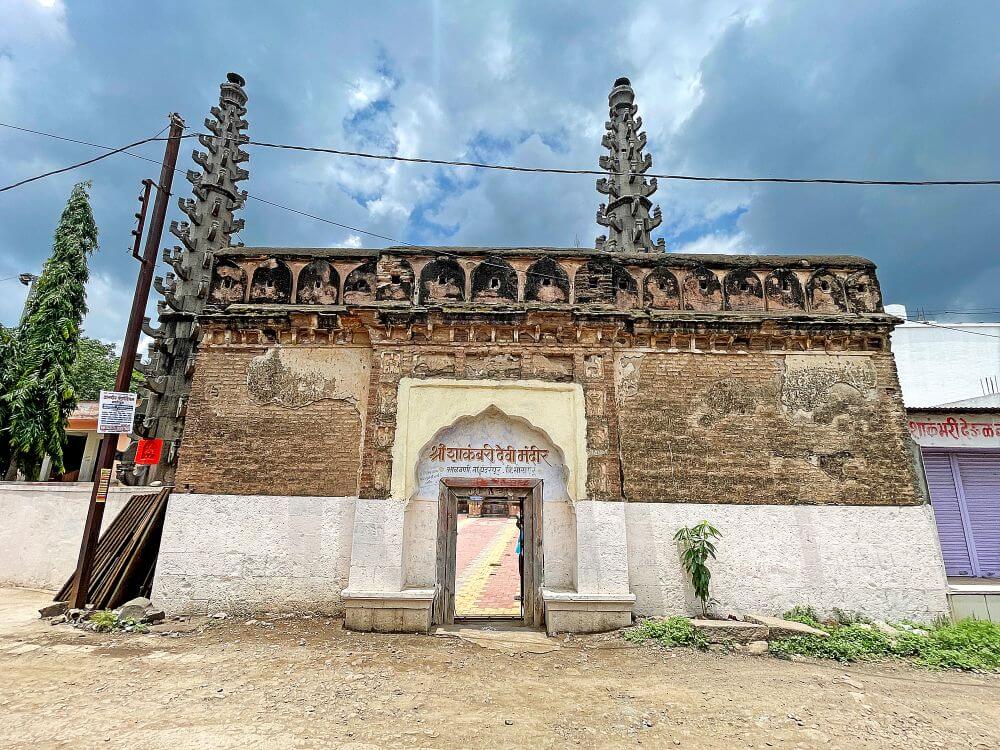
This ancient temple stands in the heart of Bhalwani village. There is a main entrance within the perimeter wall surrounding the temple. Sculptures are carved onto the pillars on both sides of the entrance. Above the entrance, in the upper section, there are 15 niches for deities (devakoshthas). One enters the temple courtyard through the gate in the perimeter wall. In the courtyard, to the right and left of the entrance, are unique, beautifully crafted lamp pillars (deepmalas). The lamp pillar on the left stands on an octagonal pedestal. There are elephant sculptures on all four sides of this pedestal. In the upper part of the pedestal, around the lamp pillar, there are six elephant sculptures. Above that section are the brackets of the lamp pillar. In the center of these brackets, Ganesha, Maruti, Mahadev, and other deities are carved. This sculptural design continues to the top of the lamp pillar. The lamp pillar on the right has fewer, yet equally beautiful, sculptures.
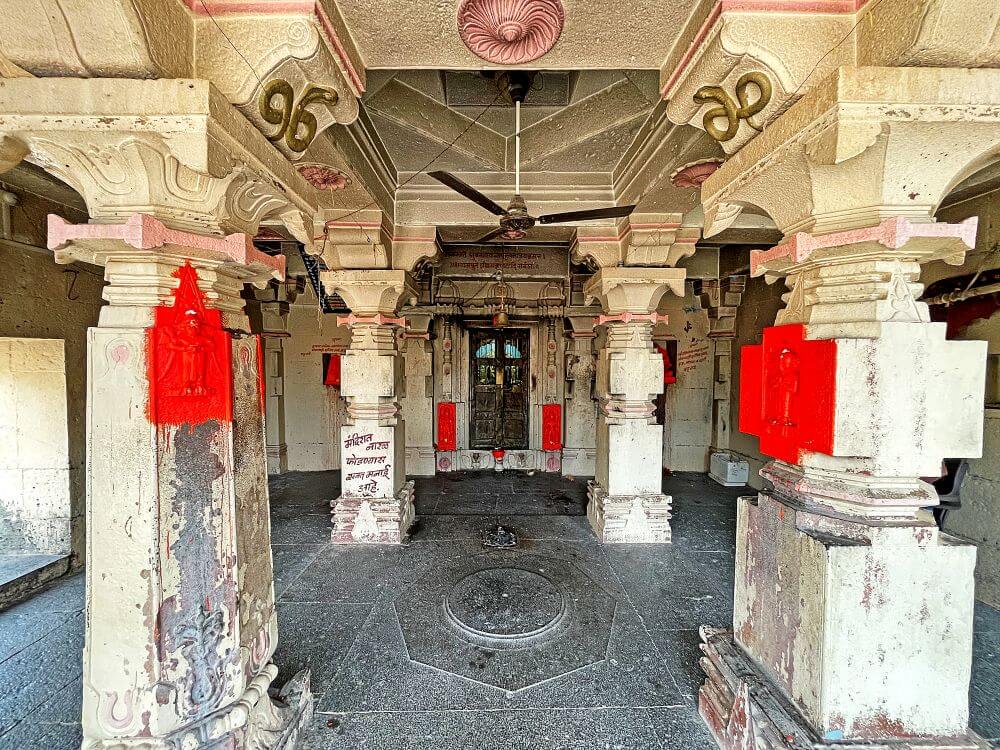
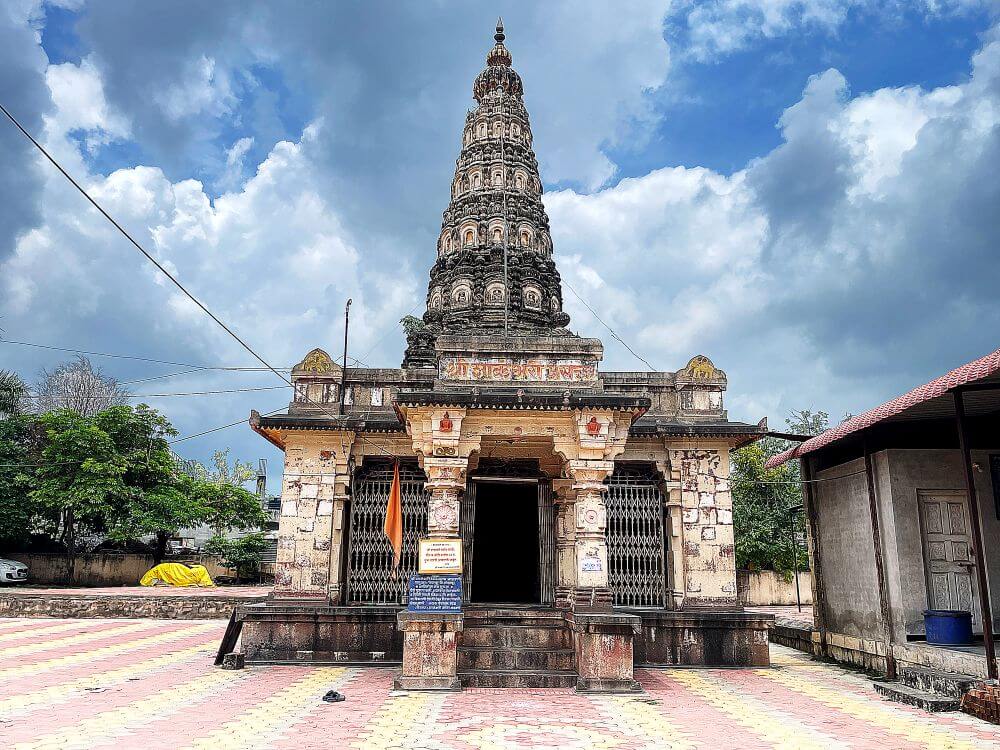
The temple structure consists of a front hall (mukhamandap), an assembly hall (sabhamandap), an intermediate chamber (antarala), and the sanctum sanctorum (garbhagriha). The four stone pillars in the front hall are intricately carved. One enters the assembly hall of this temple, which stands on a high plinth (jagati), by climbing four steps at the front hall. On both sides of these steps are stone seats (kakshasanas). In the center of the four stone pillars of the enclosed assembly hall is a colored stone slab (rangshila). On the first two of these pillars are relief sculptures of Hanuman and Garuda. The pillar with the sculpture of Garuda is known as the Garuda pillar. Naga sculptures are carved on the brackets above the ornate pillars in the assembly hall. Such Naga sculptures are found in many places throughout this temple. There are stone chandeliers featuring Naga mandalas on the ceilings of both the front hall and the assembly hall. A graceful idol of Vishnu is visible in the center of these chandeliers.
In the intermediate chamber, there are niches on both sides of the entrance to the sanctum sanctorum. These contain idols of local deities along with Ganesha. On the pillar branches on both sides of the entrance, there are sculptures of gatekeepers (dvarapalas) at the bottom. There is an idol of Ganesha on the lintel (lalatbimba), and on the upper row above it (the carving parallel to the top of the door frame), three spires and two sheep figures are carved. Between the horns of these sheep are Naga sculptures.
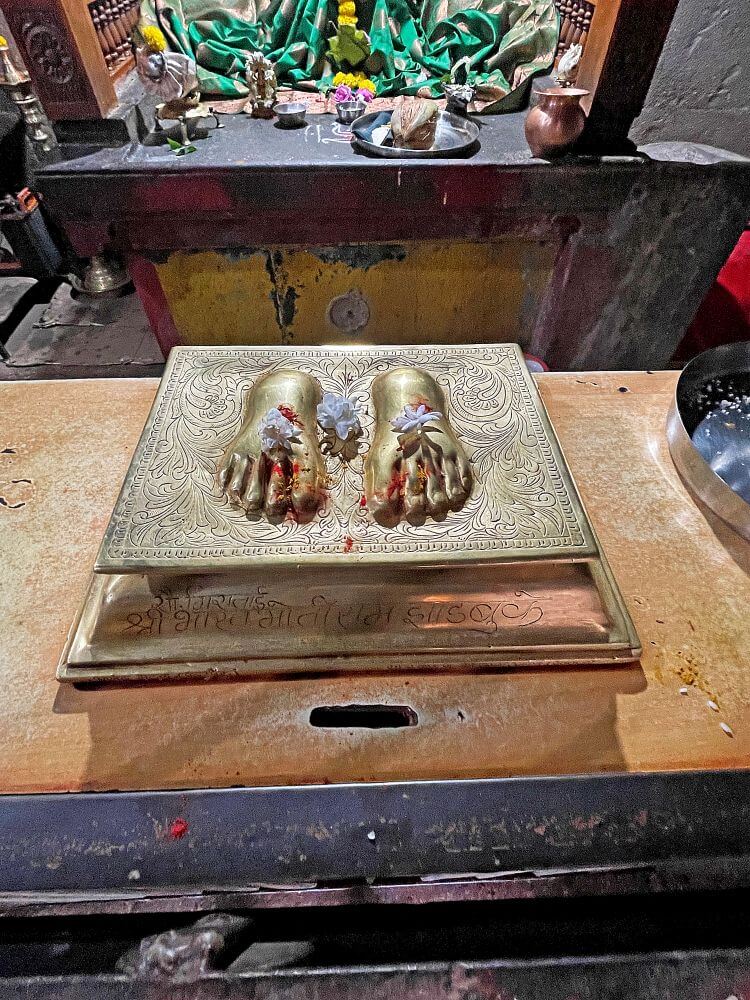
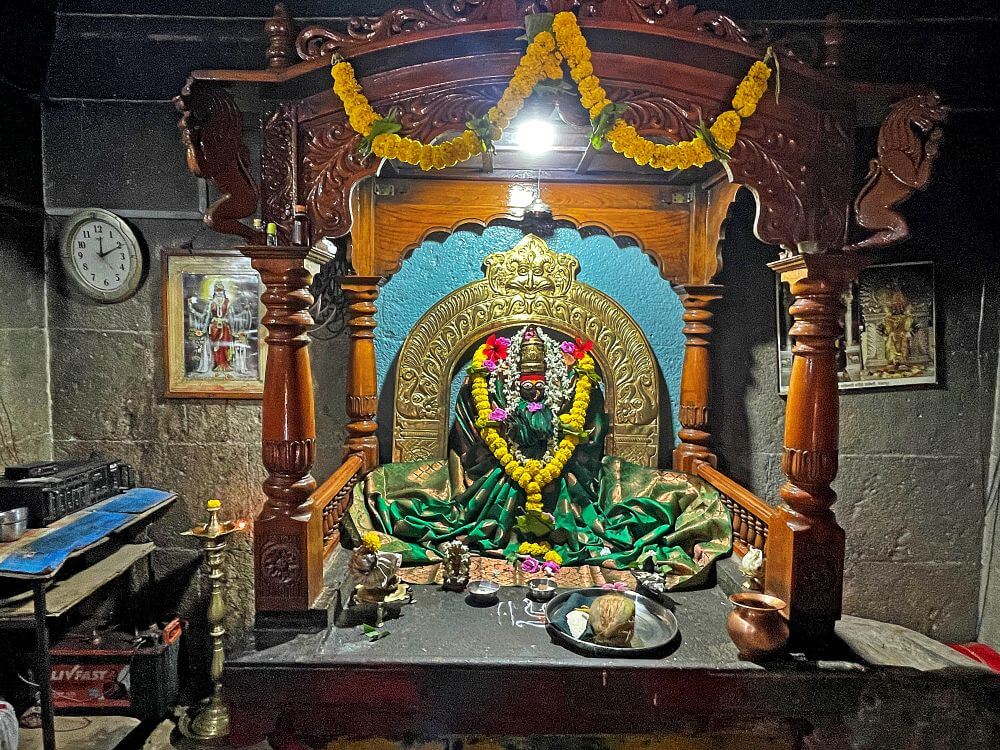
Near the entrance of the sanctum sanctorum are the metal sandals (padukas) of the Goddess. Inside the sanctum, on a diamond-shaped pedestal (vajrapitha), sits the four-armed idol of Shakambhari Devi made of black stone, placed within an intricately carved wooden canopy (makhar). Adorned with a crown, a vermilion mark on her forehead, silver eyes, a nose ring, and rich garments and jewelry, the idol of the Goddess appears calm and beautiful. In her hands, the Goddess holds weapons such as a damaru, a trident, a spear, and a discus. One of the Goddess’s legs is lowered while the other is folded. Behind the idol is a brass halo (prabhaval) with ornate carvings. The sanctum sanctorum of the temple is topped by a five-tiered spire (shikhara). The first tier is square, and the upper part is circular up to the finial (kalash). This spire features many niches containing various idols. At the apex of the spire are two amalakas, topped by a finial.
The temple sees a large influx of devotees during the month of Shravan, as well as during the Ashwin and Paush Navratris. The Paush Navratri festival is celebrated on a grand scale at the temple. The Navratri festival of Shakambhari Devi lasts from the eighth day (ashtami) to the full moon (purnima) of the bright fortnight of Paush. This Navratri is as significant as the one in the month of Ashwin. During this period, devotees offer a feast consisting of more than 60 different types of vegetables to the Goddess. Banashankari Devi is the family deity of many clans in Maharashtra. Her devotees believe that her blessings are always upon them because she watches over them with a hundred eyes. For this reason, she is also called Shatakshi.
In many families across Maharashtra, the Shakambhari Devi Navratri is observed with deep devotion. In their homes, the Naivedya is offered to the Goddess on Shakambhari Purnima before sunrise. For this, cooking begins after midnight. Only freshly prepared items are included in the offering. This includes special Maharashtrian delicacies such as Metkut, Udad papad, Tilvade, Gavhale, Katachi Amti, Sakharbhat, Gunja, Tambit, Amti-bhat, Varan-bhat, plain rice, and sixty types of vegetables. To commemorate the Goddess who sustains the universe with leafy vegetables, leaves, fruits, flowers, and green vegetables are donated on Shakambhari Purnima.
This sacred temple stands as a testament to deep spiritual devotion, ancient architectural grandeur, and rich local cultural traditions.
The sanctum sanctorum houses the divine idol consecrated according to ancient Vedic traditions, surrounded by serene courtyards and traditional temple architecture.
Navratri, Maha Shivratri, Annual Temple Jatra & Deepotsav
Compare and book flights, secure top-rated local hotels near the temple, hire reliable guides, and rent cars instantly.
Extend your pilgrimage by visiting other highly sacred temples located nearby.


Add ₹999 more to unlock FREE SHIPPING!
Your sacred cart is currently empty.
Shop Photo FramesFill in your delivery details below to place your order.
Add comment