
Add ₹999 more to unlock FREE SHIPPING!
Your sacred cart is currently empty.
Shop Photo FramesThe Shrimant Dagadusheth Halwai Ganapati Temple holds an extremely significant place in the cultural and religious history of Pune city. When one speaks of Ganapati in Pune, the name Shrimant Dagadusheth Halwai is the first to come to mind. This deity is renowned worldwide as the Ganapati who fulfills vows. This Ganapati is considered the wealthiest and most benevolent deity in Pune. This temple and the annual public festival celebrated here are regarded as an integral part of Pune’s cultural tradition.
This temple was established in 1893. The story behind it is that Dagadusheth Gadve, originally from Ausa village in Latur district, came to Pune for business. He started his sweetmeat business in Budhwar Peth. As his business grew significantly, people began to know him by the name ‘Halwai’ (sweetmaker). This later became his surname. Dagadusheth was a successful merchant. He was renowned for his virtuous character and generosity. Recognizing his social work, the British honored him with the title ‘Nagarseth’ (City Elder). Dagadusheth had a fondness for exercise. He himself was an accomplished wrestler. He was known as the ‘Vastad’ (master) of Pune’s famous Jagaba Talim (wrestling arena). He had trained many wrestlers.
A tragic event suddenly occurred in the lives of Dagadusheth and his wife, Lakshmibai. Around 1892, Pune faced the severe calamity of the plague epidemic. In this epidemic, they lost their only son. The death of their son brought immense sorrow upon the couple. A sense of detachment from worldly life arose in their hearts. It was during this difficult period that they met their spiritual guru, Shri Madhavnath Maharaj. Maharaj consoled the grieving couple. Maharaj advised them to consecrate idols of Shri Dattatreya and Ganapati. He told them to serve these deities as if they were their own child. Maharaj blessed them, saying that these deities would spread their name and fame across the world. Maharaj’s words gave Dagadusheth new hope. He found the strength to live.
He consecrated a clay idol of Ganapati and a marble idol of Datta in Budhwar Peth. Even today, the Shrimant Lakshmibai Dagadusheth Halwai Datta Temple and Ganapati Temple are famous in their name. The history of this Ganapati is linked with the Indian freedom struggle. This Ganapati was established in 1893. The public nature of this festival was inspired by Lokmanya Tilak. During that period, the British had banned political gatherings. However, religious events were legally permitted. Recognizing this opportunity, Lokmanya Tilak called for a public Ganesh festival in 1894. This brought people together. A sense of patriotism was instilled in them. In 1896, Dagadusheth Halwai decided to celebrate the public Ganesh festival in his temple. The consecration (Pranapratishtha) of this Ganapati idol was performed by Lokmanya Tilak. This is a significant event in Pune’s history.
In the initial period, this Ganapati was known as ‘Kotwal Chavadi cha Ganapati’. It was also called ‘Bahulichya Houdacha Ganapati’ (Ganapati of the Doll’s Pond). Dr. Vishram Ghole had built a pond there in memory of his deceased daughter. There was a doll on that pond. From that, the Ganapati in this area got its name. The magnificent idol present in the temple today is the third idol of the Mandal (trust). The first idol was created by Baburao Naik in 1893. It is currently in the Ram Temple in Shukrawar Peth. Subsequently, the second idol was made in 1896. It is currently at the Trust’s center in Kondhwa. The current famous idol was created in 1968 on the occasion of the Mandal’s Amrit Mahotsav (Diamond Jubilee). This idol was crafted by the renowned sculptor from Karnataka, Shri Shankarappa Shilpi.
While the work of making the idol was underway, there was a major solar eclipse. During this eclipse period, the sculptor performed special worship of the deity. A consecrated Shri Yantra has been installed in the abdomen of the idol. Devotees believe that due to this Yantra, the spiritual radiance of the idol will continue to grow over time. The Dagadusheth Halwai Ganapati holds a special allure for many eminent personalities. Ganasamradni Lata Mangeshkar sang her first song at the age of eight in the pandal (marquee) of this very Ganapati. Former President of India, Fakruddin Ali Ahmed, performed the aarti of this Ganapati in 1975. Jaya Bachchan, wife of superstar Amitabh Bachchan, had made a vow to this Ganapati. After Amitabh Bachchan recovered, she herself came to Pune and offered golden ears to Ganapati. Even today, many artists, politicians, and athletes come to seek darshan (blessings) of this Ganapati.
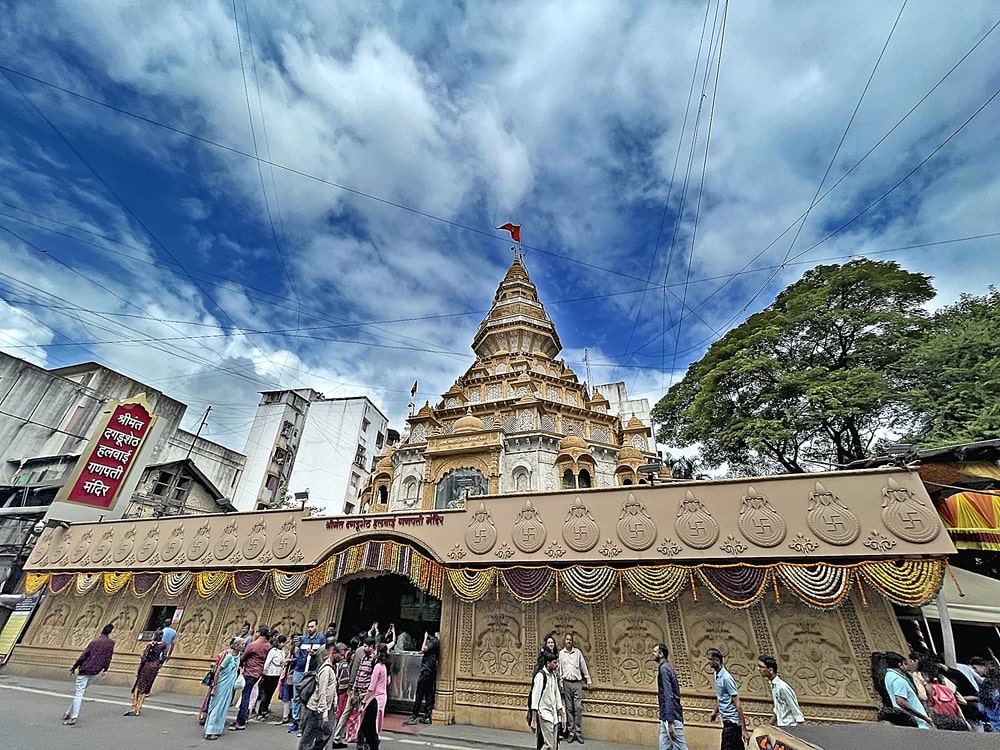
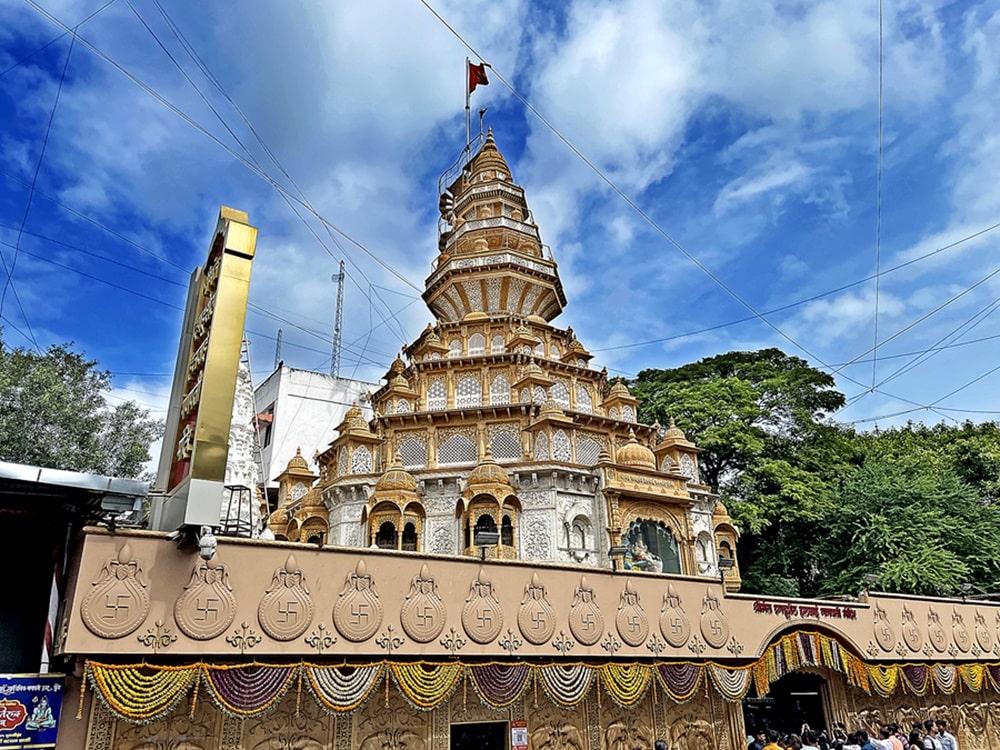
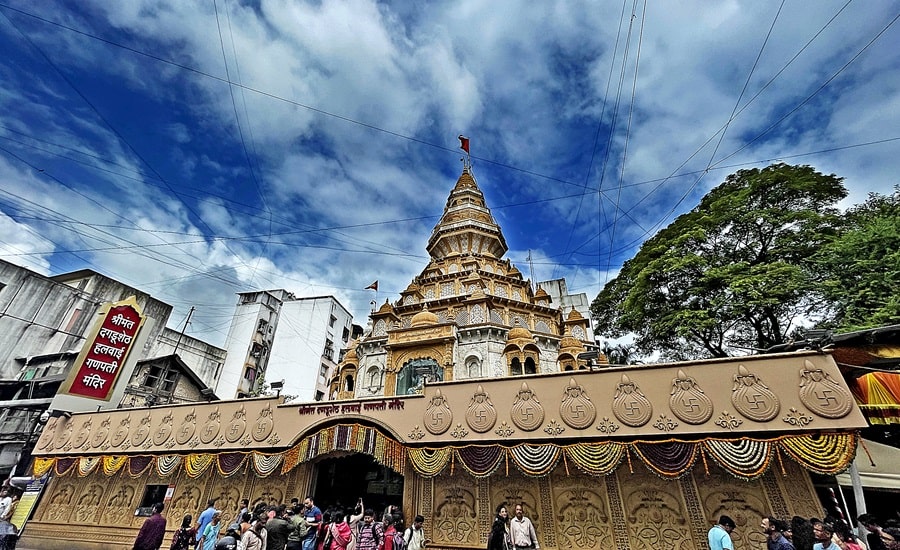
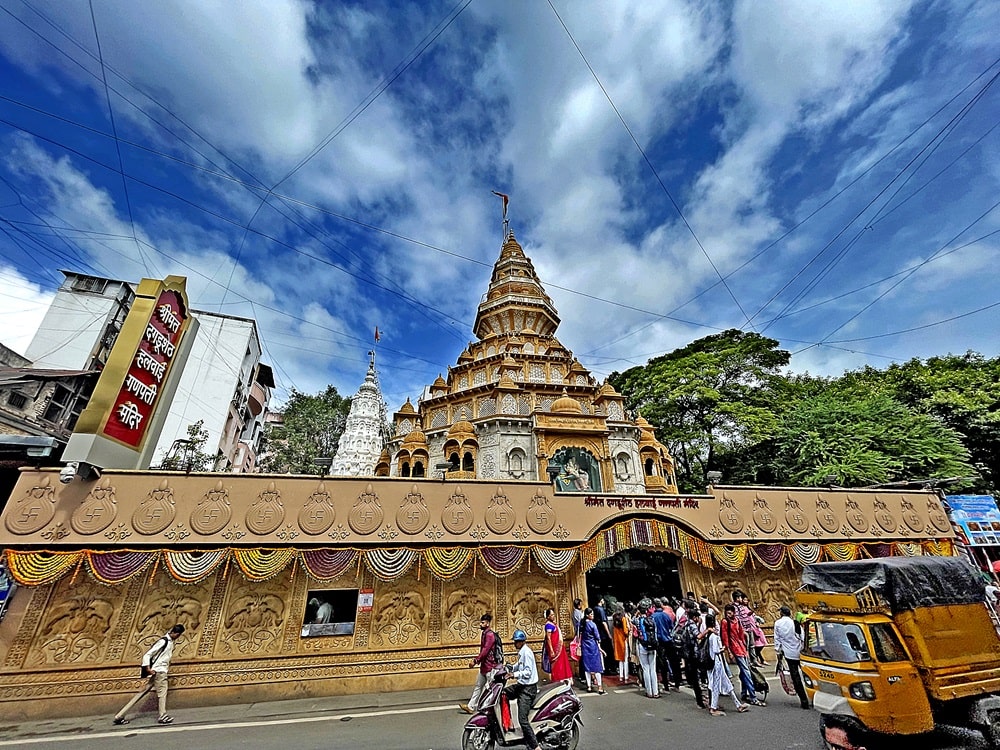
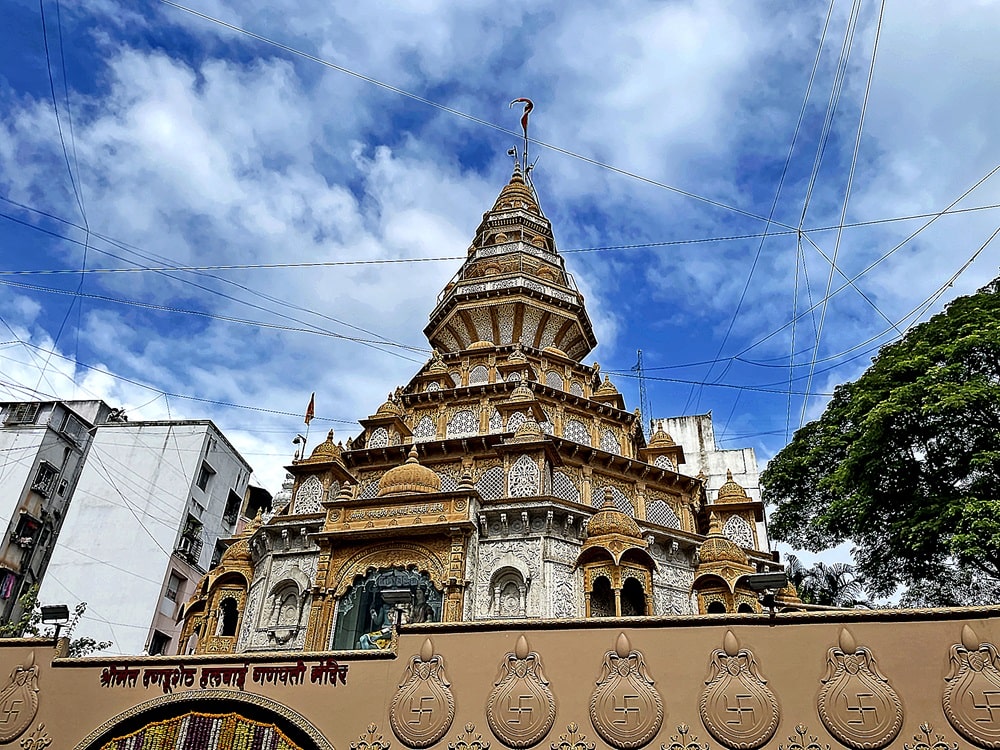
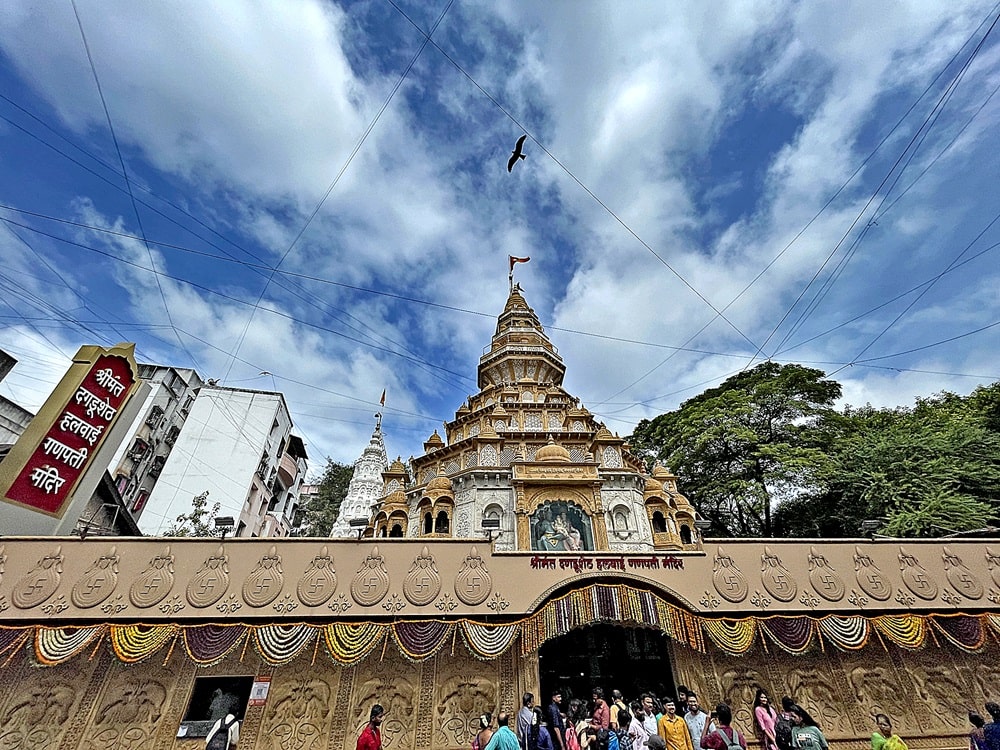
The architectural style of this temple is a confluence of ancient Indian temple tradition and modern grandeur. The main construction of the temple is done in stone and marble. The entrance is extremely grand and intricately carved. A unique feature of this temple is the glass panels installed on its walls. This allows devotees passing by on the main road to easily have darshan of Ganesha. The walls of the temple’s sanctum sanctorum (garbhagriha) are adorned with delicate and artistic carvings. In the center of the garbhagriha is a beautiful idol of Ganesha, 7.5 feet tall and 4 feet wide. This idol captivates devotees not only with its grand size but also with its elegance and radiance. Ganapati’s ears, hands, and crown are made of pure gold. They are adorned with precious gems like diamonds, rubies, and emeralds.
The temple’s shikhara (spire) and kalasha (finial) bear witness to traditional Indian architectural style. The parapet on the temple’s roof is adorned with Swastika symbols and Mangal Kalash (auspicious pots). This shikhara is divided into many tiers. It tapers upwards. The entire shikhara has been given a golden sheen. It appears even more beautiful when sunlight falls upon it. Each tier of the shikhara features intricate carvings. These include small Meghadambari (canopies) and Gavaksha (arch-shaped windows) designs. At the pinnacle of the shikhara is a golden kalasha. Smaller domes and chhatris (umbrella-shaped pavilions) are designed around the main shikhara. This makes the structure resemble a royal palace. At night, when the shikhara is illuminated with electric lights, the beauty of the temple is further enhanced.
In this temple, festivals like Ganesh Jayanti, Sankashta Chaturthi, and Vinayaka Chaturthi are celebrated. During Ganesh Utsav, magnificent replicas of famous temples from across the nation are erected here every year. Thousands of devotees gather to witness this Ganpati’s illuminated chariot during the immersion procession on Anant Chaturdashi. The collective recitation of Atharvashirsha by thousands of women on Rishi Panchami is a highly disciplined and cherished event here. Devotees can have Darshan of this Ganpati daily from 5:30 AM to 11:00 PM. Aarti is performed here in the morning, afternoon, and evening. Additionally, Abhishekam and the divine adornment (Shringar) of the idol are performed. Shejarati is offered at 10:30 PM. The Shrimant Dagdusheth Halwai Ganpati Trust makes significant contributions not only in the educational sphere but also in the health and social sectors. Services such as assisting underprivileged students and providing medical treatment to needy patients are also rendered by the Trust.
This sacred temple stands as a testament to deep spiritual devotion, ancient architectural grandeur, and rich local cultural traditions.
The sanctum sanctorum houses the divine idol consecrated according to ancient Vedic traditions, surrounded by serene courtyards and traditional temple architecture.
Navratri, Maha Shivratri, Annual Temple Jatra & Deepotsav
Compare and book flights, secure top-rated local hotels near the temple, hire reliable guides, and rent cars instantly.
Extend your pilgrimage by visiting other highly sacred temples located nearby.


Add ₹999 more to unlock FREE SHIPPING!
Your sacred cart is currently empty.
Shop Photo FramesFill in your delivery details below to place your order.
Add comment