
Add ₹999 more to unlock FREE SHIPPING!
Your sacred cart is currently empty.
Shop Photo Frames
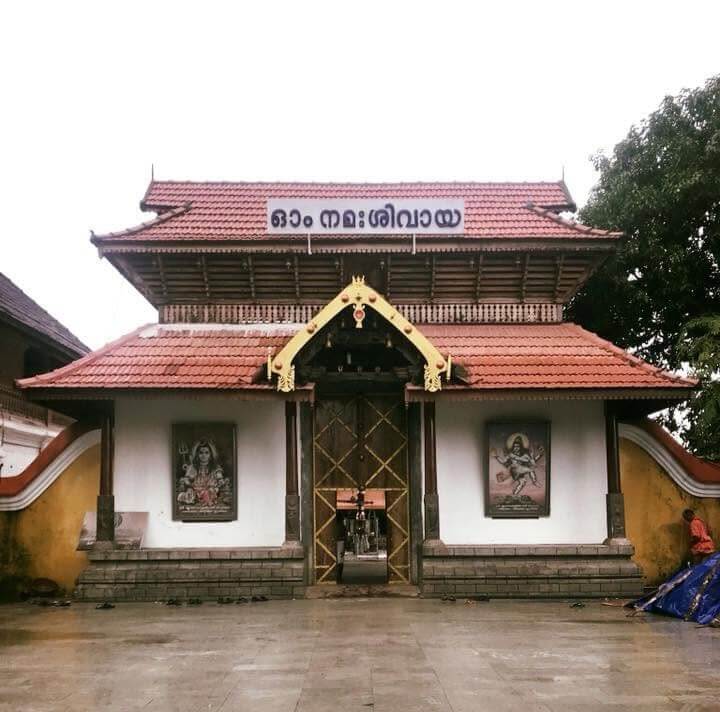
Ernakulam Shiva Temple is a renowned Shiva temple situated in the heart of Ernakulam city, the industrial capital of Kerala, overlooking the picturesque Kochi backwaters. Be-lieved to be one of the 108 Shiva temples consecrated by Sage Parashurama, the temple is dedicated to Lord Shiva in his fierce form. The deity is worshipped in two aspects: as Kiratha Moorthy and together with Goddess Parvathi. The temple also houses shrines dedicated to Lord Ganesha, Lord Subrahmanya, Lord Ayyappa and the Naga deities. Popularly known as Ernakulathappan, the presiding deity is regarded as the tutelary deity of Ernakulam city. The temple is also one of the seven royal temples of the former Kingdom of Kochi and is presently administered by the Cochin Devaswom Board.
The Ernakulam Shiva Temple is believed to have a history spanning more than 2,000 years. References to the temple can be found in Sangam literature, where it is described as one of the prominent centres of worship in the ancient Chera Kingdom. In the 17th century, following the Dutch conquest of Fort Kochi, the Kochi rulers shifted their capital to Ernakulam and built a royal palace near the temple. Thereafter, Ernakulathappan came to be revered as the guardian deity and tutelary deity of the city. Having fallen into disrepair over the centuries, the temple underwent extensive reconstruction under the leadership of Diwan Sri Edakkunni Sankara Warrier of the Kingdom of Kochi, beginning in 1842. Completed in 1846, this renovation gave rise to the grand temple complex seen today, built in the traditional Kerala architectural style. The temple remained under the direct administration of the Kochi royal family until 1949, after which its management was transferred to the Cochin Devaswom Board.
A popular legend associated with the origin of the Ernakulam Shiva Temple is linked to the Mahabharata. It is believed that Arjuna performed severe penance to please Lord Shiva and obtain divine weapons. To test Arjuna’s devotion and determination, Lord Shiva and Goddess Parvathi appeared before him in the guise of hunters (Kirathas). At that moment, the Asura Mookasura, disguised as a wild boar, charged towards Arjuna. Both Arjuna and Lord Shiva, in his hunter form, simultaneously shot the boar with their arrows. A fierce dispute and battle then arose between them over who had slain the animal. Eventually, Arjuna realised that the hunter standing before him was no ordinary man. In deep devotion, he fashioned a Shiva Linga from the earth and worshipped it. Pleased by Arjuna’s unwavering faith, Lord Shiva appeared in his true form along with Goddess Parvathi and bestowed upon him the divine Pashupatastra. Devotees believe that the Shiva Linga worshipped by Arjuna is the very deity enshrined at the Ernakulam Shiva Temple today.
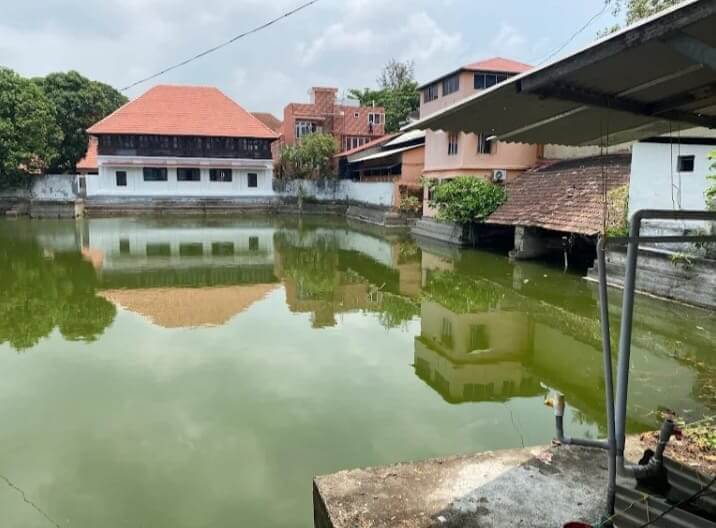
Another legend associated with the temple concerns a sage’s son named Valan (referred to as Devalan in certain Puranic accounts). A disciple of Sage Kashyapa, he is believed to have been cursed, resulting in him acquiring the body of a Naga and a disfigured face. In search of relief from the curse, he travelled to numerous sacred sites across India, but without success. Eventually, he arrived at this forest-covered region and discovered the Shiva Linga worshipped by Arjuna. Embracing the Linga and praying with deep devotion, he is said to have invoked the grace of Lord Shiva, who appeared before him and instructed him to immerse himself in the nearby sacred temple pond. Upon doing so, the curse was lifted and he regained his original divine form.It is also believed that the area was originally known as ”Rishinagakulam”, meaning ”the pond of the sage and the Naga”, referring to the Shiva Linga worshipped by both the sage’s son (Rishi) and the Naga. Over time, the name is believed to have evolved and transformed into the present-day name, ”Ernakulam”.
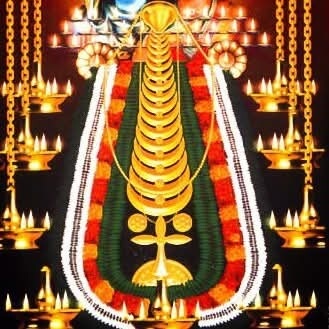
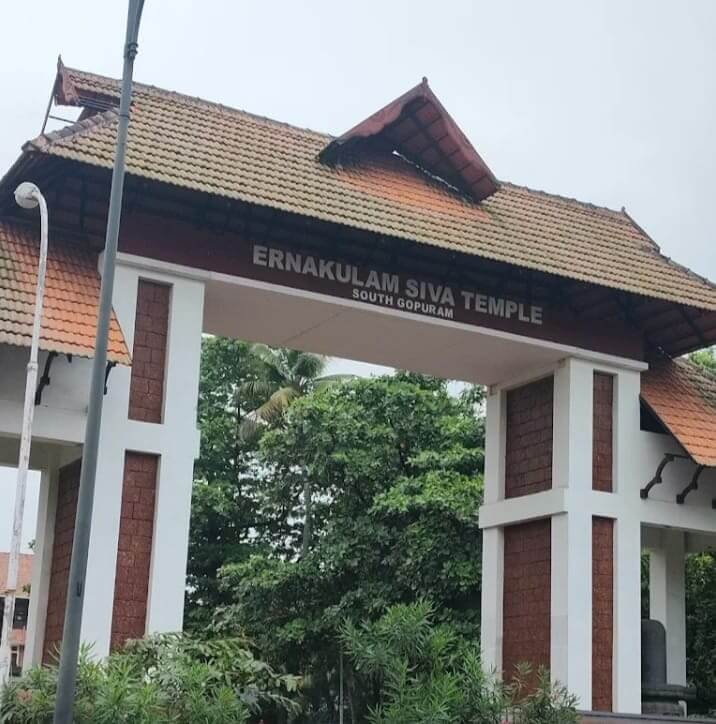
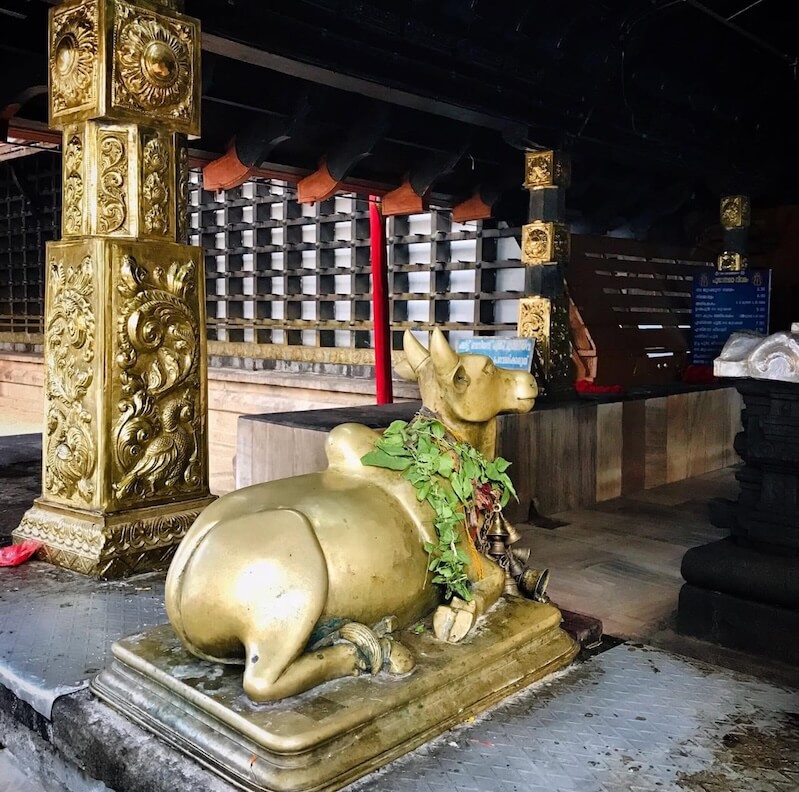
Ernakulam Shiva Temple has two gopurams, one on the eastern side and the other on the western side. The eastern side features an elegant entrance gateway bearing the name of the temple, while the western side is marked by a majestic two-storeyed gopuram. Upon entering through the western gopuram, visitors first reach a spacious elephant shelter. Nearby stand the golden flagstaff facing Nandi, the sacred vehicle of Lord Shiva and the Balikkalpura (sacrificial altar pavilion). The ceiling of the Balikkalpura is adorned with carvings of Lord Brahma and the Ashta Dikpalakas (guardians of the eight directions). Within the temple courtyard, which covers an area of approximately two acres, stands the main temple complex along with the Ernakulathappan Hall on the northern side. In the north-eastern corner is a shrine dedicated to Lord Ayyappa, facing west. Close to it is the shrine of the Naga deities, where Vasuki is worshipped as the Naga Raja, accompanied by Naga Yakshi, Naga Kanyaka, Naga Chamundi and other attendant deities. Outside the temple walls, on the north-eastern side, lies the legendary temple pond associated with the temple’s traditions. Although the eastern entrance remains closed at present, it is believed to preserve indications that the presiding deity originally faced east.
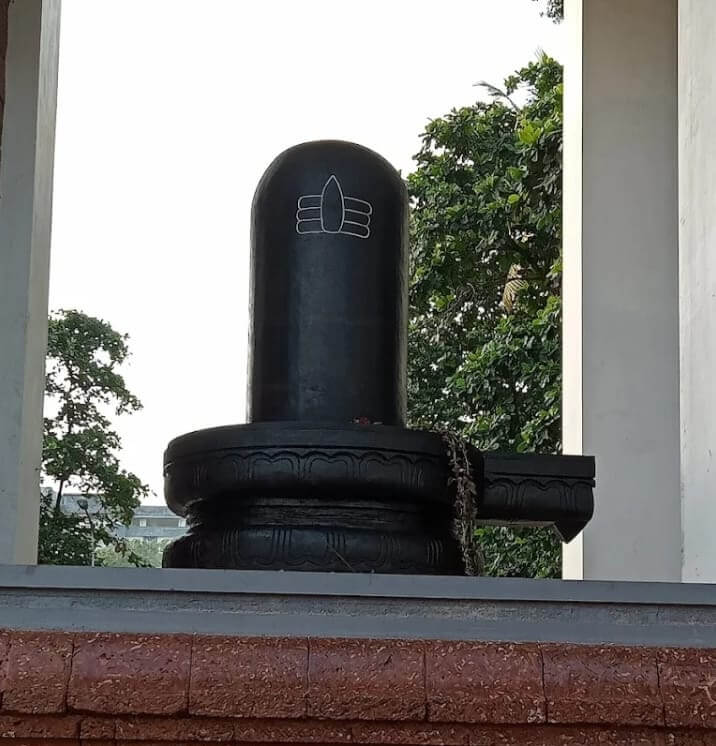
The main sanctum sanctorum (Sreekovil) of Ernakulathappan Temple is a fairly large circular shrine built in the traditional Kerala style. Constructed of granite, the Sreekovil is crowned with a copper-clad roof topped by a golden finial. The structure consists of three chambers, with the innermost chamber serving as the sanctum, where a Shiva Linga of approximately two and a half feet in height is enshrined facing west. The outer chamber is used for preparing rituals and storing ceremonial articles, while the middle chamber serves as a passage between the outer chamber and the sanctum sanctorum, providing access for the priests. Priests access the sanctum through this intermediate chamber. On the northern side of the Sreekovil is a beautifully constructed outlet through which the sacred abhisheka water flows out. In accordance with the customs observed in Shiva temples, devotees are not permitted to perform circumambulation beyond this outlet.
Surrounding the main Sreekovil is a Nalambalam, constructed in the traditional Kerala temple architectural style. Entrance pavilions can be seen on either side of the gateway leading into the Nalambalam, with the southern pavilion being used for Vedic rituals, including homams. To the north of the main sanctum is the shrine of Kiratha Moorthy. The temple complex also includes a Thidappally (temple kitchen) and a well situated in the north-eastern corner. In the south-western corner stands a shrine dedicated to Lord Ganesha, facing east. Shrines for Lord Subrahmanya and the Karinaaga deity are also located nearby. In front of the main Sreekovil is a square-shaped Namaskara Mandapam. Supported by four pillars, this pavilion features a copper-clad roof topped with a golden finial. The ceiling is adorned with carvings of Lord Brahma and the Ashta Dikpalakas (guardians of the eight directions), while the pillars bear sculpted images of various deities and Brahmins. On the eastern side of the mandapam stands a statue of Nandi, the sacred vehicle of Lord Shiva.
The annual festival of Ernakulam Shiva Temple is celebrated with great devotion over eight days during the Malayalam month of Makaram (January–February). The festival concludes with the ceremonial Aarattu on the Thiruvathira star day of Makaram. Major attractions include the renowned Pakal Pooram, caparisoned elephants, Panchavadyam, Pandimelam, the grand Aarattu procession and a spectacular fireworks display held at the Durbar Hall Ground. The festival period also features a variety of cultural programmes, including Kathakali, Ottanthullal and classical music concerts, along with the distribution of prasadam to devotees.
Apart from the annual Makara Festival, Mahashivaratri, Dhanu Thiruvathira, Pradosham and Ayilyam are among the major observances at Ernakulam Shiva Temple. Mahashiv-aratri, celebrated during the Malayalam month of Kumbham (February–March), attracts large numbers of devotees, with special poojas and devotional programmes continu-ing throughout the night. Dhanu Thiruvathira, observed during the month of Dhanu (December–January), is regarded as an especially sacred day associated with Lord Shiva and is marked by special rituals and worship. In addition, special Pradosha poojas are conducted on every Pradosham day, while Mondays, considered particularly auspicious for the worship of Lord Shiva, witness increased devotional activities. Special poojas and offerings of Noorum Paal are also performed for the Naga deities on every Ayilyam star day, drawing numerous devotees seeking blessings.
The principal offerings (Vazhipadu) at the temple include Ellu Thulabharam, Udayasthamaya Pooja, Jaladhara, Shankhabhishekam, Mrityunjaya Homam, Koovalam Mala and Pinvi-lakku. Among these, Ellu Thulabharam, in which devotees offer sesame seeds equal to their body weight, is one of the most popular offerings. Udayasthamaya Pooja, a series
of rituals conducted from sunrise to sunset, is also performed with great devotion. Jal-adhara and Shankhabhishekam, involving the ceremonial offering of sacred water to the Shiva Linga, are believed to promote good health, longevity and peace of mind. Mrityun-jaya Homam is performed for protection from dangers and for long life. Other important offerings include the presentation of Koovalam Mala, the lighting of Pinvilakku, Adima Kidathal, Vedi Vazhipadu and Pithru Bali Tharpanam. Devotees undertake these offer-ings with the belief that they bring family welfare, prosperity, fulfilment of wishes, and spiritual well-being.
At Ernakulam Shiva Temple, the sanctum opens at 3:30 a.m. with the Palliyunarthal (awakening of the deity), followed by Nirmalya Darshanam, various Abhishekams, Malar Nivedyam, Usha Pooja, Ethirettu Pooja, Pantheeradi Pooja, Ucha Pooja and Ucha Sree-bali. The morning rituals conclude with the closing of the temple at 11:30 a.m. The temple reopens at 4:30 p.m. for evening darshan. This is followed by Deeparadhana, Athazha Pooja and the Night Sreebali. The day’s rituals conclude with Thrippuka and the closing of the sanctum at 8:00 p.m. (Please note that pooja timings may vary on festival days and special occasions such as Mahashivaratri and Thiruvathira.)
This sacred temple stands as a testament to deep spiritual devotion, ancient architectural grandeur, and rich local cultural traditions.
The sanctum sanctorum houses the divine idol consecrated according to ancient Vedic traditions, surrounded by serene courtyards and traditional temple architecture.
Navratri, Maha Shivratri, Annual Temple Jatra & Deepotsav
Compare and book flights, secure top-rated local hotels near the temple, hire reliable guides, and rent cars instantly.
Extend your pilgrimage by visiting other highly sacred temples located nearby.


Add ₹999 more to unlock FREE SHIPPING!
Your sacred cart is currently empty.
Shop Photo FramesFill in your delivery details below to place your order.
Add comment