
Add ₹999 more to unlock FREE SHIPPING!
Your sacred cart is currently empty.
Shop Photo FramesThe Tirumala Tirupati Devasthanam is the richest temple in the world after the Vatican City in Rome. This temple is a place of faith for millions of Balaji devotees across the country. With the intention that devotees of Tirupati Balaji in Goa could have the divine darshan right here, this Gomantak Tirupati Balaji Temple was established at Kunkolim a few years ago. Dedicated to Balaji, this temple complex also houses shrines for Goddess Padmavati and Lord Ganesha. Built through a confluence of Goan and South Indian temple architectural styles, countless Balaji devotees from the taluka visit this temple for darshan.
Regarding Lord Balaji, the legend goes that in the Satya Yuga, Sage Bhrigu went to Lord Vishnu to test Him, in order to decide which deity should receive the accumulated fruits of the penance performed by the sages. To test the Lord, Sage Bhrigu kicked Vishnu on His chest. Goddess Lakshmi, who resided in Vishnu’s heart, became angry and left the divine realm for Earth. Vishnu, realizing that Sage Bhrigu’s feet must have been strained, massaged them and destroyed the ‘eye of ego’ present on the sage’s foot. Sage Bhrigu then offered all his accumulated merit to Vishnu and blessed Him, saying that in the Kali Yuga, He would fulfill the wishes of every seeker on Earth. Thereafter, Vishnu established Himself on Earth in the form of Balaji and began fulfilling the wishes of His devotees.
Goa has had a tradition of Vaishnava devotion since ancient times. There are many temples of Lakshmi-Narayana here. Among the Saraswat and Karhade Brahmins of the Madhva Vaishnava tradition here, the Anant Chaturdashi fast is observed as a special vow to Vishnu. Pandharpur’s Vitthal and Tirupati’s Venkatesh, both worshipped in Maharashtra and Goa, are deities of the same nature. Both are manifestations of Vishnu. In his scholarly book ‘Shri Vitthal: Ek Mahasamanvay’, the great researcher R. Ch. Dhere noted that Vitthal is considered to be Balakrishna, while Venkatesh is known as Balaji. Vitthal’s wife Rukmini, on the pretext of Radha, stayed sulking in Dindirvan, while Venkatesh’s wife, angered by her husband bearing the insult inflicted by Bhrigu, stayed separately, first in Karveer and then in Tiruchanur. Like Vitthal, Venkatesh is also weaponless and silent, keeping his left hand on his waist (kati) and blessing devotees with his right hand. In this temple in Goa, just like the idol in the Tirupati Balaji temple, the idol of Balaji is installed in the boon-bestowing (varapradan) posture.
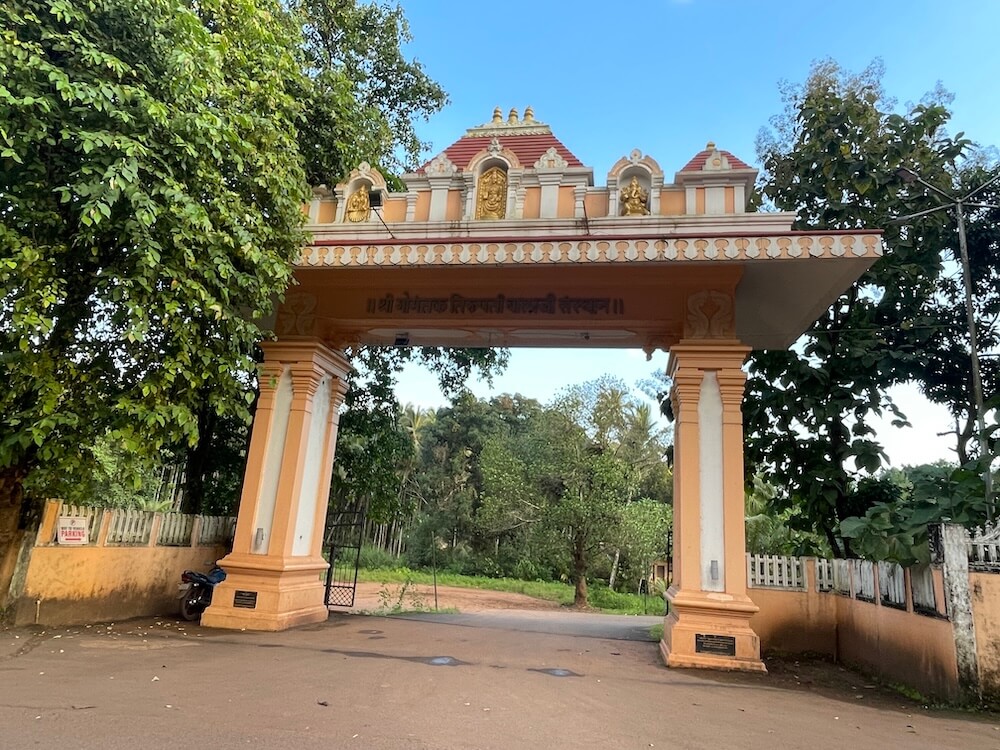
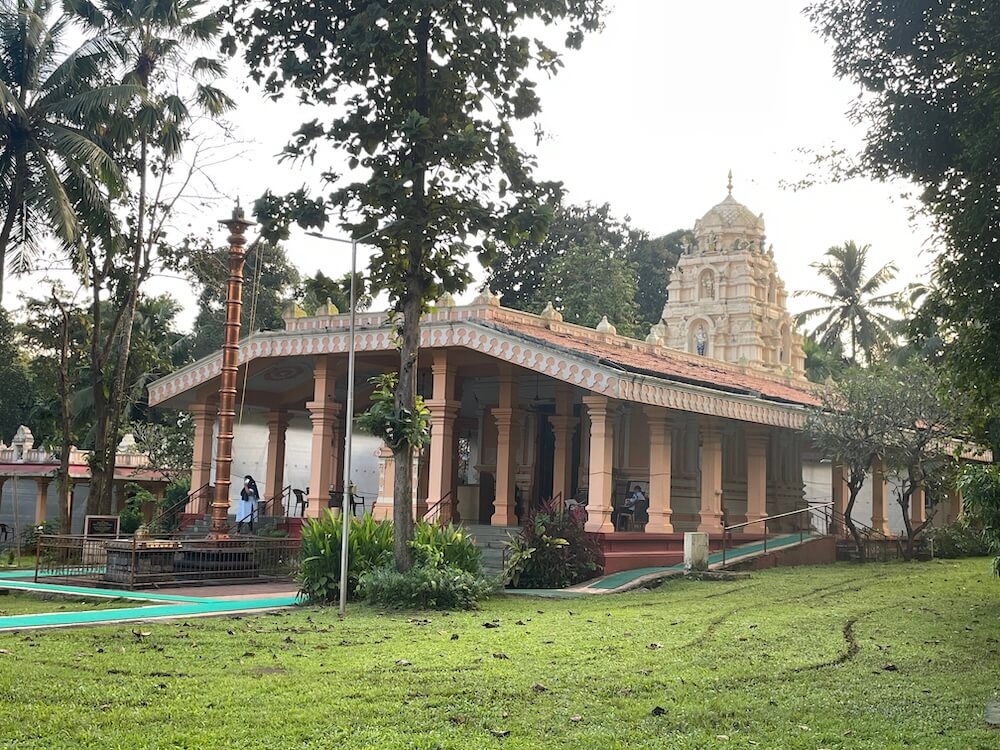
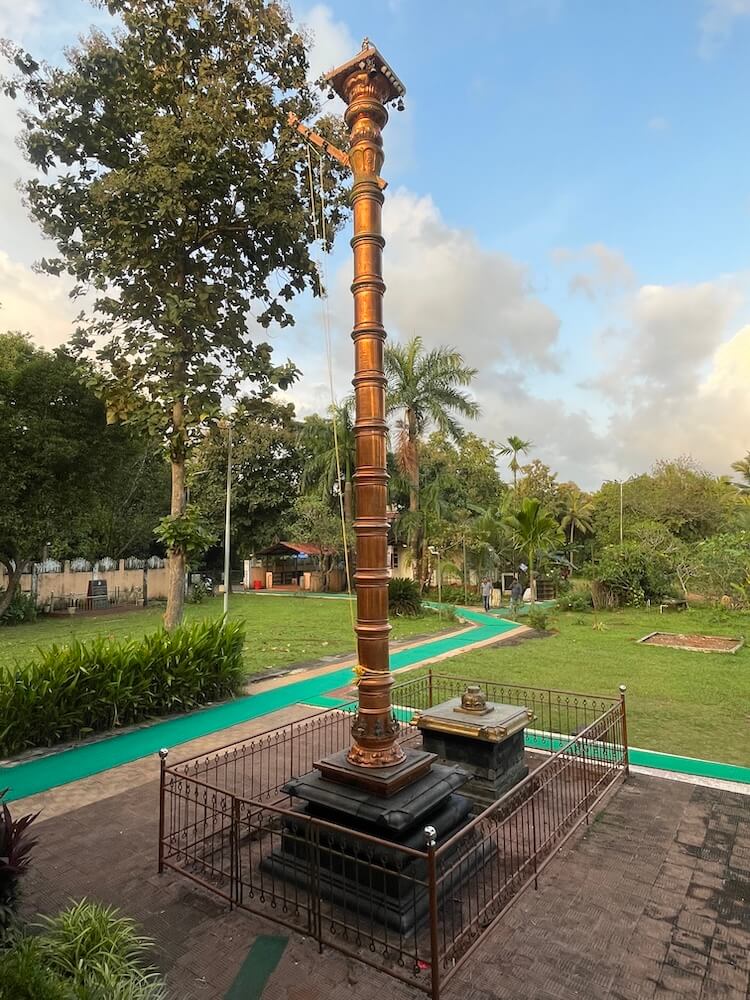
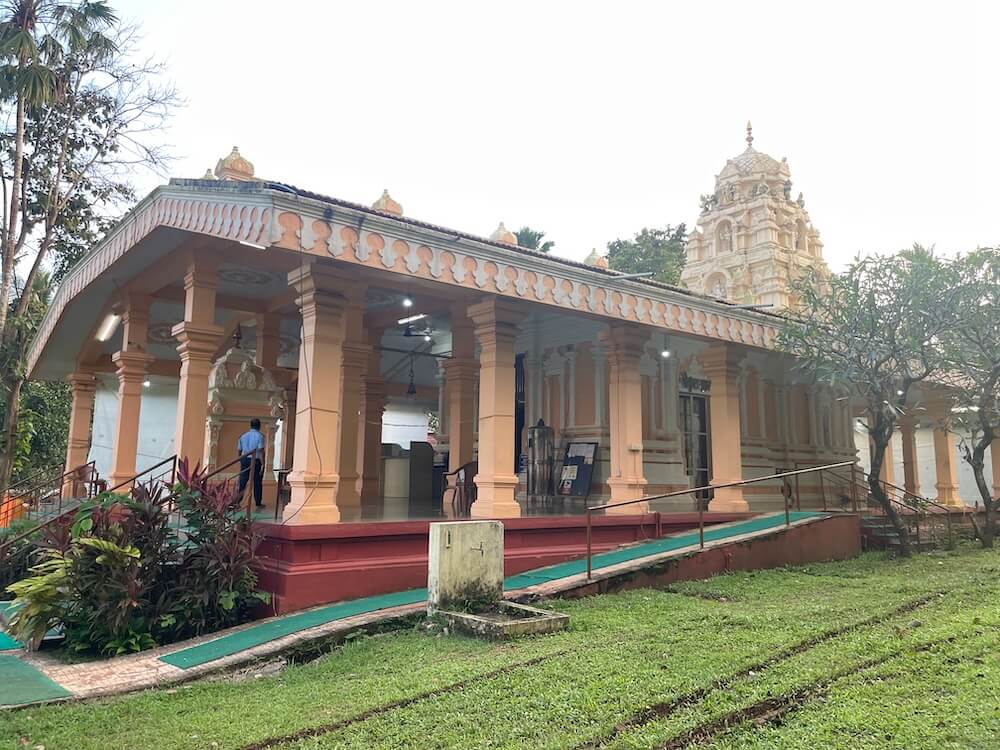
This temple was established in 2001 with the blessings of Jagadguru Shankaracharya Jayendra Saraswathi of the Kanchi Kamakoti Peetham. The temple is situated on a 14,000-square-meter plot donated by Smt. Jayanti S. Sinai Kundaikar to the ‘Shri Kanchi Kamakoti Peetham Charitable Trust’ of Goa in memory of her late parents. The temple’s spacious, lush green courtyard has a large entrance gate. In the niches on its roof, there are idols of Tirupati Balaji in the center, Goddess Padmavati on the left, and Ganesha on the right. In front of the temple, there is a Balipitham on a pedestal. On the next pedestal stands a tall, gold-plated metal flagstaff (dhwajastambha). A short distance away is the temple’s sabhamandapa (assembly hall), built in the Goan architectural style. This hall features numerous square pillars, a flat ceiling in the center, and a sloping roof on both sides. Beyond this are the upamandapa and the garbhagriha (sanctum sanctorum). The garbhagriha is topped with a shikhara in the South Indian architectural style, crowned with a dome-shaped amalaka and kalasha. The shikhara is adorned with idols of various deities on all four sides. In the sabhamandapa, there is an idol of Garuda, the vehicle of Vishnu, in a large niche. There is a circumambulation path (pradakshina marg) around the garbhagriha from the sabhamandapa. The entrance to the garbhagriha is covered with ornate silver plating, engraved with the Dashavatara. Inside, on a silver lotus, the tall, standing idol of Tirupati Balaji, carved in black stone and in the varada mudra, is installed.
This idol, received as a donation from the Tirumala Tirupati Devasthanam, wears a crown on its head, earrings in its ears, and a serpent on its shoulders. A Vaijayanti garland adorns its neck. In the upper two hands, it holds the Panchajanya conch and the Sudarshana Chakra. One hand is in the boon-bestowing posture, while the other rests on the waist. The idol is adorned with various garments, ornaments, and flower garlands. Pure camphor paste is applied in an English ‘V’ shape from the forehead to the eyes. Because of this, the idol’s eyes are always closed. It is said that Balaji’s eyes are always open and possess immense energy. This energy is so powerful that it could potentially scorch the entire universe. Therefore, they are kept covered with a special type of camphor. Another explanation given is that Balaji’s lotus-eyes are so beautiful that if they were left open, devotees would be so mesmerized that they would never want to leave. Hence, they are covered. The camphor is removed only during the time of ‘netra darshan’, when devotees can behold Balaji’s eyes. The idol is seated in a tall, silver throne (makhar). The pillars and arch of this throne are intricately carved, with a Kirtimukha carved at the top center. Many oil lamps (samai) burn in front of the deity. The outer walls of the garbhagriha feature niches containing idols of various deities.
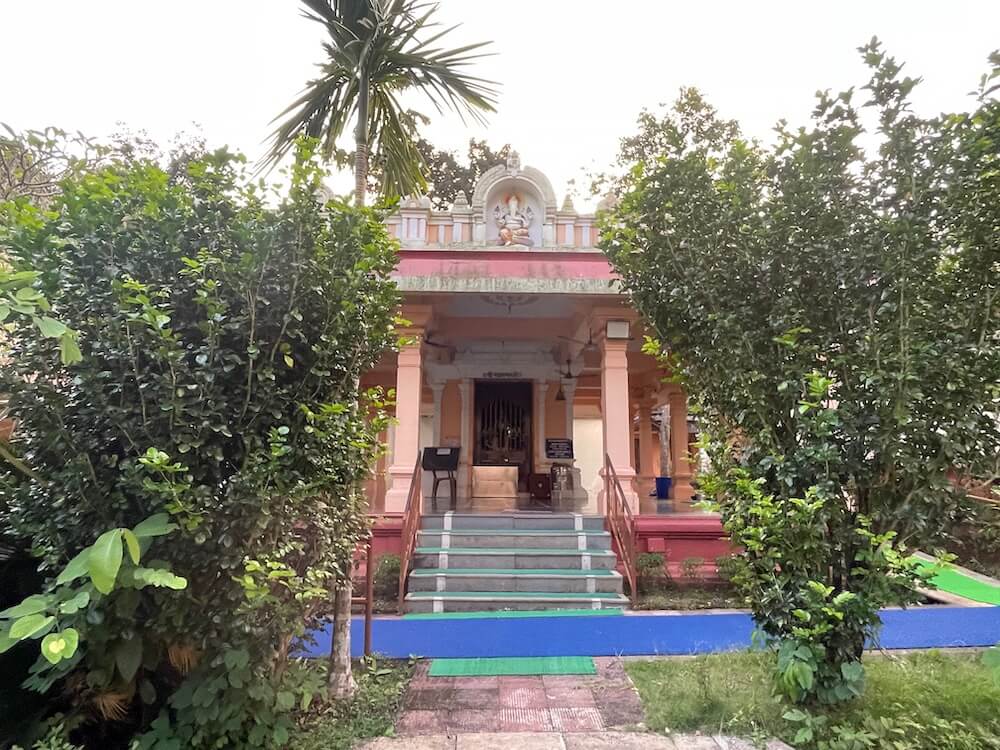
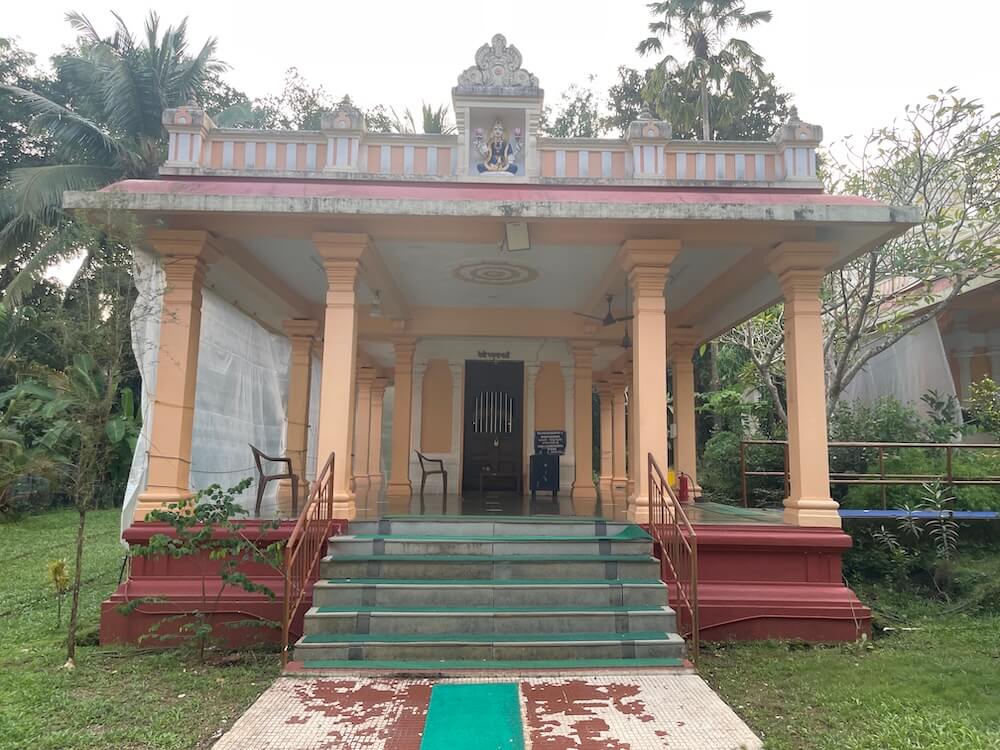
Two other important temples in the temple courtyard are those of Balaji’s consort, Padmavati, and Ganesha, the remover of all obstacles. The temple of Padmavati is built on a high platform and consists of a sabhamandapa and a garbhagriha. The sabhamandapa is an open structure. In the niches on its roof, there is an idol of Goddess Padmavati. In the garbhagriha, a large black stone idol of Goddess Padmavati is seated on a silver lotus throne within a silver prabhavali (arch). The Goddess has silver hands and a silver crown. This idol of the Goddess was also received as a donation from the Tirumala Tirupati Devasthanam. The Ganesha temple is structured similarly to the Padmavati temple. There is an idol of Ganesha in the niche on the roof of the sabhamandapa. A massive black stone idol of Ganesha is installed in the garbhagriha. This idol has silver ears, tusks, and hands. There is a large Shankar Math building within the temple premises.
Festivals and celebrations such as Deepavali, Tulsi Vivah, Vaikuntha Ekadashi, Dhanurmas Puja, Kojagiri, and Navaratri are celebrated with great enthusiasm in this temple. The ‘Navaratri Brahmotsav’, celebrated in the month of Ashwina, is a significant festival here. During this period, religious programs such as Abhishekam, Vishnu Sahasranama Parayana, Lalita Panchami Puja, and Kumarika Puja are performed. The Balaji Garuda Vahana Rathotsava is organized on the evening of Saptami, and the Balaji Rathotsava is held on the evening of Ashtami. Thousands of devotees from the surrounding areas attend these festivities.
This sacred temple stands as a testament to deep spiritual devotion, ancient architectural grandeur, and rich local cultural traditions.
The sanctum sanctorum houses the divine idol consecrated according to ancient Vedic traditions, surrounded by serene courtyards and traditional temple architecture.
Navratri, Maha Shivratri, Annual Temple Jatra & Deepotsav
Compare and book flights, secure top-rated local hotels near the temple, hire reliable guides, and rent cars instantly.
Extend your pilgrimage by visiting other highly sacred temples located nearby.


Add ₹999 more to unlock FREE SHIPPING!
Your sacred cart is currently empty.
Shop Photo FramesFill in your delivery details below to place your order.
Add comment