
Add ₹999 more to unlock FREE SHIPPING!
Your sacred cart is currently empty.
Shop Photo FramesMangesh is the most popular deity in Goa, known to all of Maharashtra through the immortal song “Maage Ubha Mangesh, Pudhe Ubha Mangesh, Majhyakade Dev Majha Pahato Aahe” (Mangesh stands behind, Mangesh stands ahead, my God is watching over me), written by Shanta Shelke and sung by Usha Mangeshkar and Rani Varma for the film ‘Mahananda’. The temple of Mahadeva, presiding here under the name Mangirish or Mangesh, is considered the religious and cultural treasure of Goa. Hundreds of devotees as well as tourists from India and abroad visit this temple daily for darshan. Pandit Nehru had also visited this place to seek the blessings of Mangesh.
The ‘Mangish Mahatmya’, narrated in the Sahyadri Khanda of the Skanda Purana, which was composed after the thirteenth century AD, tells the legend that once Shiva and Parvati were playing a game of dice on Mount Kailasa. Parvati won the game, and she mocked Shiva with harsh words. Hurt by these words, Shiva decided to leave his abode. He traveled from there to Sangameshwar at the confluence of the Krishna and Venna rivers, where he began to perform penance. Later, deciding to reside in the land established by Parshurama, he settled there. Meanwhile, Parvati became sorrowful as Shiva had left their abode along with Ganga. Her companions advised her to go in search of Shiva. During this time, Shiva resided at Rameshwar and Harihareshwar before arriving at the Gomantaka mountain.
Meanwhile, Mother Parvati, searching for Mahadeva everywhere, reached the western bank of the Aghashi River. There, she worshipped Shiva. While she went to bathe in the river, a tiger suddenly appeared before her. It was Shiva himself who had taken the form of the tiger. Seeing his fierce and terrifying form, Parvati was frightened and cried out, “Trahi Mam Girisha,” meaning “O Girisha, save me.” However, in her state of fear, only the words “Mam Girisha” or “Mangisha” escaped her lips. Hearing this, Lord Shiva shed his tiger form and resumed his divine Shiva form. After staying here for some time, Shiva and Parvati returned to Kailasa. Before leaving, as per Mother Parvati’s wish, Shiva installed a Shiva Linga here under the name Mangisha. This place is Kushasthali, and Mangisha later became Mangesh. According to another etymological story, the word “Mam Girisha” uttered by Parvati became corrupted to Mangirish, which later evolved into Mangesh. There is another story about this place in the Sahyadri Khanda. It states that a Vatsa-gotra Brahmin named Devasharma lived in the land of Kannauj. While he was on a pilgrimage with his wife, he reached the Aghashi River and began to live there. Once, he witnessed a truly miraculous sight. At noon, a cow entered the river and, despite being submerged, emerged again. He began to investigate this phenomenon, and one day, when the cow entered the water, he followed it by holding onto its tail. There, he had the darshan of the radiant Shiva Linga. The cow performed a milk-abhisheka over the Linga. The Brahmin also prayed to Shiva. It was the Linga of Mangisha. In time, by the will of God, it emerged from the water. This Brahmin, Devasharma, is worshipped as the Gramapurusha (village guardian).
According to another legend, over time, the forest grew around the Mangesh Linga in Kushasthali, and the Linga was buried in the earth. Many years passed. Some cowherds used to bring their cattle here to graze. Once, a cowherd saw a miraculous sight: a cow would move away from its herd and release its milk at a specific spot. He told the Brahmin Devasharma about this. He came and investigated. During the excavation, they found a Shiva Linga. The people built a small temple there and began to worship this Linga. The cowherd who first saw the sight has now been given a place among the family deities of Mangesh at Priol. He is worshipped here under the name Mulkeshwar.
Thus, the original site of the Mangesh temple was at Kushasthali (present-day Cortalim). It is said that the temple there was extremely magnificent. The temple contained various precious items such as gold and silver ornaments and rich silk garments. Large bells in the temple were hung from heavy silver chains. After the Portuguese invasion, the temple faced a crisis. On the dark day of 28 February 1510, the Portuguese fleet arrived in Goa, and the misfortune of this land began. The fanatical Portuguese started converting the Hindus and Muslims of Goa. Their evil eyes turned toward the local temples. The Queen of Portugal issued a decree from Lisbon on 26 March 1559, stating that henceforth, there would be no Hindu temples in the island of Goa and its adjacent islands. No idols were to be kept in any house or outside. They were to be completely destroyed and burned. This order forbade non-Christians from performing their religious rites. Seeing that the evil eyes of the Portuguese priests and soldiers would soon turn toward Cortalim, the devotees of Mangesh held a secret meeting. Confident that the temple would be safe in the neighboring Antruz province, the villagers decided to relocate the idols. Carrying the Mangesh Shiva Linga along with the idols or symbols of the family deities, the villagers quietly took the road to the Antruz province in the darkness of the night. They crossed the river by boat to reach the banks of Madkai, and from there, the idols were brought to the Mangeshi Wada in the village of Hadiye in Priol. This event took place in the year 1560 AD. Historian Vinayak Narayan Shenvi Dhume estimates that this relocation must have taken place on the night of Kartik Shukla Dwadashi and Trayodashi of that year. Similarly, the installation of Mangesh in Priol must have taken place on the day of Magh Shukla Purnima in 1561. The annual festival of the Mangesh temple is celebrated on this very date.
According to the known history of the establishment of the temple here, the temple was renovated in 1744 and 1890. Later, after Pandit Jawaharlal Nehru liberated Goa from Portuguese rule in 1961, this temple was declared an ancient monument. In 1970, the temple structure was transferred to the temple committee. Thereafter, the temple was renovated again. This renovation work was completed on 17 February 1973. At that time, the golden pinnacle (Suvarna Kalash) was installed on the temple by Sachidananda Saraswati Swami, the head of the Gaudapadacharya Sansthan, Kavale.
This temple holds an important place in the religious and cultural history of Goa. Poet Subanant, as well as Vitthal Krishna Kaykini, wrote the ‘Shri Mangesh Mahatmya’ while seated in this very temple. Similarly, Maheshwarshastri Sukhatankar began the composition of the ‘Mangirishashtakam’ here. Shivastuti (hymns to Lord Shiva) were chanted in this temple, which fostered a great tradition of music. Renowned singers and artists were invited to perform during the musical programs held during the temple festivals. This temple shared a close bond with the Mangeshkar family. Bharat Ratna Lata Mangeshkar’s father, Master Dinanath, was born on 29 December 1900 into the Abhisheki Brahmin family, who were among the sevaks (servants) dedicated to the worship of Mangesh. He received his initial musical inspiration from this very place; the mantras and singing within the temple instilled musical values in him from childhood. Many great personalities and countless saints have visited this temple to seek the darshan of Mangesh. Among them are Swami Vivekananda as well as the then Prime Minister of India, Pt. Jawaharlal Nehru.
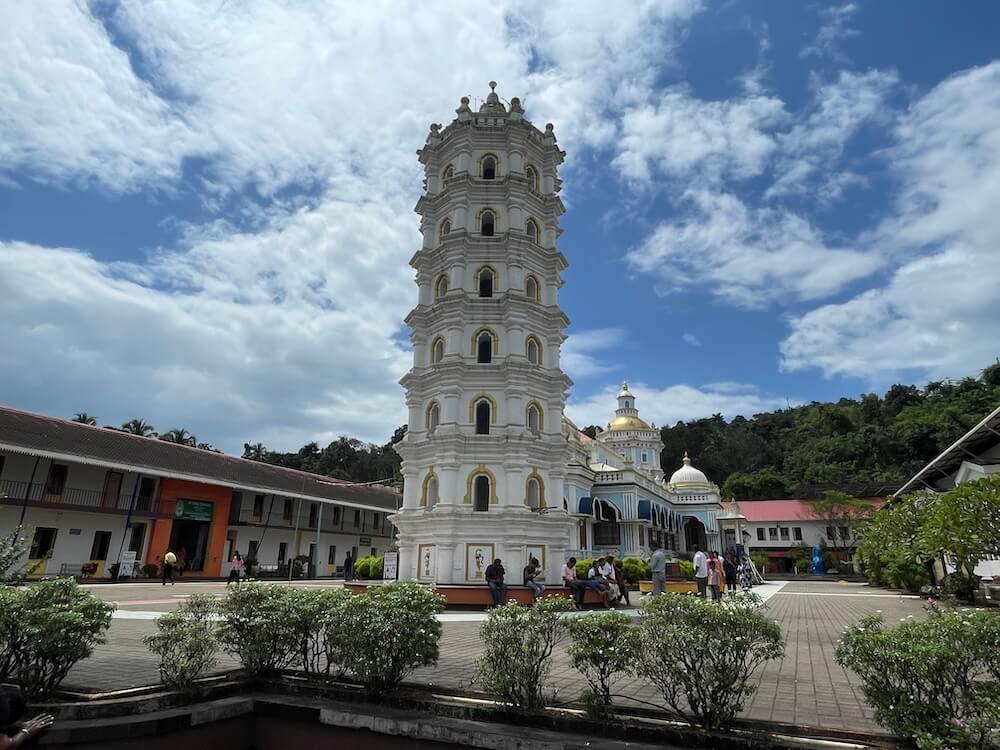
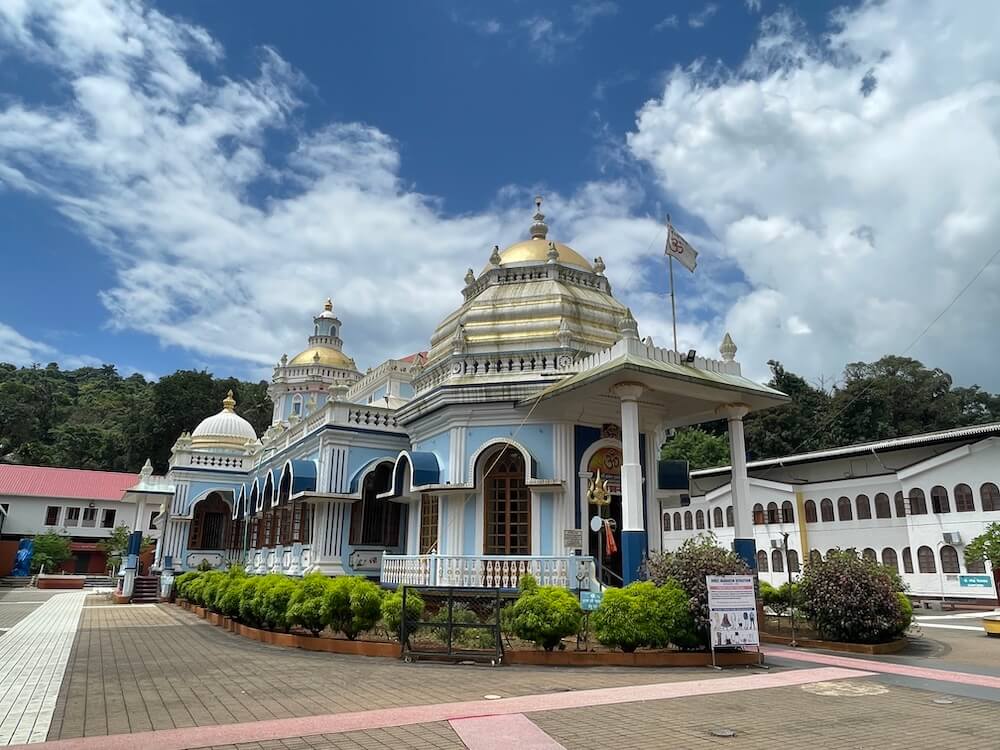
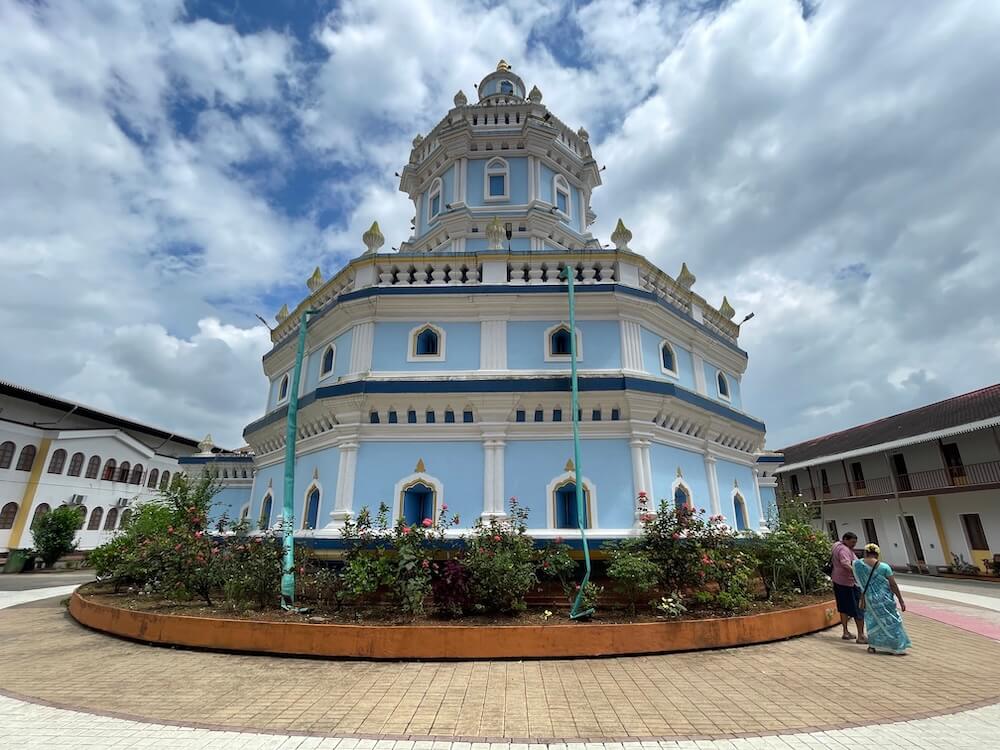
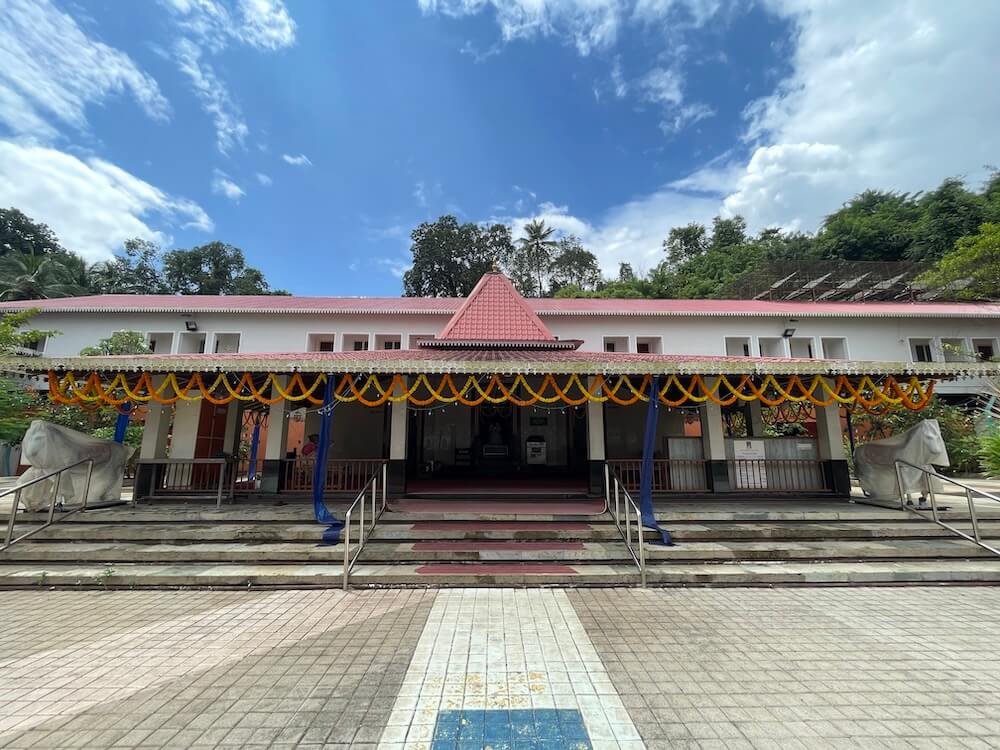
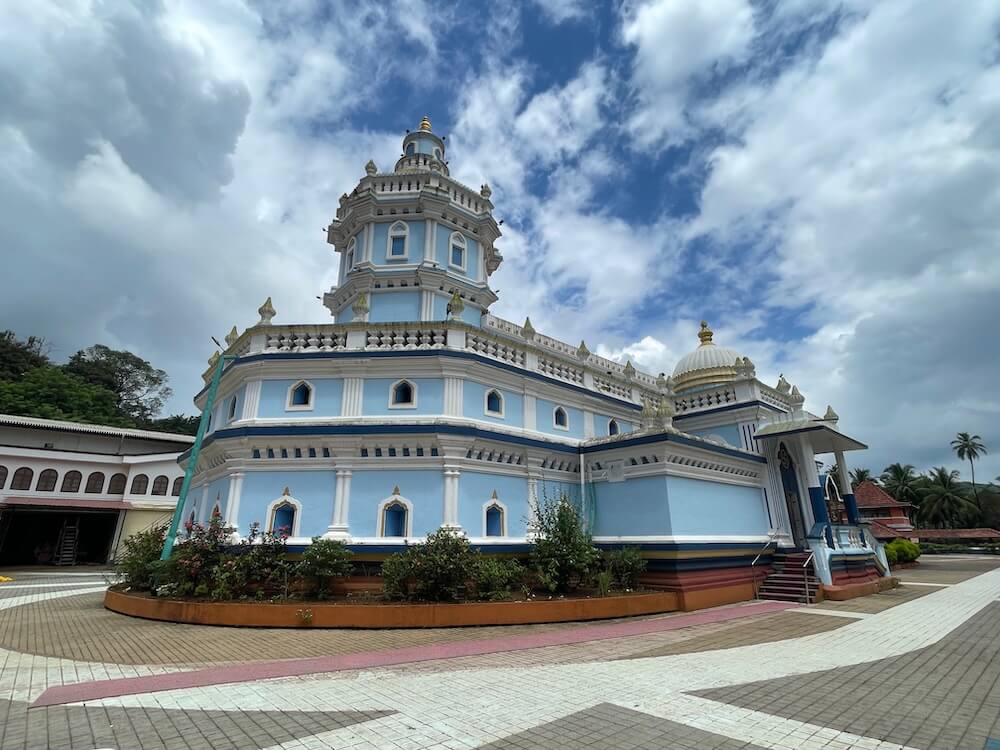
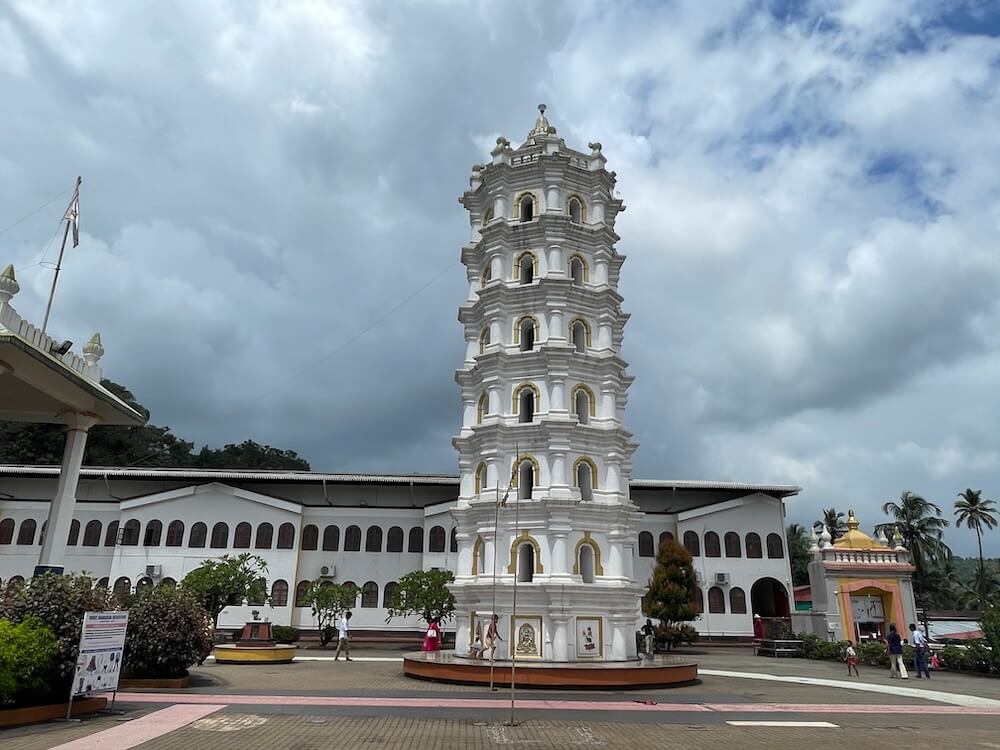
The temple is situated in a picturesque environment on elevated ground. On the path leading to the temple, there is a long row of shops selling offerings, idols, clothes, toys, and food items. On the left side of the path leading to the temple, there is a large temple tank (Pushkarani). After climbing a few steps, one enters the temple courtyard through the main gate (Mahadwar). Facing the temple is the Kalbhairav temple. To the left stands a magnificent eight-storied octagonal lamp tower (Deepastambha). It is said to be the tallest lamp tower in Goa. Beyond this stands the grand two-storied structure of the temple. Built in the Gomantaki architectural style, the temple complex consists of a main entrance, a vestibule (Mukhamandap), a main hall (Sabhamandap), an intermediate hall (Ardhamandap), and the sanctum sanctorum (Garbhagriha). The Mukhamandap features a hexagonal base topped by a dome and a spire with a finial (Kalash). The Sabhamandap has a sloping tiled roof, while the Garbhagriha’s spire consists of an octagonal base, a dome, a circular shrine-like structure above it, and a finial atop its dome. The Mukhamandap and Sabhamandap have numerous arched windows. The Sabhamandap is adorned with grand circular pillars, a high ceiling, glass chandeliers and lamps, and polished marble floors. From the Sabhamandap, there are two entrance halls on the left and right sides. In the Sabhamandap, there is a large idol of Nandi covered in silver plating. In front of it, on a marble pedestal, is the idol of the village founder, Devsharma.
Adjoining the front wall of the Ardhamandap, seated in a silver shrine, are the idols of Lord Ganesha in black stone on the left and Goddess Bhagavati on the right. On both sides of the entrance to the Ardhamandap are tall niches containing silver idols of Vaishnava door guardians (Dwarapalas). Above the door frame, a large image of Mangesh is placed, flanked by sculptures of Nandikeshwar carved in silver. From the Ardhamandap, there is a circumambulation path (Pradakshina Marg) around the Garbhagriha. Inside is an octagonal sanctum. The entrance to the Garbhagriha is covered with silver plating featuring intricate carvings. At the lintel (Lalatbimba) is an idol of Ganesha, flanked by two serpent idols on each side. Inside the Garbhagriha is the Shiva Linga of Mangesh, decorated with flower garlands and surrounded by serpent images. Behind it, on a high pedestal, is the mask (Mukhavata) of Mangesh. Lord Mahadeva is depicted here with a beard and mustache, strings of pearls on his forehead, and a serpent hood and the River Ganga on his head. Behind this mask is a large gold and silver halo (Prabhaval), with a Kirtimukha and various auspicious symbols carved in the center. At some distance behind the temple on the western side, in the sanctum of another temple, Lord Mulkeshwar is enshrined in the form of a stone (Shila). In the adjacent inner sanctum, there are idols of Lakshmi-Narayan, Suryanarayan in stone form, Garuda in idol form, as well as shrines for Virabhadra and Goddess Sateri in the form of Lingas.
Various festivals and rituals are celebrated in the temple with due ceremony. Festivals such as Ram Navami in Chaitra, Akshaya Tritiya in Vaishakh, Shri Shayan Dwadashi in the bright fortnight of Ashadh, Shri Krishna Janmashtami in Shravan, Ashwin Navratri, Kojagiri Purnima, Deepavali, the fourteen-day Deepotsav starting from the first day of the bright fortnight of Kartik, and Gita Jayanti on the eleventh day of the bright fortnight of Margashirsha are celebrated here with great joy. The annual fair (Jatra) held from Magh Shukla Saptami to Magh Purnima is the major festival here. It begins on Saptami with the Victory Chariot (Vijay Rath). The celebrations include the Elephant Ambari on Ashtami, the Palanquin Festival (Shibikotsav) on Navami, the Chariot carried on shoulders on Dashami, the Silver Palanquin Festival on Ekadashi, boating in the temple tank on Dwadashi, Sukhasan on Trayodashi, the smaller chariot on Chaturdashi, and the grand chariot on Purnima. Amidst the massive crowd of devotees, the Abhisheka of the Lord begins at four in the morning on Magh Krishna Trayodashi and continues until the dawn of the next day. Along with the crowds of devotees for these festivals, there is always a large number of tourists from India and abroad.
This sacred temple stands as a testament to deep spiritual devotion, ancient architectural grandeur, and rich local cultural traditions.
The sanctum sanctorum houses the divine idol consecrated according to ancient Vedic traditions, surrounded by serene courtyards and traditional temple architecture.
Navratri, Maha Shivratri, Annual Temple Jatra & Deepotsav
Compare and book flights, secure top-rated local hotels near the temple, hire reliable guides, and rent cars instantly.
Extend your pilgrimage by visiting other highly sacred temples located nearby.


Add ₹999 more to unlock FREE SHIPPING!
Your sacred cart is currently empty.
Shop Photo FramesFill in your delivery details below to place your order.
Add comment