
Add ₹999 more to unlock FREE SHIPPING!
Your sacred cart is currently empty.
Shop Photo FramesIn Hinduism, the Shakta sect holds as much significance as the Shaiva and Vaishnava sects. Within the Shakta tradition, Jogai is a revered deity. Jogai is none other than Yogeshwari, the eighth Matrika. She is believed to be the presiding deity of Yoga. Scholars believe that the Shakta sect emerged fifteen hundred years ago, and Jogai has been worshipped ever since. An ancient and famous temple of Jogai, whose original seat (Moola Peetha) is in Ambejogai, is located in the village of Kapadne. Devotees believe that this is a ‘Jagrut’ (awakened) Goddess, the Kuladevata (family deity) of thirteen clans, who grants the wishes of those who pray to her.
Yogeshwari Devi is considered a deity who is the embodiment of Shakti, born from the radiance of Lord Shiva. Her name evolved into the colloquial form ‘Jogeshwari’. She is also addressed as Jogai or Jugai. There is an important shrine dedicated to this Jogeshwari in Mumbai. In Ambejogai, Marathwada, she resides under the name Jogai. The temple of the Goddess at Ambejogai dates back to the Yadava period, specifically the thirteenth century. It is said that Abaji and Babaji Patil, villagers from Kapadne, were devout followers of Jogai Devi of Ambejogai. Every year, they would travel on foot to Ambejogai to seek the Goddess’s blessings. It was then that the thought occurred to them that there should be a temple of Jogai Devi in their own village as well. Accordingly, they built a temple on the banks of the Bhaat River, brought the idol of the Goddess from Ambejogai, and performed her consecration (Pranapratishthapana) in this temple.
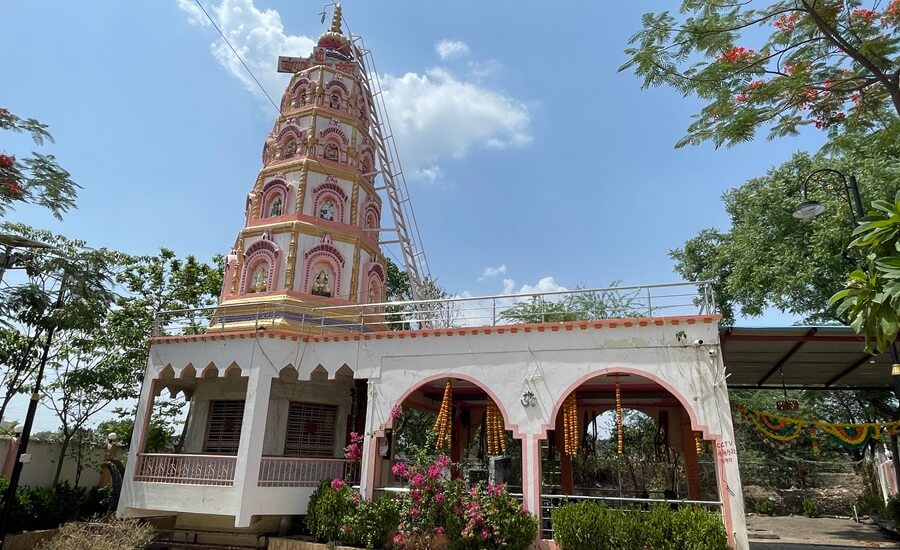
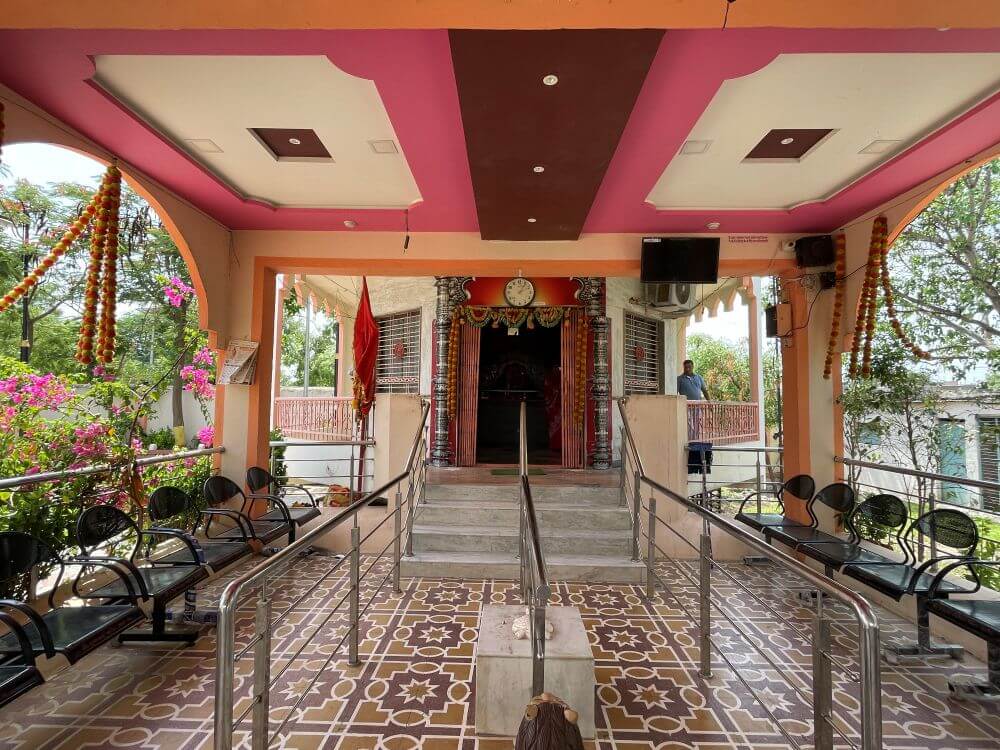
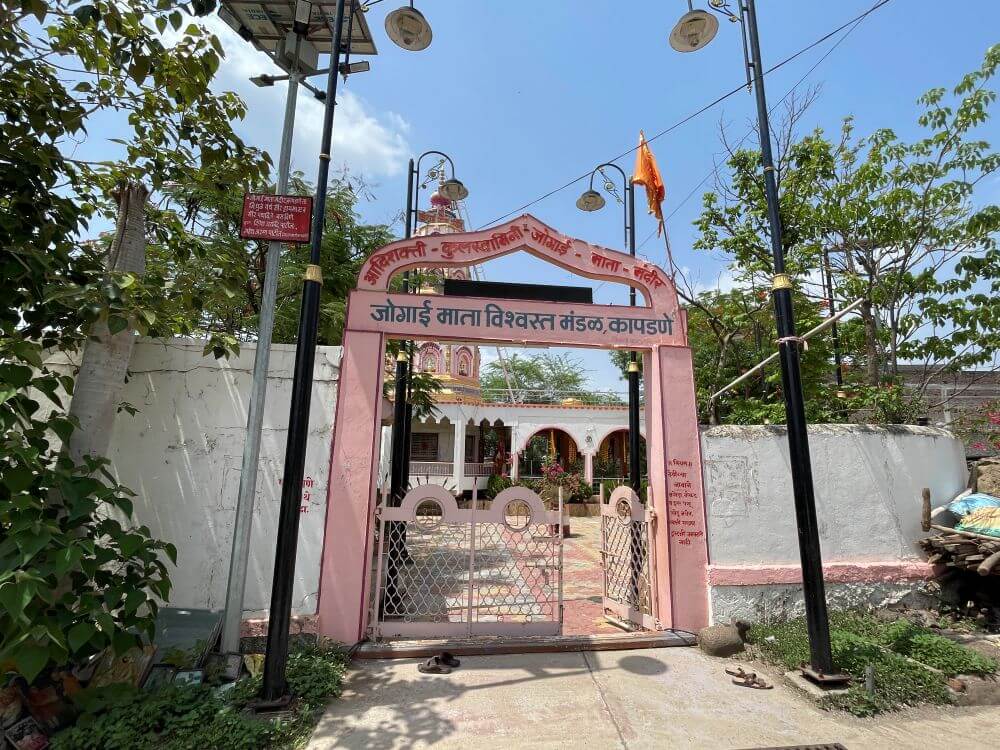
In recent times, the temple has been renovated and given a modern appearance. There is a spacious parking area in front of this temple, which is located at a short distance from the village. A sturdy boundary wall surrounds the temple. One enters the temple courtyard through the gateway in the boundary wall. Within the courtyard, along the boundary wall, there is lush greenery and seating arrangements for devotees. In front of the temple, there are two Tulsi Vrindavans, one square and one octagonal. The temple structure consists of a Sabha Mandap (assembly hall) and a Garbhagriha (sanctum sanctorum). The Sabha Mandap here is semi-open in nature and has an open entrance. There are railings on the left and right sides of the Sabha Mandap. In the railings on both sides, there are three ornate octagonal pillars each, connected to one another by arched gateways. A brass bell is hung from the ceiling here, and the canopy features intricate carvings. On a raised platform on the right side of the Sabha Mandap, there is a Shivling. Above the Shivling is a brass serpent holding a canopy, and beside it is a brass Trishul. In front of the Shivling is a black stone idol of Nandi. In this Sabha Mandap, there is a Tulsi Vrindavan, and in the center, on a raised platform, there is a sculpture of a lion, with a sculpture of a tortoise in front of it. There are seats in the Sabha Mandap for devotees to sit.
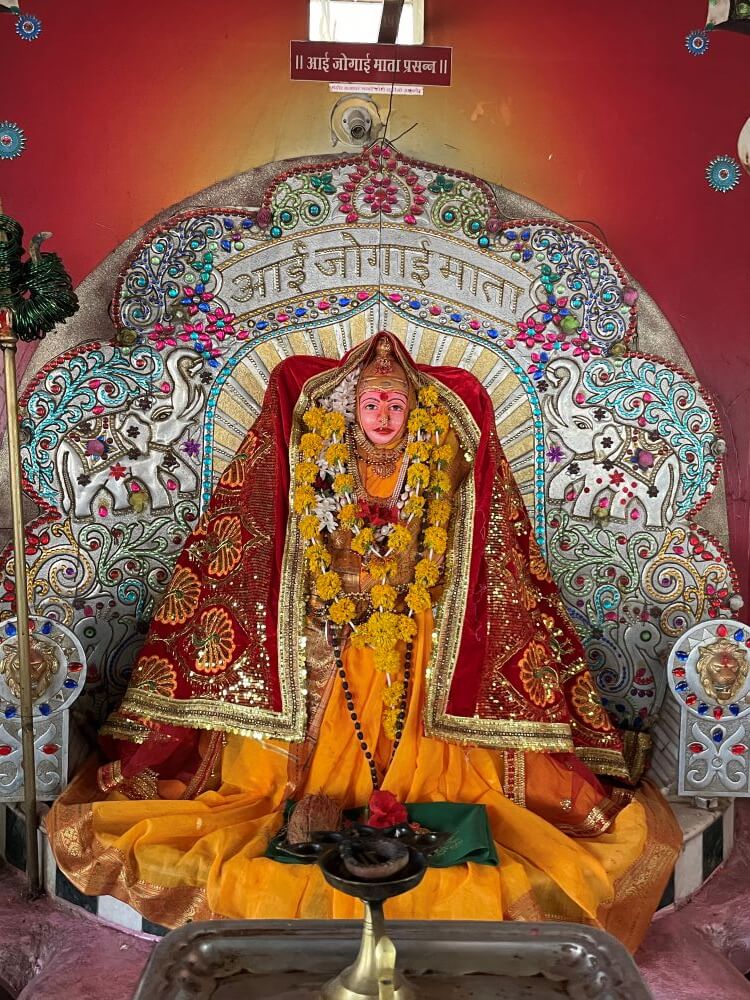
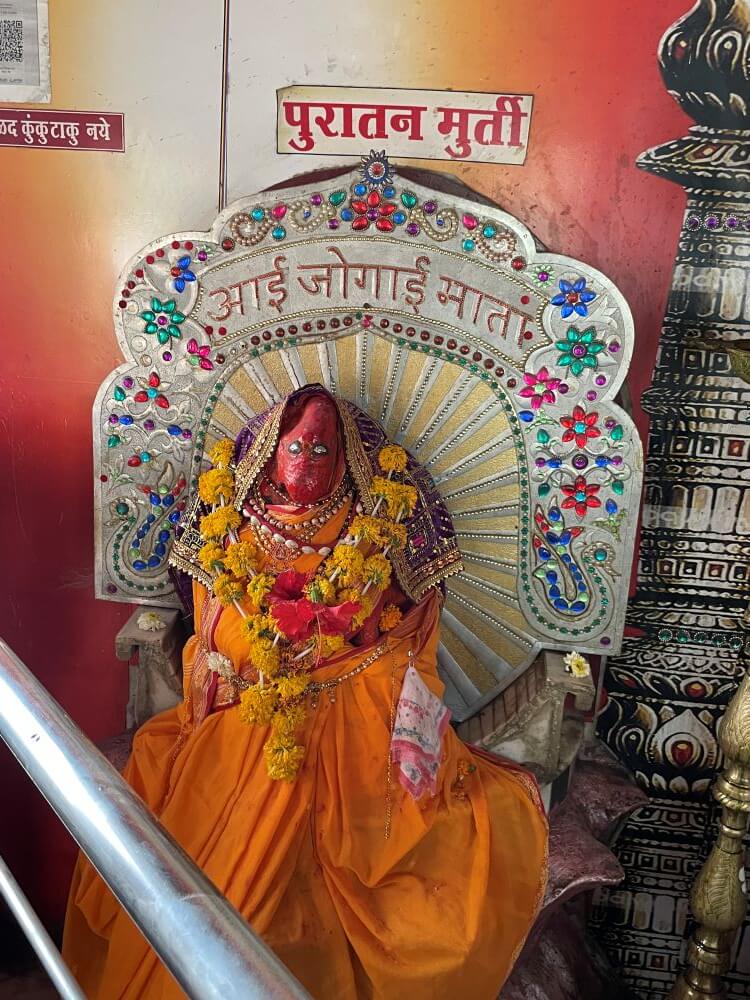
Further ahead, on an octagonal plinth about three feet high, stands the octagonal sanctum sanctorum (Garbhagriha). There are three steps in front of the entrance to the sanctum. Inside the sanctum, on a Vajrapitha, the idol of Jogai Devi is seated in the Padmasana posture in the center. In the hands of the Goddess are weapons and The deity is adorned with various ornaments. There is a crown on the Goddess’s head. In the silver prabhavali (arch) behind the idol, there are peacocks at the bottom on both sides, elephants in the center, and floral designs at the top. As the old idol of the Goddess had become worn, a new idol has been consecrated. To the right of the new idol, on a vajrapitha, is the ancient idol of the Goddess, and to the left is the idol of Lord Ganesha. There are windows in the sanctum sanctorum to allow for light and ventilation.
There is a circumambulation path (pradakshina marga) outside the sanctum sanctorum (garbhagriha). Along this path, eight square pillars on the outer side are connected to each other by arched gateways. Above the roof of the sanctum sanctorum, there is a four-tiered octagonal spire (shikhara). Each of the four tiers of the spire contains eight niches (devakoshtakas), each housing an idol of a different deity. Above the niches, there is spire-style ornamentation, and between every two niches, there is pillar-style ornamentation. At the pinnacle of the spire, there is an amalaka, topped by a kalasha and a flag (dhwajapataka).
Chaitra Shuddha Chaturdashi, the main annual festival of the Goddess, is celebrated here with great enthusiasm. During this time, devotees from various parts of the state come to seek the Goddess’s blessings and fulfill their vows. There is a large crowd for the rituals of ‘Javal’ (first hair tonsure) and ‘Shendi’ (offering of the tuft of hair). The practice of animal sacrifice (goat) during the fair has been discontinued here. Instead, ‘Puran Poli’ is offered to the Goddess as ‘Naivedya’. On the occasion of the fair, shops selling various items are set up, giving the premises the appearance of a temporary marketplace. The Sharadiya Navratri festival is the second major annual celebration here. During these ten days, programs such as Bhajans, music, Jagaran, and Gondhal are organized in the temple. For ten consecutive days, there is a steady stream of devotees in the temple for the Goddess’s Darshan. Apart from this, the temple remains busy with devotees on occasions like Chaitra Padwa, Dussehra, Diwali, Purnima, Amavasya, Mondays, Tuesdays, and Ashtami.
This sacred temple stands as a testament to deep spiritual devotion, ancient architectural grandeur, and rich local cultural traditions.
The sanctum sanctorum houses the divine idol consecrated according to ancient Vedic traditions, surrounded by serene courtyards and traditional temple architecture.
Navratri, Maha Shivratri, Annual Temple Jatra & Deepotsav
Compare and book flights, secure top-rated local hotels near the temple, hire reliable guides, and rent cars instantly.
Extend your pilgrimage by visiting other highly sacred temples located nearby.


Add ₹999 more to unlock FREE SHIPPING!
Your sacred cart is currently empty.
Shop Photo FramesFill in your delivery details below to place your order.
Add comment