
Add ₹999 more to unlock FREE SHIPPING!
Your sacred cart is currently empty.
Shop Photo FramesAccording to social and cultural scholars, as Aai Ekvira is the tutelary deity (Kuldaivat) of the Bahujan community, she is considered one of the primary divine manifestations in Hinduism. People from communities such as the Chandraseniya Kayastha Prabhu (CKP) and Daivadnya Brahmins also revere her as their Kuldevi. The famous temple of Ekvira Devi in Dhule city, revered as the patron deity (Kulswamini) of Khandesh, is said to be a thousand years old. Devotees firmly believe that this Goddess, who is the Kuldevi of 251 clans in Khandesh, is a living divine presence (Jagrut), fulfills holy vows, and instantly rushes to the aid of her devotees upon their call.
According to Hinduism, Mata Renuka of Mahur is one of the three and a half Shakti Peethas on earth. Aai Ekvira is an incarnation of Renuka Mata herself. Both Goddess Renuka and Goddess Ekvira are considered avatars of the Supreme Goddess Parvati. According to the legend in the *Renuka Mahatmya* of the *Sahyadrikhanda*, during the conflict between the Devas and Asuras, the demons defeated the gods. Distressed, the Devas took refuge in Lord Vishnu and prayed to Him to take an incarnation to destroy the demons. Lord Vishnu then declared, “When I am born from the womb of Aditi, I will destroy the demons in the form of a Brahmin (Dwija). I will rid the earth of tyrannical Kshatriyas twenty-one times and offer the land as Dakshina to Brahmins in a sacred Yajna. Aditi, my mother, who fulfills all desires, will be born on earth under the famous name of Ekvira.”
In accordance with this, Aditi later incarnated in the form of Renuka and became famous as Ekvira. Goddess Renuka had five sons, among whom Lord Parashurama was an avatar of Lord Vishnu who rid the earth of tyrannical Kshatriyas 21 times. Regarding the origin of Goddess Ekvira’s name, a popular tradition states that since Goddess Renuka was the mother of Parashurama, her only valiant (Veer) son, she came to be known as ‘Ekvira’. However, it is stated in the *Sahyadrikhanda* that the name Ekvira had already been bestowed by Lord Vishnu earlier.
Dhule, a part of Khandesh, was formerly a small village on the ancient trade route connecting Paithan to Bharuch. This route is mentioned in the text *Periplus of the Erythraean Sea*, written around 90–95 CE. In the first century, this village was under the rule of the Satavahanas. Later, in the fourth century, it was ruled by local rulers of Khandesh such as Swamidas, Bhulundadas, and Rudradas. Subsequently, the Chalukyas, Rashtrakutas, and Yadavas ruled here. In 1318 CE, Sultan Firoz Shah Tughlaq of Delhi granted the province (Subah) of Thalner and Karwand to Malik Raja Faruqui. Dhule was part of this province. Dhule gained importance during the rule of the Faruquis, as well as under the subsequent Mughal and Maratha rule. In 1819, British administrator Captain Briggs made Dhule the district headquarters and expanded the town. The shrine of Ekvira Devi is situated on the banks of the Panzara River in the Deopur area of Old Dhule.
Although the exact historical period of when the temple was originally built remains unknown, it is said to date back over four hundred years. It is recorded that about 250 years ago, Punyashlok Ahilyabai Holkar renovated this temple and constructed a stepwell (Payvihir) to provide water facilities. According to entries in the revised edition of the Dhule District Gazetteer, the temple was earlier a simple two-storied structure with a sturdy sloping wooden roof. It is also recorded that the British government provided an annual grant (Varshasan) of 29 rupees to the temple trust for maintaining the sacred perpetual lamp (Nandadeep). After the trust was officially registered for the temple’s management in 1955, the temple underwent phased renovations in 1967, 1987, and 1988.
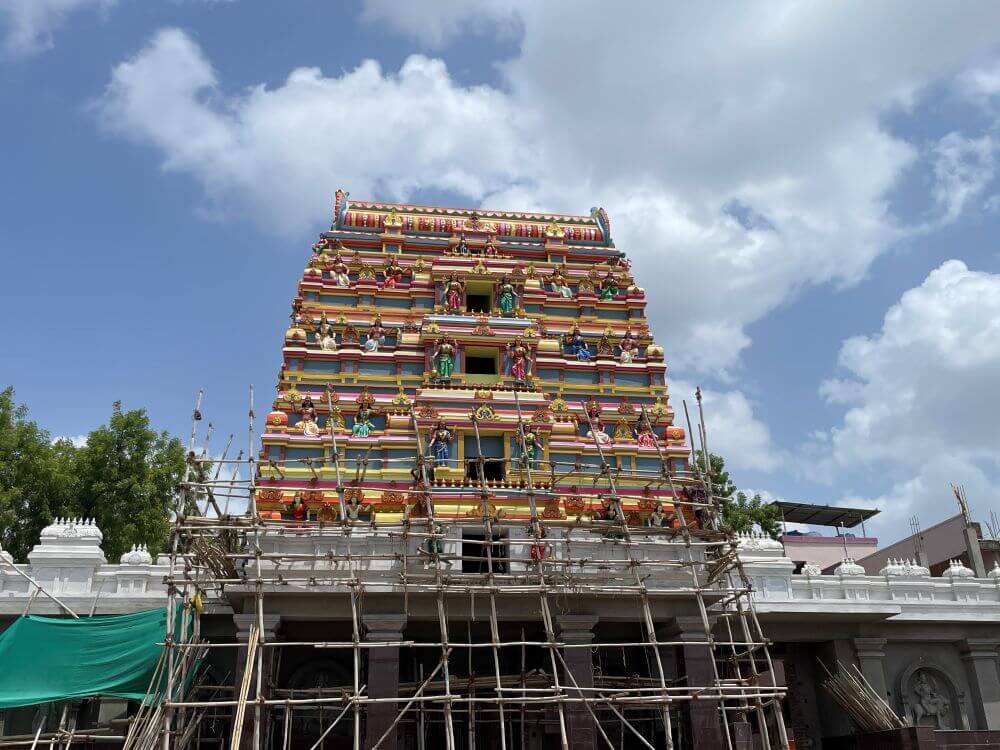
The renovated temple is enclosed by a stone fortification wall about ten feet high. On both sides of the two-storied entrance gate situated within this fortification, there are elevated platforms featuring octagonal Deepamalas (lamp towers) that taper towards the top. Flanking both Deepamalas are majestic elephant sculptures (Gajaraj). Since the temple courtyard is elevated a few feet above ground level, one ascends 11 steps from the entrance gate to enter the premises. The square carved pillars on either side of the entrance gate are connected by an arched cusped doorway. Above the pillars rests a beam, and upon its roof sits a Nagarkhana (drum house) surrounded by a parapet. At all four corners of the Nagarkhana stand two circular pillars each, and atop its sloping roof rises a two-tiered square pinnacle (Shikhara) crowned with a Kalash.
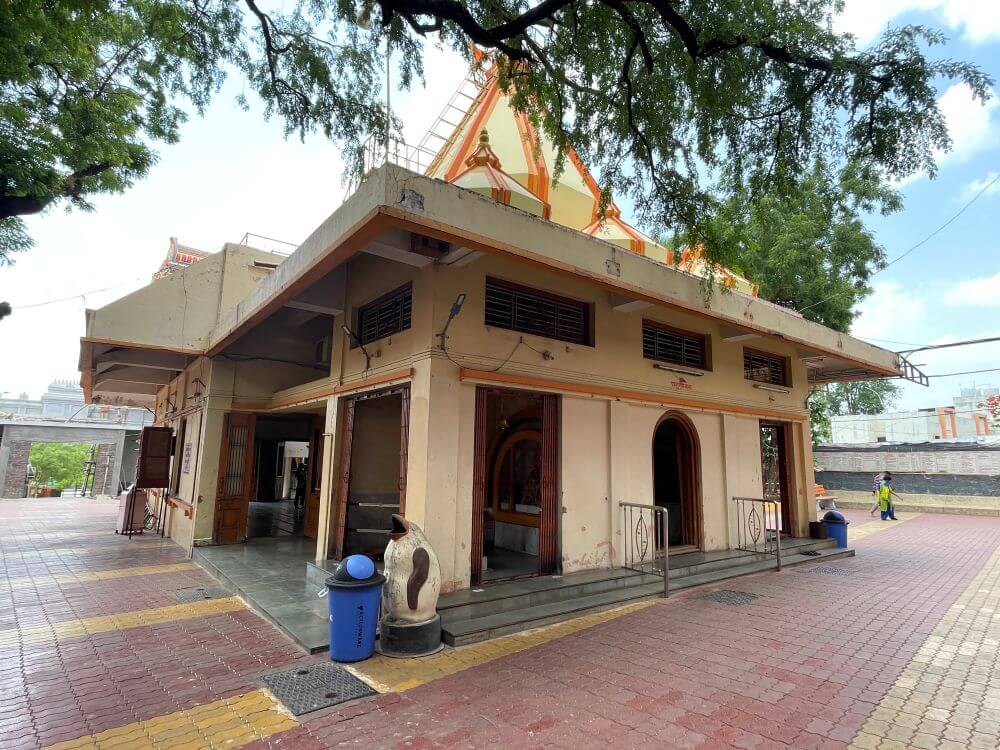
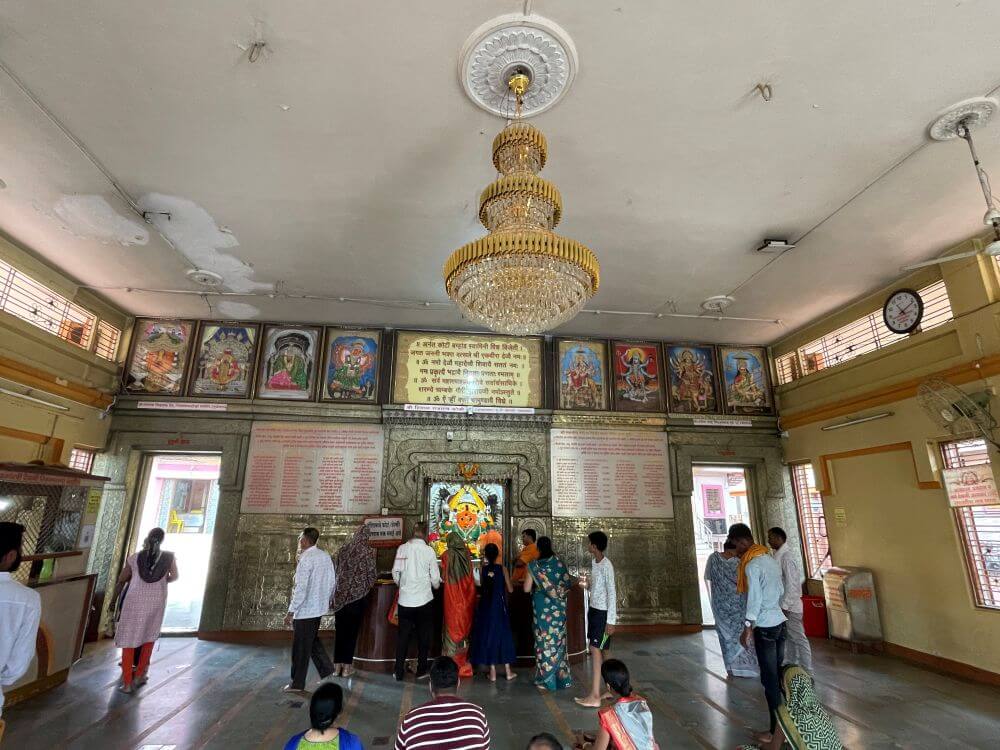
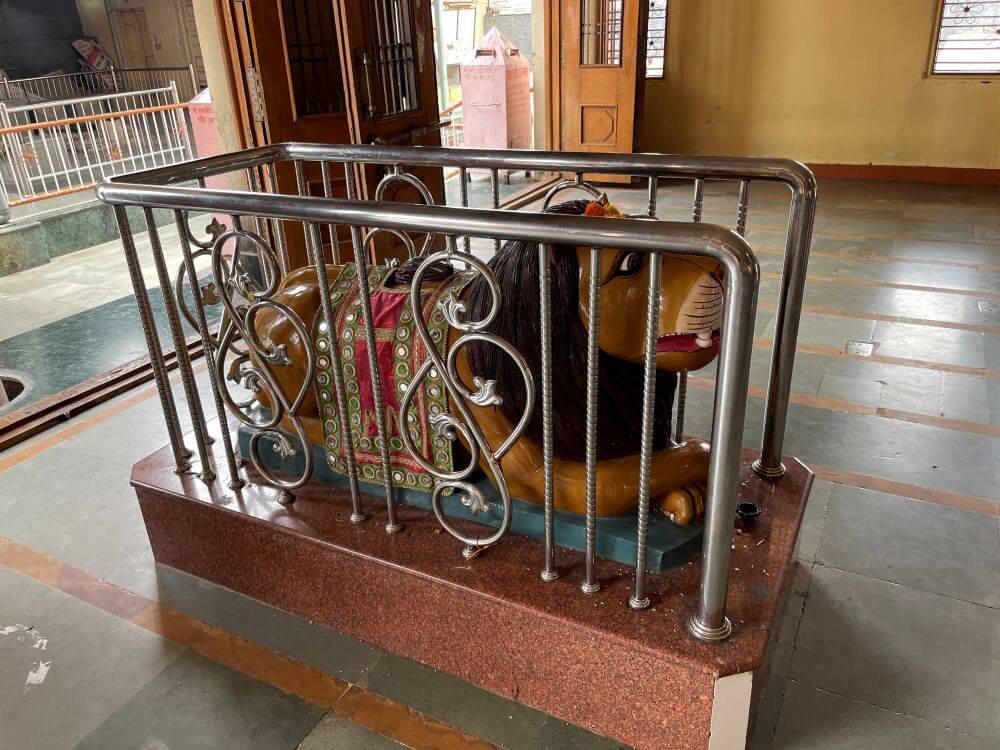
Inside the entrance gate, guard chambers are built into the walls on both sides. From here, one enters the paved courtyard of the temple. The architectural layout of the temple comprises a Sabhamandap (assembly hall) and a Garbhagriha (sanctum sanctorum). The roof of the Sabhamandap slopes on both sides, while above the sanctum rises a hexagonal Shikhara approximately thirty feet high. At the top of the pinnacle sit two Amalakas, one above the other, crowned with a holy Kalash. The Sabhamandap has three entrance doorways. Flanking the main central doorway are sculptured Dwarapalas (gatekeepers), with a Kurma (sacred turtle) carving on the floor in front, and an image of Lord Ganesha in the niche (Devakoshtha) on the lintel. The Sabhamandap is an enclosed hall provided with lattice windows (Gavaksha) for air and light. In the center of the hall, on a raised pedestal, stands an idol of a lion, the divine vehicle (Vahana) of the Goddess.
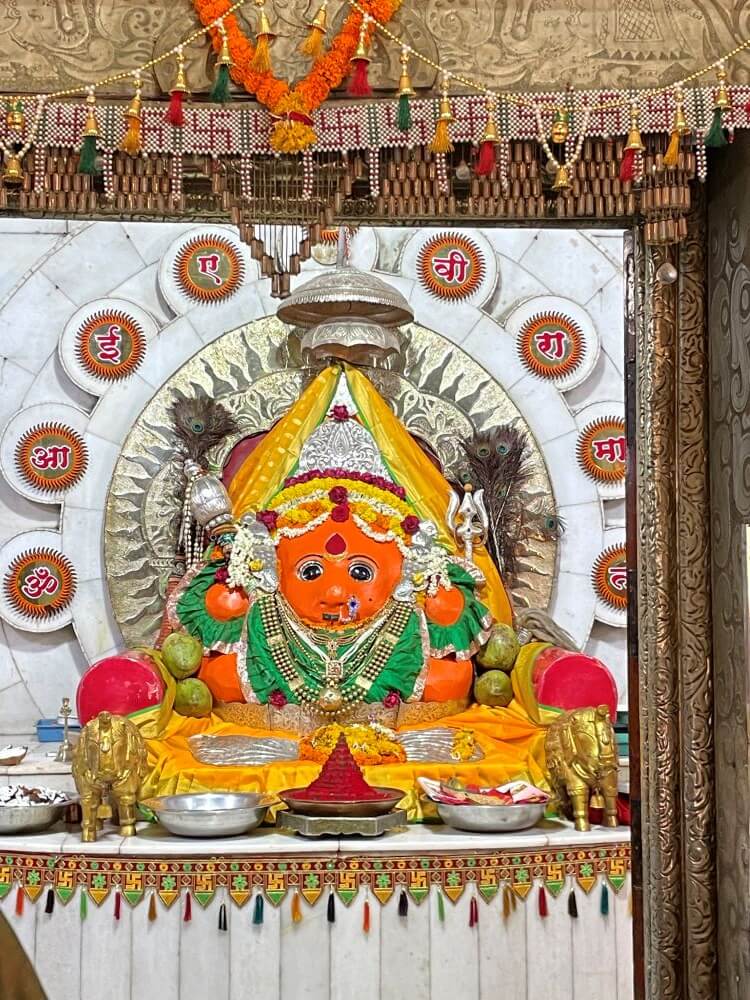
The front facade of the Garbhagriha is covered with intricately carved silver plating depicting the Navadurga. On the left and right sides of the sanctum entrance are the Surya Dwar (Sun Door) and Chandra Dwar (Moon Door) leading out of the hall. The door jambs of the sanctum are carved with floral motifs. Above the entrance are three beautifully decorated horizontal lintel panels placed one above another; their central lintel reliefs depict Lord Ganesha, the sacred Om symbol, and a Kirtimukha respectively. Inside the sanctum, upon a sacred stone pedestal (Vajrapitha), rests the holy stone idol of the Goddess—an eight-armed (Ashtabhuja) deity adorned with fine ornaments, wielding weapons, and smeared with sacred vermilion (Sindoor). A silver crown and a protective canopy (Chhatra) adorn the head of the Goddess. In front, brass elephant sculptures grace both sides. To the right stands an idol of Lord Ganesha, and to the left, an idol of Goddess Tukai.
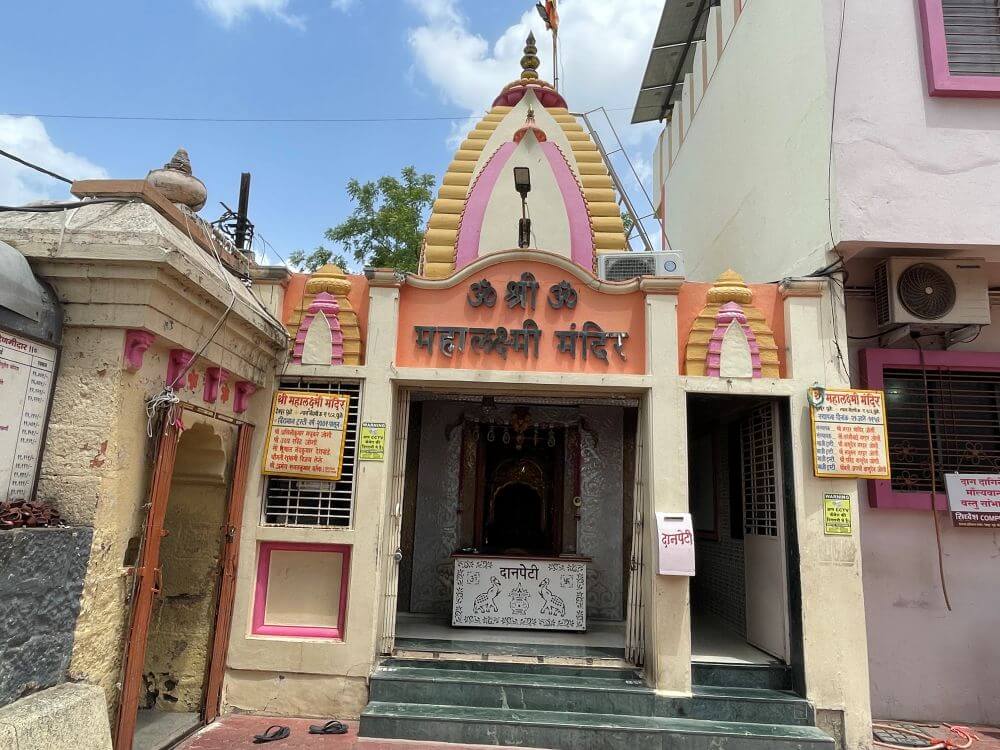
In the temple courtyard, a chariot pavilion houses a magnificent brass chariot, locally known as *Tagatrao*. This chariot features an octagonal tower adorned with images of various deities. During the annual festival (Yatra), this Tagatrao is taken in a grand procession around the temple. Additionally, the courtyard houses shrines dedicated to Shitala Devi, Khokla Devi, Lord Parashurama, Maruti, Vitthal-Rakhumai, Mahalakshmi, Kalabhairava, and Mahadev, as well as a large Bhakta Niwas (pilgrim rest house) building. Accommodation for devotees during festival periods is arranged here. The courtyard also features a traditional stepwell with steps.
Chaitra Navratri and Ashwin Navratri are the main annual festivals celebrated at the temple. During both Navratri festivals, various religious programs are organized for ten days each. On all ten days, lakhs of devotees visit the temple to seek the holy Darshan of the Goddess and to fulfill their vows. Apart from these, festivals such as Dasara, Diwali, Kartik Purnima, Mahashivratri, Hanuman Jayanti, and Makar Sankranti are also celebrated. A Palkhi (palanquin) procession of the Goddess is taken out during Chaitrotsav and on every Purnima (full moon day). Devotees from states including Maharashtra, Gujarat, Madhya Pradesh, Karnataka, Uttar Pradesh, Andhra Pradesh, and Rajasthan arrive here to seek the Goddess’s divine blessings.
This sacred temple stands as a testament to deep spiritual devotion, ancient architectural grandeur, and rich local cultural traditions.
The sanctum sanctorum houses the divine idol consecrated according to ancient Vedic traditions, surrounded by serene courtyards and traditional temple architecture.
Navratri, Maha Shivratri, Annual Temple Jatra & Deepotsav
Compare and book flights, secure top-rated local hotels near the temple, hire reliable guides, and rent cars instantly.
Extend your pilgrimage by visiting other highly sacred temples located nearby.


Add ₹999 more to unlock FREE SHIPPING!
Your sacred cart is currently empty.
Shop Photo FramesFill in your delivery details below to place your order.
Add comment