
Add ₹999 more to unlock FREE SHIPPING!
Your sacred cart is currently empty.
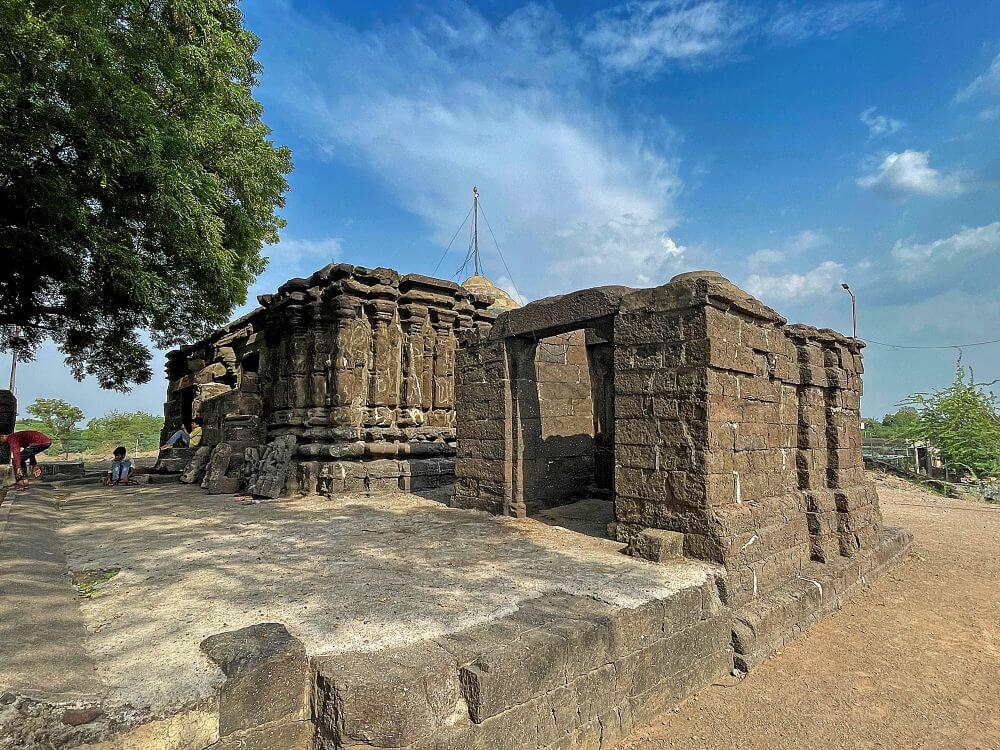
Shop Photo FramesThe history of Indian sculpture dates back to the origins of the Indus Valley Civilization. Sculptural art flourished from the Mauryan period up until the thirteenth century, during the Yadava era. Thereafter, with the advent of the Bahmani rule, the art of sculpture began to decline, and many temples that possessed a rich architectural heritage were lost in forests or buried underground. Some temples were neglected and began to literally crumble. The few temples that exist today do so because of the folk faith associated with them. One such ancient and famous Kanbai temple, blessed with a rich sculptural heritage, is located in the village of Balsane in the Sakri taluka.
A well-preserved inscription on the entrance of one of the temples in this complex, which features stone masonry in the Hemadpanti architectural style, clarifies that this temple was built in the year 1264 AD. It is said that this construction dates back to the era of the last Yadava king, Bhoja II. Since the Yadavas were of the Ahir lineage, they held a special devotion to Lord Krishna. It is believed that for this reason, they built a temple dedicated to Radha, known as Kanbai Devi. Throughout Khandesh, the festival of Kanbai Devi is celebrated with great enthusiasm in every household. It is also said that this region was named ‘Kan Desh’ due to Kanbai Devi, which later evolved into the corrupted form, Khandesh. The dialect of the Ahir lineage, ‘Ahir Vani’, later came to be known as the Ahirani language. Thus, Kanbai Devi has had an influence on Khandesh since ancient times.
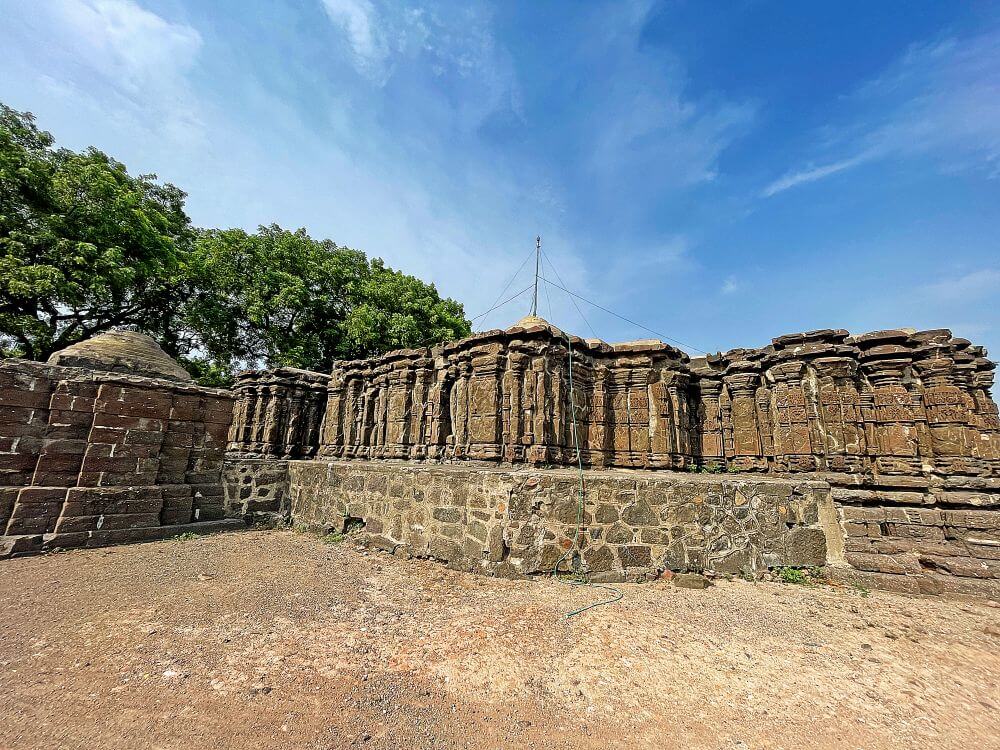
Although remnants of fortification walls can be seen around the temple premises, there is no fortification in the present state. In the vast, open courtyard, various ancient idols, hero stones (Veergal), and temple ruins are found scattered here and there. In front of the Kanbai temple, there is a square hero stone pillar on a platform, and on all four of its The sides are carved with relief-style sculptures. The unique feature of this Viragal (hero stone) is that it depicts a battle scene in two parts at the top, the ascension to heaven below that, and the soul experiencing the bliss of heaven in the lowest tier.
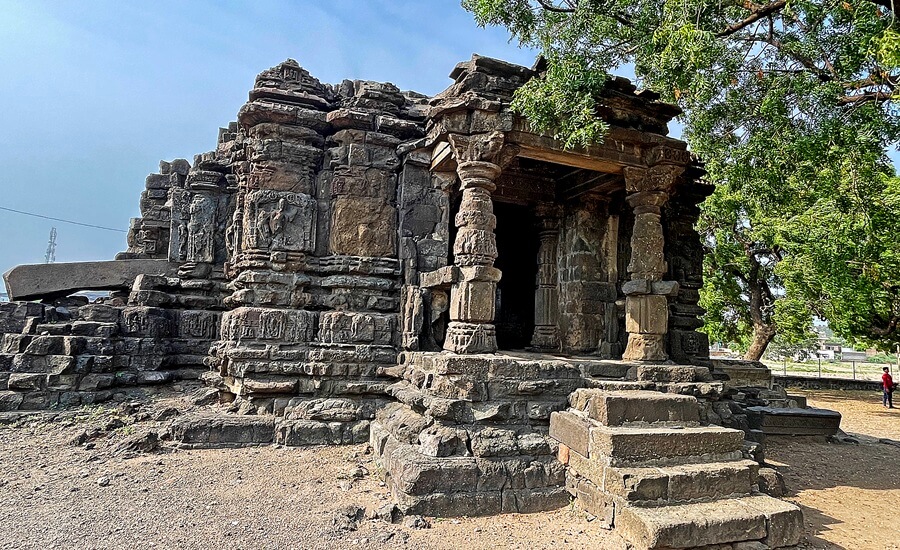
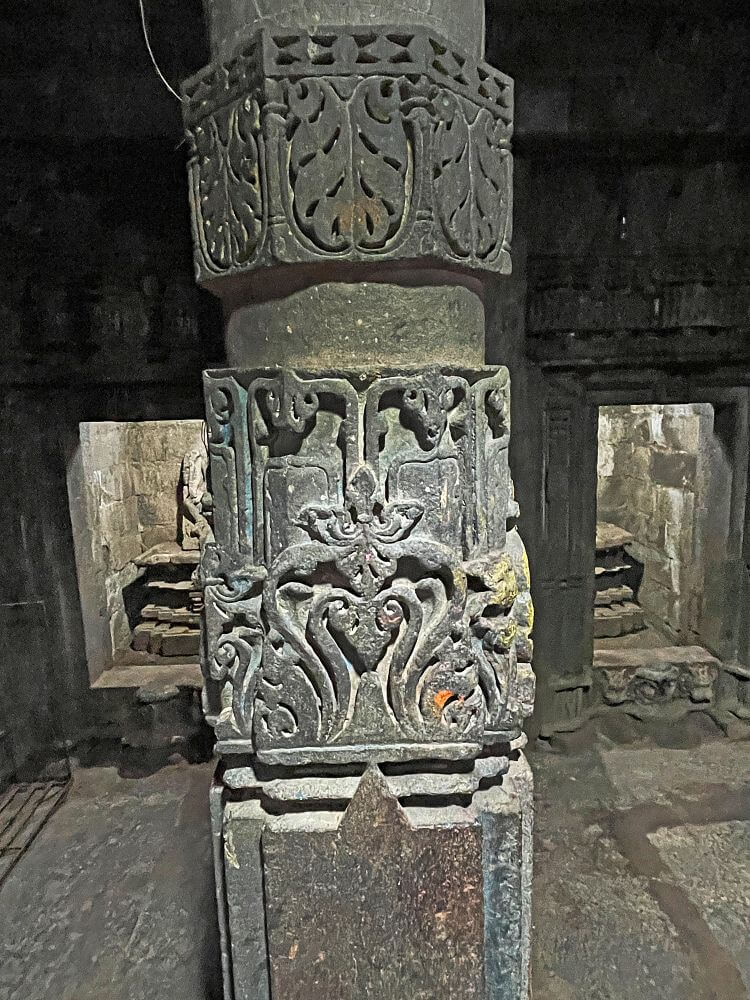
There are steps in front of the temple entrance. On the platform, in front of the entrance to the Mukhamandapa (main hall), there are black stone idols of deities such as Ganesha, Shiva-Parvati, the Dashavatara of Vishnu, and Vanadevi, along with a Shivlinga on the right side. It is said that these idols likely belonged to a temple that has since fallen into ruins. The entrance to the Mukhamandapa is somewhat narrow. It appears that the artistic pillars on the outer side may have collapsed; consequently, flat square pillars and a lintel are visible on both sides of the doorway. There are two guard chambers (Dwarapal Kaksha) on the left and right sides of the Mukhamandapa. The lintels of these chambers feature lotus flower carvings. The entrance doorway has ornate pillars and three doorjambs, each decorated with floral and leaf motifs. On the Lalatabimba (lintel block) is Ganesha. is enshrined. Sculptures of various deities are carved on the upper side of the lintel. In both chambers, idols of deities made of black stone are placed on ornate pedestals (vajrapithas). The pillars and walls of the enclosed assembly hall (mukhamandapa) are adorned with intricate carvings of various shapes. There are windows (gavaksha) in the assembly hall to allow for the passage of air and sunlight. The ceiling of the assembly hall features a rectangular, ornate dome.
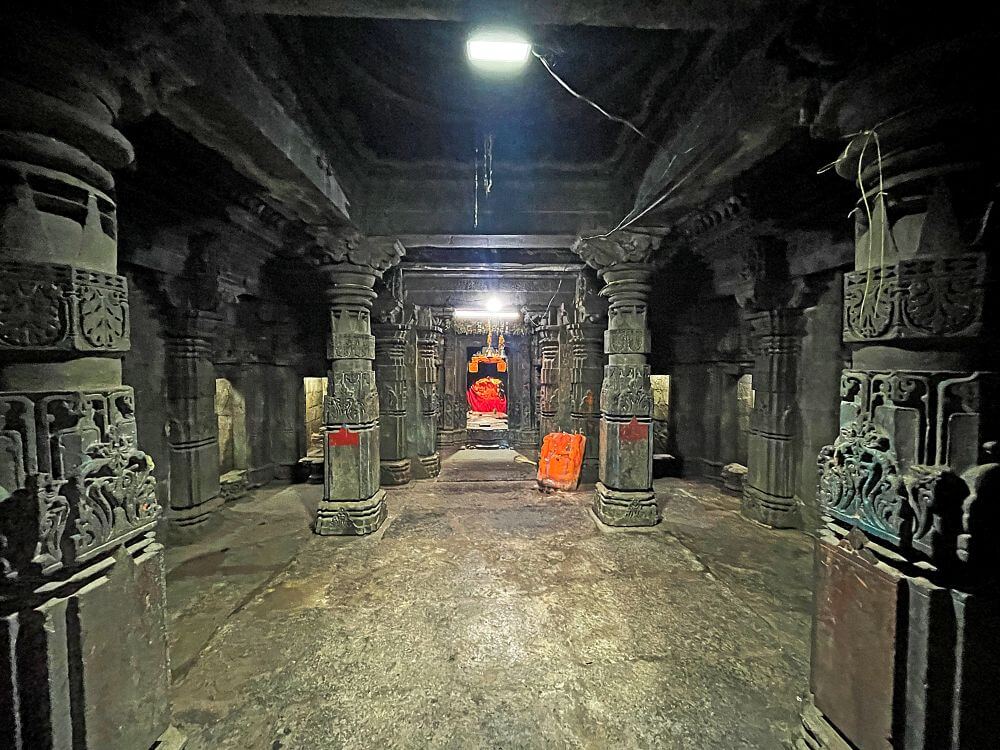
Adjacent to the entrance of the front assembly hall (Sabhamandapa), several idols are placed. The entrance features four intricately carved door frames (dvarashakhas), with Lord Ganesha depicted on the central lintel (lalatabimba). Above this, the lintel panel (lalatapatti) is adorned with a semi-circular design in the center, flanked by foliage and floral patterns on both sides. The ceiling (mandaraka) is decorated with lotus flower motifs. The assembly hall contains four rows of four ornate pillars each. The pillars in the outer rows are embedded into the walls. These pillars are wider at the base and feature carvings of various shapes in the middle. At the top, there is a capital (kani) with brackets (hasta) extending in all four directions. The Yaksha sculptures positioned on these brackets create the illusion of supporting the beams upon their heads. On the capitals of the ten pillars embedded in the walls, there are brackets on three sides, with Yaksha sculptures on the front-facing brackets. On the flat platforms above the heads of these Yakshas, there are idols of various deities.
In the Sabha Mandapa (assembly hall), there are five independent shrines on each side, housing idols of various deities. The door frames of each shrine are adorned with floral and leaf carvings, with an idol of Lord Ganesha on the lalata-bimba (lintel). Above the lalata-bimba, in the upper row, idols of various deities are carved. Along the wall of the Sabha Mandapa, there is an idol of Lord Ganesha smeared with vermilion (sindoor). The ceiling of the Sabha Mandapa features an intricately carved dome. Idols of deities are carved into the various tiers of this dome.
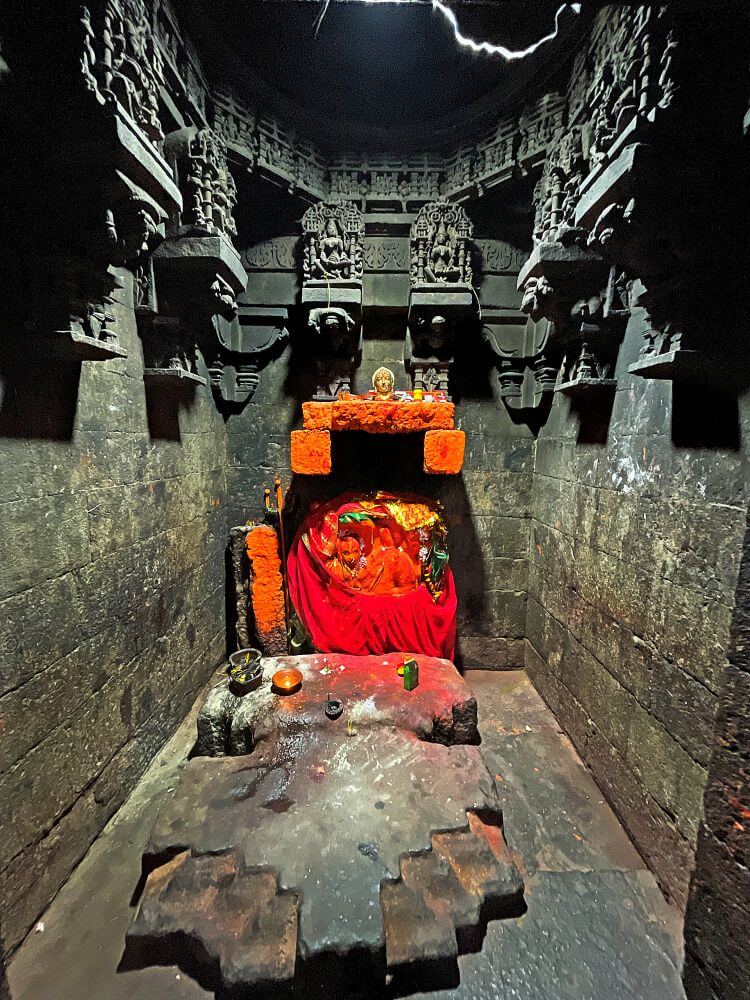
The front wall of the sanctum sanctorum (Garbhagriha) features niches (Devakoshthakas) adorned with intricately carved pillars. Above the niches, idols of various deities are carved. On the left niche is Varaha, while on the right niche is Narasimha slaying Hiranyakashipu. The entrance to the sanctum sanctorum (Garbhagriha) features five doorjambs. On these, there are five Surasundaris (celestial beauties) and door guardians on both sides at the bottom, and floral patterns at the top. On the lintel (Lalatbimba), there is an idol of Lord Ganesha, and on the upper row, there are idols of various deities and sculptures of Surasundaris. Inside the sanctum sanctorum, on a Vajrapitha, are the combined idols of Kanbai and Ranbai carved from a single stone. These somewhat indistinct idols are smeared with vermilion (Shendur).
The exterior of the temple is completely covered in intricate carvings, and the original shikhara (spire) on the roof has collapsed. The dome-shaped shikhara visible today is said to be a recent reconstruction. Beside this temple is a small shrine housing an idol of Goddess Parvati. Adjacent to it is the dilapidated temple of Goddess Ranbai. Near the entrance of the temple stands a two-armed idol of the Goddess carved from black stone. A child rests on the Goddess’s left lap, and tree branches emerge from her head. Local villagers refer to this Goddess as Khokali Mata. Beside the idol of the Goddess are a stone wheel and a Shiva Linga. Near this temple stands the Varaha Mandapa, supported by four ornate pillars, which houses an idol of Varaha smeared with vermilion. Near the pillars are idols of various deities. Nearby are a Shiva temple containing a Shiva Linga and a Bhavani temple. Adjacent to these is a large but dilapidated temple known as the Math. Above the lalata-bimba (lintel) on the entrance here is an inscription. This inscription records that all the temple structures here were built in the year 1264 AD.
Although this temple is currently under the jurisdiction of the Archaeological Department, thousands of devotees from across Khandesh visit regularly to seek the Goddess’s blessings. The ‘Chakra Puja’ is performed for the Goddess, and ‘Roth’ (a traditional sweet bread) is offered. ‘Puran Poli’ and ‘Varan Batti’ are offered as Naivedya to the Goddess. On the first Saturday, Sunday, and Monday following Nag Panchami, the festival of Kanbai and Ranbai is celebrated in every household across Khandesh. The Goddess is installed in homes and immersed on the third day.
This sacred temple stands as a testament to deep spiritual devotion, ancient architectural grandeur, and rich local cultural traditions.
The sanctum sanctorum houses the divine idol consecrated according to ancient Vedic traditions, surrounded by serene courtyards and traditional temple architecture.
Navratri, Maha Shivratri, Annual Temple Jatra & Deepotsav
Compare and book flights, secure top-rated local hotels near the temple, hire reliable guides, and rent cars instantly.
Extend your pilgrimage by visiting other highly sacred temples located nearby.


Add ₹999 more to unlock FREE SHIPPING!
Your sacred cart is currently empty.
Shop Photo FramesFill in your delivery details below to place your order.
Add comment