
Add ₹999 more to unlock FREE SHIPPING!
Your sacred cart is currently empty.
Shop Photo FramesSituated in a nature-rich region, Dahanu is a historic city located along the coastline of the Konkan region in Palghar district. This city is especially renowned due to the ancient Mahalakshmi Temple here, which is a revered sanctuary for lakhs of devotees. Every year, thousands of devotees visit here for the darshan of the Goddess from Palghar, Mumbai, and Thane districts, as well as from Gujarat. A large fifteen-day fair is held here during the period from Chaitra Purnima to Chaitra Amavasya. It is considered one of the largest yatras (fairs) in Thane and Palghar districts. During this period, lakhs of devotees flock here for the darshan of the Goddess and to fulfill their vows (navas).
The ancient name of Dahanu was Dahanuka. A river of the very same name flowed there. This name is mentioned in an inscription dated 120-121 CE from the Nashik caves of Rishabhadatta (Ushavadatta), the son-in-law of King Nahapana of the Western Satrap dynasty. This inscription states: ‘For crossing the rivers Iba, Parada, Daman, Tapi, Karabena, and Dahanuka, arrangements of charitable ferries were made. Dharmashalas (rest houses) and water stations (panpois) were built on both banks of these rivers, and thirty-two thousand coconut trees in the village of Nanangola were donated to the ascetics (bhikshu sanghas) at Pinditakavada, Govardhana, Suvarnamukha, Shorparaga, and Ramatirtha.’ This ancient sacred abode of Mata Mahalakshmi is situated in a city with a history dating back to the first century CE.
Regarding the presence of the Goddess here, legend has it that once during their exile, the Pandavas were camped on a hill in Dahanu. At that time, Mahalakshmi of Kolhapur was roaming and reached near Dahanu. There, the Goddess met Bhima. Charmed by the beauty of the heavily adorned Goddess, Bhima proposed marriage to her. At that time, the Goddess placed a condition before him that she would marry him only if he built a dam across the Surya river in a single night. Accordingly, Bhima began constructing the dam. When the construction of the dam was nearing completion, out of apprehension that an untoward event might occur, the Goddess took the form of a rooster and crowed even before sunrise. Hearing that sound, Bhima thought that the sun had risen, and assuming defeat, he backed down. The dam located in this area is known as Bhimbandh and remains in an incomplete state to this day. Afterwards, the Mother went and rested in a cave on the Bhusal mountain near Ranshet village.
According to records in the Thane Gazetteer, the peak on the Bhusal mountain was formerly called St. Valentine’s Peak. Its height is 1540 feet above sea level. The abode of the Goddess was in a cave there. That mountain was extremely difficult to climb. Only the Warli priest of the Goddess could go there. On the night of the full moon (Purnima), he would climb the peak, hoist a flag there, and return. At that time, countless people would stand below and cheer loudly once the flag was hoisted on the mountain. Except for this priest’s family members, anyone else who went to hoist the flag would risk their life. Manya Patil used to hoist the flag there regularly. However, in the year 1872, while he was climbing up to hoist the flag, he suddenly disappeared. For the next three years, the flag was not hoisted there. Thereafter, Manya Patil’s nephew Krishna received a divine vision (swapnadrushtanta) from the Goddess. The Goddess instructed him to hoist the flag. Ever since, he began climbing up to hoist the flag. This is a record from 1882.
Just like this mountain abode of the Goddess, there is also a temple of the Goddess in the village below the mountain. It is said that the first king of Jawhar State, Jayaba Mukane, established this temple. Mukane founded the Jawhar State in the year 1316 CE. This temple must have been built in the period following that. The following legend is narrated regarding the construction of the Goddess’s temple below the mountain: Once, a pregnant tribal woman was climbing the mountain to have darshan of the Goddess. At that time, she felt dizzy and fainted. Then, the Goddess appeared in a vision to that woman and told her, “From now on, you do not need to come up to the fort for my darshan; I myself am coming down.” Since then, the abode of the Goddess has been at the village of Bivalvedhe below this fort.
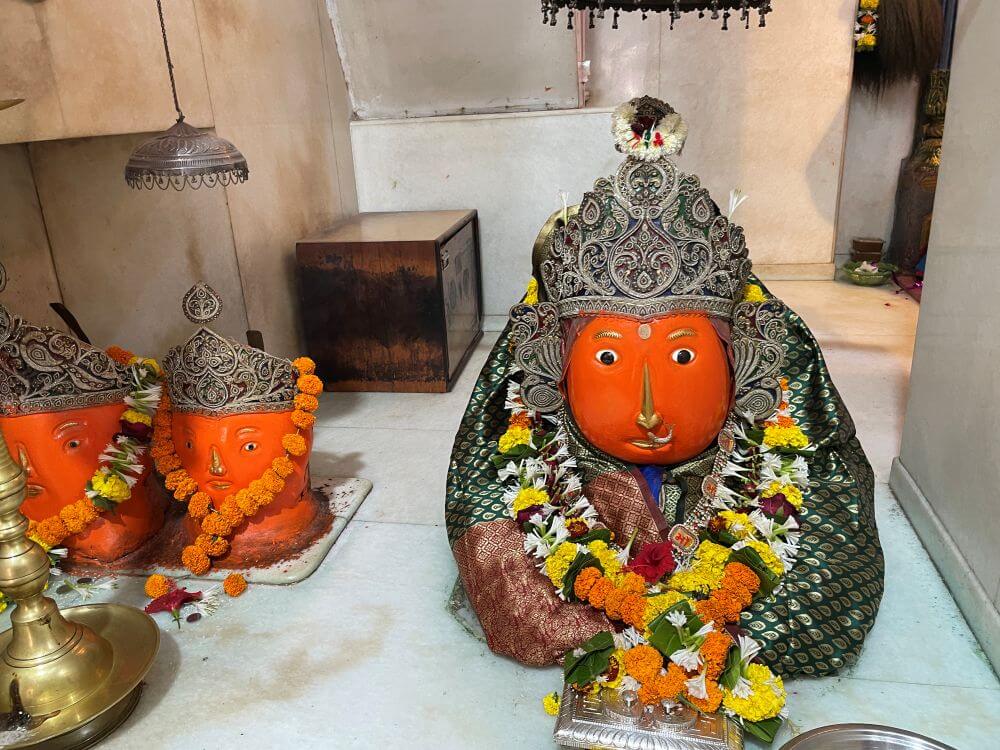
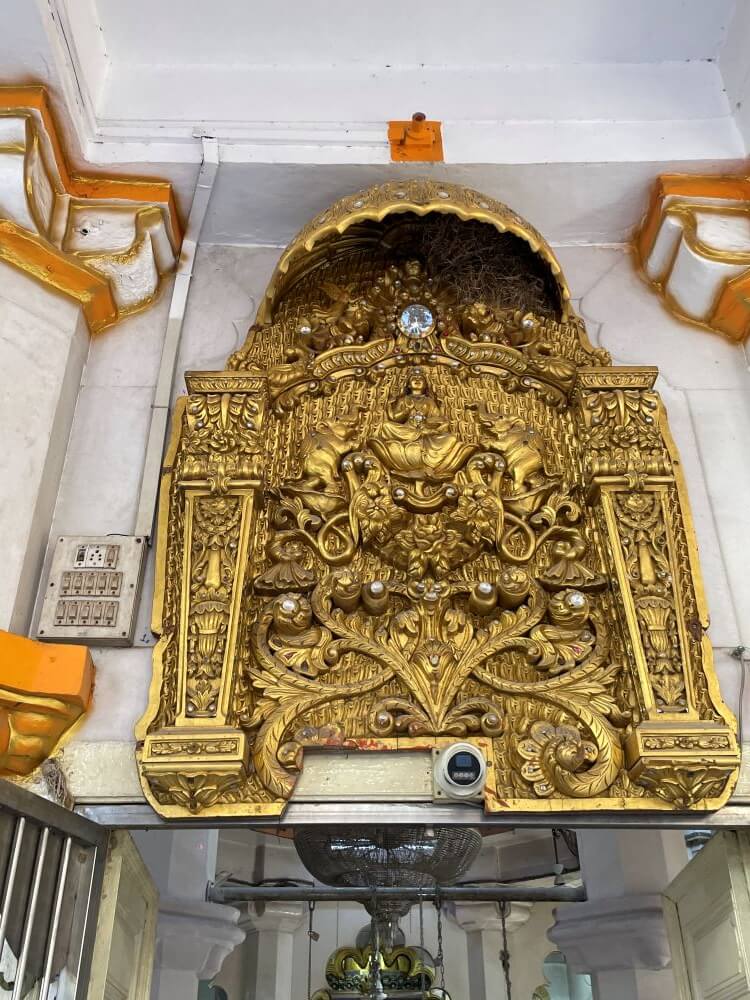
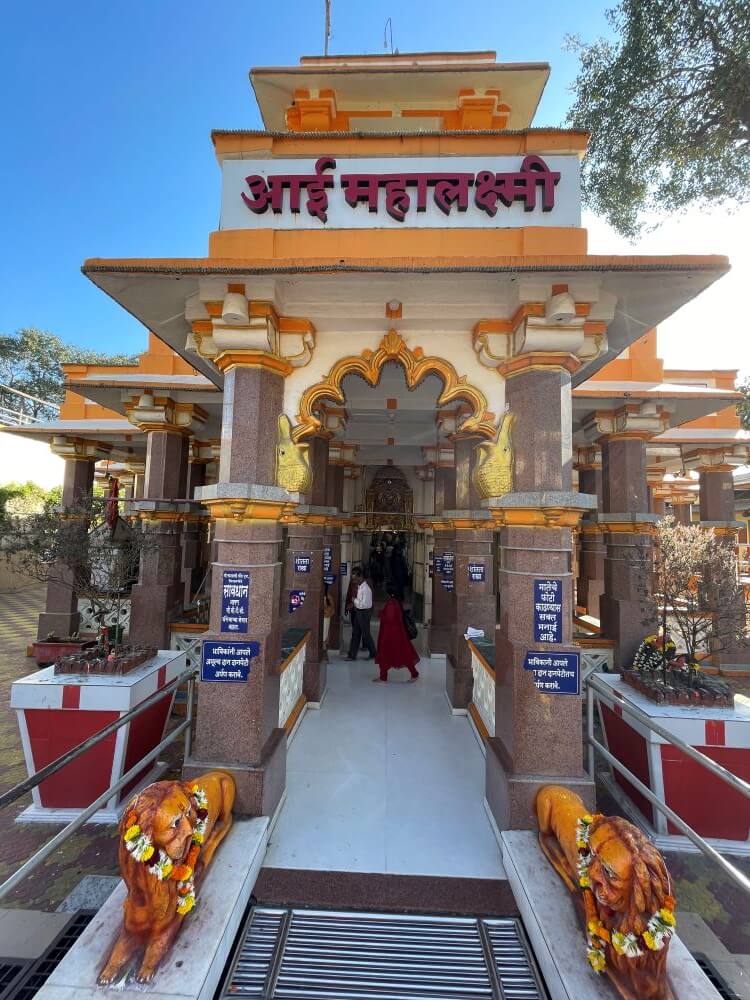
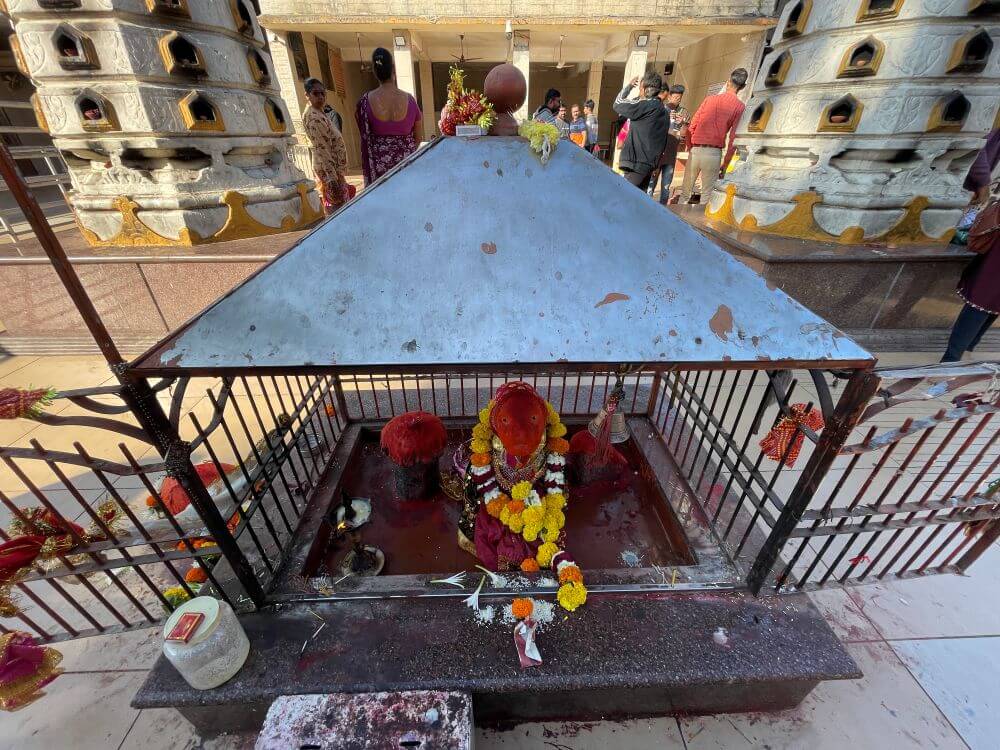
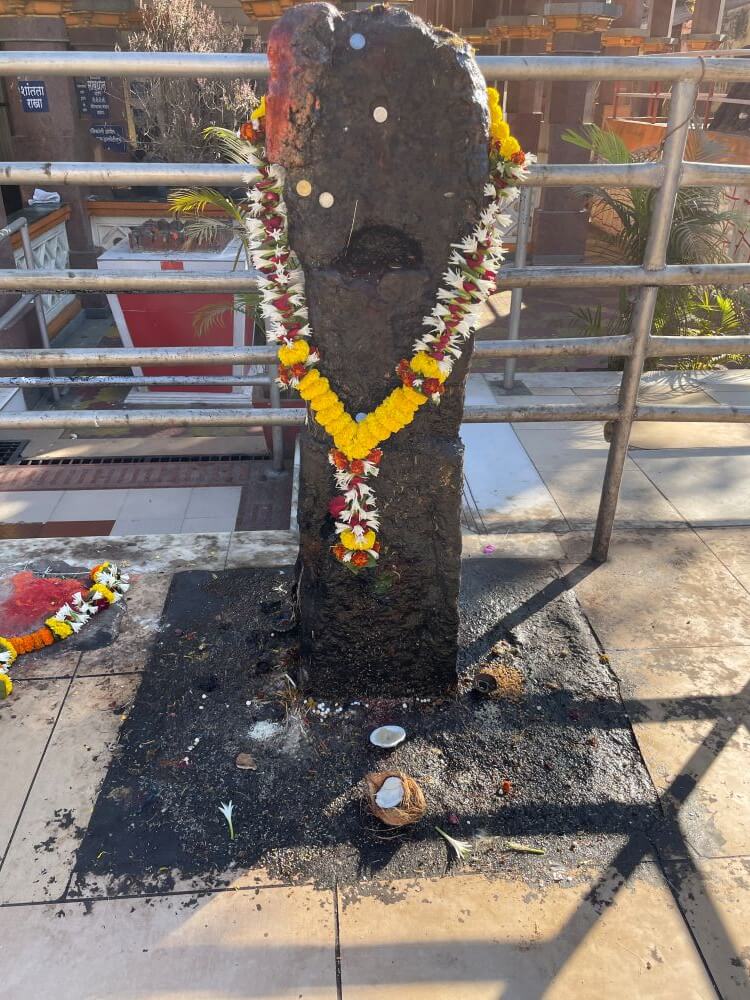
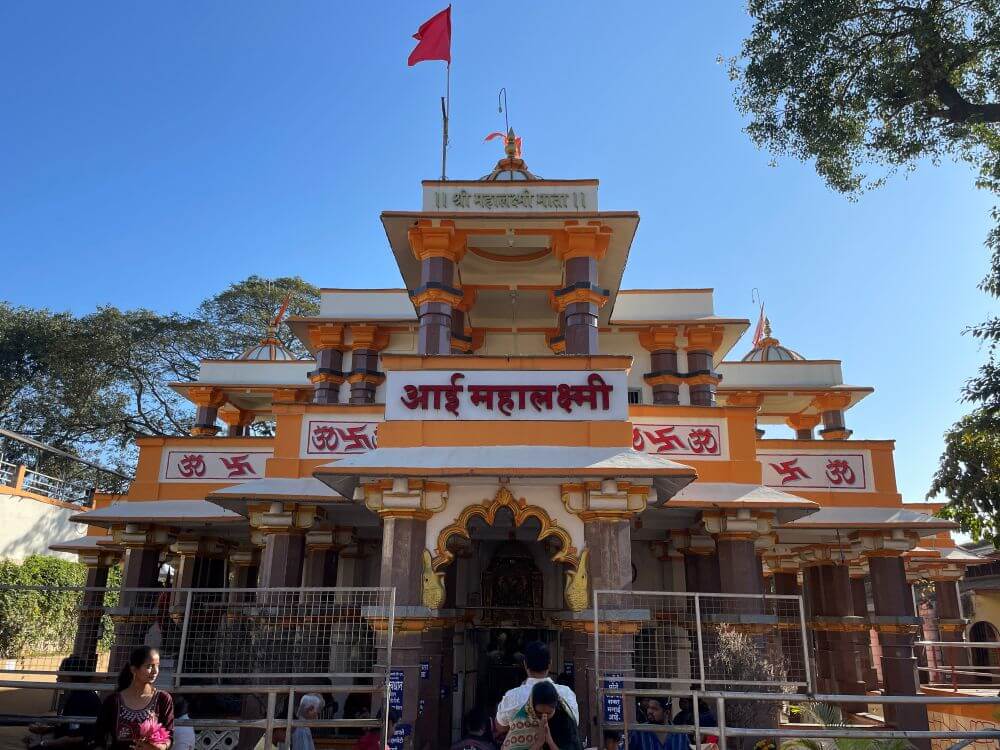
Upon entering the premises of the Mahalakshmi Temple in the village, near the entrance gate, there are two tall and distinct lamp pillars (deepstambhas). Arrangements are made in their niches to light hundreds of lamps. On a platform situated in the midst of these lamp towers (deepmalas), there are stone idols of some local deities. The temple is located at a depth of 8 to 9 feet from the road in front of it. A queue system for darshan has been arranged within this courtyard for the convenience of devotees. Besides this, there is an ancient banyan tree in the courtyard with a square platform built around it. There are also some viragals (hero stones) near the platform. This double-storied temple is structured with three front halls (mukhamandapas), an assembly hall (sabhamandapa), and a sanctum sanctorum (garbhagriha). In front of the mukhamandapa, there are two sculptures of lions, the vehicle of the Goddess. From this semi-open mukhamandapa, there is a circumambulation path (pradakshina marg) for the temple. Apart from the main mukhamandapa, there are two more mukhamandapas on the right and left sides of the sabhamandapa. All three of these mukhamandapas feature dome-shaped shikharas with kalashas on top. The sabhamandapa here is open in nature and compact. A darshan queue arrangement for devotees is made within this. Exquisite marble craftsmanship is done on all the pillars in the temple, including the sabhamandapa. A large, beautiful, and distinctive chandelier is hung on the ceiling of this sabhamandapa. Ahead of this sabhamandapa is the sanctum sanctorum (garbhagriha). In this garbhagriha, Goddess Mahalakshmi is seated on a vajrapitha (throne). Here, there is a vermilion-anointed (shendurcharchit) stone idol of the Goddess. This idol wears a golden crown and a nath (nose ring) in her nose. Adorned with various ornaments, this idol of the Goddess appears beautiful and distinctive. To the right of the Goddess is the idol of Lord Ganesha, and to the left is the idol of Mata Saraswati. The shikhara and kalasha are situated atop the sabhamandapa and garbhagriha of this temple.
Various festivals and celebrations are observed in this temple throughout the year. These include Kolyacha Shendur, Navyacha Shendur, Pittar Baras, Navaratri, Wagh Baras, Mahi Baras, Holiyacha Shendur, and the Yatra festival. In the festival of Kolyacha Shendur, the vegetables that sprout generally within the first 12 to 15 days after the onset of the monsoon are offered as naivedya to the Goddess. Thereafter, those vegetables are used in daily consumption. In the Navyacha Shendur festival, newly harvested rice is offered to the Goddess. Similarly, in Pittar Baras, grains and vegetables yielded from the fields are offered as naivedya to the Goddess by the tribal brethren. On Magha Shukla Dwadashi, the Mahi Baras festival is celebrated at the priest family’s home for five days. On this occasion, people from the entire surrounding region (panchroshi) gather and participate in this festival.
A path has been created from near this temple to reach the original abode of the Goddess situated on the fort. This path to the temple on the fort is somewhat unpaved and has an uphill climb. One has to walk along a footpath for twenty to twenty-five minutes and then climb eight hundred eighty-seven steps to reach the temple. There are some small temples along this route as well. From this hill, one can see a panoramic view of many villages situated below. There is a tradition that one should not consume non-vegetarian food before visiting the temple on this fort; however, many devotees still vow offerings of roosters and goats here. A live rooster or goat is brought up. It is offered to the Goddess, and instead of sacrificing it, it is released alive in the village. This is the uniqueness of this place.
On Chaitra Purnima at midnight, the flag of the Goddess is hoisted on the sharp peak located at the back of the temple on the hill. The tradition of hoisting the flag to the Goddess through the royal family of Jawhar is still followed here today. The priest of this temple goes up to this fort along with this flag, items for the Goddess’s *oti* (auspicious offering of saree and offerings), and a lamp. Due to the steep climb, it is generally not possible for anyone to go there. Therefore, thousands of devotees are present at the foot of the fort at this time to witness this flag-hoisting sight. There is also a facility of a Bhakta Niwas at Biwalvedhe for the stay of devotees coming from afar (Contact: Natu Bhai, Manager, Mob. ۹۳۱۶۰۶۳۶۴۴, ۹۲۶۵۴۰۲۳۴۳).
This sacred temple stands as a testament to deep spiritual devotion, ancient architectural grandeur, and rich local cultural traditions.
The sanctum sanctorum houses the divine idol consecrated according to ancient Vedic traditions, surrounded by serene courtyards and traditional temple architecture.
Navratri, Maha Shivratri, Annual Temple Jatra & Deepotsav
Compare and book flights, secure top-rated local hotels near the temple, hire reliable guides, and rent cars instantly.
Extend your pilgrimage by visiting other highly sacred temples located nearby.


Add ₹999 more to unlock FREE SHIPPING!
Your sacred cart is currently empty.
Shop Photo FramesFill in your delivery details below to place your order.
Add comment