
Add ₹999 more to unlock FREE SHIPPING!
Your sacred cart is currently empty.
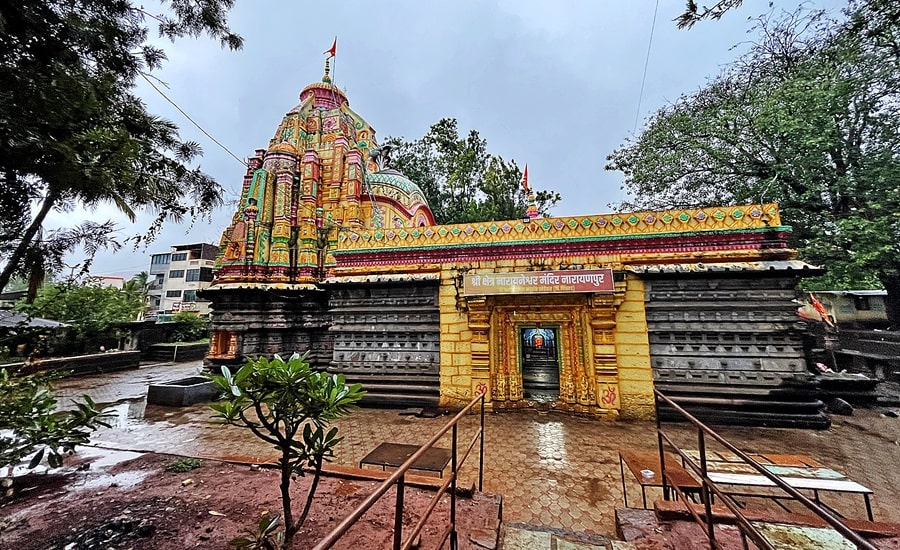
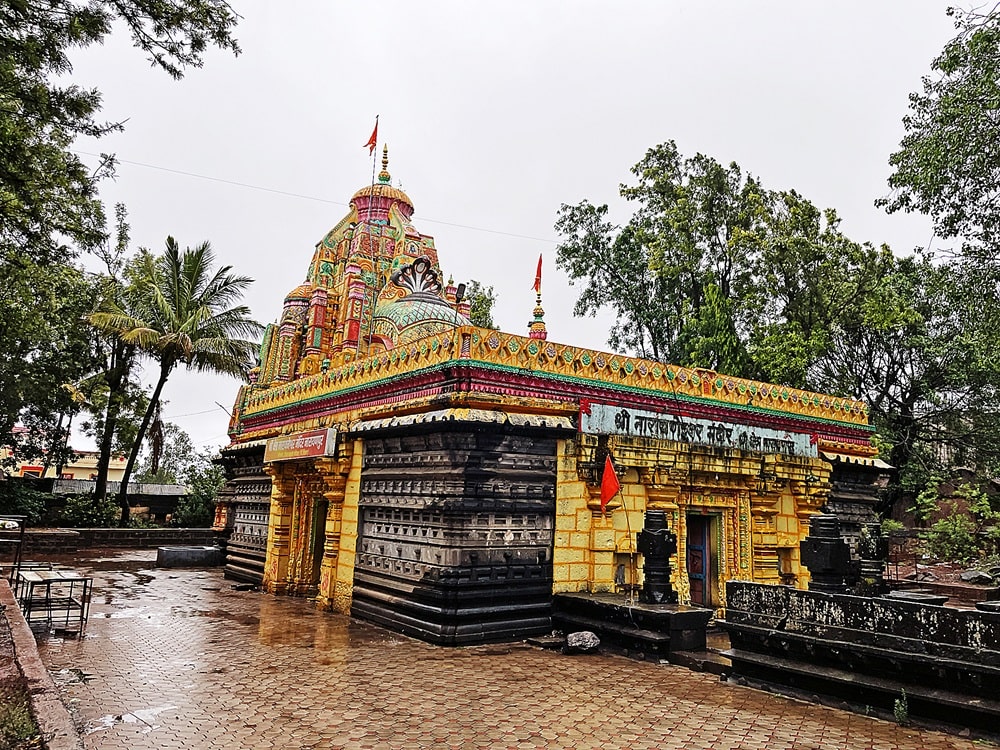
Shop Photo FramesNestled in the lap of the Sahyadri mountains and at the foothills of the Purandar Fort, the ancient Narayaneshwar Temple in Narayanpur is a unique treasure of medieval architecture. Built during the Yadava era, this temple gained significant importance during the Maratha Empire. The temple holds special reverence due to the gold covering (aavaran) offered to the Shiva Linga by Rajmata Jijabai and the intense penance performed here by Saint Changdev Maharaj. It is believed that the Tripinda (three Lingas) in the sanctum sanctorum represents the unified form of Brahma, Vishnu, and Mahesh.
The history of the Narayaneshwar Temple is primarily linked to the prosperous era of the Yadava or Seuna dynasty of Maharashtra. It is believed that this temple was built around the thirteenth century, specifically around the year 1285 CE. A stone inscription of King Ramachandra Yadava, found in the temple premises and currently preserved at the ‘Bharat Itihas Sanshodhak Mandal’ in Pune, serves as solid evidence of this period. The ancient name of the village Narayanpur was ‘Pur’, and it was once a place adorned with exquisite sculpture. After the fall of the Yadavas, this region was ruled by various powers, yet the religious significance of the Narayaneshwar Temple remained intact.
During the Maratha period, especially in the seventeenth century when Chhatrapati Shivaji Maharaj was establishing Swarajya, the Purandar Fort was of immense military importance. Being at the foothills of this fort, the Narayaneshwar Temple held both military and spiritual significance. According to historical records, Rajmata Jijabai visited this temple to offer prayers and presented a gold covering for the Shiva Linga. It is said that a Vishnu temple once existed in the vicinity, but it vanished over time. The ‘Harihar’ form idol of Lord Vishnu from the temple is currently safely housed at the ‘Chhatrapati Shivaji Maharaj Vastu Sangrahalaya’ in Mumbai.
This temple is also associated with the great yogi Saint Changdev Maharaj. It is believed that Saint Changdev Maharaj performed penance in this area for a long period. The mention of ‘Changa Vateshwar’ found in the inscription in the temple’s assembly hall (sabhamandap) bears witness to the saint’s presence here. According to mythology, the Purandar region is named after Lord Indra, and its greatness is also described in the Skanda Purana.
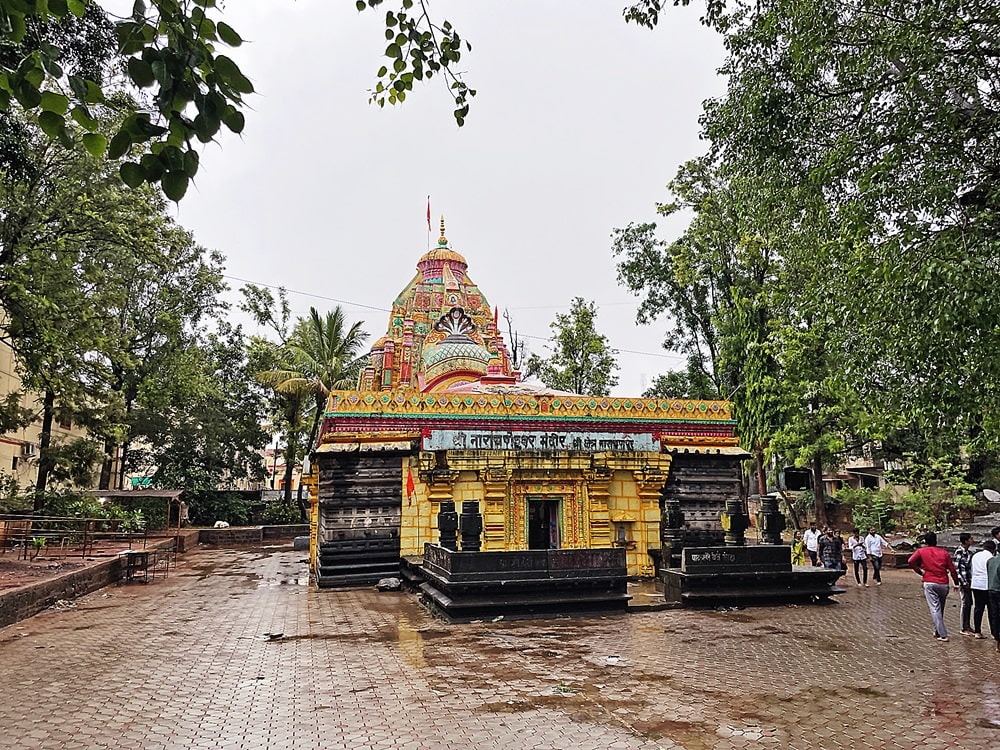
There are two main routes to reach the Narayaneshwar Temple from Pune city. The first route is via Pune-Katraj-Kapurhol, from where one can reach Ketkawale and then Narayanpur. The second route is via Pune-Kondhwa-Bopdev Ghat or Saswad. This area at the foothills of Purandar Fort is rich in natural beauty. The temple is surrounded by a stone wall about five to six feet high. One enters the temple courtyard through the main gate in this wall. There is a tall lamp pillar (deepmal) in the courtyard, as well as an ancient Audumbar tree. Opposite the temple entrance stands a large idol of Maruti, depicted slaying a demoness. In the temple premises, there is a built-in stepwell called ‘Chandrabhaga’ and a vast lake named ‘Panchganga’.
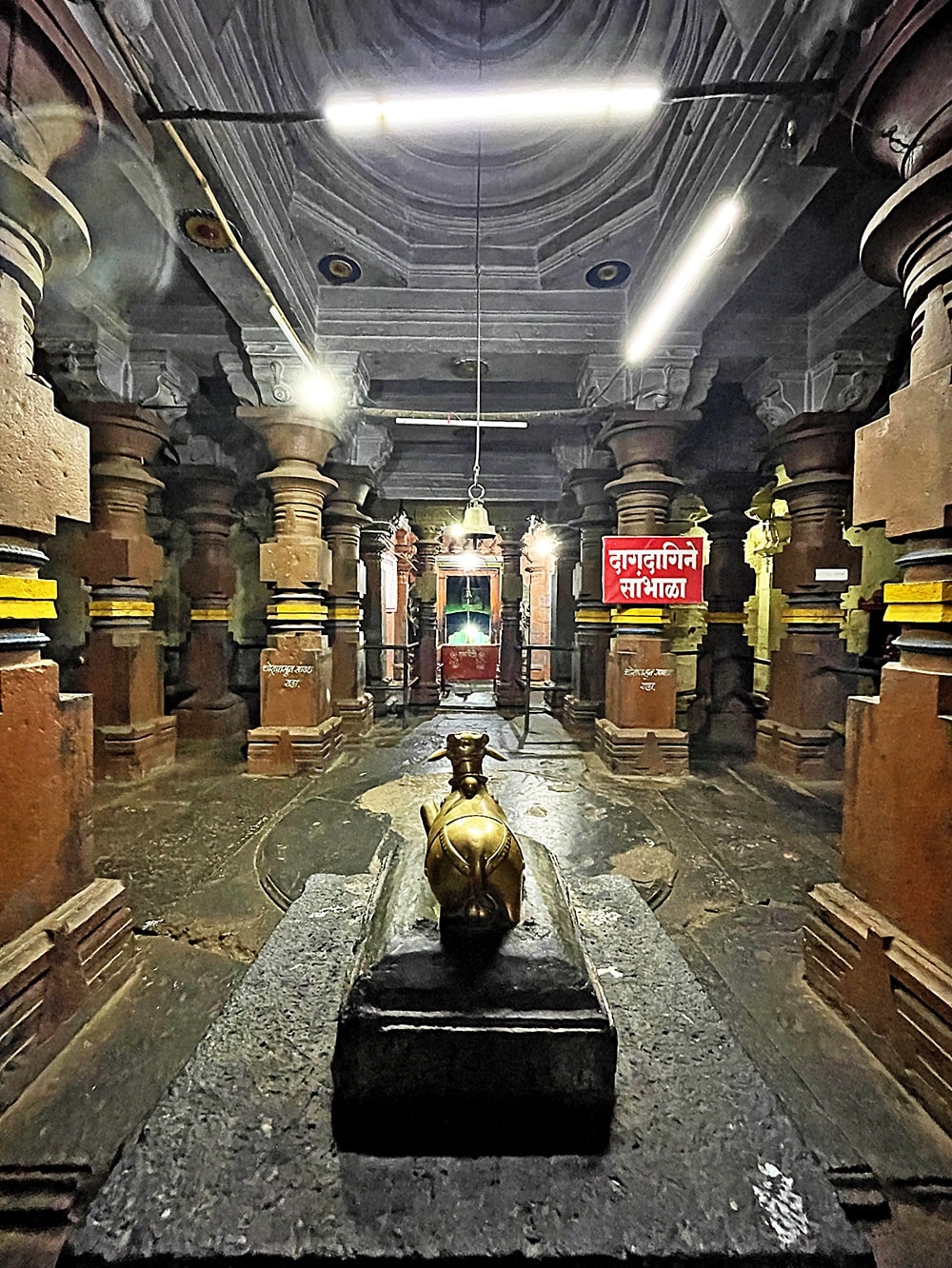
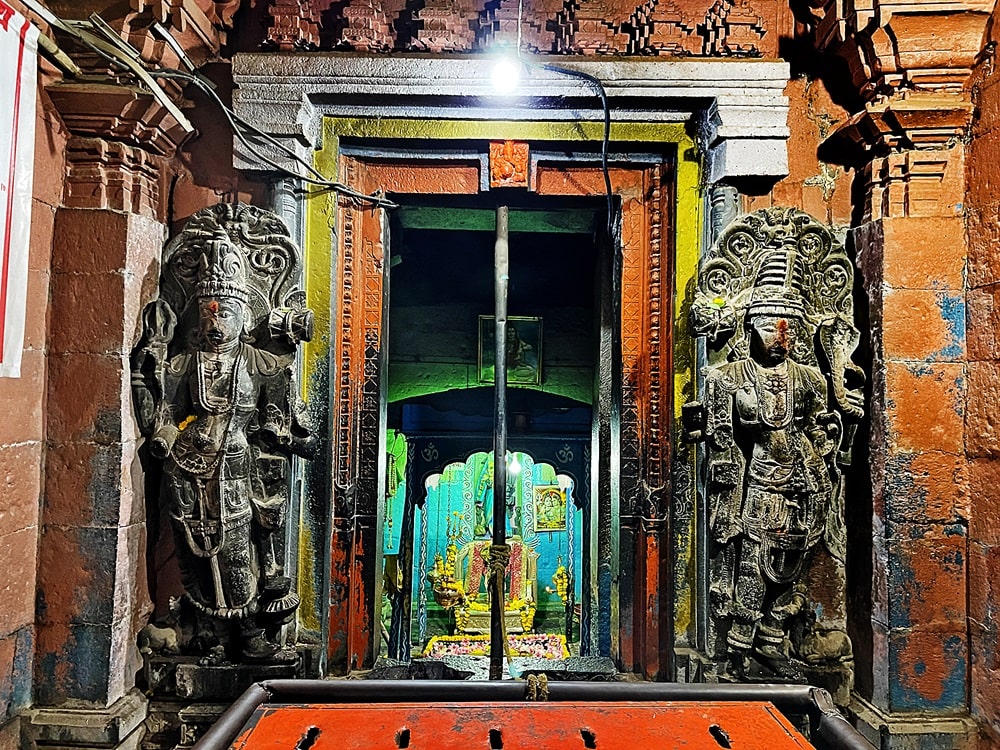
The Narayaneshwar Temple is an excellent example of Hemadpanti architectural style. The temple is built entirely of black stone, using a technique where stones are interlocked with grooves without the use of cement or lime. The temple structure consists of a porch (mukhamandap), assembly hall (sabhamandap), vestibule (antaral), and sanctum sanctorum (garbhagriha). The entrance of the west-facing temple features intricate carvings, with an idol of Lord Ganesha carved on the lintel. The assembly hall contains 20 carved pillars, adorned with sculptures of Yakshas, Apsaras, various Vedic deities, and animals. Load-bearing Yakshas are carved on the upper parts of the pillars. In the center of the assembly hall floor, a large stone tortoise is carved. Further ahead in the vestibule, there are two 5 to 6-foot-tall guardian sculptures (dwarpal), one representing the ‘Devagana’ (divine host) and the other the ‘Rakshasagana’ (demonic host). The Rakshasagana guardian is depicted with protruding tusks. The sanctum sanctorum is slightly lower than the ground level, accessible by steps.
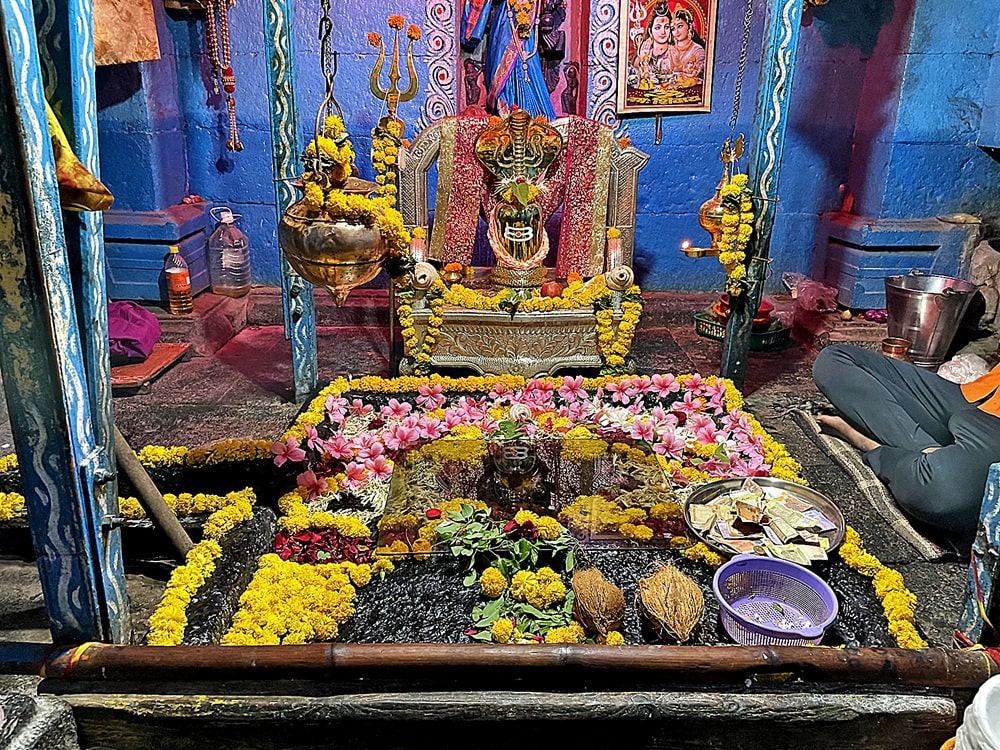
In the center of the sanctum sanctorum is a highly unique Shiva Linga structure. Three self-manifested (swayambhu) Lingas are placed together in a circular pit on the floor. They are believed to be symbols of Brahma, Vishnu, and Mahesh. This is also known as the ‘Gupta Linga’ or ‘Tripinda’. Although the form of Shiva is generally considered the destroyer in Hinduism, here it represents the unification of the three powers: creation, preservation, and dissolution of the universe. A constant stream of water flows beneath these Lingas throughout the twelve months, and remarkably, the water level remains constant year-round, which is considered a mystery. An idol of Goddess Parvati is carved on the back wall of the sanctum. As the original spire (shikhara) of the temple was lost over time, the current one was built in a later period. Sculptures of various dancers and Apsaras are carved on the outer walls and up to the pinnacle. The horizontal band carvings are quite attractive.
Various religious festivals and celebrations are held at the Narayaneshwar Temple throughout the year. The Mahashivratri festival is the grandest among them. A large fair is held here on the day of Mahashivratri. On this day, special abhishek is performed on Mahadeva, and bhajan-kirtan programs continue throughout the night. The temple also holds special significance during the month of Shravan. On Shravani Mondays, devotees bring water in ‘kavads’ to perform abhishek on the Gupta Linga. There is a large crowd at the temple on all Mondays of Shravan. Since Narayanpur is known for its famous Ek-Mukhi Dattatreya Temple, thousands of devotees also visit during Datta Jayanti. As Dattatreya is the combined form of Brahma, Vishnu, and Mahesh, and the Narayaneshwar Temple also houses the Tripinda of these three deities, Datta devotees also visit this temple for darshan. Additionally, religious rituals are performed on Chaitra Purnima and other important festivals.
This sacred temple stands as a testament to deep spiritual devotion, ancient architectural grandeur, and rich local cultural traditions.
The sanctum sanctorum houses the divine idol consecrated according to ancient Vedic traditions, surrounded by serene courtyards and traditional temple architecture.
Navratri, Maha Shivratri, Annual Temple Jatra & Deepotsav
Compare and book flights, secure top-rated local hotels near the temple, hire reliable guides, and rent cars instantly.
Extend your pilgrimage by visiting other highly sacred temples located nearby.


Add ₹999 more to unlock FREE SHIPPING!
Your sacred cart is currently empty.
Shop Photo FramesFill in your delivery details below to place your order.
Add comment