
Add ₹999 more to unlock FREE SHIPPING!
Your sacred cart is currently empty.
Shop Photo FramesSituated on the banks of the Nira River in the Purandar taluka of Pune district, the Shri Nath Mhaskoba Temple at Veer is considered a highly awakened and powerful shrine. Shri Nath Mhaskoba is believed to be an incarnation of Kalabhairava, the presiding deity of the Kashi region. The annual fair held here for ten days, from Magh Purnima to Vadya Dashami, is famous. Thousands of devotees and farmers gather here to listen to the ‘Bhaknuk’ (prophetic predictions) delivered during this fair. It is said that the deity was named Shri Nath Mhaskoba because this place was once a cremation ground, known as ‘Mashanvata’. The state government has honored this awakened shrine with the ‘B’ grade status of a pilgrimage site.
The Shri Nath Mhaskoba Temple is directly linked to the Kashi region. It is believed that Lord Shiva bestowed the stewardship of Kashi upon Kalabhairava, and thereafter, this deity assumed various incarnations to protect his devotees. According to historical records and local references, Chhatrapati Shahu Maharaj of Satara once came to this area for hunting, during which he experienced the presence of Shri Nath in the Nira River valley. After the Maharaj challenged the local shepherds to catch a live tiger, Shri Nath appeared before them in response to the prayers of the shepherd boys. Impressed by this, Shahu Maharaj accepted this deity as his family deity (Kuladaivat). The Maharaj himself built a ‘Deepmal’ (lamp tower) in front of the temple and made arrangements for an annual grant to cover the daily expenses of the temple. During the Indian Rebellion of १८५७, the British attempted to seize the weapons kept in the temple, but the British officers were forced to retreat due to the fear of the divine wrath displayed by the priests. The historical Purandare family of Saswad and many local landowners have contributed to the preservation of this temple from time to time. Even today, ancient swords and weapons are preserved in the temple.
The legend of the temple states that Kamlaji, a devout follower of Shri Nath Mhaskoba, used to take his goats, sheep, and cattle to graze as far as Sonari in Belgaum district. At night, he would tether his cattle in a courtyard and go to the Shri Nath temple in Sonari to perform Abhishekam and Abhyangsnan (ritual bathing) for the deity. This devotee, who worshipped with deep devotion by offering Tarwad leaves and flowers, would offer his own piece of Bhakri and onion as Naivedya to the Lord. Seeing the daily routine of Kamlaji, who worshipped Shri Nath throughout the night, the local villagers became suspicious and decided to verify the identity of this priest who came to the temple secretly.
Sensing the danger to his devotee, Shri Nath appeared before Kamlaji and advised him not to come to the temple. However, Kamlaji, distraught at the thought of separation from Shri Nath, insisted on worshipping the Lord under any circumstances. Seeing this deep longing of his devotee, the Lord himself agreed to come to meet him. Shri Nath clarified that as a sign of his arrival, a barren cow would start giving milk and a dried tree would sprout new leaves. The next day, Kamlaji witnessed a miraculous sight. A five-headed cobra was coiled around the belly of a barren cow, and four of the serpent’s heads were drinking the cow’s milk. At the same time, Kamlaji saw green leaves sprouting on a dried tree. Convinced by these signs given by Shri Nath, Kamlaji respectfully spread his upper garment (Uparne) on the ground. This five-headed serpent came and rested on that seat, and Kamlaji safely hid the serpent in his woollen blanket (Ghongadi).
This routine of worshipping the serpent in the blanket and offering Naivedya continued for the next twelve years. A villager saw this and informed Kamlaji’s father about the serpent. A suspicion arose in the father’s mind that his son might be learning witchcraft or black magic. When his father questioned him, Kamlaji, fearing separation from Shri Nath and not wanting to lie to his father, maintained silence and departed from there. Kamlaji expressed his grief to the Lord, and following Shri Nath’s instructions, he released the serpent into an anthill on the plateau. Kamlaji would come every day to worship and pray near this anthill, which was located near land owned by the Raut family. A few years later, when the Raut family decided to plow this land, Kamlaji requested them not to harm the anthill. Ignoring this request, the Raut family drove the plow over the anthill, and at that very moment, the twelve oxen pulling the plow and the members of the Raut family died.
There was a stir throughout the village, and people gathered at the spot. At that moment, Shri Nath possessed Kamlaji, and he explained the entire incident in detail to the villagers. Realizing their mistake, the people sincerely apologized to Shri Nath. Kamlaji blew the holy ash (Angara) of Shri Nath over everyone, and the twelve dead oxen and the Raut family were brought back to life. Subsequently, a temple was established at this site.
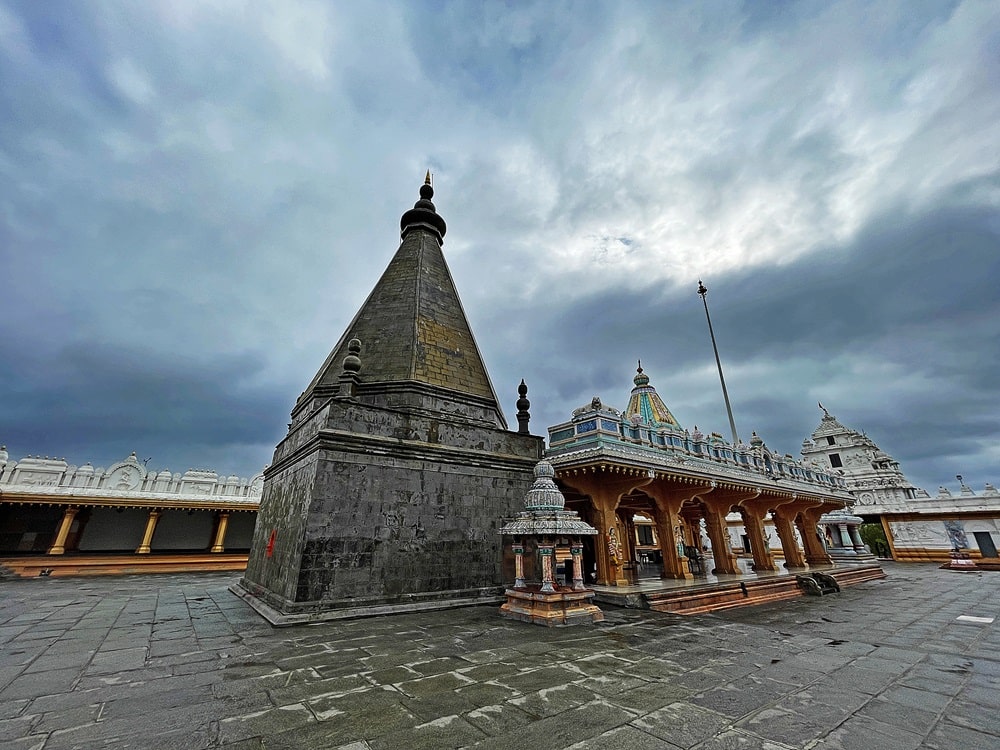
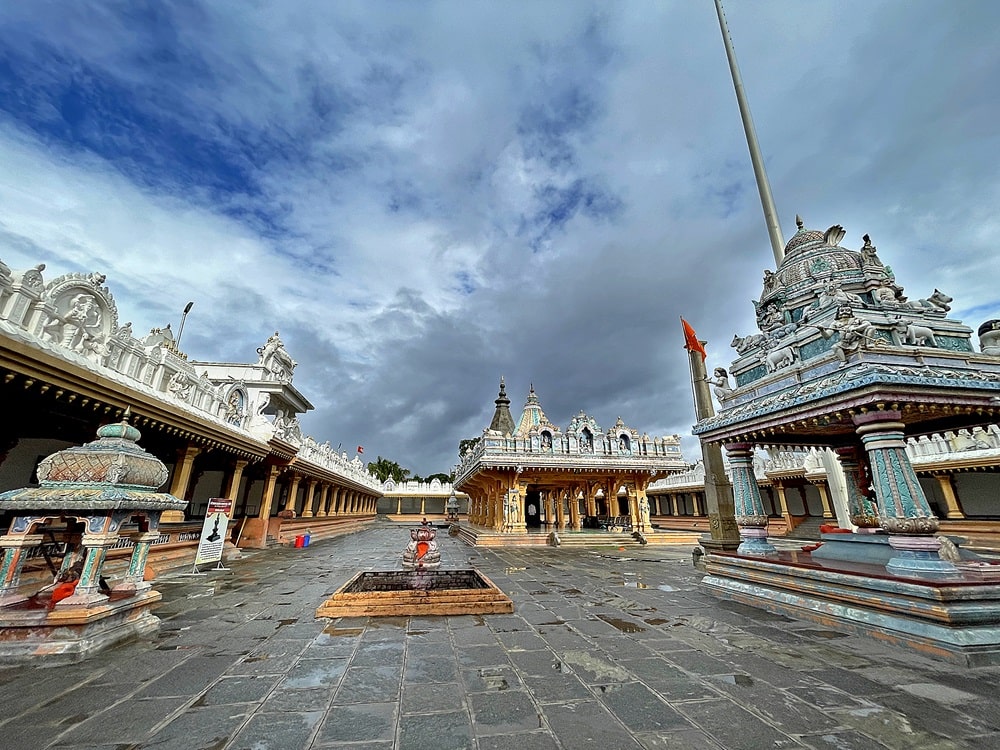
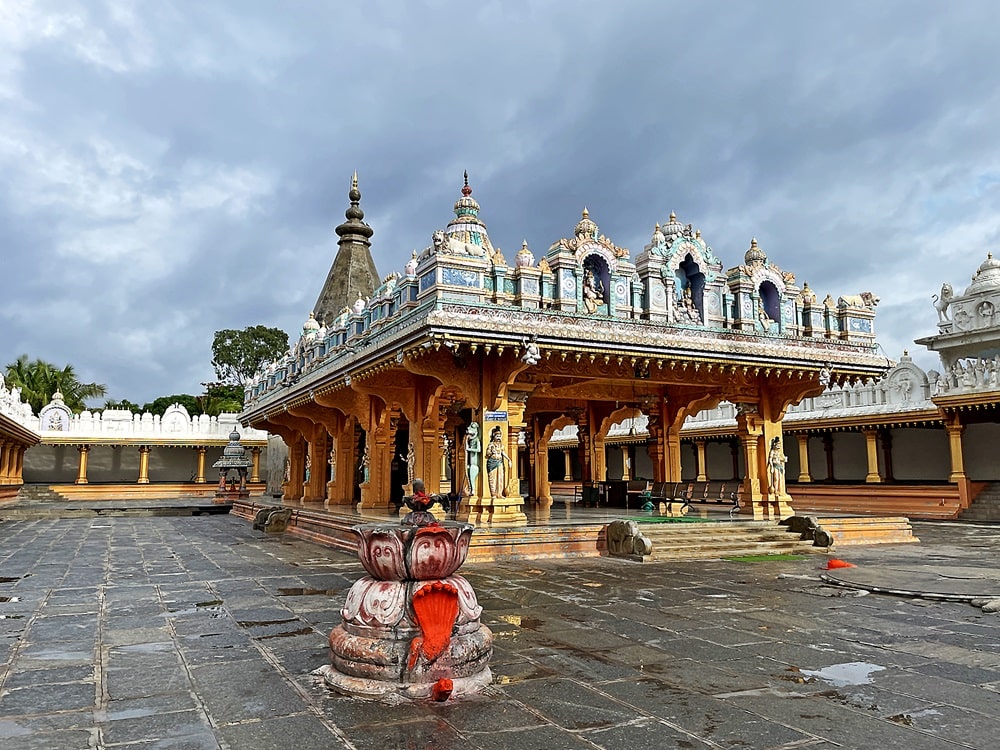
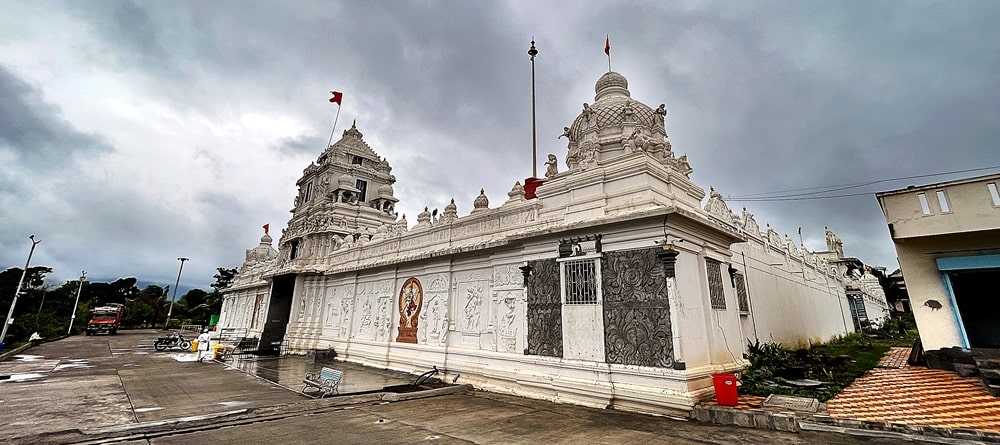
Veer village in Purandar taluka is situated on the border of Pune and Satara districts. Located at a short distance from the main town of Saswad, this village is on the banks of the Purnaganga, also known as the Nira River. The spot in the riverbed where the deity leaped on his horse is famous as ‘Ghode Uddhan’. Even today, the hoofprints of the horse are visible on the black rock there. The structure of the Shri Nath Mhaskoba Temple is carved from black stone. The temple is surrounded by a large stone fortification, १५ to २० feet high, on all four sides. The main entrance of the temple is adorned with intricate carvings in black stone. A large brass bell is hung above it. Upon entering through the main gate, there is a small stone-built Paduka temple in front. Above it is a beautifully carved spire (Shikhar). Next to this temple, on a large platform, stands a tall lamp tower (Deepmal). A large, smooth stone tortoise placed on the ground between the Paduka temple and the main temple is an attraction here.
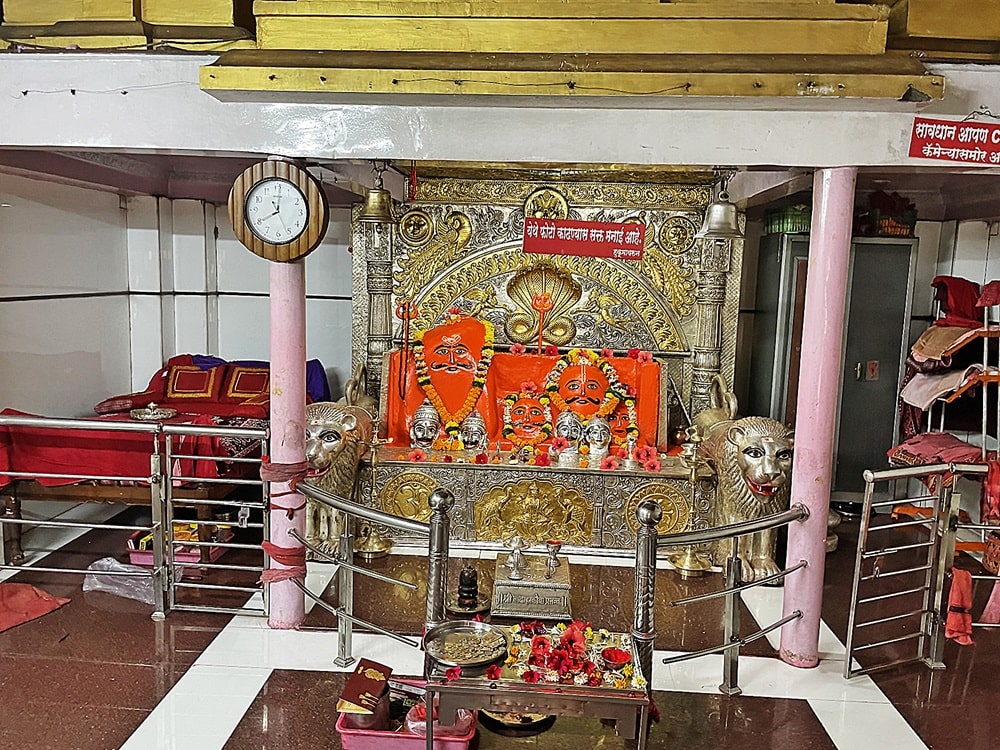
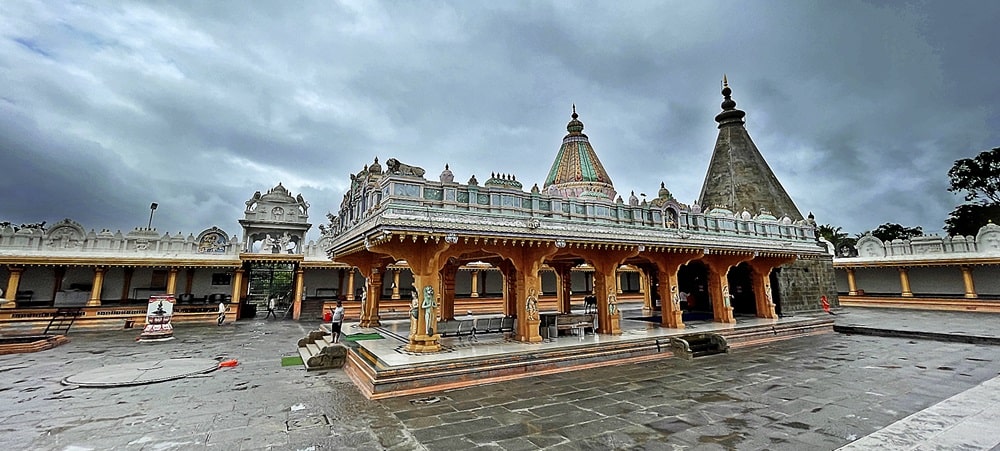
The temple is designed with a semi-open assembly hall (Sabhamandap) and a sanctum sanctorum (Garbhagriha). At the base of each pillar in the assembly hall, idols of various deities are carved. All these pillars are connected to each other at the top by arched gateways. To the left of the entrance to the sanctum sanctorum, there is a sculpture of a horse. Opposite it stands the eight-armed idol of Goddess Tukai, the slayer of Mahishasura. Inside the sanctum, on a silver throne, are the vermilion-anointed, stone-form idols of Shrinath Mhaskoba and Mother Jogeshwari Devi. There are lion sculptures on both sides of the throne, and a large serpent sculpture is carved into the arch (prabhaval) behind the idols. To the right of the throne is the deity’s well-appointed bedchamber. There are spires (shikharas) over the main assembly hall and the sanctum. In the temple courtyard, there is a small temple of Kalubai.
Many festivals and celebrations are observed with great enthusiasm at the Shrinath Mhaskoba temple throughout the year. The ten-day annual fair, which begins on Magh Purnima, is the grandest event here. During this time, the wedding ceremony of Shrinath Mhaskoba and Jogeshwari takes place. The tradition of ‘Bhaknuk’ (prophecy) held during this period is highly unique. In this, predictions regarding rainfall and crop yields for the coming year are made. During the pilgrimage, lakhs of devotees shower red vermilion (gulal) amidst chants of ‘Changbhale’. Thousands of devotees gather to participate in the wedding ceremony held late at night on Magh Purnima and the subsequent palanquin procession. The sword play performed on Vadya Panchami and the divine possession (sanchar) experienced by men are the highlights of this fair. Additionally, various religious rituals are performed in the temple for nine days during Navratri, and on the day of Dussehra, the palanquin goes to Tukai’s meadow for the crossing of the border (Simollanghan). The birth anniversary of Kalbhairav is celebrated with great pomp on Kartik Vadya Ashtami. At that time, the entire temple is illuminated with lights. A Bhandara (community feast) is organized here on the new moon day of every month, where thousands of devotees partake in the Mahaprasad.
This sacred temple stands as a testament to deep spiritual devotion, ancient architectural grandeur, and rich local cultural traditions.
The sanctum sanctorum houses the divine idol consecrated according to ancient Vedic traditions, surrounded by serene courtyards and traditional temple architecture.
Navratri, Maha Shivratri, Annual Temple Jatra & Deepotsav
Compare and book flights, secure top-rated local hotels near the temple, hire reliable guides, and rent cars instantly.
Extend your pilgrimage by visiting other highly sacred temples located nearby.


Add ₹999 more to unlock FREE SHIPPING!
Your sacred cart is currently empty.
Shop Photo FramesFill in your delivery details below to place your order.
Add comment