
Add ₹999 more to unlock FREE SHIPPING!
Your sacred cart is currently empty.
Shop Photo FramesThe Navadurga Devi Temple, the family deity (Kuldevata) of many Gaud Saraswat and Daivadnya Brahmin families, has been situated in the village of Kanyale, near Redi, since the sixteenth century. This temple is nestled in a nature-rich landscape near the border of the states of Maharashtra and Goa, close to the Terekhol Fort. Navadurga Devi is considered a form of Parvati and is also known by the name Mahishasuramardini. It is said that the original abode of this Goddess was in the village of Gavsi in the Tiswadi Taluka of Goa. The world-renowned cricketer Sunil Gavaskar considers this Goddess his family deity.
The historical legend regarding this temple in Kanyale states that the Goddess arrived here from Goa in the sixteenth century. Goa was previously under the rule of the Vijayanagara Empire. Later, it fell under the Nizamshahi rule of Ahilyanagar. After the fragmentation of the Nizamshahi, the Adilshahi of Bijapur took control. Following the death of Adilshah, Daryasarang Thimayya (Timoji) of Vijayanagara decided to conquer Goa and establish his own kingdom. For this, he sought the help of the Portuguese. Afonso de Albuquerque was the Portuguese Governor in India at that time. He attacked and conquered Goa on 28 February 1510. The Hindu leaders there approached Albuquerque and handed over the keys to the city of Goa. He had to leave Goa following a counter-attack by the Bijapur army; however, he attacked again on 25 November 1510, recaptured Goa, and established Portuguese rule.
Soon, the Portuguese revealed their true nature and began religious persecution. Albuquerque demolished the Saptakoteshwar temple in Tiswadi and built a church in its place. After his death, the Inquisition in Goa became rampant. Portuguese missionaries first started a campaign of conversion in the island of Tiswadi. Within a short time, Hindus were wiped out from the island. To save their religion and their deities, the Hindus fled to safer places. During that period, the people of Gavsi village in Tiswadi fled carrying the idol of Navadurga Devi. A legend is told that they intended to install the Goddess in the city of Vengurla. They were supposed to reach Vengurla the next day, but night fell and they had to halt in a nearby village. When they tried to lift the idol the next morning, it would not budge from its place. It remained stuck there as if by a magnet. Finally, everyone decided to seek the ‘Kaul’ (divine oracle) of the local Mauli Devi in the nearby village of Redi. The Goddess gave the oracle that Navadurga Mata wished to stay at this very spot and should be installed there. Respecting the oracle of Mauli Devi and the wish of Navadurga Devi, the devotees purchased the land. The temple was constructed on the very spot where the idol had remained fixed. This is the Navadurga Devi of Kanyale village.
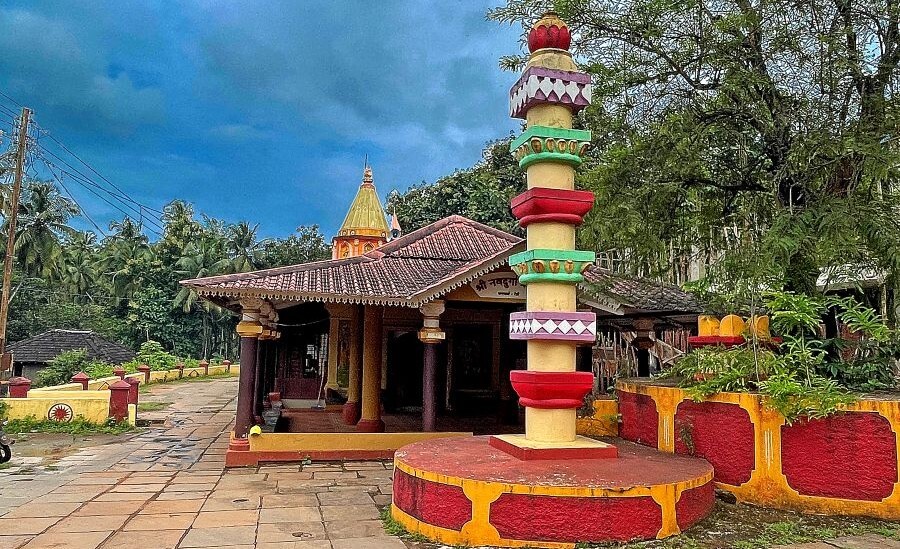
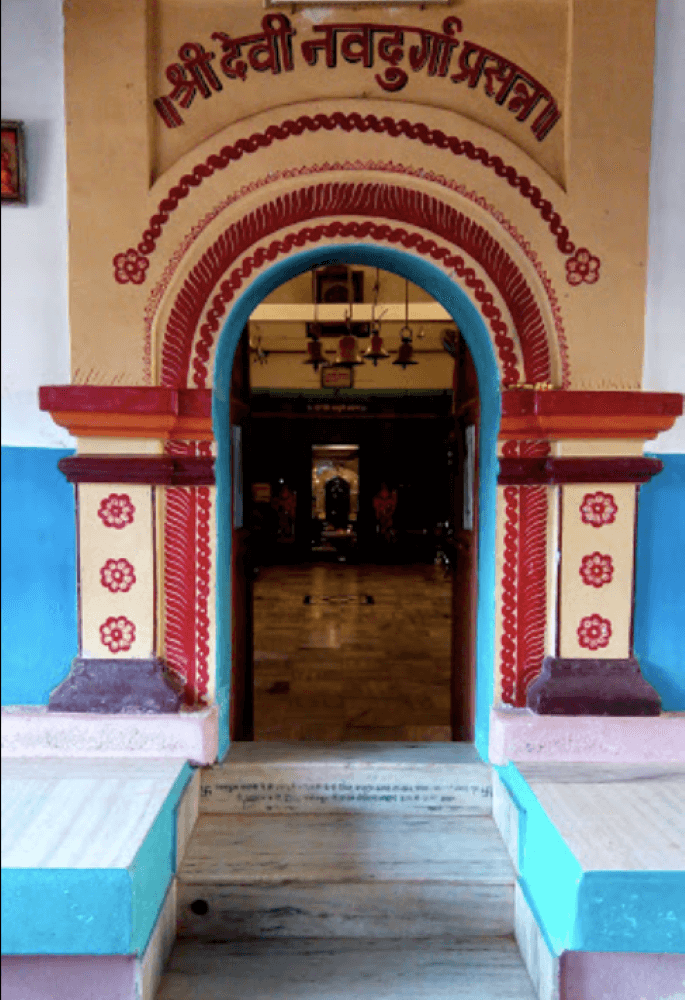
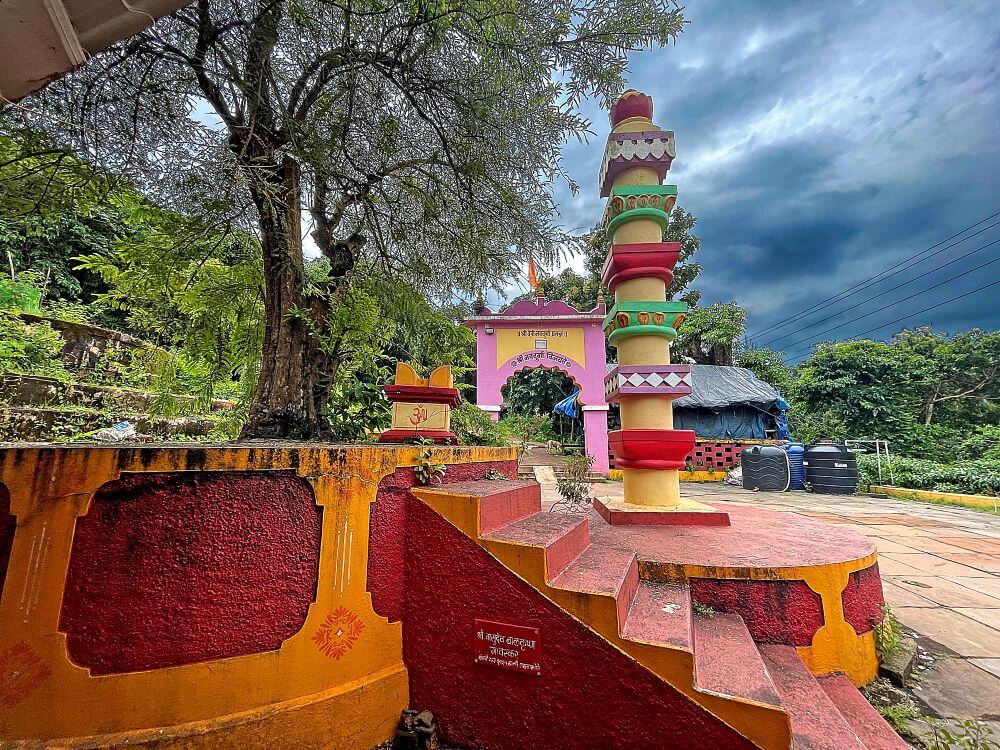
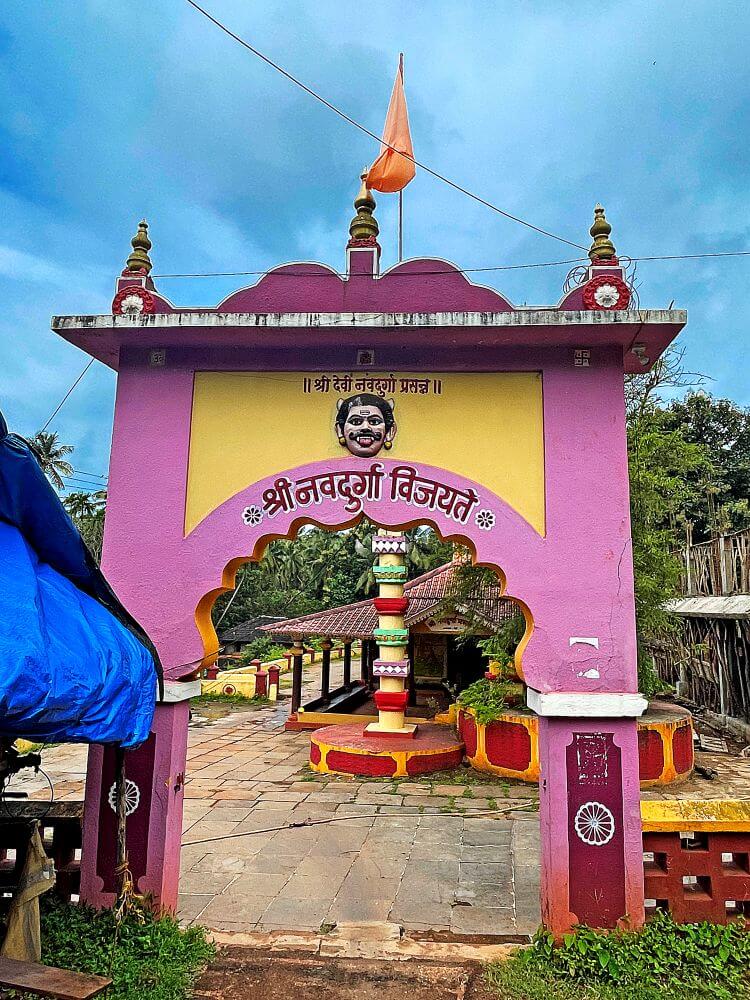
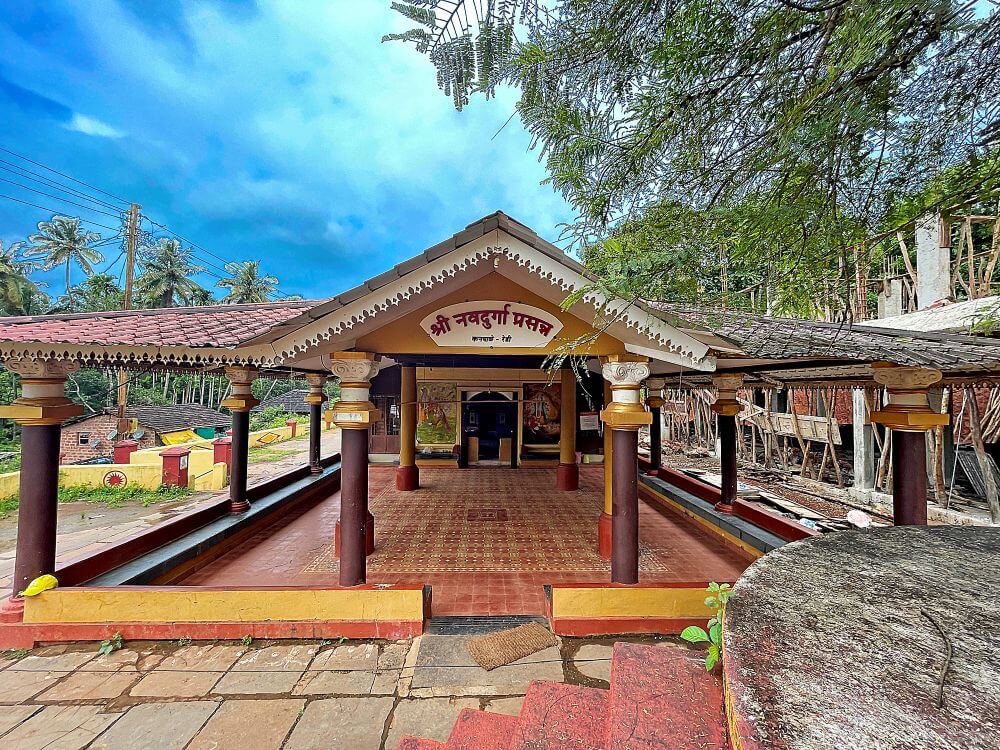
This Navadurga temple is located in a spacious courtyard amidst coconut and areca nut groves in the vicinity of the Redi lake. The old temple was renovated on 2 February 1963. The temple courtyard has a high entrance gate. In the center, above the arched gateway, there is a relief sculpture of Mahishasura. A short distance inside, a seven-tiered lamp pillar (Deepastambha) is erected on a pedestal. Beside it is a traditional Tulsi Vrindavan. The temple of the Goddess is tiled and built in the distinct Konkani architectural style. One enters the temple’s Sabhamandap (assembly hall) by climbing five steps near the lamp pillar. The Sabhamandap is open and spacious. There are stone benches for devotees to sit in this hall, which is supported by fourteen pillars. A special feature of this Navadurga temple is the intricate designs created using the ‘Kavi art’ on the ceiling and walls of the Sabhamandap, an art form that is now gradually disappearing. These designs primarily feature flowers and mandala-like patterns. Kavi art is a painting style from Goa. It is said that this style has a history of about 600 years and originated in Goa itself. In the past, people in many communities used walls to draw pictures. The Warli community also shares this tradition. Similarly, the people of Goa used to paint pictures on walls in their own unique style. For this, they would first make a paste of crushed seashells mixed with jaggery and sand. This putty was applied to the wall, and then a layer of red soil (Kavi) was applied over it, mixed with natural gum. Later, designs were carved into it using metal tools. This art can be seen in temples, landlords’ houses, and some churches in Goa.
The temple has a large Antarala (vestibule), and two large murals are painted on its outer walls. Both paintings depict Shri Krishna. One painting shows Shri Krishna giving the Gita Upadesha to Arjuna, who had abandoned his Gandiva bow on the battlefield of Kurukshetra, while the other shows Shri Krishna revealing his Virat Rupa (cosmic form) to Arjuna. Below these paintings, and on the inner walls of the vestibule, there are stone benches. The manifestation of Kavi art can be seen there as well.
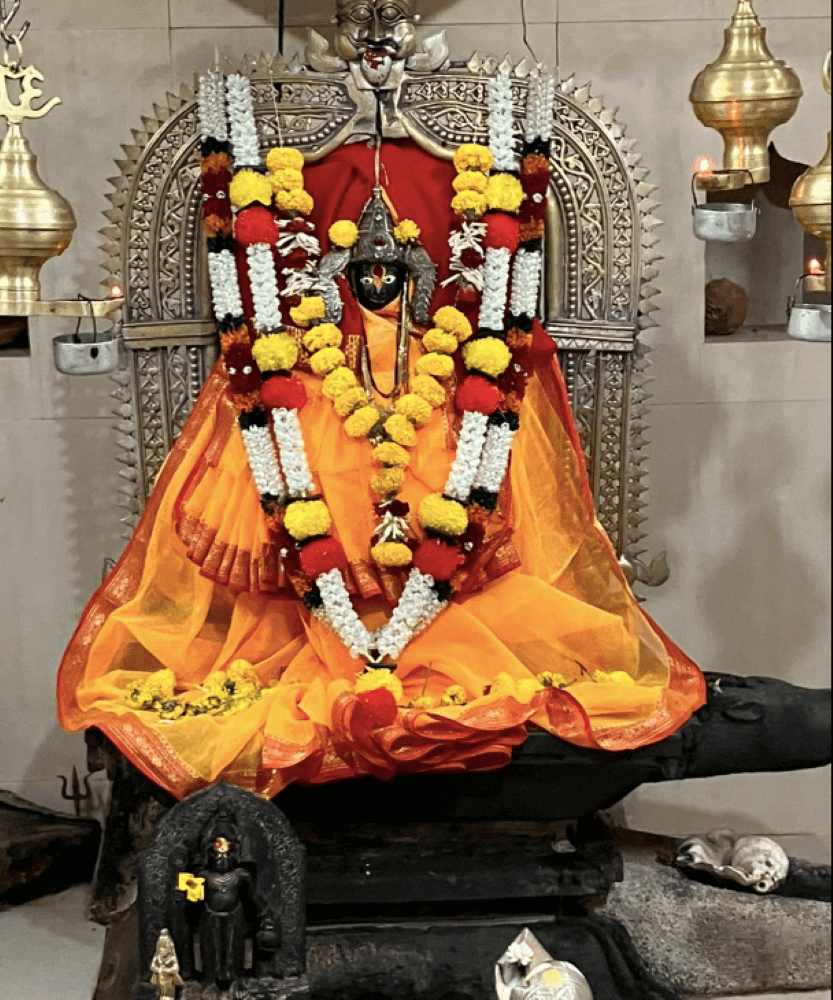
Beside the entrance to the sanctum sanctorum (Garbhagriha), there are tall sculptures of four-armed female door guardians holding a conch and a mace. Inside, the idol of the Goddess is placed on a Vajrapitha within an ornate arch. In 1971, a priest noticed a crack in the original idol. After he brought it to the attention of the villagers, the idol was ritually immersed in the sea, and a new, identical idol was installed. This Navadurga is in the form of Mahishasuramardini. She has eight arms. In her hands, she holds a conch, discus, mace, lotus, spear, and trident. With one hand, she has grabbed the head of Mahishasura. One foot of the Goddess is on the back of Mahishasura, and the other is on the ground. A lion is near her feet. This idol is carved in black stone. In the sanctum of the temple, there are also the deities Kashi Kalyani Brahmin, Jain Brahmin, Bhavnath, and the ancestors of Devbhar.
Two major festivals are celebrated in this temple every year. The Navratri festival is observed for nine days in the month of Ashwin, and the Devi Yatra takes place on Magh Shuddha Navami. During the festival period, the temple is decorated with flowers and electric lights. On the day of the Yatra, rituals such as Abhishek, Naivedya, Kumkumarchan, Tulabhar, Ekadashini, and Laghurudra are performed. In the Tulabhar ritual, a person is weighed against items like sugar and coconuts, which are then distributed as Prasad. Brahmana Bhojan and Mahapuja are also conducted. On the night of the Yatra, a Dashavatar performance is held. The Devi’s Palkhi procession is carried out four times. The Kamat, Gavaskar, Tarkar, and Dalal families are the ‘Mahajans’ of this Devi; meaning, this Devi is the Kuldevata (family deity) of people with these surnames. They arrive in large numbers from various places such as Pune, Mumbai, Mangaluru, and Udupi for this fair. After the fair concludes, the sarees of the Devi are auctioned. Devotees purchase these sarees with great devotion for amounts ranging from ५००० to २१००० rupees.
This sacred temple stands as a testament to deep spiritual devotion, ancient architectural grandeur, and rich local cultural traditions.
The sanctum sanctorum houses the divine idol consecrated according to ancient Vedic traditions, surrounded by serene courtyards and traditional temple architecture.
Navratri, Maha Shivratri, Annual Temple Jatra & Deepotsav
Compare and book flights, secure top-rated local hotels near the temple, hire reliable guides, and rent cars instantly.
Extend your pilgrimage by visiting other highly sacred temples located nearby.

Add ₹999 more to unlock FREE SHIPPING!
Your sacred cart is currently empty.
Shop Photo FramesFill in your delivery details below to place your order.
Add comment