
Add ₹999 more to unlock FREE SHIPPING!
Your sacred cart is currently empty.
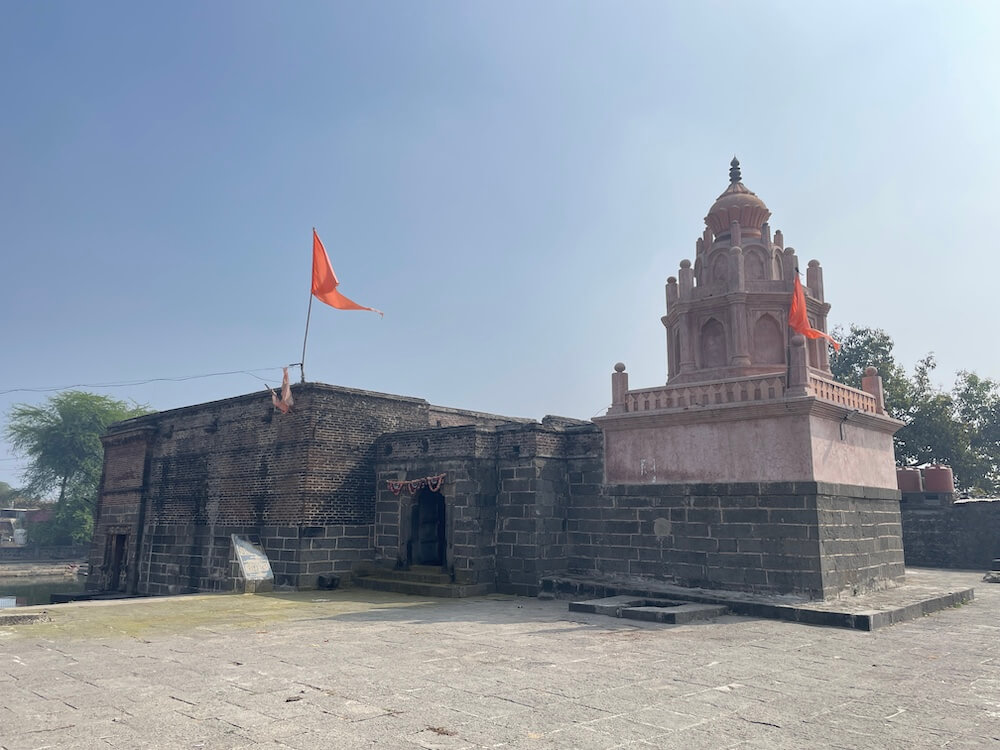
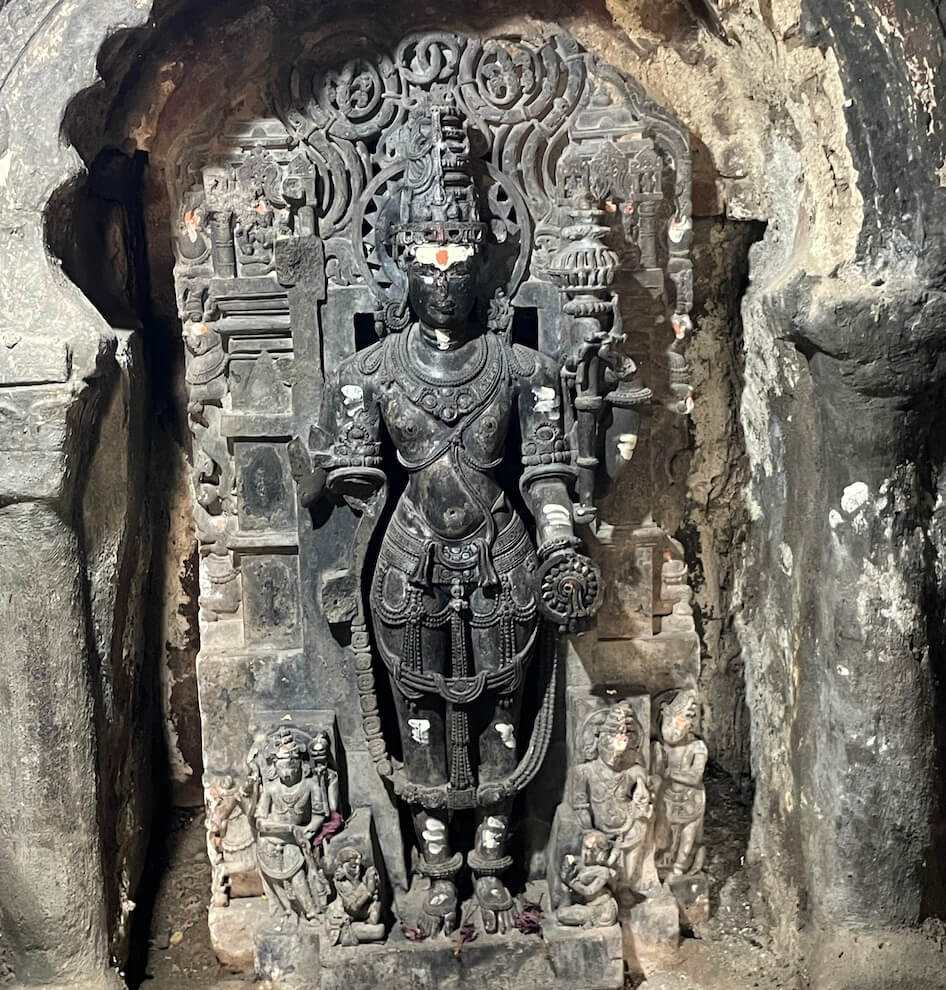
Shop Photo FramesThe ancient and famous temple of Nilkantheshwar is located in Sindkhed Raja, the maternal hometown of Chhatrapati Shivaji Maharaj. In this temple, one can behold an ancient Shiva Linga along with a rare eleventh-century idol of Harihara. Originally built in the Hemadpanti architectural style during the reign of the Yadava dynasty of Devgiri, this temple was renovated in the seventeenth century by Raghoji Jadhav, the brother of Rajmata Jijau. The temple faces east and is designed like a palace; its architecture is such that for a few days of the year, the sun’s rays fall directly upon the idol of Harihara. This temple underscores the antiquity of Sindkhed, dating back to the pre-Jadhav era.
It is believed that the village of ‘Sindkhed’ was established by a king named Siduram, and the village derives its name from him. Another etymology suggests the name comes from ‘Siddhakshetra’, meaning ‘the village of the Siddhas’. Yet another theory posits that the name ‘Sindkhed’ was adopted because of the abundance of Sindhi trees in the region in the past. According to the Jadhavrao chronicles, the original name of ‘Sindkhed’ was ‘Alapur’. It is mentioned that Alapur was renamed ‘Sindkhed’ after the Gawali king Sinduraj settled there; however, no concrete evidence of Sinduraj’s reign exists. Other evidence suggests the original name of ‘Sindkhed’ was ‘Siddhapur’ or ‘Siddhakshetra’. An inscription in the Nilkantheshwar temple here mentions ‘Pargana Siddhapur’. In a poetic biography of the famous saint-poet of Sindkhed, Gosavinandan, it is stated: ‘Sindkhed sthal siddhache keval, dekhoni tatkal vas kela’ (Seeing that Sindkhed is truly the place of the Siddhas, I immediately settled there). The ‘Central Provinces and Berar District Gazetteers – Akola District, Volume A’ (१९१०) clarifies that the original name of Sindkhed was likely ‘Siddhakshetra’, which later transformed into ‘Sindkhed’.
In the year १४४०, the Pargana of Sindkhed was granted as a Jagir to the Qazi of the city. A century later, this Pargana was transferred to the family of Raja Lakhujirao Jadhav, the father of Jijau. Raja Lakhujirao Jadhav held a Mansabdari of ten thousand horses under the Nizamshahi of Ahilyanagar; however, in later years, he accepted a Mansabdari of fifteen thousand cavalrymen in the imperial army of the Mughal court. Later, Jijau was married to Shahaji Raje Bhosle. Despite this, setting aside these familial ties, and with the exception of one instance, Lakhujirao always fought on the side of the Emperor in the battles between the Marathas and the Mughals. The government gazetteer also states that due to the birthplace of Jijamata, this village has attained the status of a historically sacred site in Maharashtra.
An eleven-line inscription is carved on a stone pillar in the Nilkantheshwar temple. It reads: ‘Nil Kant Shri Ganeshaya Namah Sake १५०९ Sarvajit Samvatsare Shravan Sudi Padwa Jirnoddhar he deool dhabanle Raghoji Lakhuji Jadhav Shrideshmukh Pargane Siddhapur!’ This proves that the renovation of this temple was carried out by Raghoji, the brother of Jijau.
After coming from Rangmahal Road in the city, one enters the temple courtyard through the gate in the fortification wall. Adjacent to the temple is a large stepwell (Barav), and on the edge of this stepwell are three Shiva Lingas. It is said that there were once fifteen such Shiva Lingas. It is believed that Rao Jagdevrao, the great-great-grandson of Lakhujiraje, built this stepwell. This square stepwell measures ३४ by ३४ meters and has stone steps (Ghat) built on all four sides. On the northern wall of this stepwell is an idol of Uma-Maheshwar. On the northern bank of this nine-meter-deep stepwell, near the edge of the temple platform, is an idol of Bhairava, and just a few steps away is a temple of Shani Deva. Inside this temple, there is a beautiful idol of Shani Deva carved in black stone. There are also some old idols in the stepwell area. The temple premises are paved with stone, and directly in front of the temple entrance is a large Tulsi Vrindavan. A short distance from the entrance, there are footprints carved into the stone.
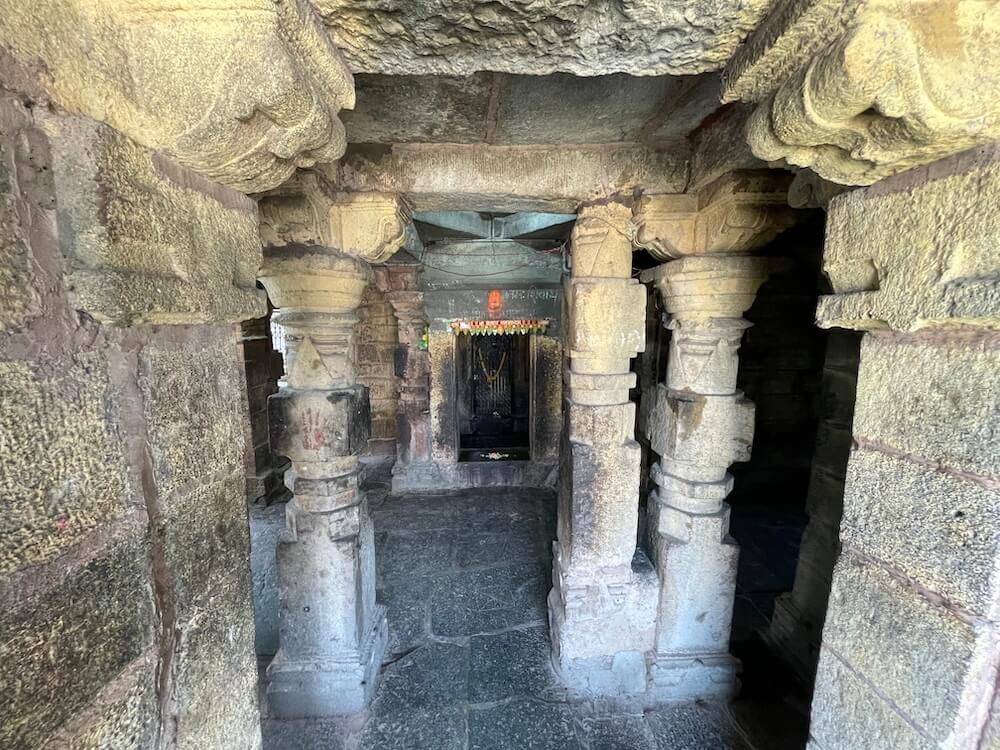
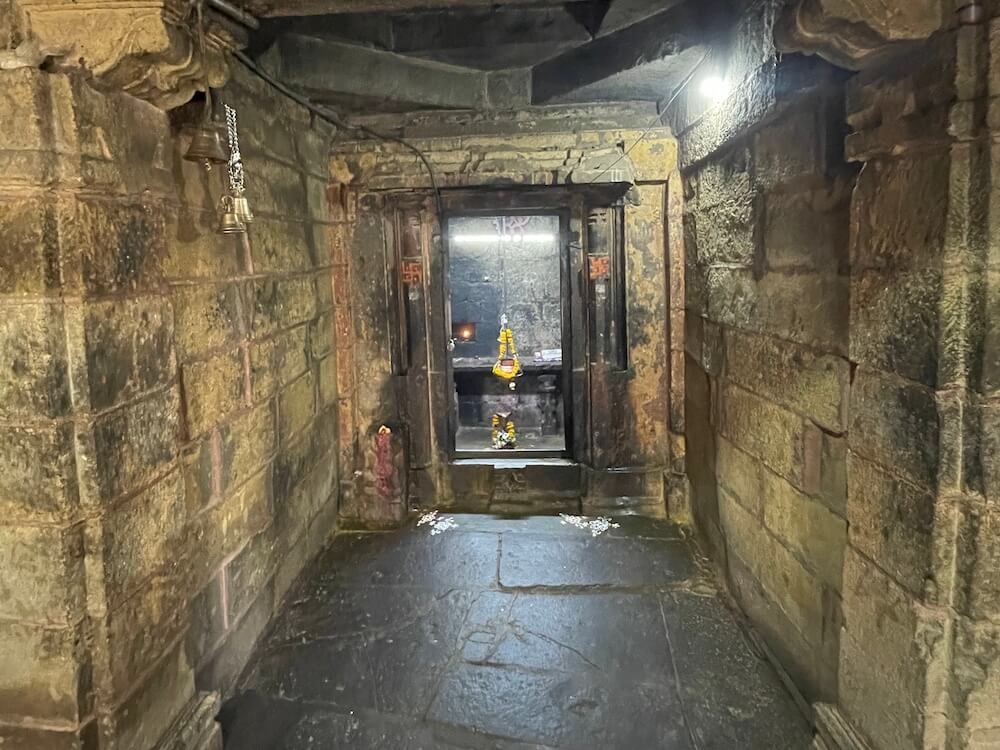
The temple structure consists of a Sabha Mandap (assembly hall), two Antarala (vestibules), and two Garbhagrihas (sanctum sanctorum). One enters the Sabha Mandap through the main entrance of the temple. Here, an ancient idol of Ganpati is enshrined in a niche. The Sabha Mandap has some carved stone pillars, and the ceiling features beautiful carvings. In the left Garbhagriha, there is an ancient idol of Harihara carved in black stone. This Harihara idol, dating back to the tenth or eleventh century, is ९० centimeters tall. The right side of the idol represents Shiva, while the left side represents Vishnu. Near the right foot of the idol, Nandi is carved, and near the left foot is Garuda. It is said that there was once a diamond on the forehead of this four-armed idol. This diamond was stolen during foreign invasions, and the idol was slightly damaged in the attempt to remove it. It is said that this caused a small pit to form on its forehead.
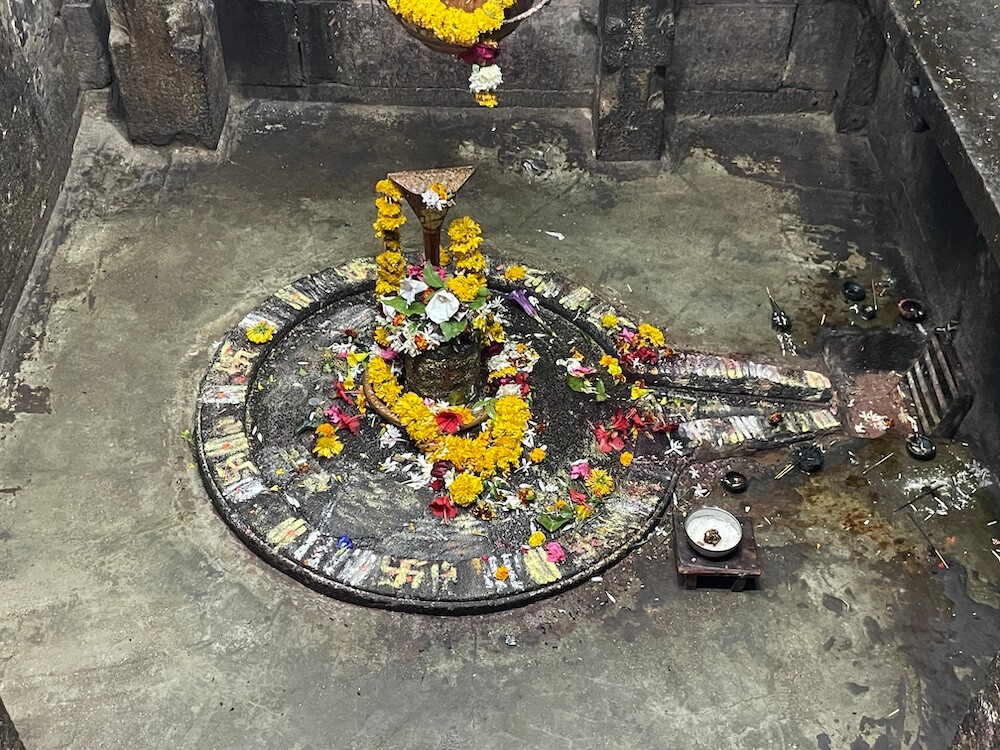
Near the entrance of the main Garbhagriha on the right, there is an idol of Nandi carved from a single stone on a platform. One descends four steps from the vestibule in front of the Garbhagriha to enter it. On the lintel in the center of the doorway of this Garbhagriha, there is a sculpture of Ganesha. Inside the Garbhagriha, there is a Shiva Linga in a large Shalunka on the floor. A brass serpent forms a canopy over the Shiva Linga, and an Abhishek pot is hung from the ceiling above it. Beautiful sculptures are carved on the ceiling of this stone Garbhagriha. On a platform in the courtyard in front of this Garbhagriha, there is a stone idol of Nandi. An inscription is found on one of the stone pillars in this temple. In one of the niches here, there is an idol of Ganesha smeared with vermilion.
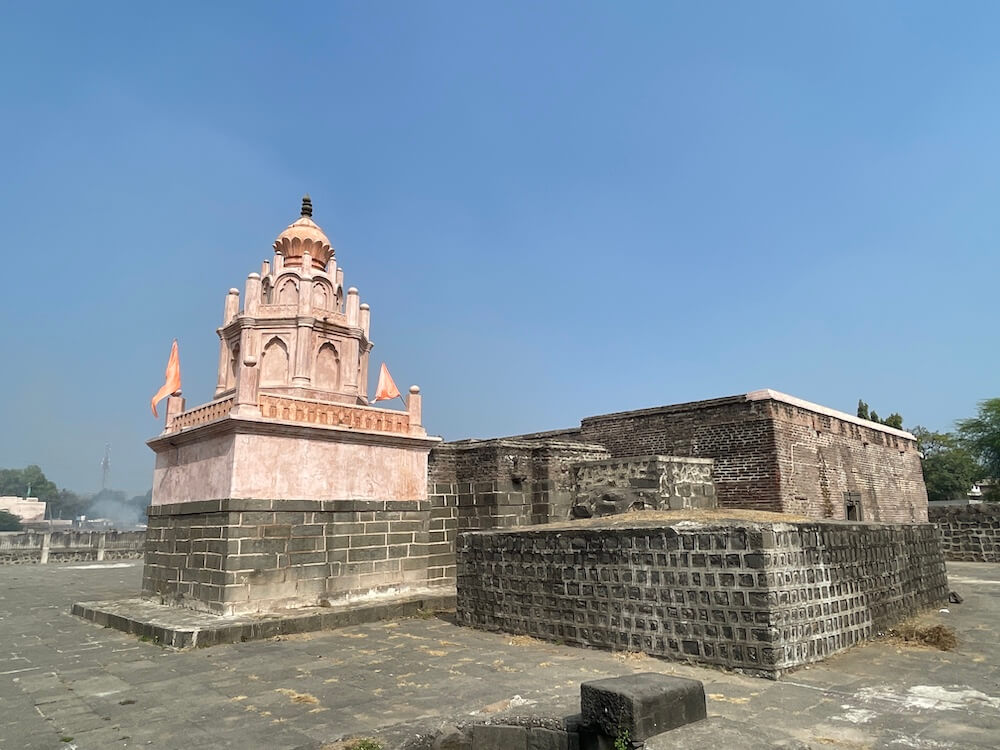
The pavilion-like structure in front of this temple is eye-catching. The brick-built pavilion has many arches and several niches. In one of these niches, there is an ancient idol of Hanuman. Idols of Hanuman are carved on all four sides of the Tulsi Vrindavan in the courtyard. Near the nearby idol of Ganesha, there is a secret passage.
On the lower side of the shikhara above the sanctum sanctorum of this temple, deity niches are carved on all four sides within a square tier, and there is a minaret-like structure above it. Above the square tier, there is another square tier, which also features carved deity niches. Above this, a pillar structure is visible, topped with lotus flower craftsmanship. Resting upon this is a large amalaka and kalasha. The lower part of this temple is constructed of stone, while the upper part is built of bricks. There is beautiful carving on the entrance at the rear of the temple. The temple courtyard houses many ancient idols and sculptures.
Mahashivratri is the largest and most important festival of the year at this temple. On this day, the Jalabhishek and Mahapuja of Lord Neelkantheshwar commence from early dawn. Thousands of devotees from the city of Sindkhed Raja and the entire district gather here for darshan. On this day, special bhajan, kirtan, and night-long vigil programs are organized in the temple. During this time, the temple is decorated with electric lighting. Apart from this, special puja and aarti of Mahadeva are performed every Shravani Monday. In the month of Shravan, many Shiva devotees bring holy water from various rivers in kawads to perform Jalabhishek of Neelkantheshwar. On Kartik Shuddha Purnima, which is Tripurari Purnima, a Deepotsav is celebrated in this temple. Every year on January १२, special prayers and abhishek are organized in the temple on the occasion of Jijau Janmotsav.
This sacred temple stands as a testament to deep spiritual devotion, ancient architectural grandeur, and rich local cultural traditions.
The sanctum sanctorum houses the divine idol consecrated according to ancient Vedic traditions, surrounded by serene courtyards and traditional temple architecture.
Navratri, Maha Shivratri, Annual Temple Jatra & Deepotsav
Compare and book flights, secure top-rated local hotels near the temple, hire reliable guides, and rent cars instantly.
Extend your pilgrimage by visiting other highly sacred temples located nearby.


Add ₹999 more to unlock FREE SHIPPING!
Your sacred cart is currently empty.
Shop Photo FramesFill in your delivery details below to place your order.
Add comment