
Add ₹999 more to unlock FREE SHIPPING!
Your sacred cart is currently empty.
Shop Photo FramesIn the medieval period, specifically the tenth and twelfth centuries, Achare was a major center for trade and commerce. During that era, trade with foreign lands was conducted through its port. The village of Achare, which holds a history spanning approximately one thousand to twelve hundred years, is known today for the unique tradition of ‘Gavpalan’, which takes place every five years. Another identity of this village is the Inamdar Shri Dev Rameshwar Temple. Devotees believe that the Rameshwar here is the brother of Kunkeshwar from Kunkeshwar in Devgad. This temple is also historically significant.
The history of the Rameshwar temple here is inscribed on the sanctum sanctorum of the temple itself. A small inscription is installed in a corner on the wall of the sanctum. It records that the foundation stone ceremony of this temple took place in 1684, four years after the passing of Chhatrapati Shivaji Maharaj. There is also a record that Chhatrapati Sambhaji, the son of Chhatrapati Rajaram Maharaj and the King of Kolhapur, gifted the village of Achare as an ‘Inam’ (grant) to this temple in 1720. For this reason, this shrine is addressed as the Inamdar Shri Dev Rameshwar Temple. Consequently, festivals in this temple are celebrated with great enthusiasm and royal grandeur to this day. Notably, although this is a temple of Lord Shiva, most of the festivals celebrated here are Vaishnava festivals. In this way, this temple is a symbol of the unity of Hari and Hara.
This Rameshwar temple is an excellent example of Konkani architectural style. Its structure resembles an old mansion. A three-story building stands at the entrance of the temple premises. To the right of this entrance is a small temple of Lord Ganesha. Upon entering, one finds a two-story building on one side, four ancient lamp pillars standing on the platform in front, and an open courtyard in front of them. Here, on a high plinth, stands a modern temple of Ravalnath. Inside is an armed idol of Ravalnath. A short distance ahead is another entrance. This entrance has guard rooms on both sides inside and a drum house (Nagarkhana) above. One enters the temple complex through old-fashioned wooden doors. Directly in front is the ancient Rameshwar temple. Along the boundary wall of the temple, on the right side, there are eight lamp pillars. In front of the temple’s assembly hall (Sabhamandap), there are two artistic stone lamp towers (Deepmala). These lamp towers feature small elephant heads, mythical creatures (Vyala), and bird heads. There are stone oil lamps on their heads as well as on the temples of the elephants. This makes these lamp towers unique. There is also a Tulsi Vrindavan there.
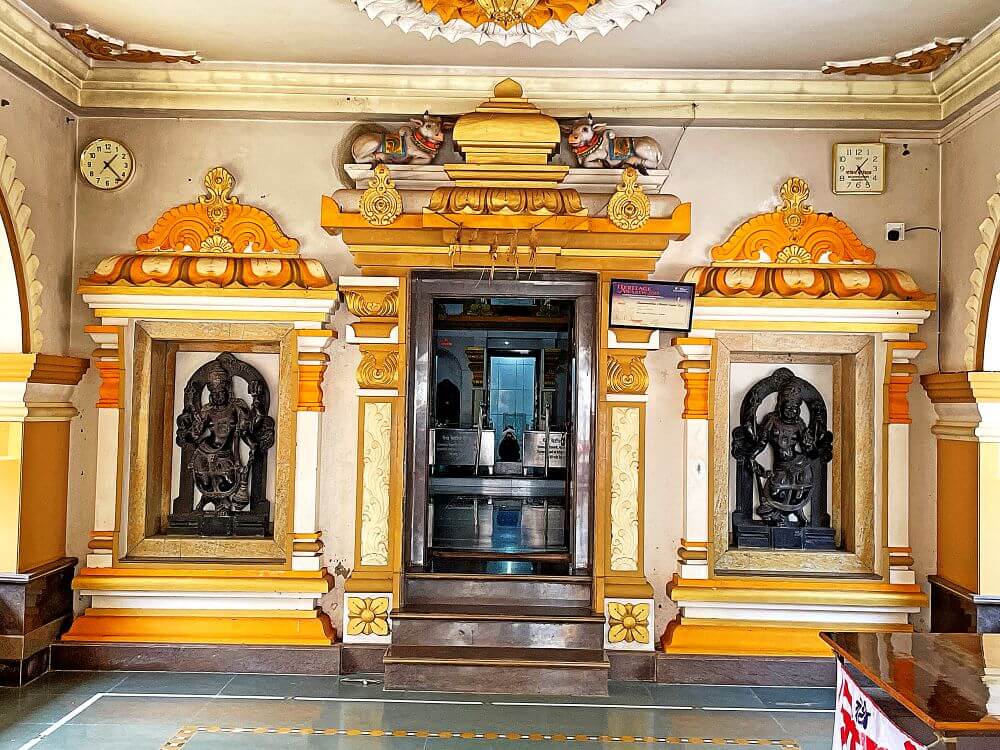
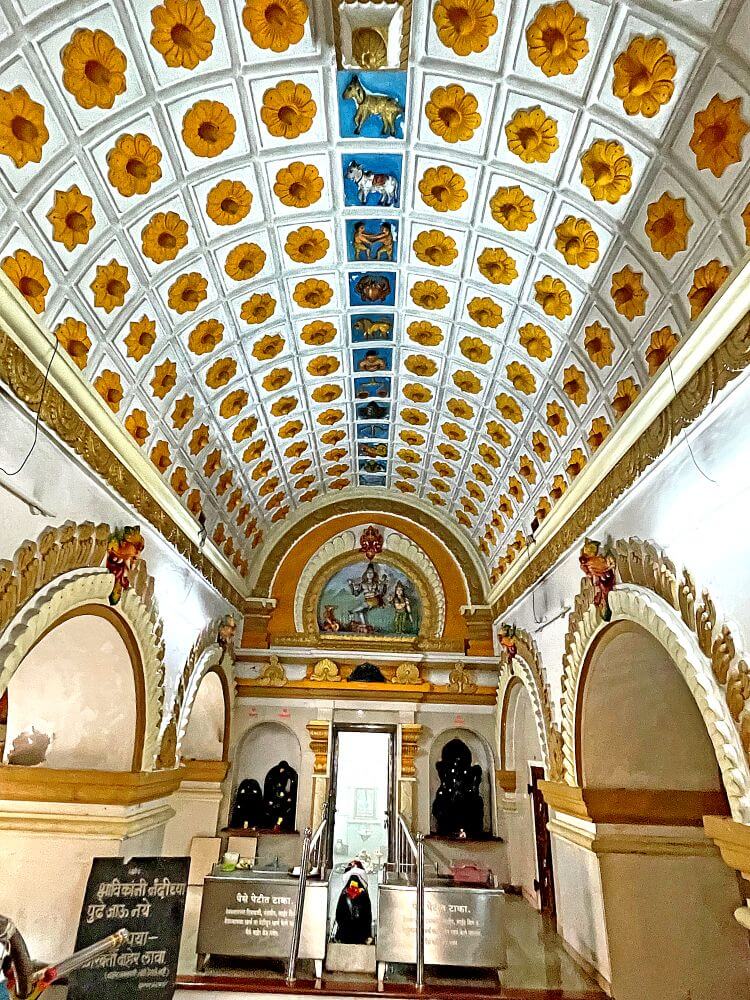
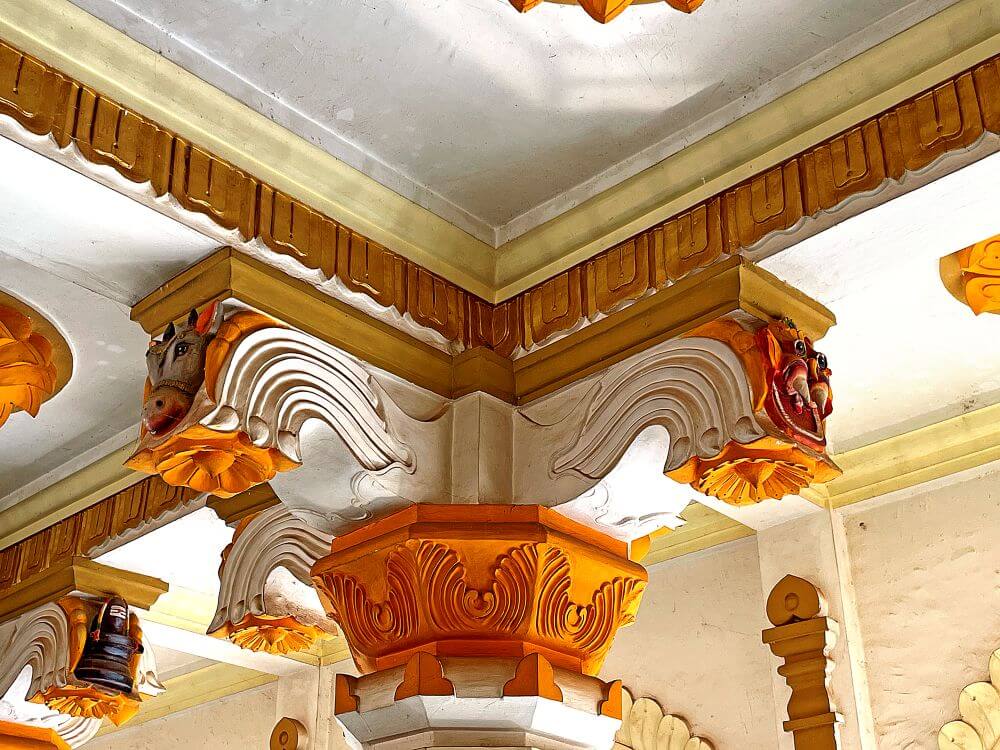
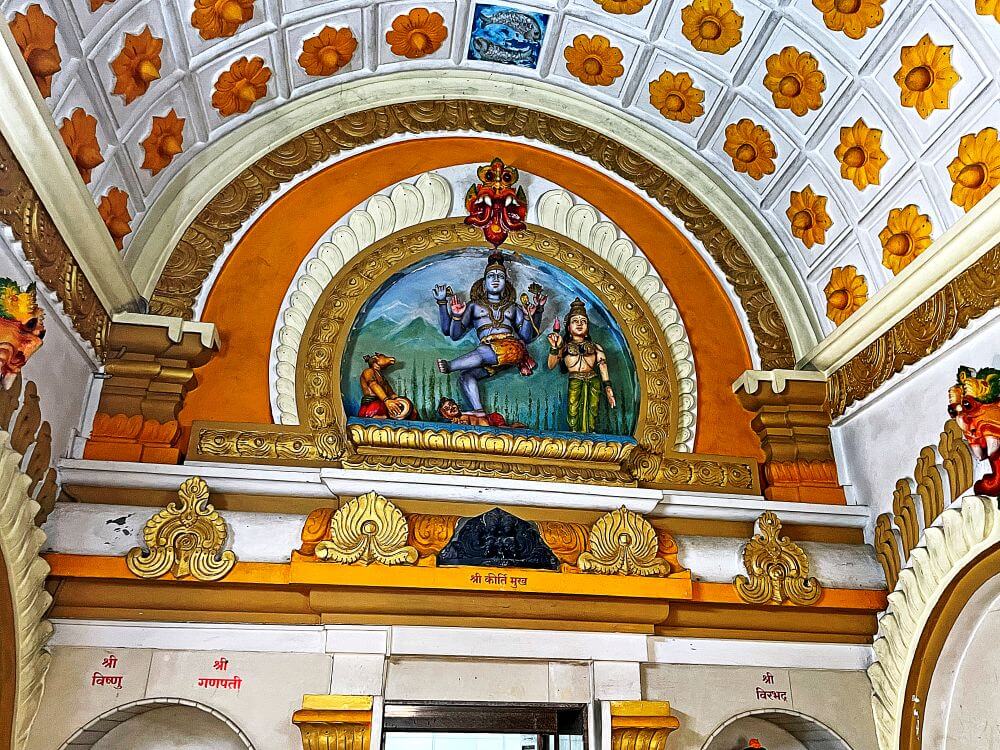
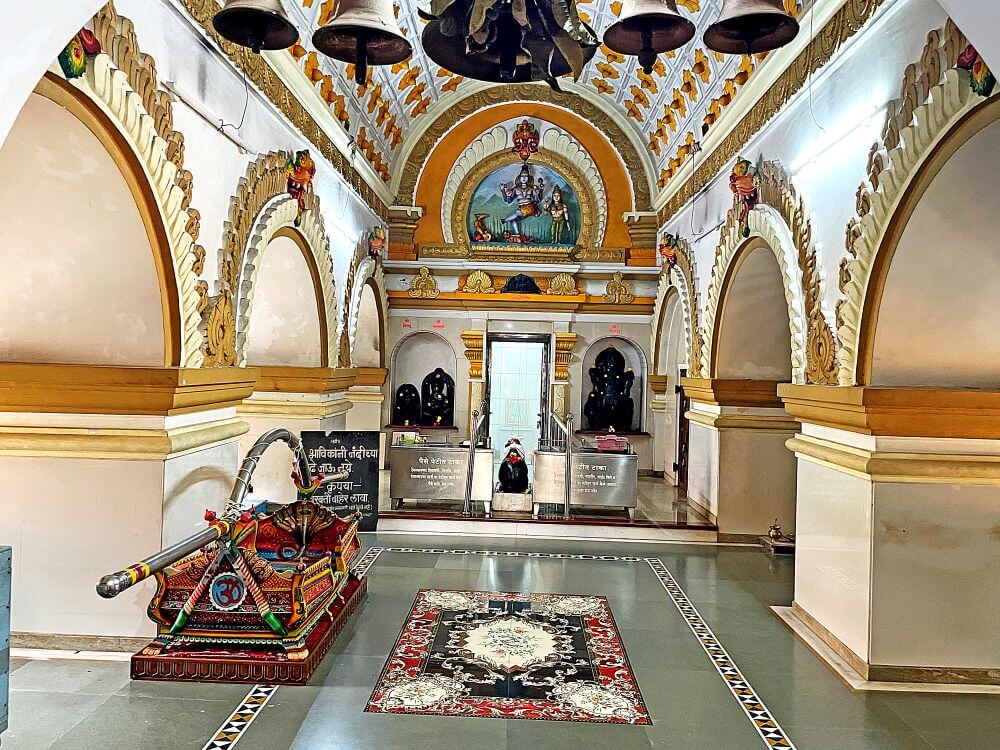
The structure of the Rameshwar temple consists of an assembly hall, an intermediate chamber (Antaral), and a sanctum sanctorum (Garbhagriha). The assembly hall is open and spacious. Built using wood, this assembly hall has five arched wooden pillars on both the outer and inner sides. There are arched gateways between these pillars. On both sides of the entrance to the intermediate chamber, there are colorful idols of the Vaishnava gatekeepers, Jaya and Vijaya, each approximately the height of a man. The intermediate chamber also has entrances on the left and right sides. Along the walls, there are platforms built with marble tiles for sitting. From here, there is a staircase to go to the upper floor. The large circular stone pillars in the intermediate chamber are eye-catching. The upper parts of these pillars feature beautiful carvings. These include idols of Ganesha, Krishna, Lakshmi, Shriram, Narada, Tumburu, Garuda, Panchanan Shiva, and Nandi. It is noteworthy that most of the idols on these pillars belong to the Vaishnava pantheon.
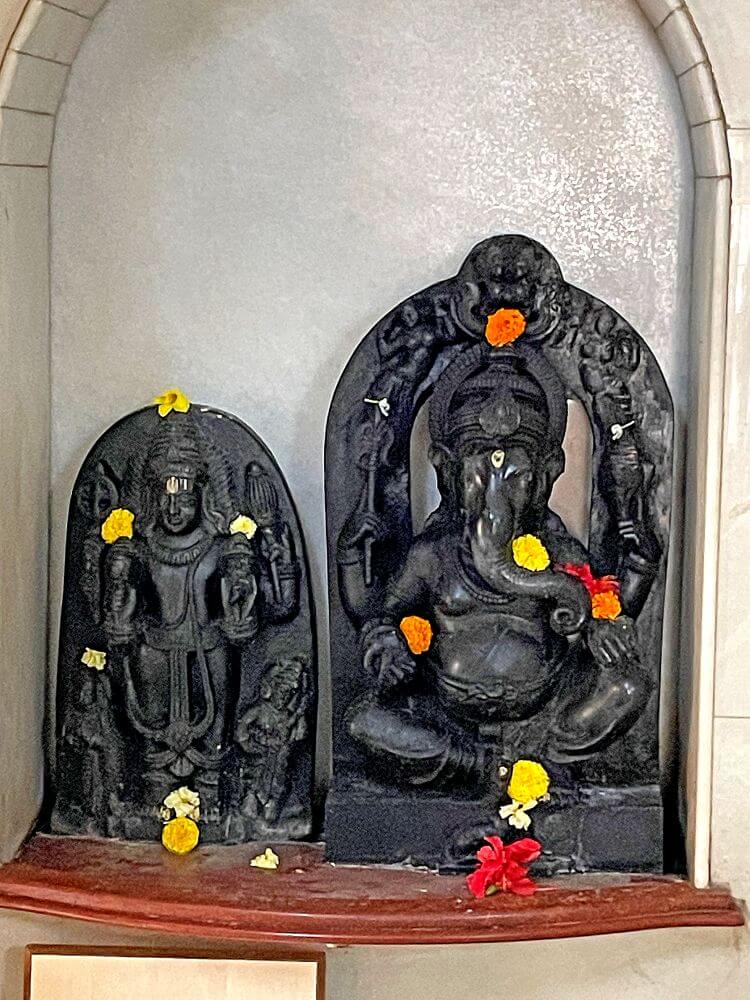
In front of the temple’s sanctum sanctorum is the Nandi courtyard. There is a marble idol of Nandi there. Along the front wall of the sanctum are idols of Ganesha and other deities. On the door frame of the sanctum, there is an idol of Garuda and a dwarf in the center, and sculptures of Jaya-Vijaya at the bottom. There is a carved image of Ganesha at the lintel of the entrance. Inside the sanctum, on the floor, is the beautiful Linga of Rameshwar. The mask of Rameshwar is installed on the base (Shalunka). Behind the mask is a five-metal (Panchadhatu) hood of the Serpent deity.
Daily worship of the deity takes place every morning in the Rameshwar temple. This is followed by Abhishek and Laghurudra Abhishek. After the midday worship, the deity’s court is held after 12:00 PM. In this, the problems of devotees are resolved by seeking the deity’s guidance (Kaul). In the evening, the deity is adorned with a mask and jewelry. The grand worship (Mahapuja) and Aarti take place at 8:00 PM.
The festival of Ram Navami is celebrated in this temple. The idol of Shriram, coming from the Kanvinde family of honor, is brought into the temple with music and fanfare. It is worshipped traditionally. The idol of Shriram is installed to the left of Rameshwar. This festival is celebrated for nine days. On the day of Ram Navami, there is a grand feast (Mahaprasad). For the Ram Janma and Hanuman Janma celebrations here, Ramdasi Buvas come from Sajjangad. The Kartik festival lasts for a month at this place. During the month of Kartik, the deity’s palanquin is taken out every evening. After performing rituals like Kakad Aarti and bathing in the morning, the original installation of the deity is done on the full moon day. During Diwali, the temple is illuminated by lighting many lamps. The Shiva wedding is performed in a royal manner. On the left side of the outer entrance of the temple is the Ganesha temple. There is a grand festival there on Ganesh Chaturthi in the month of Bhadrapada.
The music festival during the Kartikotsav at this temple is famous. Kumar Gandharva, Pt. Jitendra Abhisheki, Pt. Prabhakar Karekar, Ramdas Kamat, and Devki Pandit have graced this music festival held in the assembly hall of Rameshwar. Renowned litterateur Pu. La. Deshpande had also offered his musical service here. The tradition of ‘Dalapsvari’ is also followed here. According to the village customs of Konkan, ‘Dalap’ is the ritual of pacifying the border-protecting deities and the ritual of the village deity visiting the homes of the honor-holders. In this festival, a procession of Lord Rameshwar is taken out, and he meets all the deities of the village. People’s problems are told to the deity. People from all communities participate in this. The Dalapsvari takes place here every three years, while the tradition of ‘Gavpalan’ is observed in Achare village every five years.
This tradition has been observed for hundreds of years in a few select villages of Maharashtra. Achare is one of the prominent villages among them. The legend regarding this ‘Gavpalan’ (village evacuation) is that many years ago, ghosts and spirits created great havoc in the village of Achare. All the villagers were distressed by this. To overcome this crisis, the villagers prayed to Lord Rameshwar. Then, Rameshwar asked everyone to leave the village for three days and three nights. During this period, Rameshwar removed the demonic influence from the village. Even today, people believe that by leaving the village for three days, Rameshwar removes the ghosts and spirits and purifies the village. Because of this, the tradition is still followed today. During this time, all the people of the village reside in the open fields.
This sacred temple stands as a testament to deep spiritual devotion, ancient architectural grandeur, and rich local cultural traditions.
The sanctum sanctorum houses the divine idol consecrated according to ancient Vedic traditions, surrounded by serene courtyards and traditional temple architecture.
Navratri, Maha Shivratri, Annual Temple Jatra & Deepotsav
Compare and book flights, secure top-rated local hotels near the temple, hire reliable guides, and rent cars instantly.
Extend your pilgrimage by visiting other highly sacred temples located nearby.


Add ₹999 more to unlock FREE SHIPPING!
Your sacred cart is currently empty.
Shop Photo FramesFill in your delivery details below to place your order.
Add comment