
Add ₹999 more to unlock FREE SHIPPING!
Your sacred cart is currently empty.
Shop Photo FramesOnce located on the outskirts of Kolhapur city along the banks of the Jayanti stream, the temple of Mother Renuka has today become an integral part of the city. Renuka and Yellamma are two names for the same Goddess. Since the Goddess’s shrine is situated by the stream, she has also come to be known as Odhyavarachi Yellamma (Yellamma of the Stream). Saundatti in Belagavi, Karnataka, is the primary seat of Goddess Yellamma. She is the worshipped deity for many people and the family deity (Kuldevata) for numerous families across the states of Karnataka, Maharashtra, and Andhra Pradesh. Consequently, there is always a large influx of devotees here.
In the ‘Renuka Sahasranama’ stotra, Goddess Renuka is addressed with the epithets Mahapuraniwasini (residing in the great city) and Mahapuradrinilaya (dwelling on the great mountain). Similarly, by applying the epithet Alakapurasansthana, the text refers to her Alampur Peetha. Alampur is associated with Goddess Ellamma. Likewise, in this stotra, Renuka is referred to by the names Ekavira and Yamamba (Yamai), just as she is called Elamba (Ellamma). Goddess Renuka is considered an avatar of Goddess Parvati. Scholars state that Lajjagauri, Jogulamba, Bhudevi, Matangi, and Santeri are her various forms. Her temples are located in many places across the country. Her devotees are spread all over the world. In Kolhapur, Renuka is also worshipped in the form of Ellamma. Those who keep the ‘Paradi’ of Mother Renuka in their homes must visit the Goddess’s original seat, the Saundatti hill near Belagavi, at least once a year. After visiting that place, devotees come to this temple.
The mythological legend of Goddess Renuka appears in the Sanskrit Alampur Sthalamahatmya, which is a part of the Skanda Purana. It states that Renuka was the devoted and virtuous wife of Sage Jamadagni. She had five sons named Vasu, Vishwavasu, Rumanvat (Brihatbhanu/Marutvat), Sushena (Brihatkarman), and Ramabhadra. Among these, Ramabhadra is none other than Lord Parashurama. Lord Parashurama is believed to be one of the Saptachiranjivis. It is said that He is still engaged in deep penance on the Mahendra Mountain. Renuka used to bring water from the Tungabhadra River in a clay pot for her husband’s daily worship. For this, she would craft a pot out of mud every day and carry the water in that fresh vessel. Due to the power of her devotion and chastity, that wet, unbaked pot would never leak or dissolve. However, one day, a king was enjoying water sports in the Tungabhadra with his young and beautiful wife. Some stories mention that it was a Gandharva enjoying the water sports. Seeing that scene, Renuka’s mind wavered for a moment. Because of that slight mental lapse, she was unable to keep the fresh, unbaked clay pot intact. Despondent, she returned to the ashram empty-handed. Jamadagni was extremely short-tempered. He perceived the entire situation and ordered one of his sons to behead her. The first three sons refused to commit matricide. However, Parashurama immediately obeyed his father’s command. The head of his mother, which he severed, fell into a tanner’s water trough. Pleased by his obedience, Jamadagni asked him to seek a boon. Parashurama then requested that his mother be brought back to life. To this, Jamadagni replied that it was now impossible because the head he had severed had fallen into an impure place, and therefore, it was not appropriate to reattach it to her body. However, he declared that from then on, people would worship her head by the name of Yellamma, and her body would be revered as Bhudevi.
According to another mythological legend, when Parashurama ran after his mother to behead her, Renuka entered a Dalit settlement. Parashurama found her and beheaded her, and also severed the head of the Dalit woman who had intervened to save Renuka’s life. When Renuka Devi was being resurrected through the blessings of Jamadagni, the head of the Dalit woman was mistakenly placed on Renuka Mata’s body, and Renuka Devi’s head was placed on the Dalit woman’s body. Renuka, who had received the head of a Dalit woman, was accepted as a wife by Jamadagni, and the Dalit woman who had received the head of Renuka began to be worshipped as Ellamma Devi in the Dalit community.
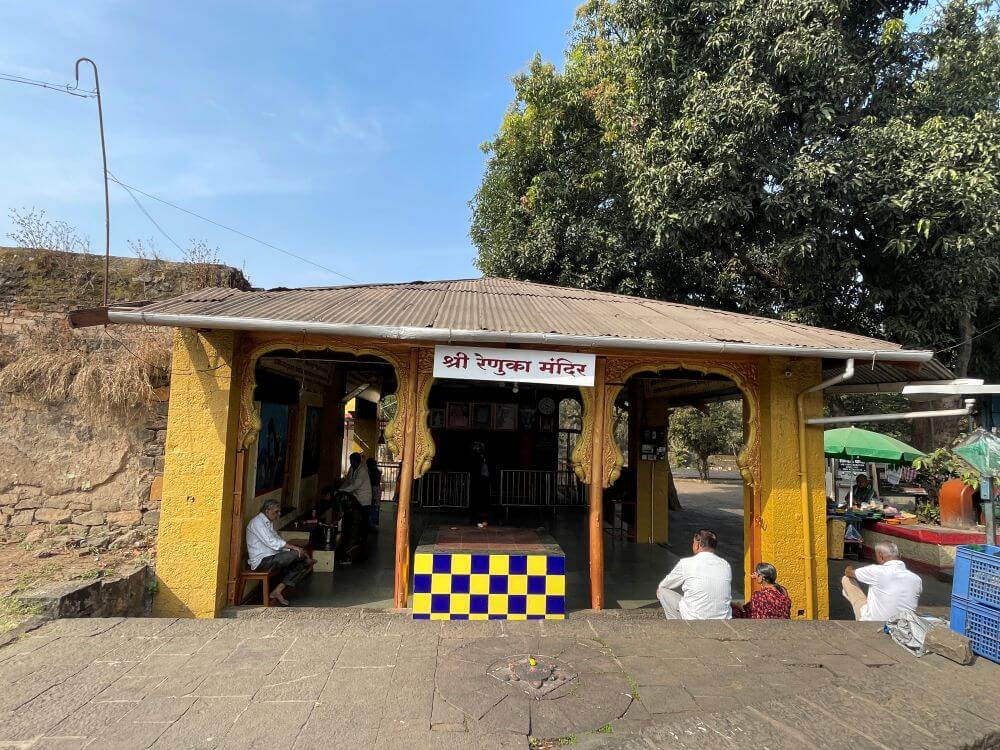
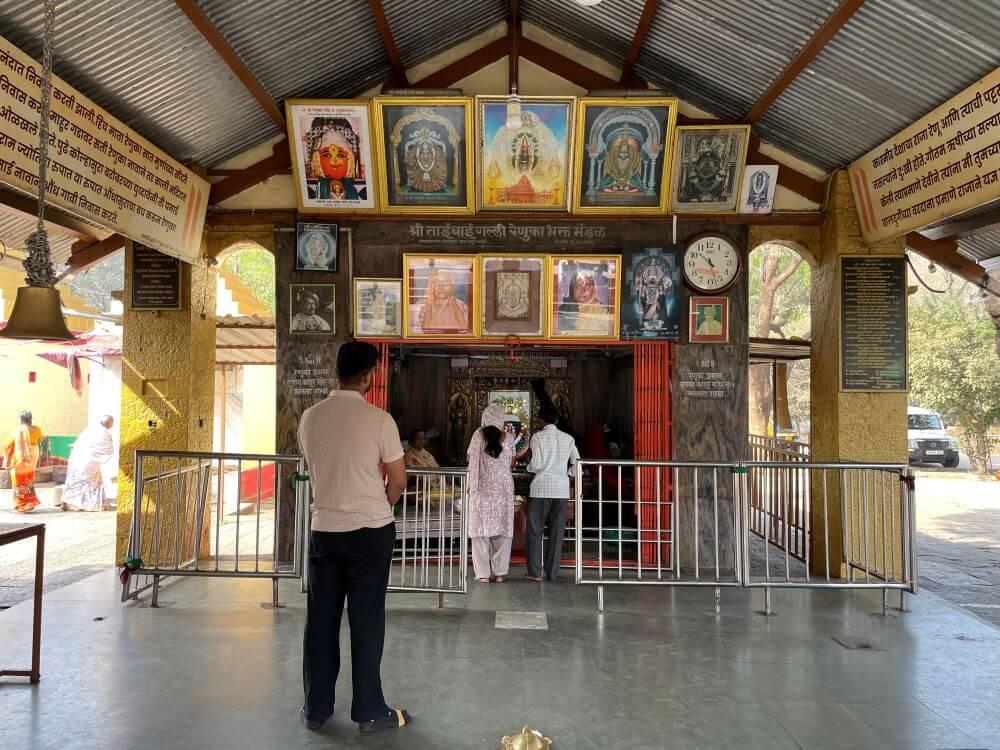
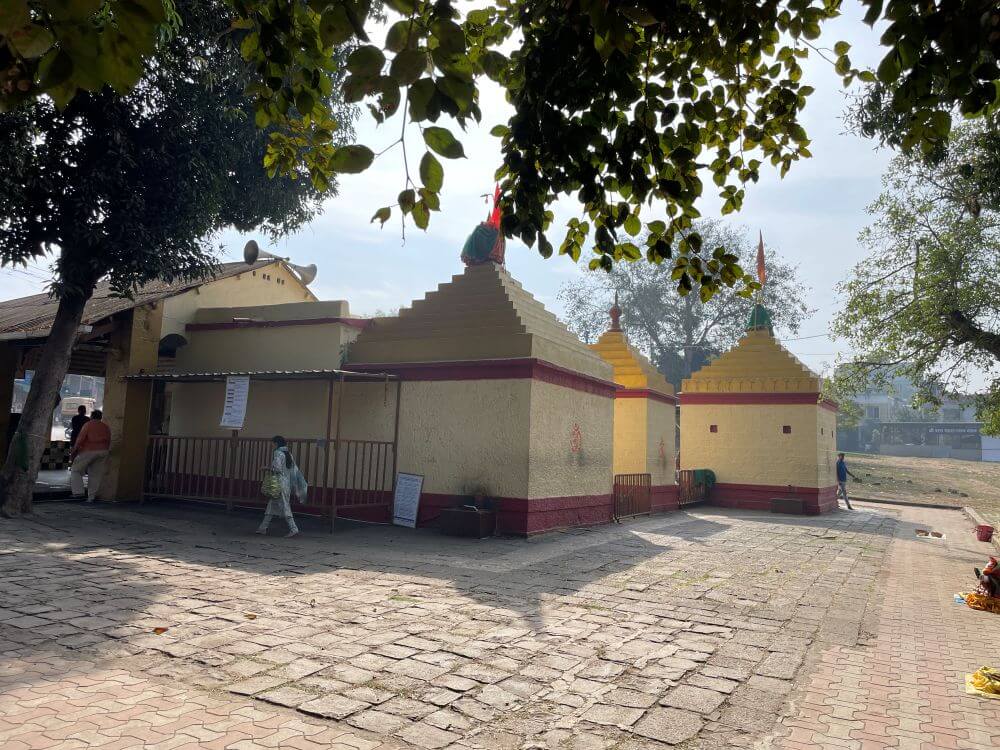
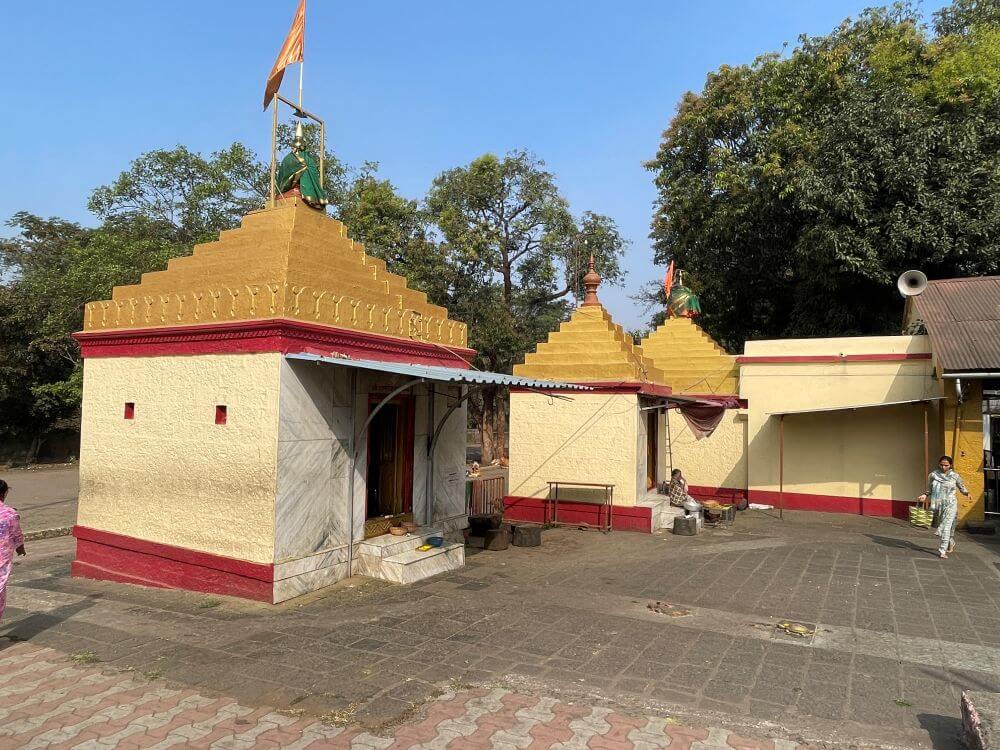
The temple of Goddess Renuka is located right along the main road in Mangalwar Peth. The temple is situated in a large area. The entire courtyard is paved with stone. There are some shops here that sell worship materials for the Goddess. The original temple is not very large. The former stone temple has been renovated. The structure of the temple consists of a Sabha Mandap (assembly hall), Antarala (vestibule), and Garbhagriha (sanctum sanctorum). Between the round, slender pillars in the Sabha Mandap, there is an intricately carved arched gateway. The roof is made of corrugated sheets. Plaques narrating the legend of the Goddess are displayed in the Sabha Mandap. There is a platform for the Goddess’s Palkhi (palanquin) here. The Palkhi of the Goddess is kept in the Antarala.
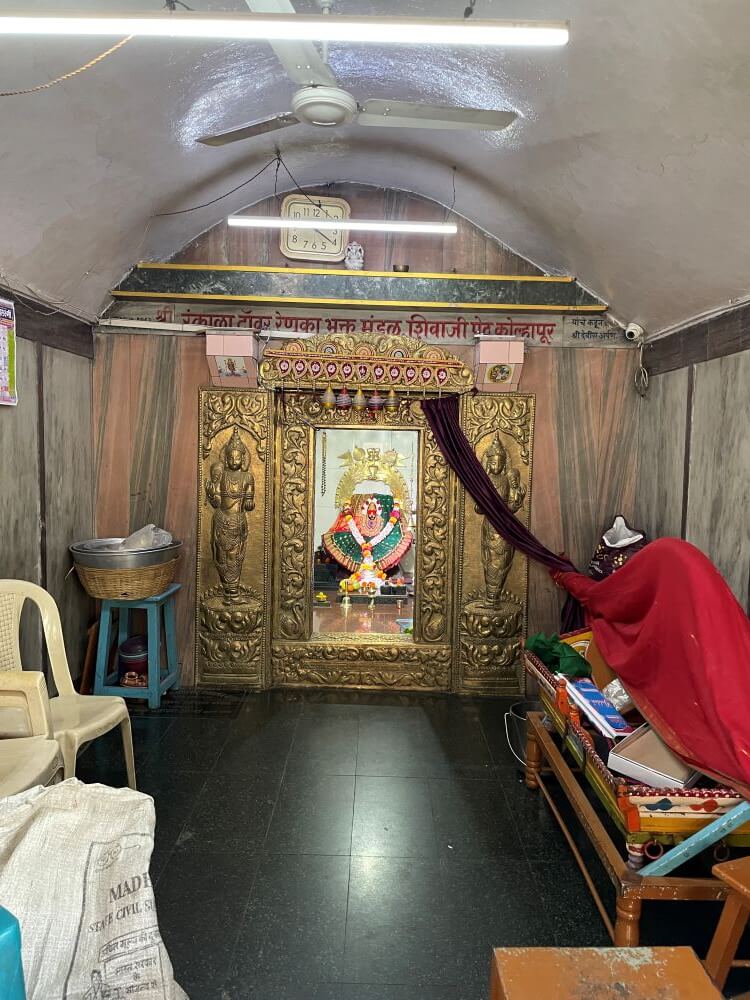
The entrance to the sanctum sanctorum is clad in brass plating. It features intricate carvings, On both sides of the frame, tall statues of the gatekeepers are carved. Inside, the idol of Renuka Devi is enshrined in a silver canopy. The adornment and decoration of the Goddess in a Kalash-patterned saree remind one of the Mahalakshmi of Kolhapur.
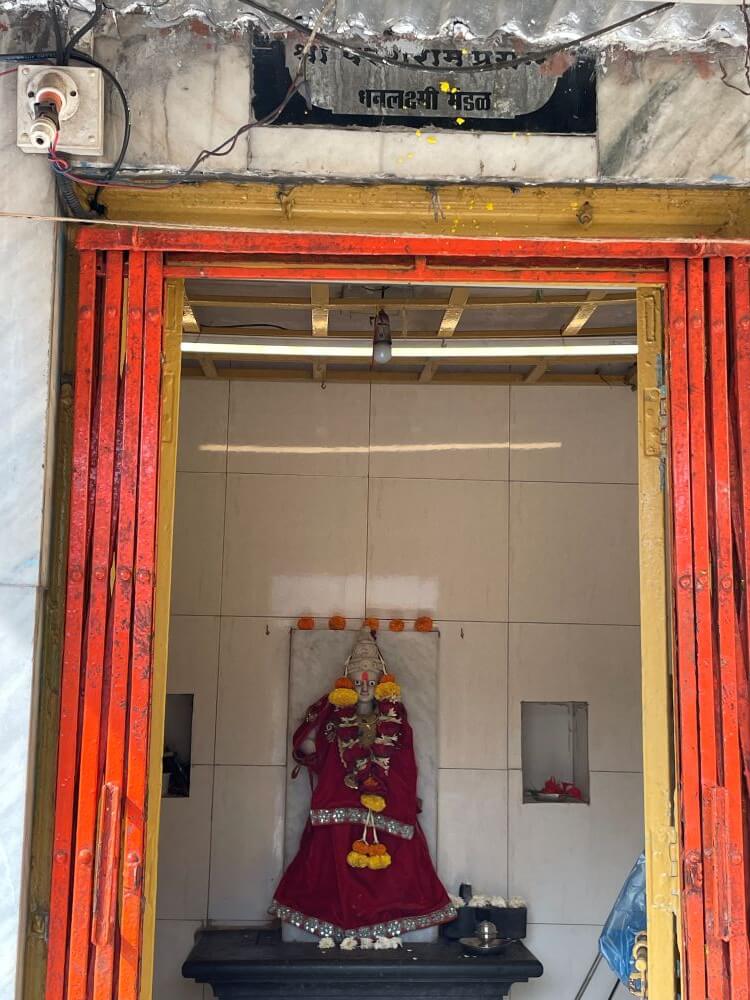
To the left of the Goddess’s temple, there are also temples dedicated to Parashurama and Matangi Devi. The spires of these temples are pyramid-shaped. A unique feature here is that the finial (kalash) atop the spires of the Renuka and Matangi Devi temples is draped in a saree. Considering the finial as an image of the Goddess, a green saree is draped around it, just as a saree is draped around the Goddess’s idol (tandala).
The Ambil Yatra of Goddess Ellamma is the main festival celebrated at this temple. The Ambil Yatra takes place on the first Saturday following the Yatra held at Saundatti on the Margashirsha Purnima. During this time, one can witness an enthusiastic atmosphere filled with the chants of “Udam Aai, Udam…”, early morning abhishek, the Aarti of the Goddess, the Palkhi procession, and the showering of Bhandara. On the day of the Yatra, offerings made to Goddess Renuka include curd rice, Ambil, Vadi-bhakri, lentil curry with eggplant, fenugreek vegetable, carrots, bananas, spring onions, lemons, and various other vegetables and fruits. A massive crowd of devotees gathers here on this occasion. As this is considered a highly awakened (Jagrut) shrine, a large number of devotees also visit every Tuesday and Friday. The Maha Aarti of the Goddess is performed in the temple every morning and evening.
This sacred temple stands as a testament to deep spiritual devotion, ancient architectural grandeur, and rich local cultural traditions.
The sanctum sanctorum houses the divine idol consecrated according to ancient Vedic traditions, surrounded by serene courtyards and traditional temple architecture.
Navratri, Maha Shivratri, Annual Temple Jatra & Deepotsav
Compare and book flights, secure top-rated local hotels near the temple, hire reliable guides, and rent cars instantly.
Extend your pilgrimage by visiting other highly sacred temples located nearby.


Add ₹999 more to unlock FREE SHIPPING!
Your sacred cart is currently empty.
Shop Photo FramesFill in your delivery details below to place your order.
Add comment