
Add ₹999 more to unlock FREE SHIPPING!
Your sacred cart is currently empty.
Shop Photo FramesLoni is a prosperous village situated about 13 kilometers away from the world-famous Lonar Lake, which was formed by a meteorite impact approximately five hundred seventy thousand years ago. In this village, there is a temple of Sadguru Sakharam Maharaj. Due to this temple, the village of Loni has attained the status of a pilgrimage site. Sakharam Maharaj is worshipped as the presiding deity of Loni. Devotees believe that this shrine of the Maharaj is spiritually awakened and that he fulfills the heartfelt wishes of his followers.
According to the text ‘Shri Sakharam Leelamrut’ published by ‘Shri Sakharam Maharaj Sansthan, Loni’, Shri Sakharam Maharaj was born on the day of Ram Navami, on Chaitra Shuddha Navami, Shake 1708, which is 9 April 1786, in the village of Talni in Jalna district. His mother’s name was Ahilya and his father’s name was Balshastri. He pursued his Vedic studies under the guidance of the learned scholar of Vedas and Shastras, Balshastri, in Washim. Balshastri was a devotee of the Goddess. According to the story in the Leelamrut, once Goddess Bhavani herself appeared to Balshastri in a vision and told him that Sakharam was no ordinary student, but a Yogi of three lifetimes. After completing his education under Balshastri, at the age of fourteen, On 21 November 1800, he was married against his will. However, immediately after that, he renounced his home.
It is said that He performed rigorous penance through Jalastambha Yoga at Padmatirtha in Washim, the Pingalakshi Devi Temple in Risod, the Kamalaja Devi Temple in Lonar, and in the holy Ganges at Kashi. In Kashi, He was blessed with the divine vision of Goddess Bhagirathi. Thereafter, He traveled across the country and returned to Loni. Upon His arrival, He received initiation from Sachchidananda Swami of Lonar and adopted the name ‘Yogananda’. Witnessing the miracles performed by Him, people from various castes became His devotees. He lived in the state of Ayachita Vritti (accepting only what is offered without asking). He would offer half of the food received to living beings and consume the remainder. He was a man of few words. Much like the great saint of Maharashtra, Gadge Maharaj, He did not like anyone falling at His feet. ‘A fish in water cannot survive in ghee, a bird cannot live in a burrow, a snake cannot fly in the sky, an Arabian horse is of no use for ploughing, and a battle cannot be fought on an ox,’ Bearing this in mind, a person should not abandon their inner nature, nor should they forsake their prescribed duties. He would always say that Dharma means morality and righteous conduct. At the age of ๙๒, on ๒๓ November ๑๘๗๘, he attained Samadhi.
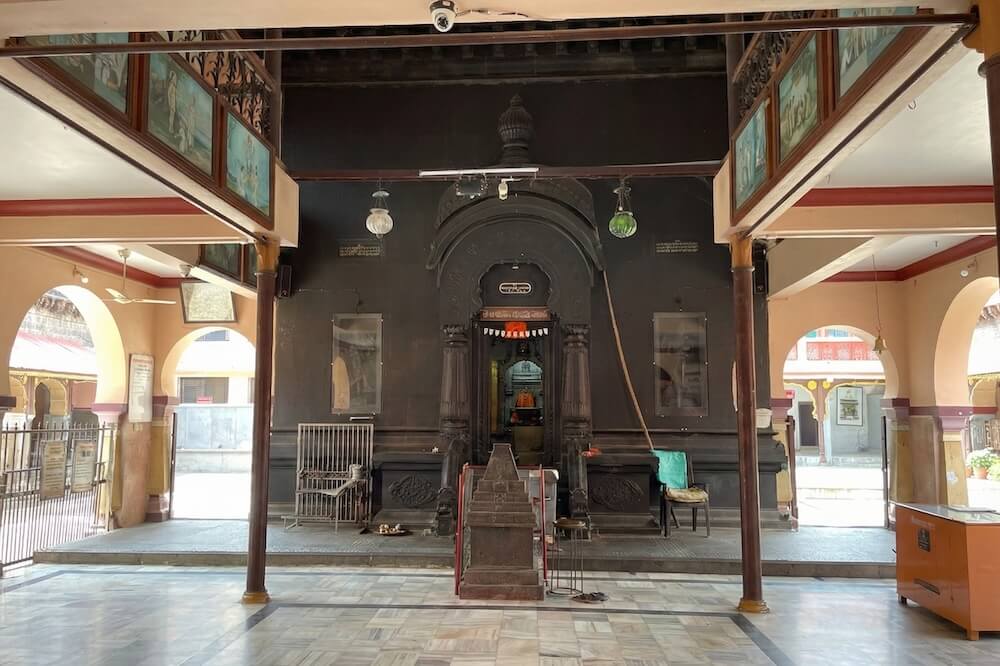
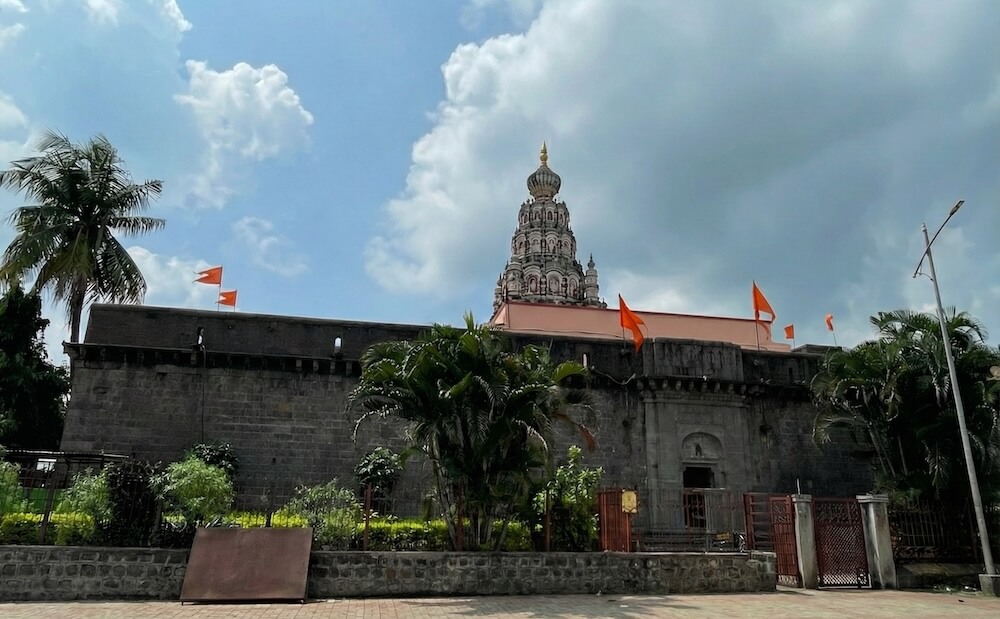
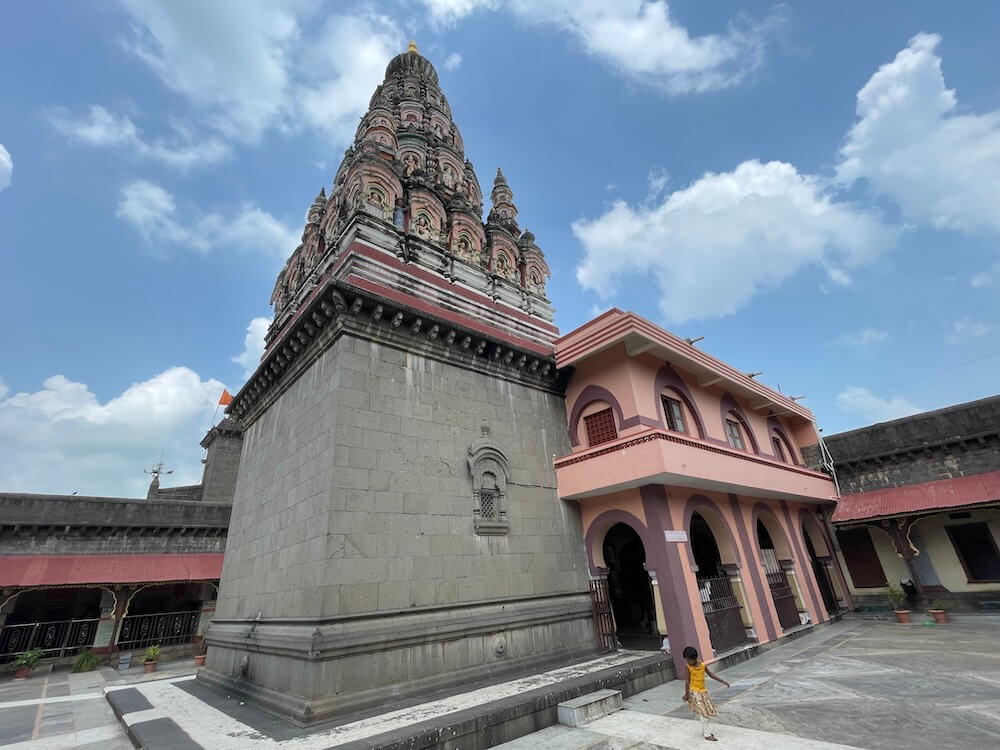
The first small stone temple was erected in the year 1880 at the very spot where the Maharaj attained Samadhi under the banyan tree. Subsequently, on 25 March 1925, the construction of a new, grand temple began here. The stones from the old temple were used to build the Kunda in Sakharam Vatika, located to the southeast. Notably, the door of that old temple, as well as some stone remnants, are still preserved here. This temple of Sakharam Maharaj appears like a fortress. It has high stone ramparts. The temple courtyard is vast. The courtyard features a grand, stone-built main entrance. Inside, in the center, stands the magnificent structure of Sakharam Maharaj’s temple. There is a two-story assembly hall here. This assembly hall, featuring many arches, is open in design. The upper floor features a balcony. Its railing is adorned with various mythological paintings. This leads to the entrance of the main temple. The temple is constructed entirely of black stone in the Maratha architectural style. Its entrance is decorated with great artistry, resembling a ceremonial canopy. Inside, the silver mask of Sakharam Maharaj is consecrated upon a silver pedestal featuring intricate carvings. This stone temple of Sakharam Maharaj stands at a total height of 90 feet. It is crowned by a three-tiered spire in the Maratha style. The niches within the spire house the idols of the Dashavatara.
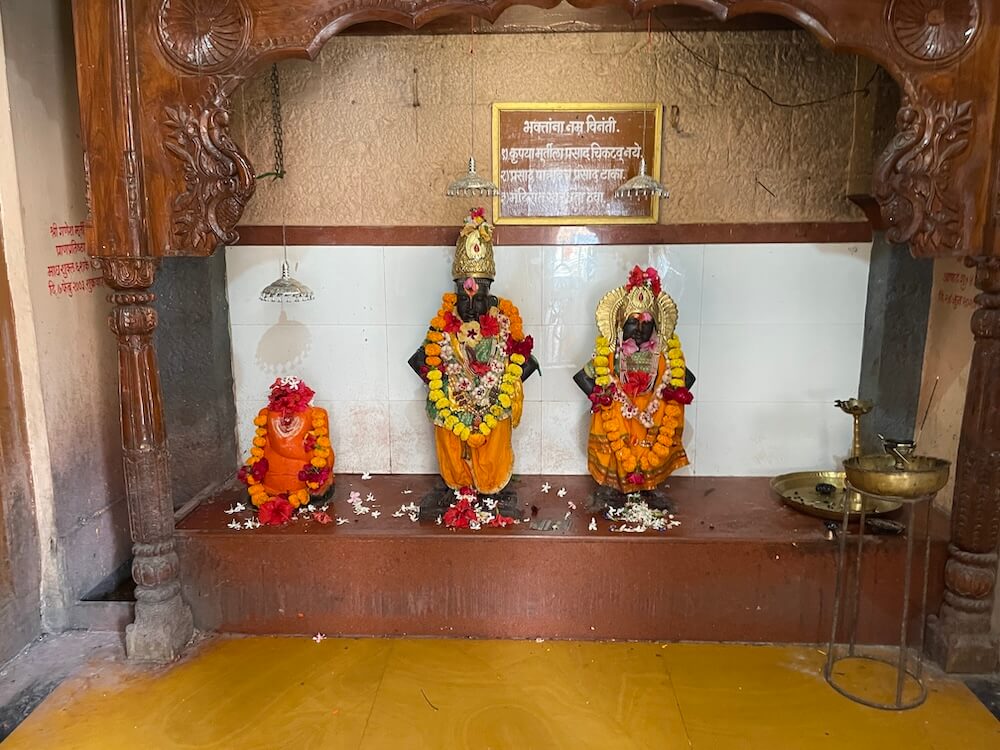
Beside the main temple, there are also shrines dedicated to Vitthal-Rukmini, Ganesha, and Shriram-Sita-Lakshmana. Within the temple complex stands the mansion where Sakharam Maharaj resided. This mansion features teak wood pillars and unique lighting arrangements. The descendants of Sakharam Maharaj reside there. The stone temple of Lomeshwar Mahadeva, where Sakharam Maharaj performed his penance, is also located here.
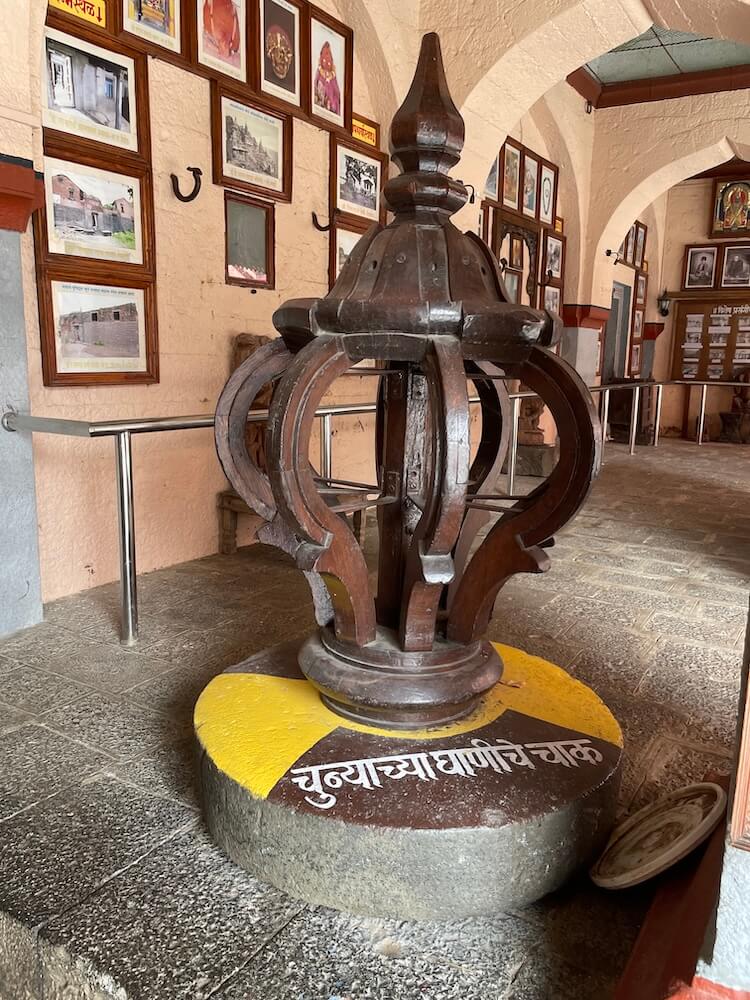
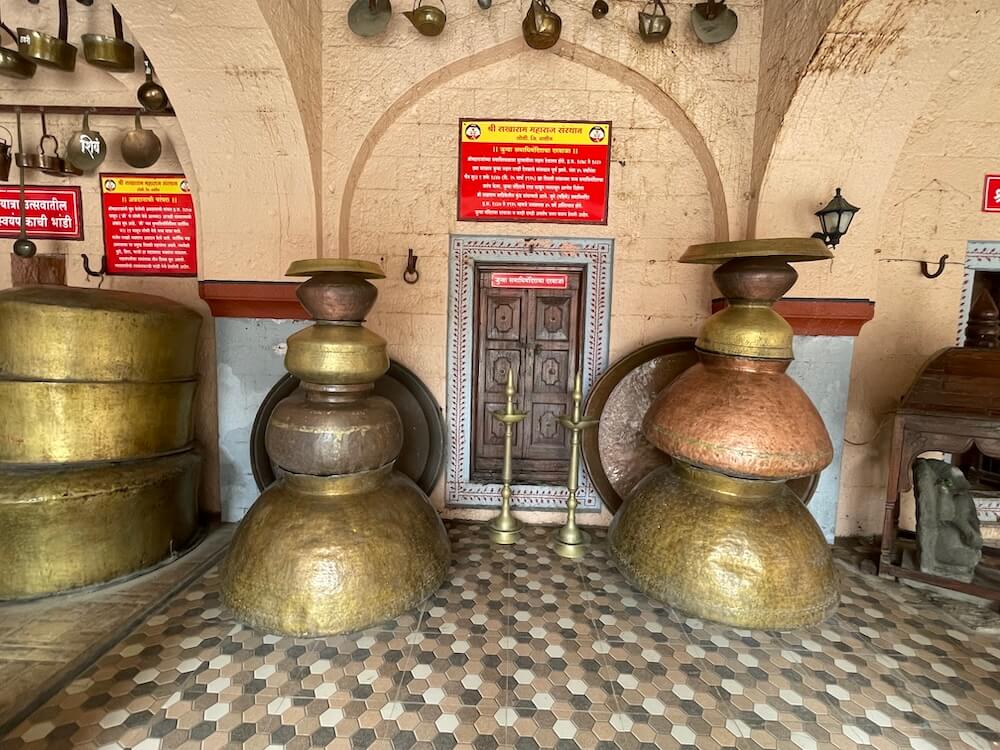
In an open hall within the temple premises, old cooking vessels used during pilgrimage festivals are displayed. Since the year १८५७, Sakharam Maharaj initiated the tradition of providing free food to all here. These vessels serve as a preserved memory of that legacy. Even today, the institution continues the tradition of uninterrupted free food distribution, and arrangements for the meals and accommodation of devotees are provided free of charge. On the wall of one of the corridors, an exhibition of photographs is displayed. Through these photographs, an informative overview of significant events in the life of Sakharam Maharaj is presented. Lime was used for the construction of the temple. For this purpose, a lime mill was set up right here. The unique wheel used for that mill can also be seen here.
Various religious programs are organized at the temple. Here, the Abhisheka of the Maharaja is performed daily between 8 and 11 in the morning. The Aarti takes place at 11.45 in the morning and at 7 in the evening (from April to September, the evening Aarti is at 7.30). The offering of Naivedya begins at 1 in the afternoon, followed by the distribution of Prasada. The Ramayana Katha is held here from Chaitra Shukla Pratipada to Shashthi. On Ram Navami, the birth anniversary celebrations of Shri Ram and Sakharam Maharaj are observed. On Ashadhi Ekadashi, a Dindi procession is taken from here to the site of Sakharam Maharaj’s first arrival in Loni. Apart from this, Ganeshotsav is celebrated here on a grand scale. The largest festival at the temple is the Yatrotsav. This festival commences from Kartik Vadya Panchami and continues until Margashirsha Shuddha Tritiya. During this period, the Shraddha ceremony of Sakharam Maharaj is performed on Kartik Vadya Chaturdashi, while his Punyatithi is observed on Kartik Vadya Amavasya. On the day of the Punyatithi, Maha-Prasad consisting of Shira-Puri and vegetable curry is served to thousands of devotees. The honor of performing the Puja during this Maha-Prasad belongs to the Gosavi and Vanjari communities. The Puri served in this feast is considered extremely significant by the devotees. There is a popular belief that if this Puri is kept with the grain stored at home, one will never face a shortage of food grains.
The chariot festival is held here on the first day of the bright fortnight of the Margashirsha month. On this occasion, the temple circumambulation is performed using a three-story wooden chariot. This chariot festival commences by honoring five traditional community representatives: the Vadar, Lohar, Sutar, Gavandi, and Adivasi communities. Some devotees pull the chariot to fulfill their vows. There is a tradition of throwing Revadis (sweet treats) onto this chariot. Following this, a Palkhi (palanquin) procession takes place at night. By tradition, this honor belongs to the Sutar community. The Palkhi is brought into the temple with music and fanfare, and the mask of Sakharam Maharaj is placed inside it to lead the procession.
On behalf of this temple trust, along with religious activities, significant social work is also carried out. The Sakharam Maharaj Vidyalaya has been operating here since the year 1966. Additionally, an English-medium school has also been started. There are hostel facilities for needy and poor people. Education, accommodation, and food are provided free of charge. The library here houses a collection of ancient scriptures. The temple has a cowshed (Goshala), from which biogas and fertilizer are produced. Every year, the trust organizes health camps where free medical examinations and medicine distribution are provided to the poor by renowned doctors.
This sacred temple stands as a testament to deep spiritual devotion, ancient architectural grandeur, and rich local cultural traditions.
The sanctum sanctorum houses the divine idol consecrated according to ancient Vedic traditions, surrounded by serene courtyards and traditional temple architecture.
Navratri, Maha Shivratri, Annual Temple Jatra & Deepotsav
Compare and book flights, secure top-rated local hotels near the temple, hire reliable guides, and rent cars instantly.
Extend your pilgrimage by visiting other highly sacred temples located nearby.


Add ₹999 more to unlock FREE SHIPPING!
Your sacred cart is currently empty.
Shop Photo FramesFill in your delivery details below to place your order.
Add comment