
Add ₹999 more to unlock FREE SHIPPING!
Your sacred cart is currently empty.
Shop Photo FramesSateri Devi is considered the Gramadevata (village deity) of Sindhudurg. It is believed that Sateri or Santeri is one of the Saptamatrikas (seven divine mothers). The goddess is also known by the names Bhumka, Bhumika, and Purvi. According to mythological legends, the first form taken by the Divine was Prakriti or Maya. Hence, she is called ‘Bhumka’, while her antiquity is expressed through the word ‘Purvi’. In the Bara-Pacha tradition of the Konkan region, she is referred to as the ‘Purvasatta Sthala’ (the primordial seat of power). An anthill is the symbol of this goddess. In the temple at Pavashi in Kudal Taluka, Sateri Devi is worshipped in the form of a magnificent anthill.
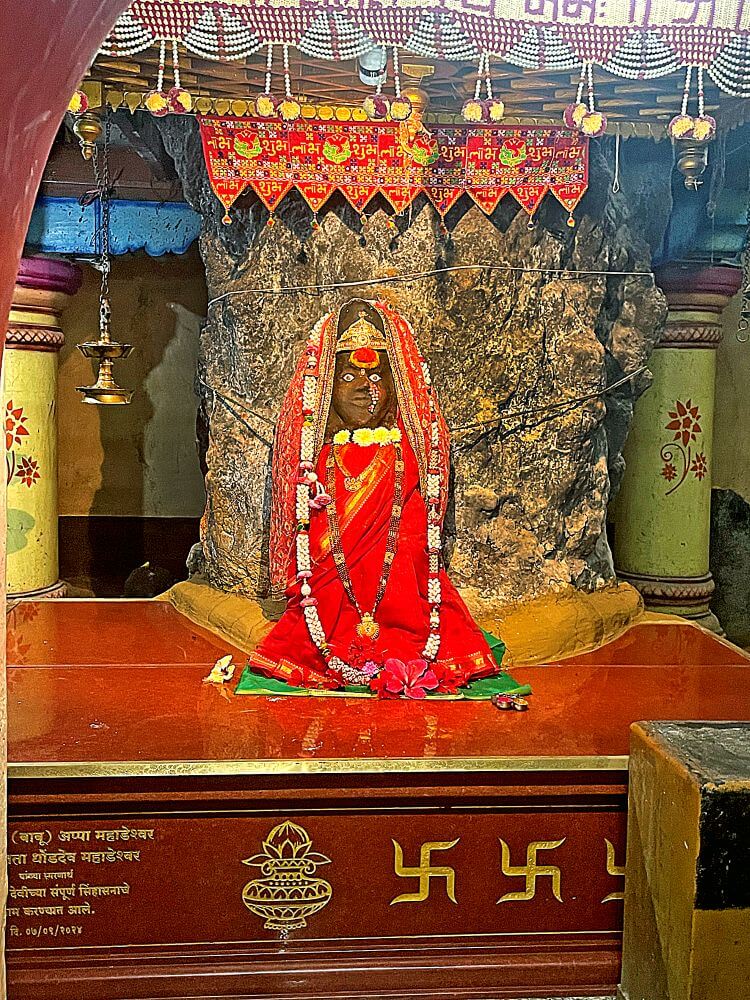
The worship of an anthill holds an important place in the Shakta tradition. There is a legend regarding Renuka, the mother of Lord Parashurama, that she was born from an anthill and disappeared into one. The word Renuka itself comes from ‘renu’, meaning a microscopic particle. An anthill is also formed by microscopic particles of soil. According to the renowned scholar R. Ch. Dhere, the anthill is considered a Yoni-pratika (symbol of the womb). The tradition of worshipping the goddess in this form is ancient. Temples of Sateri Devi in the form of an anthill are also famous in villages like Devali and Pendur in Malvan Taluka. However, it is only at Pavashi that one can behold the magnificent anthill idol of Sateri Devi. Inside this temple, there is a grand anthill that looks like a massive banyan tree. The height of this anthill is about 15 feet and its width is 20 feet.
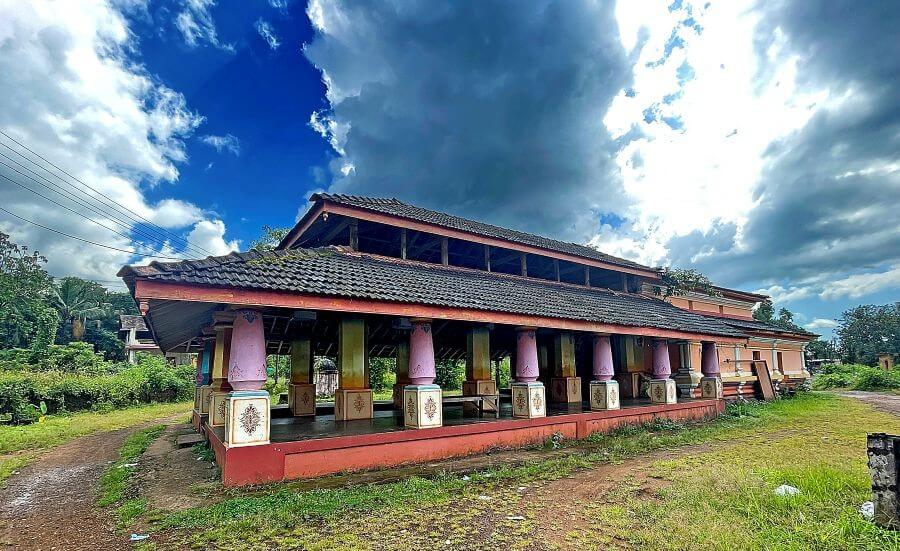
The magnificent temple of Sateri Devi is located in the picturesque village of Pavashi on the Mumbai-Goa highway. It is said that this temple is extremely ancient. Regarding the history of the goddess, it is said that members of the Pawar dynasty lived in the Dhar princely state of Madhya Pradesh. About 500 years ago, they brought Sateri here and consecrated her. There is also a legend regarding the construction of this temple: about 500 years ago, there was a house where the temple stands today. A family named Mahadeshwar lived in that house. An anthill would always form exactly where their hearth was located. The Mahadeshwar family would repeatedly destroy it. But once, it so happened that the anthill began to form and its height kept increasing. That same night, Sateri Devi appeared in a vision to a member of the Mahadeshwar family. The goddess said, “I have come into your home.” From that day on, the worship of that anthill began. However, the growth of the anthill did not stop. It reached the roof of the house. Finally, the Mahadeshwar family wrapped the anthill in a white cloth and prayed to the goddess not to let it grow any further. After that, the growth of the anthill stopped. Even today, this anthill can be seen touching the roof of the temple. Devotees here say that although the growth of the anthill has stopped, its shape continues to change.
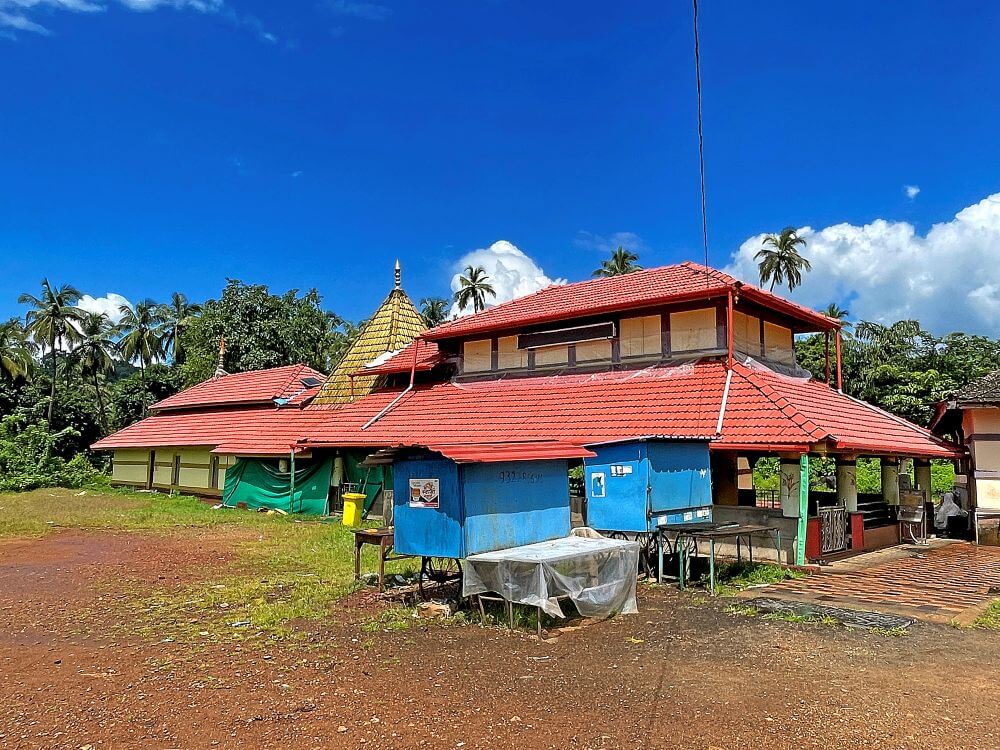
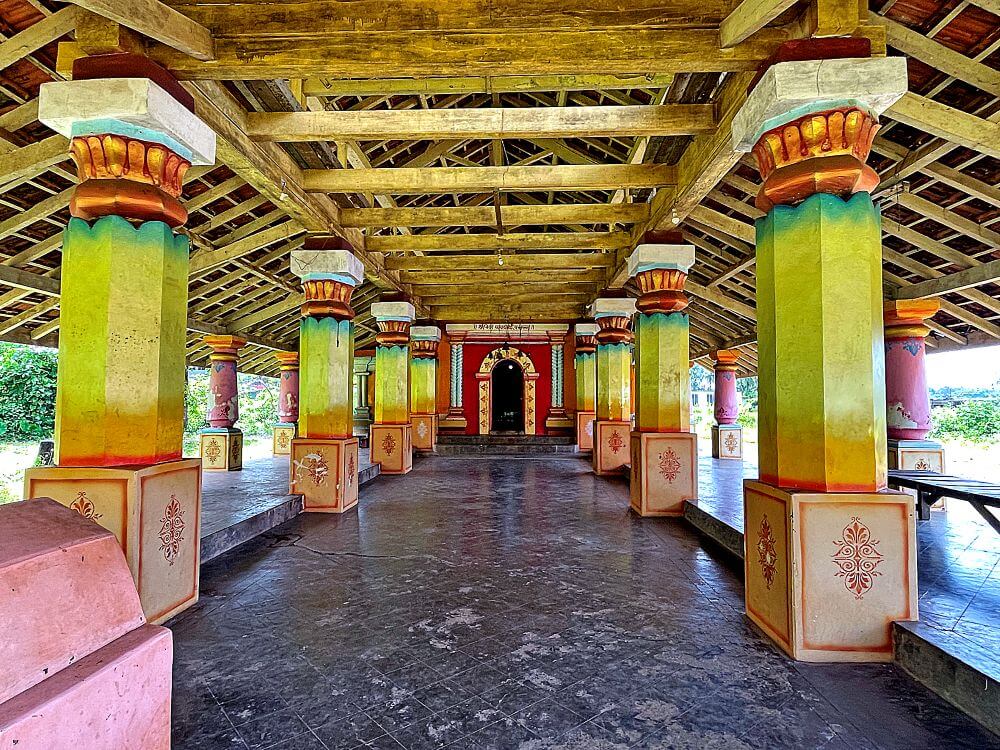
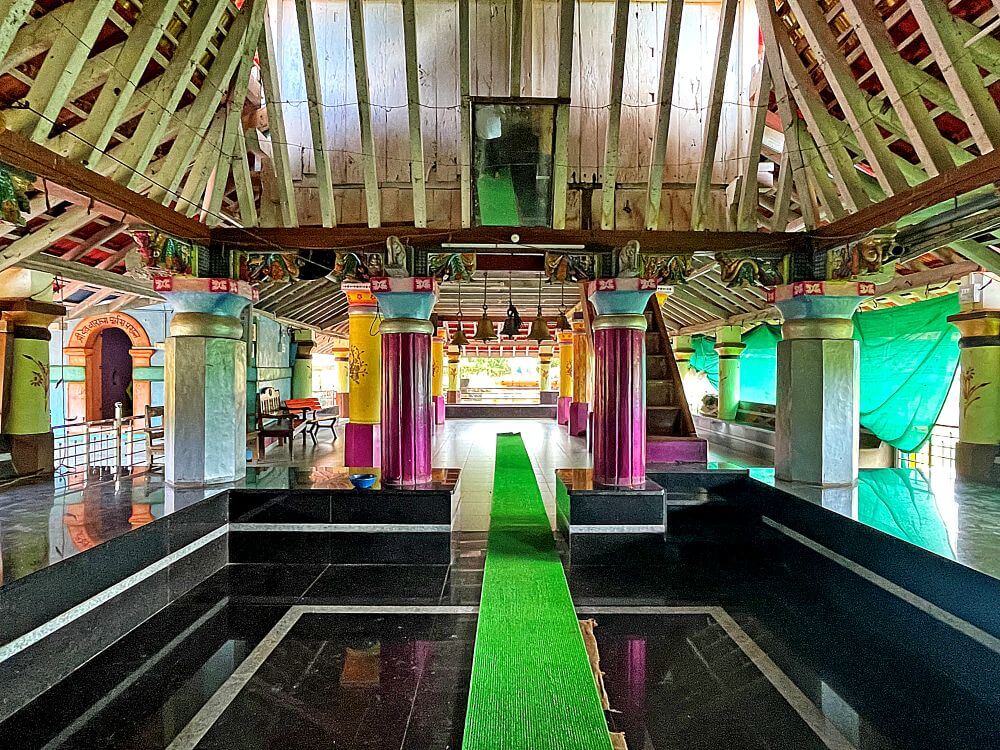
The magnificent temple of Sateri Devi is now built on the site of that old house. Built in the Konkan architectural style, this temple is two-storied. The Sabha Mandap (assembly hall) is semi-open and features round stone pillars. The roof of the Sabha Mandap is sloping and tiled, while the Garbhagriha (sanctum sanctorum) has a pyramid-shaped tiled spire topped with a Kalash. Inside the Sabha Mandap, there are wide stone pillars placed at a distance from the outer walls. In the upper part of these pillars, one can see ‘Kamalshirsha’, which are petals carved like an inverted lotus. The ‘Taranghastas’ (brackets) on these pillars are intricately carved. (Taranghastas are structures shaped like a plus sign where the vertical pillars meet the roof.) On one side of the Sabha Mandap, various ceremonial staffs (Tarangkathis) of deities are also arranged.
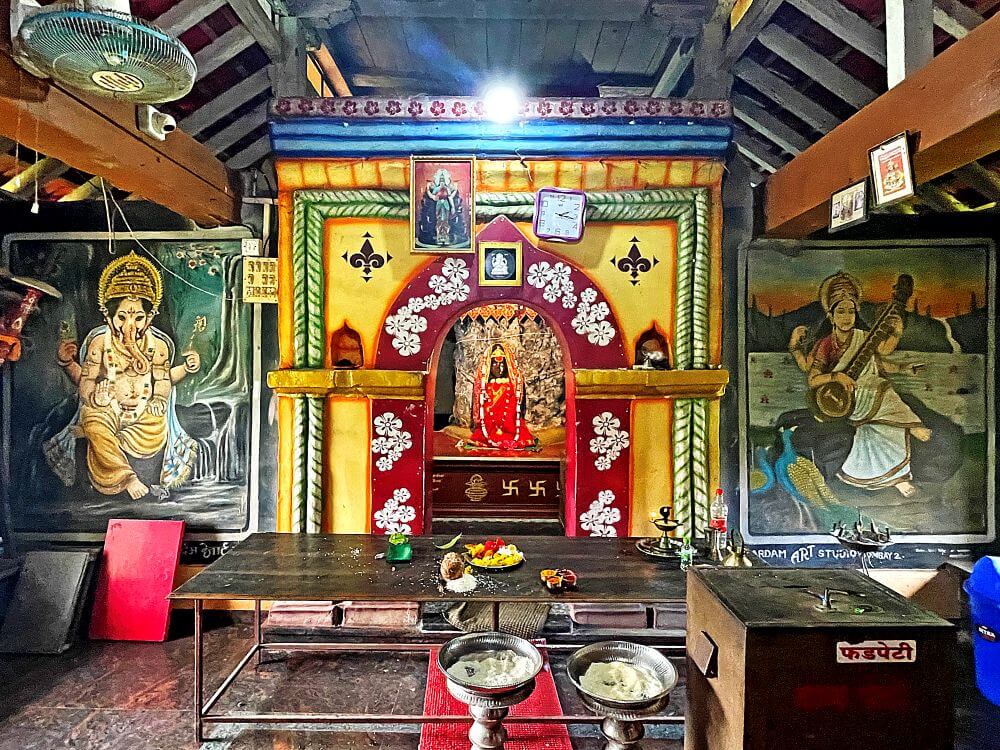
On the front wall of the Garbhagriha, a large image of Ganesha is painted on the left, and Saraswati on the right. The entrance to the Garbhagriha is cylindrical and decorated with floral patterns. Upon entering the Garbhagriha, one sees the magnificent anthill directly in front. A marble platform has been built around the anthill. In front of the anthill, a standing stone idol of Sateri Mata is enshrined, adorned with a nose ring and a crown. Behind this platform in the Garbhagriha, there are idols of Ganesha and various other deities as ‘ancestral spirits’. There are also smaller anthills here. Devotees believe that Sateri Devi resides in the large anthill here in the form of a serpent.
Festivals like Navaratri and Deepavali are celebrated with great enthusiasm at this temple in Pavashi. During Navaratri, the idol of the goddess is decorated in various forms. A Harinam Saptah is also celebrated here on a large scale. However, the biggest attraction of this temple is the ‘Neel-karya’ festival. This festival is celebrated with great fervor every year on the first Monday of the Vaishakh month. On this day, a gruel (pej) made of 20 to 25 kilograms of rice is prepared here. There is a rule that this rice must be grown on the temple’s own land. Indigo (neel) is then mixed into this gruel. The anthill of Sateri Devi is painted with this indigo-mixed gruel, followed by a cacophony of traditional musical instruments. On the occasion of this ritual, a large number of devotees from the district as well as from Mumbai, Kolhapur, and Goa come to Pavashi. Devotees believe that this goddess fulfills their vows. A ‘Kaul’ (divine permission) is sought from her using rice. When making a prayer, devotees call out “Mate Maje Avashi” (Mother, my mother). Devotees see her in the form of ‘Avashi’, meaning a loving mother.
This sacred temple stands as a testament to deep spiritual devotion, ancient architectural grandeur, and rich local cultural traditions.
The sanctum sanctorum houses the divine idol consecrated according to ancient Vedic traditions, surrounded by serene courtyards and traditional temple architecture.
Navratri, Maha Shivratri, Annual Temple Jatra & Deepotsav
Compare and book flights, secure top-rated local hotels near the temple, hire reliable guides, and rent cars instantly.
Extend your pilgrimage by visiting other highly sacred temples located nearby.


Add ₹999 more to unlock FREE SHIPPING!
Your sacred cart is currently empty.
Shop Photo FramesFill in your delivery details below to place your order.
Add comment