
Add ₹999 more to unlock FREE SHIPPING!
Your sacred cart is currently empty.
Shop Photo FramesSince the emergence of village culture in Hindu Dharma, deities have existed at the village boundaries or borders. It is believed that this deity, adorned with vermilion and devoid of specific human-like features, protects the village from external forces. This village deity safeguards the crops, water resources, and livestock of the villagers. Furthermore, these deities serve to protect the village from evil forces and epidemics. Usually, there is a temple of a Goddess or Hanuman at the village boundary. However, at the boundary of Kandhar village in Nanded district, there is a Swayambhu (self-manifested) Ganesh temple. Devotees believe that this awakened Ganpati grants their prayers.
It is said that this temple is about two hundred years old. The legend regarding this temple is that there was a realized soul named Sadhu Maharaj in Kandhar village. He was always absorbed in the devotion of Ganesh. One day, Lord Ganesh appeared in Sadhu Maharaj’s dream. He gave a vision stating that He was present under an anthill on the banks of the Mankarnika River at the village boundary and asked to be brought out from there. Sadhu Maharaj arrived at the riverbank with his disciples and entourage. Following the signs received in the vision, he located the anthill hidden in the dense thicket on the riverbank. There, he saw the Swayambhu Ganesh idol lying face down under the anthill. He asked his disciples to lift the idol while he sat in meditation. Even after about one hundred disciples and as many villagers tried for nearly four hours, the idol did not move from its place. Then, all the villagers requested Sadhu Maharaj to find a solution himself. Upon the request of the disciples and villagers, as soon as the Maharaj touched the idol, it straightened on its own. Then, the Maharaj performed the consecration of the idol at this very spot. Later, the villagers built a temple here. This legend is found in the biographical book of Sadhu Maharaj titled “Sadhu Sudha”.
This idol is approximately eight hundred years old. Some experts speculate that it may originally belong to the ‘Mandala Siddhivinayak’ temple mentioned in the Kandhar inscriptions. Records of donations made by Rashtrakuta kings to this same Mandala Siddhivinayak temple are found in some inscriptions. Over time, this idol must have been buried under the soil. Nowadays, this Ganpati is also addressed as ‘Sadhu Maharaj’s Ganpati’. Many remains of Rashtrakuta-era temples are scattered in this area, while some remains are found in the premises of the Kandhar Fort.
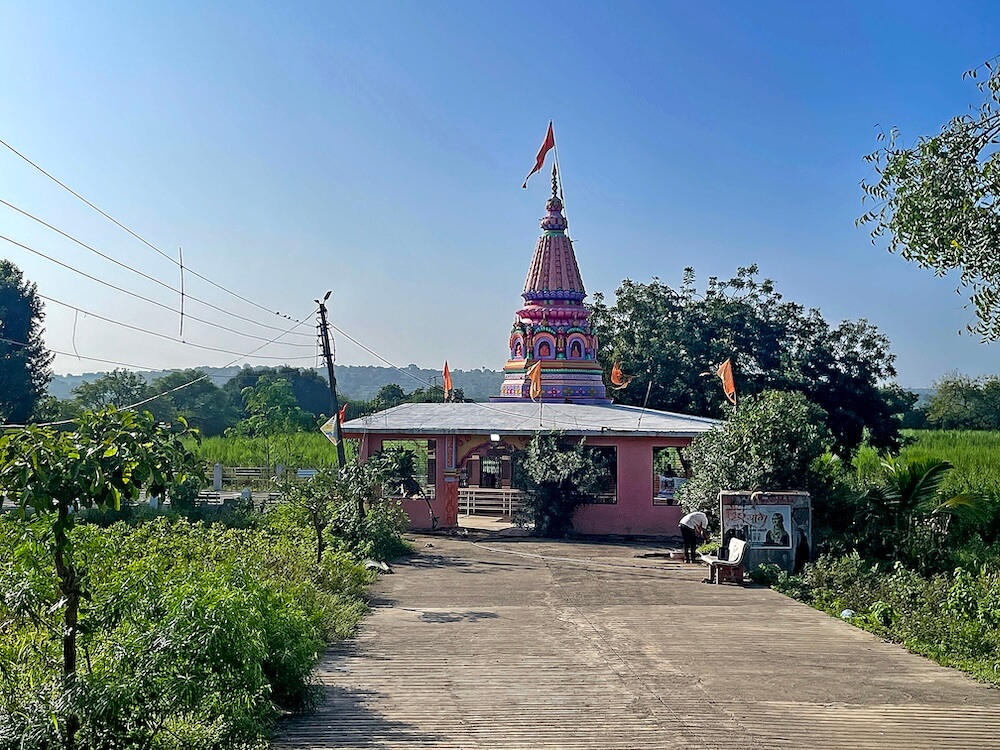
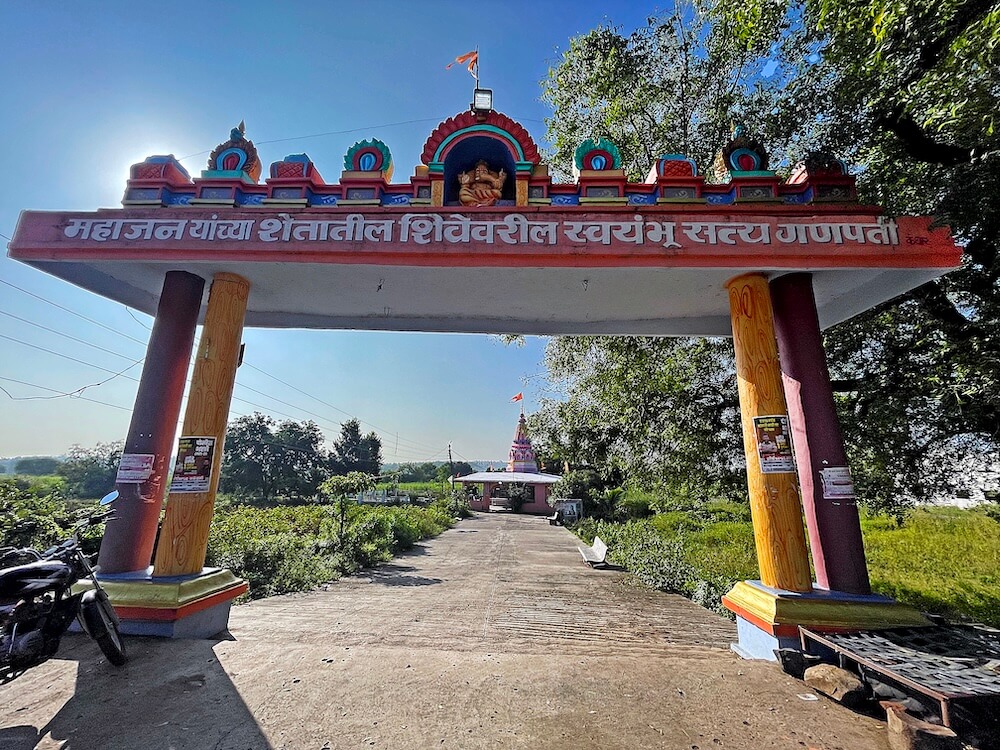
The temple stands on the riverbank along the main road at the village boundary. A fortification has been created around the temple using cement pillars with stainless steel pipes. There is a welcome arch in the fortification. In this welcome arch, there are two platforms on both sides. There are two pillars on each of these two platforms. There is a horizontal canopy over the pillars, in the center of which is a niche containing an idol of Ganpati. On both sides of the niche are auspicious emblems and small spires. On the path leading from the welcome arch to the temple and along the fortification in the courtyard, there are seats for devotees to sit.
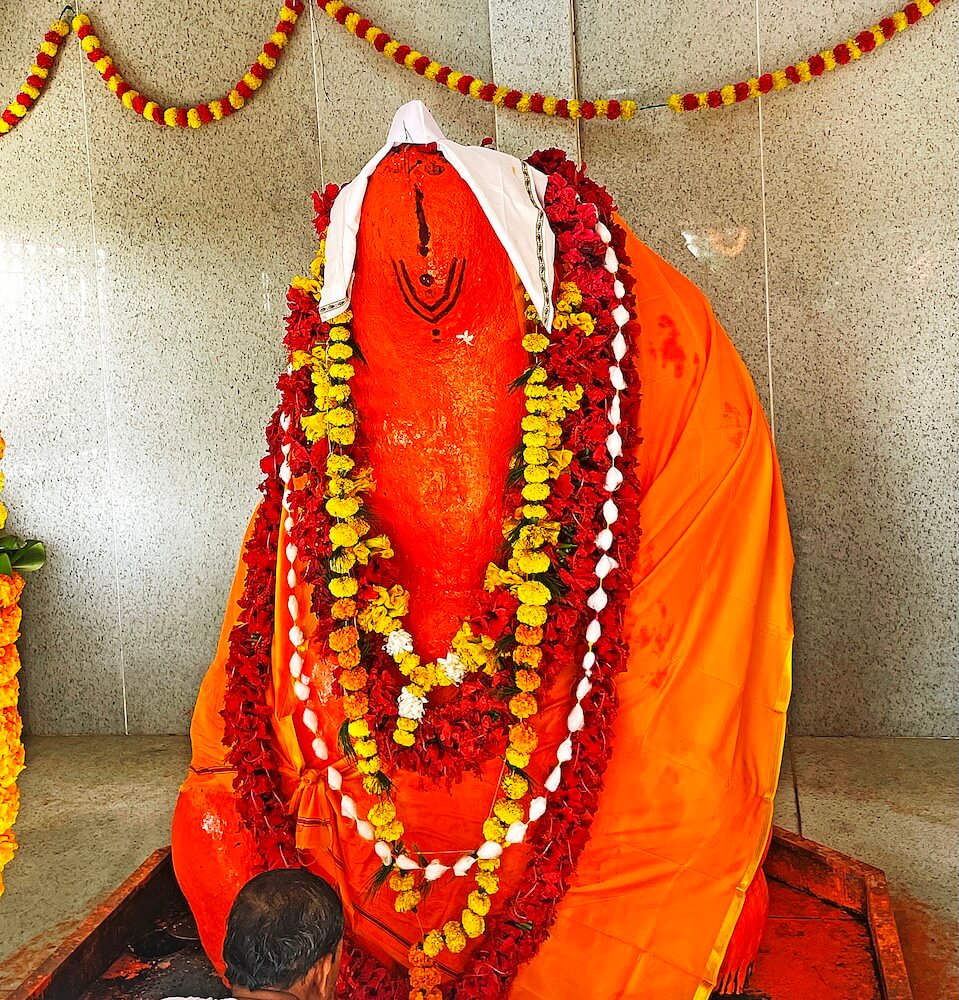
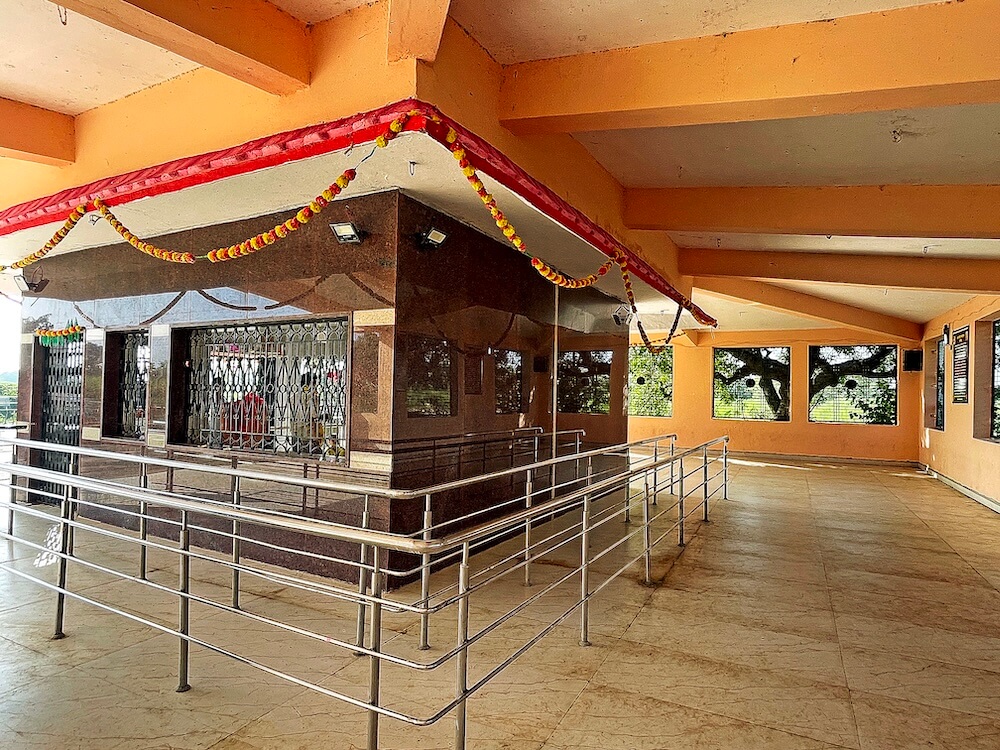
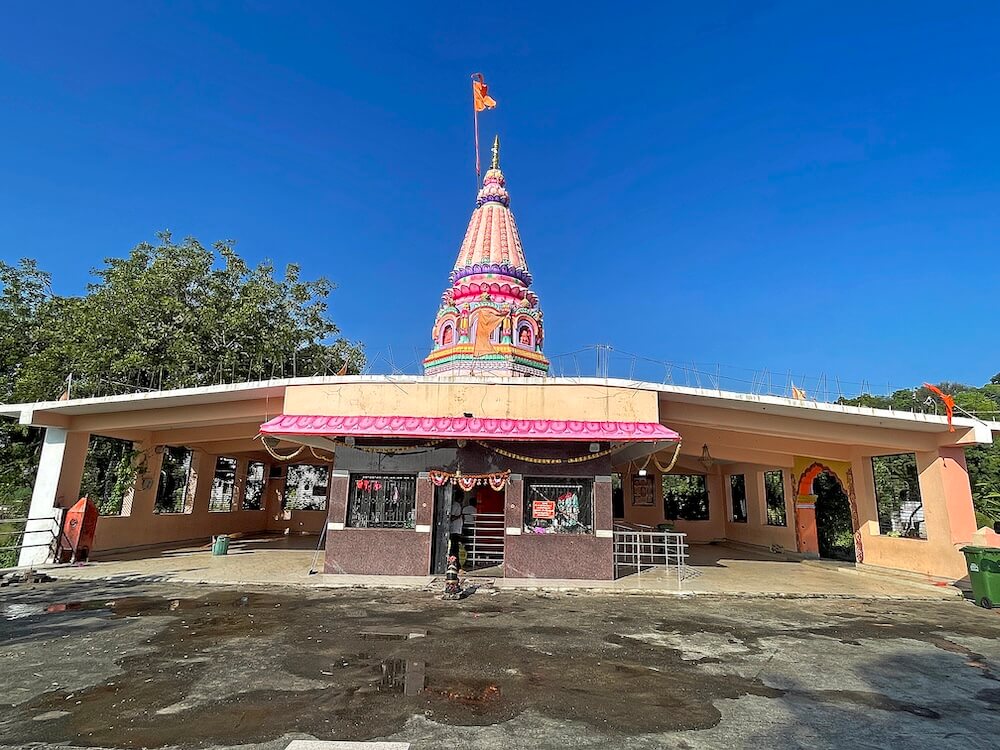
The structure of the temple is simple and consists only of a sanctum sanctorum. Queue management has been arranged in front of the temple entrance by installing stainless steel safety railings. There is a railing around the sanctum sanctorum. There are pillars in the railing, upon which there are beams and a roof. Brass bells and a glass illuminated chandelier are hung from the ceiling. There are circular patterns on the ceiling. There are floral carvings on the pillars. Iron meshes are installed between the railing and the ceiling. In the center of the temple on the ground is the Swayambhu stone idol of Ganesh. This vermilion-adorned idol is in its natural form; the idol is about five and a half feet tall and four and a half feet wide. Near the feet of the Ganesh idol is an idol of the mouse, the vehicle of Ganpati.
There is a two-tiered spire on the roof of the temple. In the first octagonal tier below the spire, there are eight niches containing Ashtavinayak sculptures. The second tier of the spire is circular and tapering, with pillar carvings on it. Both tiers of the spire are separated by a lotus petal circle. At the top of the spire, there are two amalakas placed one above the other, upon which there is a pinnacle and a flag.
Shri Ganesh Jayanti and the ten-day Parthiva Ganeshotsav in the month of Bhadrapada are the main annual festivals here. A fair is held at the temple on the Sankashti Chaturthi of every month. All festivals such as Chaitra Padwa, Dussehra, Diwali, Kojagiri Purnima, and Kartik Purnima are celebrated in the temple. During all festivals, thousands of devotees from the surrounding area come for the darshan of the deity and to fulfill their vows. Sweets and modaks are offered to the deity. During festivals, programs like bhajans, kirtans, and music are organized in the temple.
Navratri, Maha Shivratri, Annual Temple Jatra & Deepotsav
Compare and book flights, secure top-rated local hotels near the temple, hire reliable guides, and rent cars instantly.
Extend your pilgrimage by visiting other highly sacred temples located nearby.


Add ₹999 more to unlock FREE SHIPPING!
Your sacred cart is currently empty.
Shop Photo FramesFill in your delivery details below to place your order.
Add comment