
Add ₹999 more to unlock FREE SHIPPING!
Your sacred cart is currently empty.
Shop Photo FramesThe history of Kundal village, mentioned as Kaundinyapur in mythological legends, dates back approximately 1500 years. It is stated in the Puranas that this was the capital of King Hingandev. It is also said to have been the capital of the Chalukya dynasty King Satyeshwar. In Jainism, Kundal holds the status of a pilgrimage site. Lord Parshvanath and Vardhaman Mahavir held religious assemblies on the hill here. King Vijayaditya made a donation to the Kundal Jinalaya in the year 705 AD. On this very hill of Kundal, there is an ancient temple of Veerabhadra, the commander of Lord Shiva’s army.
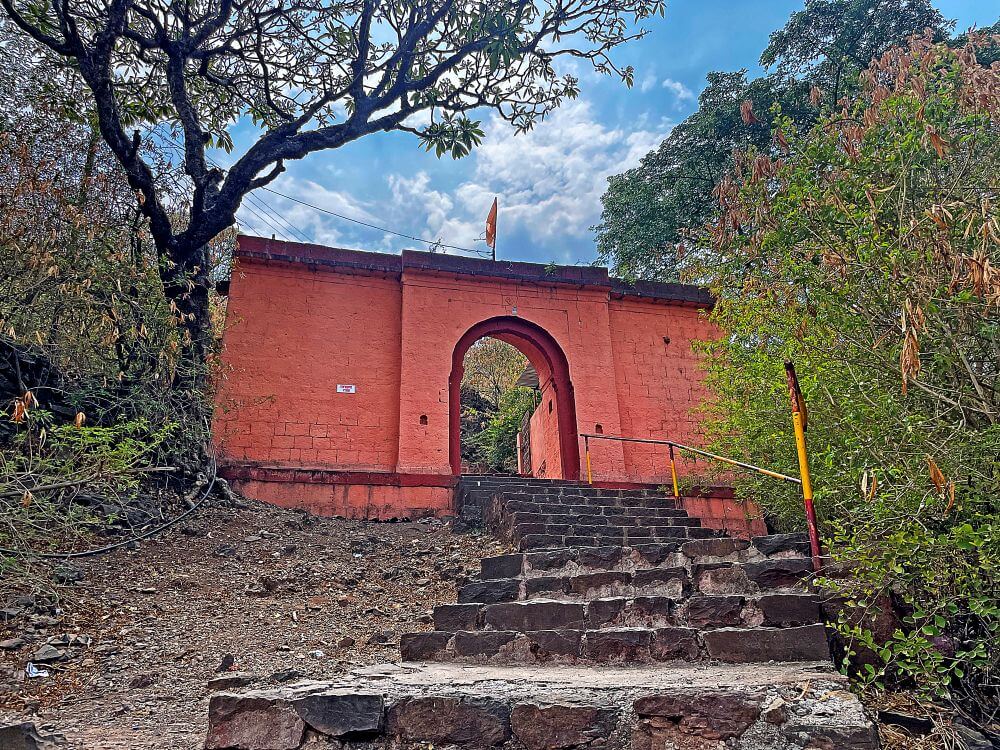
It is said that this temple dates back about 900 years. The legend of the temple is that Satyappa Lupne of Kundal was a supreme devotee of Lord Veerabhadra of Yadur. He used to visit the Veerabhadra temple in Yadur for darshan every new moon day. Later, due to old age, it became impossible for Satyappa to travel to Yadur for darshan. At that time, he prayed for the Lord to come to the hill at Kundal for his sake, He prayed thus to the Lord. Pleased by Satyappa’s supreme devotion, Veerabhadra resided at this place according to his wish. Thereafter, Satyappa built a temple of Veerabhadra here. The descendants of Satyappa Lupne carried forward this tradition of devotion. In the year 1870, Basappa, a descendant of Satyappa Lupne, spent 25000 rupees to construct two grand gateways on the stairway path of this temple.
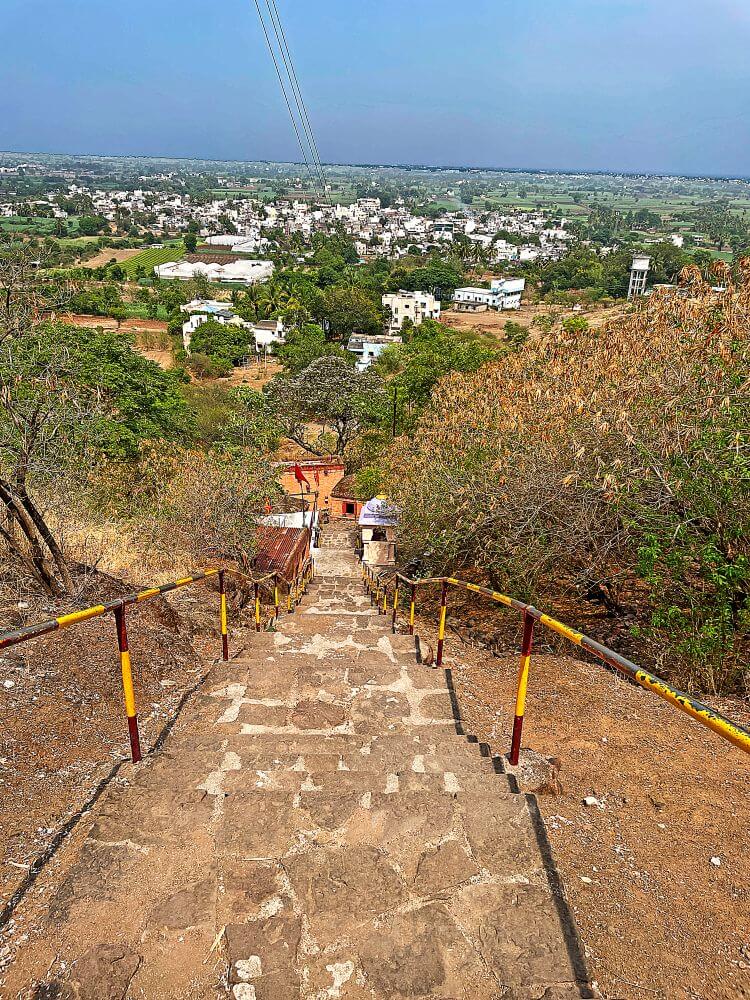
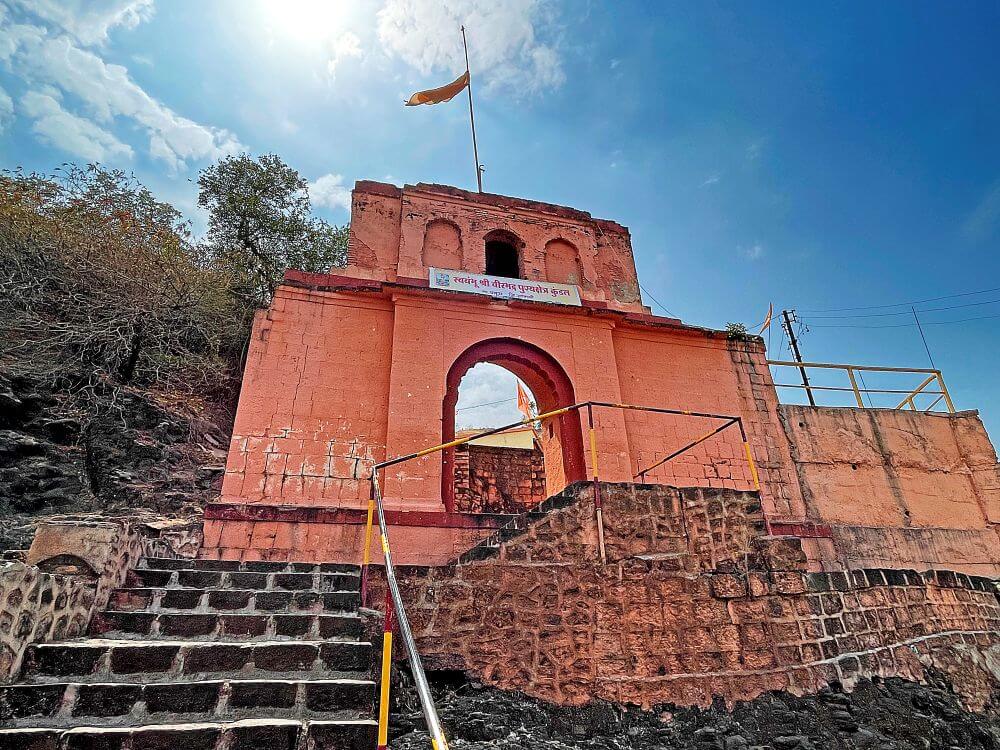
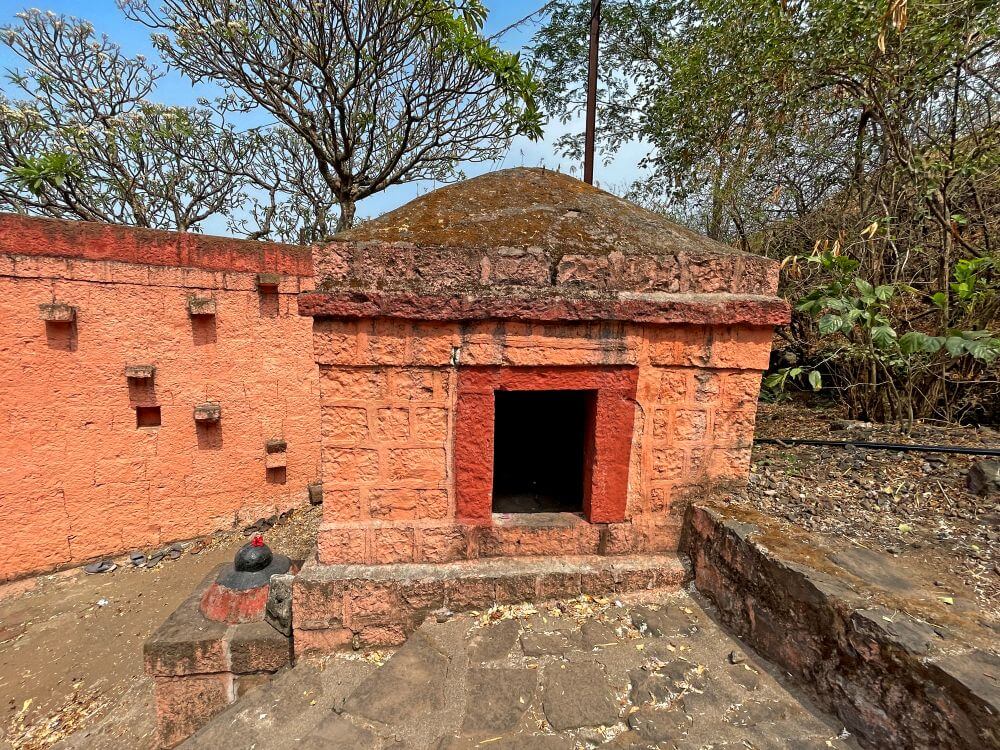
This temple is situated in a cave atop a mountain. There is a paved road leading to the foothills of the mountain. From the foothills to the temple, there is a staircase path consisting of approximately one hundred and fifty steps. After climbing twenty steps from the base, one reaches the first welcome gate of the temple. This welcome gate, which features a semicircular arch, has lamp niches built into the walls on both sides. Beyond the welcome gate, on the right side of the staircase path, is a semi-open temple of Mahadeva. Inside the temple, there is a Shivlinga on the ground and a Nandi facing it. In another temple located on the left side of the staircase path, there is another Shivlinga.
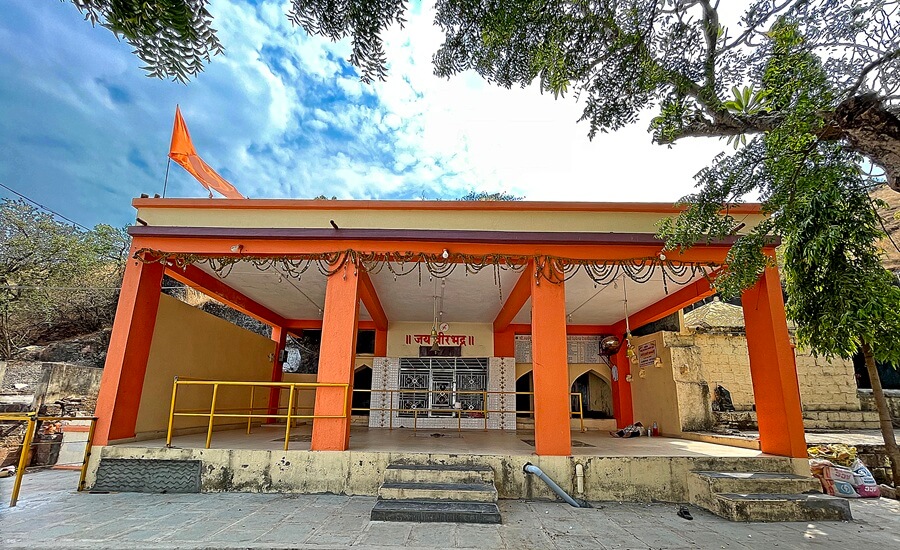
Further ahead is the Samadhi of Satyapa Lupne, a devotee of Virabhadra. Beside the Samadhi is a temple of Maruti. Inside the temple is a self-manifested stone idol of Maruti Raya, and on the wall behind it, eleven idols of Maruti are carved onto a single monolithic slab. At the final stage of the stairway path is the two-storied entrance gate of the temple. The entrance features an arched gateway and three niches in the inner walls. On the upper floor is the Nagarkhana. To the left of the entrance is a natural fortification of the mountain, and to the right is a stone wall of the fortification. To the left of the entrance is a freshwater pond. From here, one ascends a few steps to reach the paved courtyard of the temple. Further ahead is the Sabha Mandap of the temple. To ascend to the Sabha Mandap, which is at a higher level than the courtyard, there are three steps in the center and two steps each on the left and right sides. The Sabha Mandap has four pillars in the front, with beams resting on the pillars and a roof over the beams. In the center of the floor of the Sabha Mandap is a Kurma sculpture. The construction of the Sabha Mandap is of recent times.
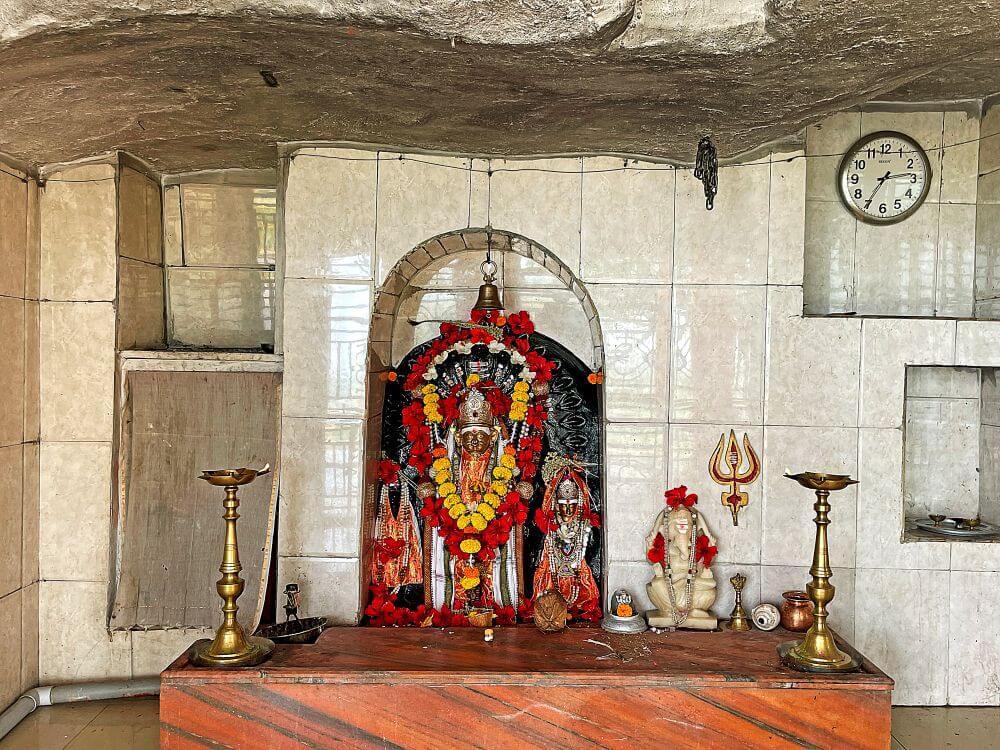
Further ahead, in the cave of the mountain, lies the sanctum sanctorum. Inside the sanctum, on a diamond-shaped pedestal, stands the four-armed idol of Veerabhadra carved from black stone. Above the deity’s head is a canopy of a five-hooded serpent; in his hands, he holds a trident, a sword, a bow, and a staff, and around his neck are garlands of skulls. On the right and left sides of the deity are the idols of the Shaktis. A silver crown adorns the head of the idol. On the right side of the diamond-shaped pedestal is a marble idol of Ganesha. The circumambulation path of the temple passes through the cave. Along the sides of this circumambulation path are reservoirs of fresh water.
Beside this temple are the temples of Goddess Danamma Devi and Lord Mahadeva. Adjacent to the temple, there are storage chambers within the caves. A short distance away, in a cave, lies the Samadhi of Brahmanand Swami, with water reservoirs nearby. The entire hill area is home to numerous freshwater springs and cave chambers. The walls in front of some of these cave chambers are constructed from stone. In ancient times, many ascetics performed penance and spiritual practices within these chambers. The main annual fair of the deity is celebrated with great enthusiasm on Kartik Amavasya. During this time, the divine wedding ceremony of the deity takes place. The deity’s palanquin departs from the house of the Lupane family in the village to circumambulate the village, and after the conclusion of the ceremony at the temple, it is returned to the Lupane household on the third day. The honor of managing the deity’s palanquin and worship has been held by the Lupane family for generations. The right to perform the rituals and worship belongs to the Jangam community. The Harade and Bidve communities hold the honor of carrying the deity’s ceremonial torch.
During the annual festival of the Deity, programs such as Bhajan, Kirtan, music, discourses, night-long devotional singing, Gondhal, and Mahaprasad are organized at the temple for three days. During the pilgrimage, thousands of devotees from the surrounding areas come to have Darshan of the Deity and to fulfill their vows. Mahaprasad is organized at the temple every Amavasya. This tradition has been continuing for the past one hundred years.
This sacred temple stands as a testament to deep spiritual devotion, ancient architectural grandeur, and rich local cultural traditions.
The sanctum sanctorum houses the divine idol consecrated according to ancient Vedic traditions, surrounded by serene courtyards and traditional temple architecture.
Navratri, Maha Shivratri, Annual Temple Jatra & Deepotsav
Compare and book flights, secure top-rated local hotels near the temple, hire reliable guides, and rent cars instantly.
Extend your pilgrimage by visiting other highly sacred temples located nearby.


Add ₹999 more to unlock FREE SHIPPING!
Your sacred cart is currently empty.
Shop Photo FramesFill in your delivery details below to place your order.
Add comment