
Add ₹999 more to unlock FREE SHIPPING!
Your sacred cart is currently empty.
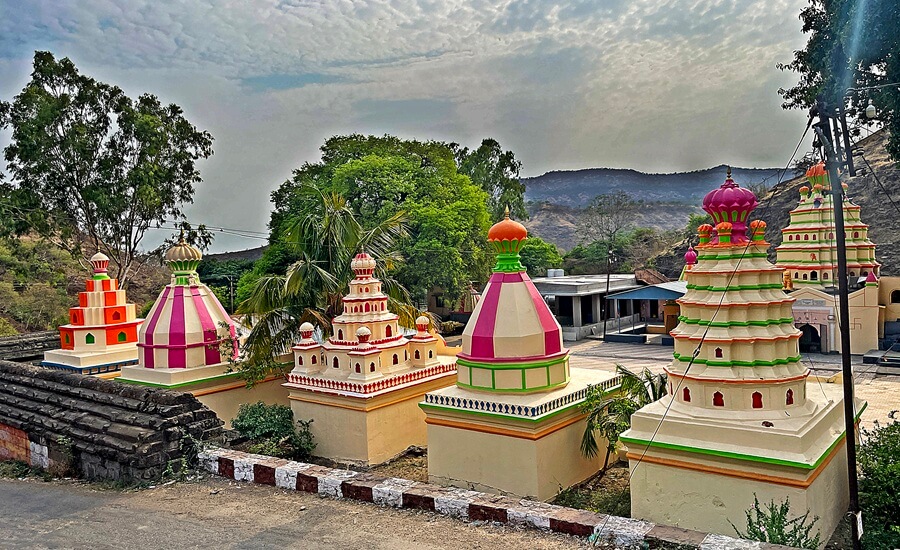
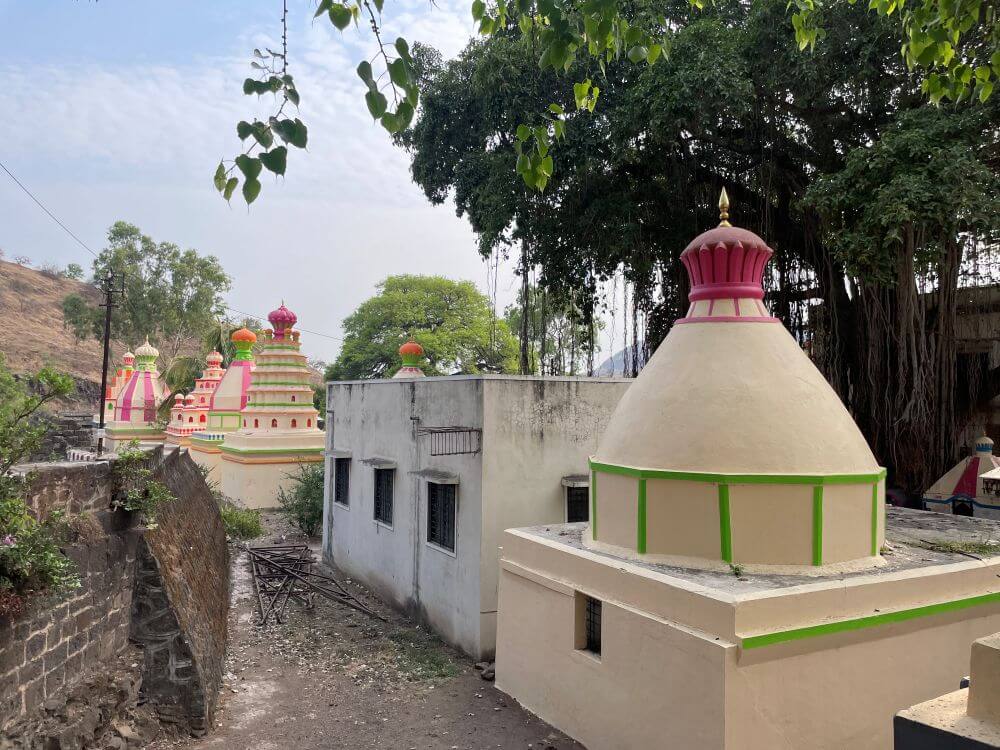
Shop Photo FramesIn the Sahyadri mountain ranges, the existence of a sea is simply impossible. However, a sea is not merely a reservoir of saltwater. Some freshwater bodies have also been referred to as seas. A prime example of this is the freshwater lake in Israel, which is addressed as the Sea of Galilee. In this sense, it is said that the perennial freshwater ponds located at Devrashtre in Kadegaon taluka were referred to as Sagar or Samudra, and the Mahadeva here was named Sagareswar. The unique feature of this place is that there are as many as ૪૮ small and large temples within the premises of this temple.
The legend regarding the Sagareshwar Temple states that King Satyeshwar, the ruler of the land of Kaundinyapur (Kundal), once went to the Ambika region for a hunt. While pursuing his prey, he entered a dense forest. At that time, he became thirsty. While searching for water, he saw Sage Sumitra. He asked the sage for water, but as the sage was in a state of deep meditation, he did not hear the king’s plea. Feeling that the sage was ignoring him, the king became angry. He threw insects onto the sage’s body. This interrupted the sage’s penance, and in his fury, he cursed the king, saying, “Insects shall infest your body.” Upon hearing this curse, the king was filled with remorse. He begged for forgiveness. The sage then told him that the insects would infest his body only at night, and they would disappear during the day.
Saddened by the curse, King Satyeshwar returned home. From that night onwards, worms began to appear in the King’s body every day. A few days later, the King went to the same forest again for hunting. There, he felt thirsty. Suddenly, he saw water seeping through the rocks. He washed his hands and face and drank that water. He drank it. That night, insects did not fall upon his hands and face. Seeing this, the Queen understood everything. She told him to bathe in the water of that spring. Satyeshwar went there, constructed a large reservoir, and bathed in that water. Thereby, he was freed from the curse. He wondered where this divine power in the water came from. Then, the sages told him that this water flows from the matted locks of Shankara.
The legend mentioned in the ‘Sangli District Gazetteer’ (1969) provides an explanation for the name Samudreshwar. It states that once, Lord Shankara slew a gigantic sea demon named Jalandhar. Overjoyed by this, the Sea God prayed to Lord Shankara, requesting that He reside at the very place where he would ceremoniously install a Shiva Linga. Lord Shankara accepted this request. The Shiva Linga installed here by the ocean came to be known as Sagareshwar. At that time, a small stream of the Ganga flowed from the matted locks of Lord Shankara. This is the very spring that was discovered by King Satyeshwar.
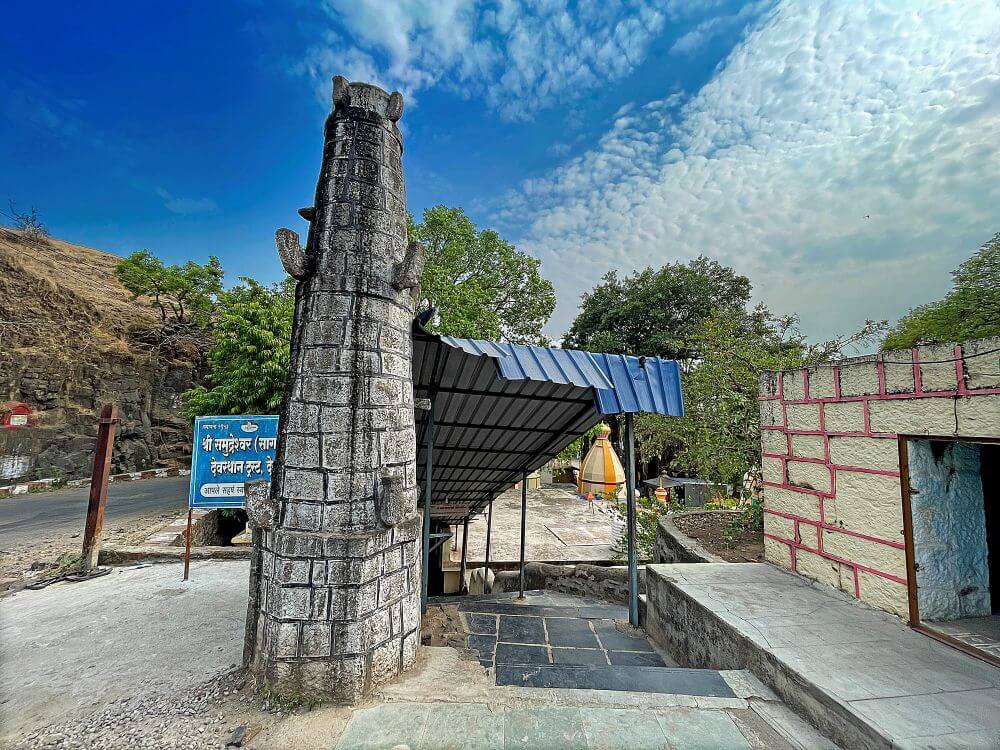
The Sagameshwar temple complex is situated on the threshold of the Sagameshwar Sanctuary on the Tasgaon-Karad road. One enters the temple courtyard through an archway adjacent to the road. Upon entering the courtyard, the samadhis of the priests are the first to be seen. In this ancient structure, which resembles a long row of dwellings with narrow entrances, ceilings, and walls, there are 14 independent chambers. The local villagers express the belief that these must have been meditation cells. It is still unknown exactly when these chambers were built. According to the Sangli Gazetteer, these chambers were built by King Hingandev of Kaundinyapur.
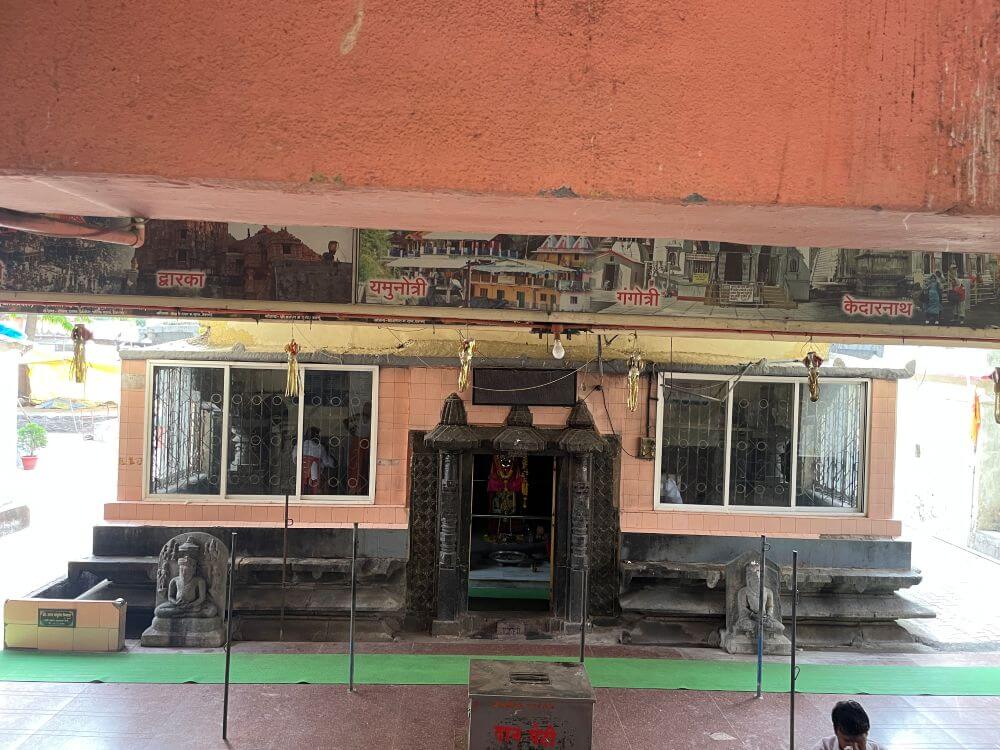
Ahead lies the main temple of Sagareshwar. There is a well in front of the temple. Legend has it that the King was liberated from a curse after bathing in this very water. Even today, it is believed that bathing in this water cures skin diseases. In front of the temple is a pavilion built in recent times. There are steps to descend into the pavilion, which is situated at a level lower than the courtyard. On both sides of this pavilion There are railings and pillars. In this semi-open mandapa, there are stone benches (kakshasanas) on both sides for devotees to sit, leaving a circumambulation path. Ahead lies the entrance to the sabhamandapa. The door frames are adorned with intricate carvings, and an image of Lord Ganesha is carved on the lintel (lalatabimba). On both sides of the entrance, there are ornate pillars, and the arch above them features sculptures of shikhara. There is a moonstone (chandrashila) at the threshold. On both sides of the entrance, leaning against the facade walls, are two sculptures of ascetic sages.
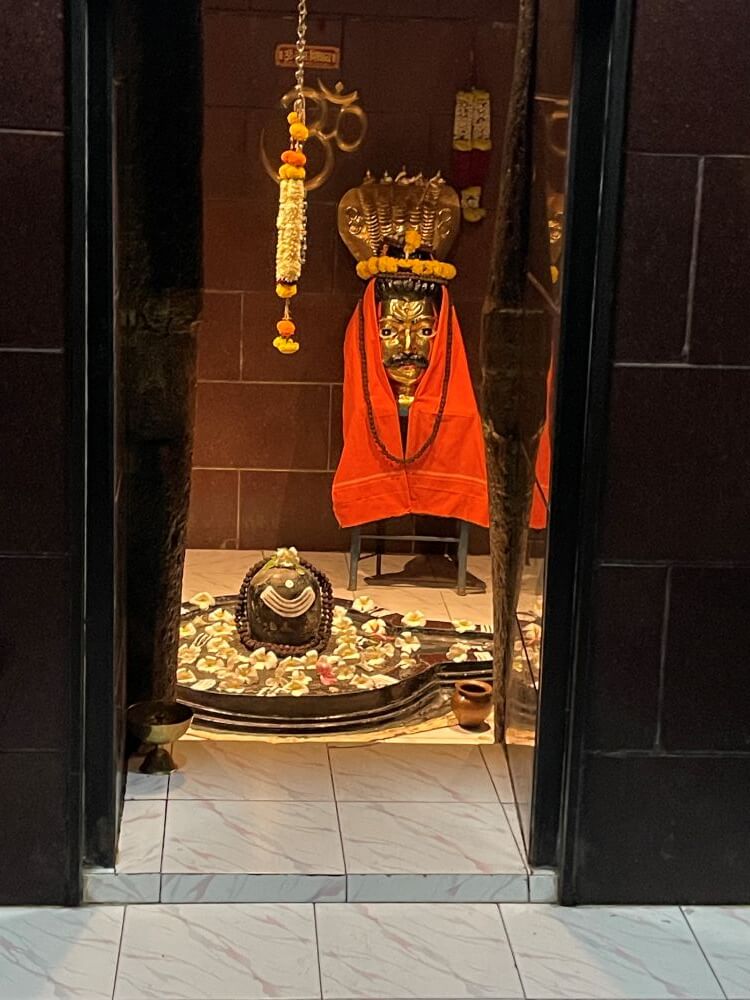
In the assembly hall, there are four rows of five ornate pillars each. The base of the pillars is wider and square-shaped. Above this, the vertical pillars are carved in various geometric shapes, including square, hexagonal, octagonal, and circular forms. In the enclosed assembly hall (Gudhamandapa), windows have been provided in the front wall to allow for light and ventilation. In the center of the assembly hall, the Utsavamurti (processional deity) of Sagareshwara is placed upon a Vajrapitha. On the pedestal behind the deity, there is an idol of Nandi carved from black stone. Further ahead is the entrance to the Antarala (vestibule). The door frames are adorned with floral and leaf carvings, and an image of Lord Ganesha is carved on the Lalatabimba (lintel). In the narrow Antarala Near the wall, on the right side, is the idol of Lord Vishnu, and on the left is the idol of Goddess Lakshmi, both carved in black stone. Further ahead is the entrance to the sanctum sanctorum. Inside the sanctum, on the ground, is the Swayambhu Shiva Linga. It is said that there is water beneath this Linga. For this reason, this Mahadeva is also known as Sagareshwar or Samudreshwar.
There is a parapet on all four sides of the temple roof. On the roof of the assembly hall (Sabhamandapa), there is a square-shaped spire (Shikhara) topped with a dome featuring lotus petal carvings and a finial (Kalasha). The roof of the vestibule (Antarala) features a hexagonal dome, topped with an Amalaka and a finial. The main spire above the sanctum sanctorum (Garbhagriha) is dodecagonal. There are tiger sculptures on all four sides of the spire. Above this, the Amalaka is adorned with lotus petal carvings, which is crowned by a finial and a flag (Dhvajapataka). There are a total of three spires on the temple roof.
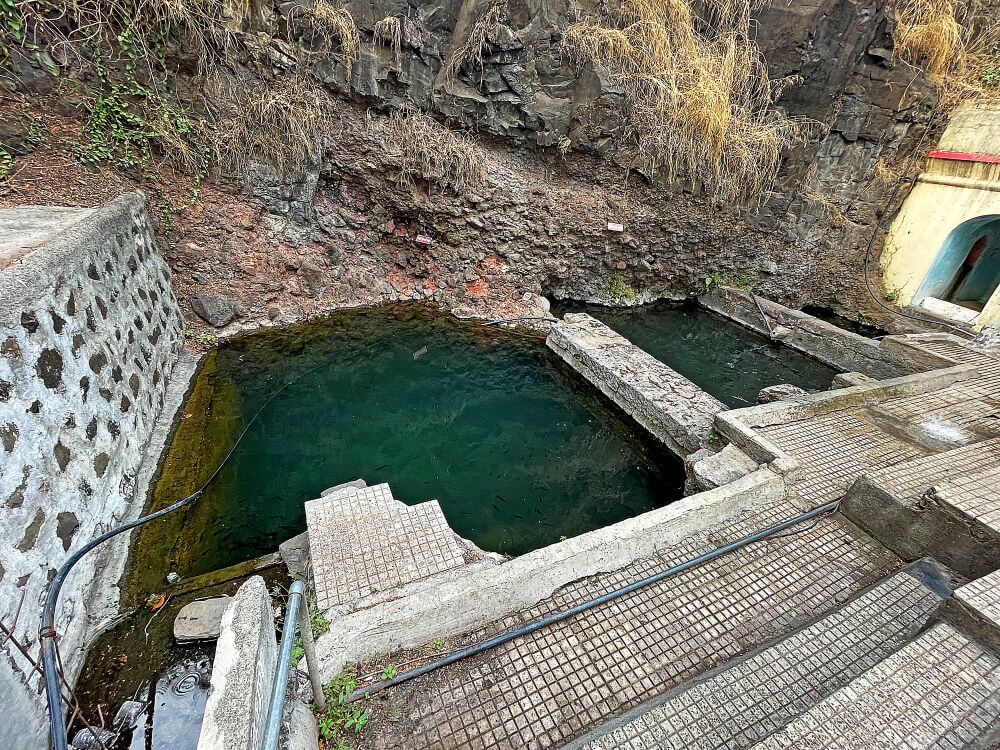
Beside the Sagareshwar temple, there are three freshwater tanks, each approximately ten feet long and six feet wide. It is said that the water in these tanks never dries up and remains at the same level throughout all seasons. Apart from the main Sagareshwar temple, there are twelve temples here representing the twelve Jyotirlingas: Somnath, Mallikarjun, Mahakaleshwar, Omkareshwar, Kedarnath, Bhimashankar, Kashi Vishwanath, Trimbakeshwar, Vaidyanath, Nageshwar, Rameshwar, and Grishneshwar. According to the Sangli Gazetteer, the Somnath temple among these was built by a king named Bhil. In front of this small temple, there is a courtyard with railings. The structure of this temple consists of a Sabhamandap (assembly hall) and a Garbhagriha (sanctum sanctorum). There is a Nandi in the Sabhamandap and a Shivling on the floor in the Garbhagriha. There are lamp niches in the temple walls. On the roof of the temple, there are railings on all sides, topped with a Shikhara and a Kalash. Additionally, there are a total of forty-eight temples in the courtyard, including Parvateshwar, Dharmeshia, Sateshwar, Rameshwar, Siddheshwar, Ambabai, Kartikaswami, Katakaswami, and Ganapati idols with left and right-turned trunks. There are a total of one hundred and eight Shivlings and some Veergal (hero stones) in the temple premises. Experts believe that the temples here, built in the Hemadpanti architectural style, belong to different periods.
The main annual festivals celebrated at the temple are Chaitra Padwa, Mahashivratri, and the fair held on the last Monday of Shravan. On Mahashivratri, the deity’s palanquin is taken out in a procession around the village. During all annual festivals, thousands of devotees come to seek the blessings of the deity and fulfill their vows. At this time, programs such as Bhajans, Kirtans, discourses, night vigils, and music performances are organized in the temple. During these times, the entire area is illuminated with decorative lights.
Near the temple is the Sagareshwar Wildlife Sanctuary. Spread over an area of eighty-six square kilometers, this sanctuary is home to animals such as Sambar, blackbuck, deer, hyenas, jungle cats, wolves, foxes, and hares. Besides the Sagareshwar temple and the sanctuary, the village of Devrashtre is known as the birthplace of the country’s former Deputy Prime Minister and Defense Minister, Yashwantrao Chavan.
This sacred temple stands as a testament to deep spiritual devotion, ancient architectural grandeur, and rich local cultural traditions.
The sanctum sanctorum houses the divine idol consecrated according to ancient Vedic traditions, surrounded by serene courtyards and traditional temple architecture.
Navratri, Maha Shivratri, Annual Temple Jatra & Deepotsav
Compare and book flights, secure top-rated local hotels near the temple, hire reliable guides, and rent cars instantly.
Extend your pilgrimage by visiting other highly sacred temples located nearby.


Add ₹999 more to unlock FREE SHIPPING!
Your sacred cart is currently empty.
Shop Photo FramesFill in your delivery details below to place your order.
Add comment