
Add ₹999 more to unlock FREE SHIPPING!
Your sacred cart is currently empty.
Shop Photo FramesThe grand temple of Shri Anjaneshwar, nestled at the foothills of a mountain to the east of Mithgavane village in Rajapur Taluka, Ratnagiri District, is one of the largest and most renowned temples in the Konkan region. With a history spanning approximately 800 years, this temple is revered as a vibrant and self-manifested deity (Jagrut and Swayambhu Devsthan) for twelve surrounding villages. The fair held on Tripurari Pournima (Kartiki Pournima) is the main attraction here. There is a unique tradition of fulfilling vows here. Accordingly, men perform a circumambulation (parikrama) of the temple by prostrating themselves (lotangan) to fulfill their vows, while women clean the palanquin path with their pallus (saree end). This is known as ‘Darbar Zhadne’ (cleaning the court).
The legend of the temple states that where the Shivling stands today, there was once a forest of Anjan trees. In this forest, a cow belonging to a Brahmin from the village would regularly release her milk onto a particular stone. To investigate why the cow released her milk there, the Brahmin went and attempted to break the stone. As soon as the stone was struck, blood began to flow from it. When the villagers excavated around it, they discovered a Shivling there. Since then, the worship (puja-archa) of this Lingam commenced. After some time, the same Brahmin built a small, dome-like shrine there. As this Shivling was found in a forest of Anjan trees, the deity came to be known as ‘Anjaneshwar’.
According to another legend, a ship belonging to a Muslim individual was caught in a storm near the village’s coast. He made a vow to Anjaneshwar that if his ship reached the shore safely, he would build a large temple. After some time, the storm subsided, and his ship reached the shore. Believing that his ship and life were saved by Anjaneshwar’s grace, he constructed a spacious temple on the site of the small, dome-like shrine. Some remnants of that original construction can still be seen in the temple today. Years later, the same Muslim individual sacrificed his life by leaping from the temple’s pinnacle. As a memorial to him, a Dargah has been built on the left side of the temple. It is known as Gaibi Pir Dargah . Along with the temple, a lamp is lit daily in this Dargah as well. Over time, the temple underwent renovation many times. Records indicate that in 1822, Narsimha Joshi from Janshi constructed the grand Sabhamandap (assembly hall) of the temple. After the renovation carried out in 1958, the temple acquired its present form. This is recorded at the temple’s entrance.
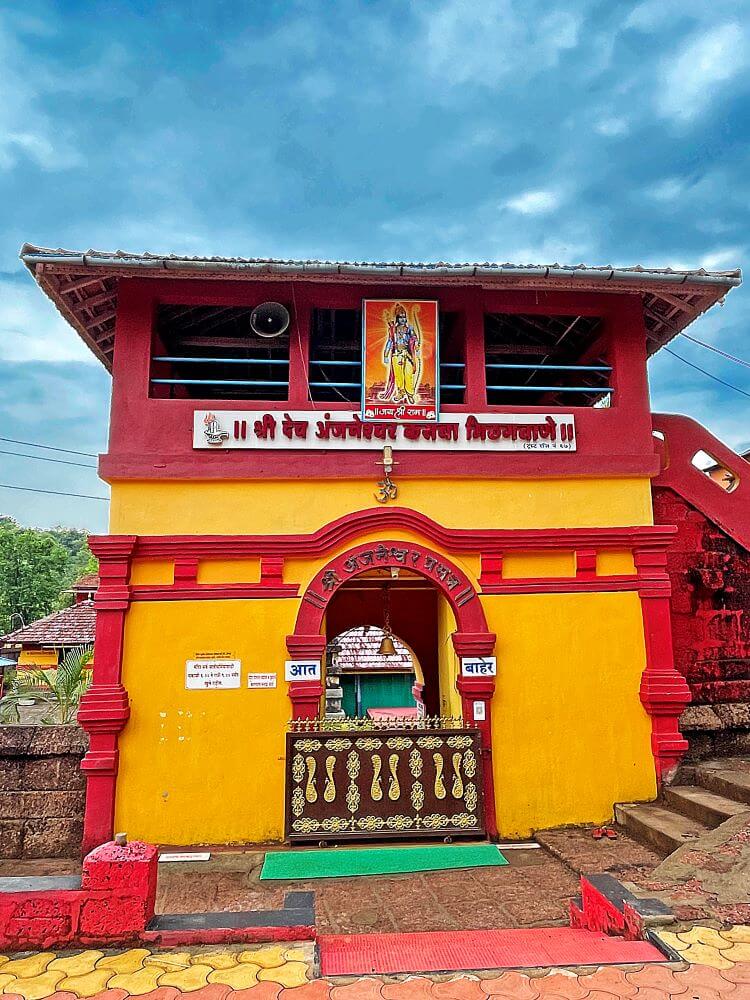
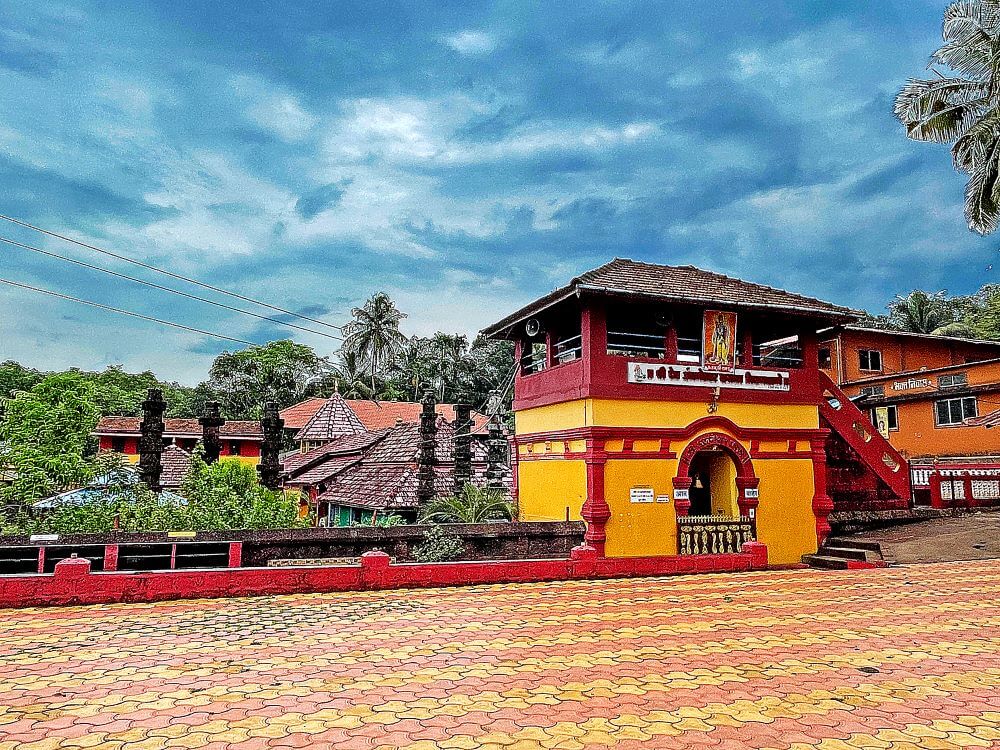
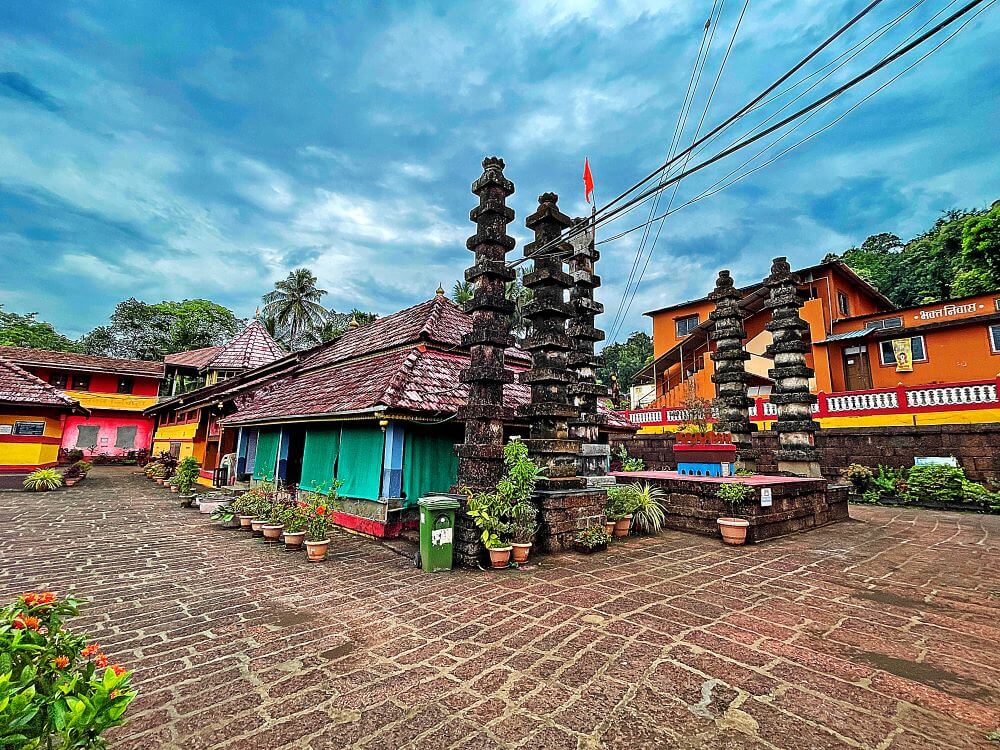
Upon entering the village, a road passing under an arch leads directly to the temple. The temple stands in a spacious area, and its architectural style shows a Goan (Gomantakiya) influence. All four sides of the temple are fortified with laterite stone walls, and the courtyard’s paving is also made of laterite stone. Above the laterite main entrance of the temple is a Nagarkhana (drum house), with a staircase leading up to it from below. From this Nagarkhana, one can have a direct view (darshan) of the deity in the sanctum sanctorum. Near the entrance and in front of the temple, there are eight tall Deepmalas (lamp towers) made of laterite stone.
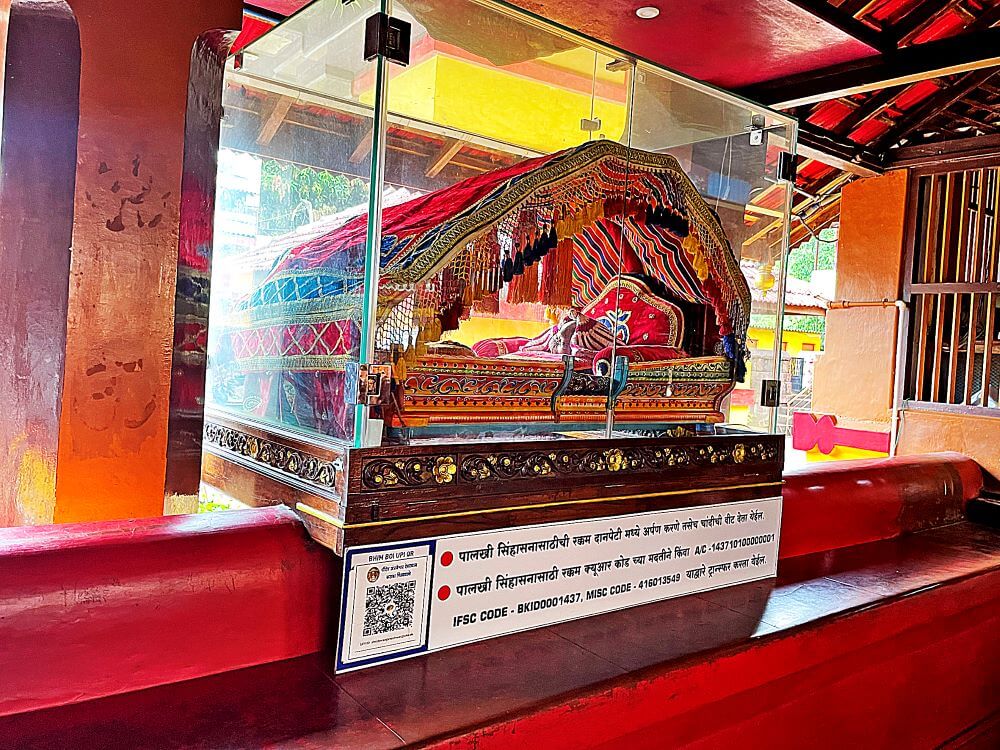
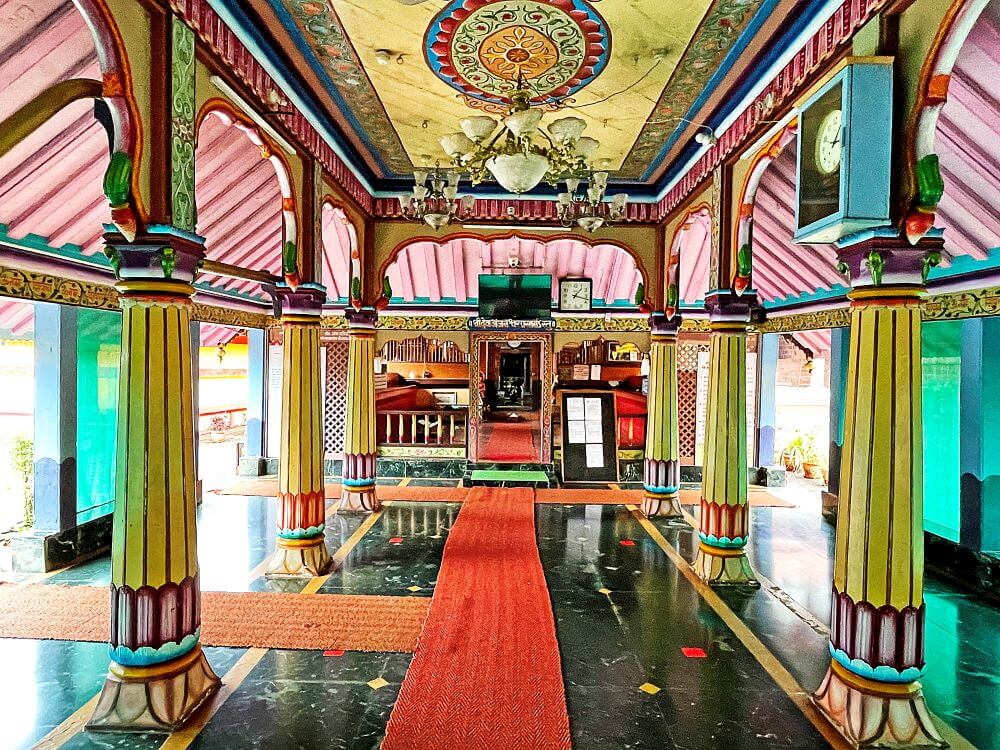
The temple’s structure comprises a Sabhamandap (assembly hall), Antaral (vestibule), and Garbhagriha (sanctum sanctorum). The Sabhamandap and Antaral feature sturdy wooden pillars adorned with sculptures of deities and other intricate artwork. These pillars are named after the Khot families of the village, and during festivals, they sit near these pillars. The open-plan Sabhamandap and Antaral are embellished with attractive carvings. One pillar bears a sculpture of Lord Brahma. In the Sabhamandap, there is a throne for the deity, where the Lord is seated during the festivals held in the month of Kartik. Additionally, there is a wooden palanquin of Anjaneshwar here. Outside the entrance to the sanctum sanctorum, there is a Nandi carved from black stone, and to the right, the deity’s brass mask and a five-headed serpent hood (Nagphana), used during festivals, are kept. A small idol of Lord Ganesha is present on the Lalatbimba (lintel) of the Garbhagriha. Inside the sanctum sanctorum is a magnificent Shivling, adorned with a silver five-headed serpent hood (Panchmukhi Nagphana). The tiled spire (shikhar) above the Garbhagriha is of a distinct style and octagonal in shape.
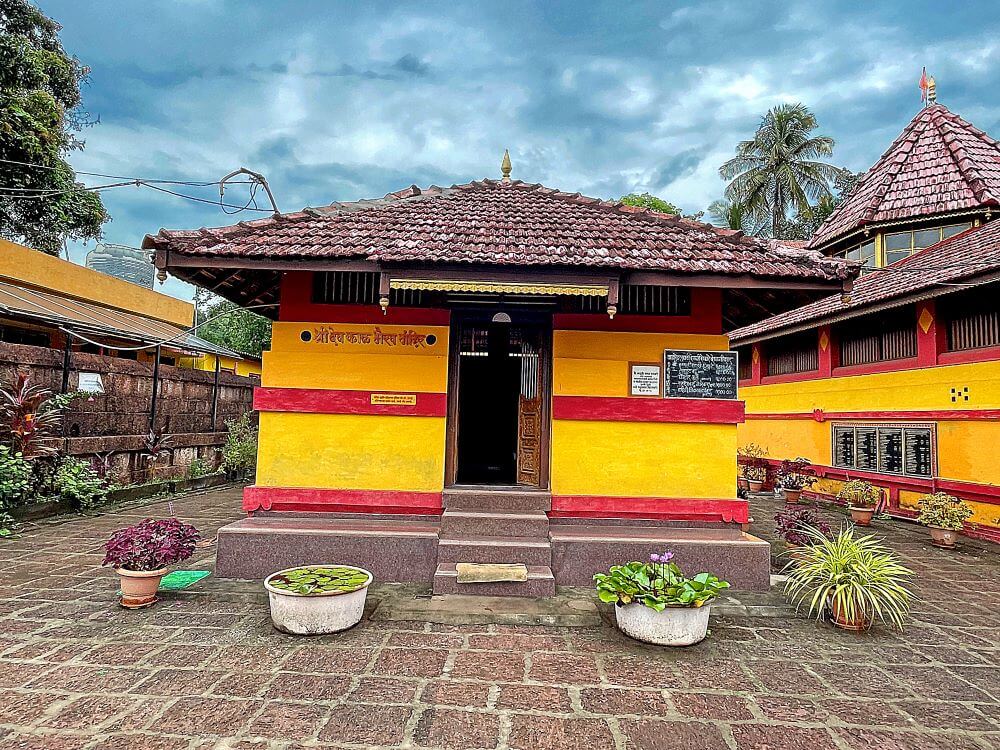
Within the temple premises, there is a small temple dedicated to Kalbhairava. The villagers believe that this Kalbhairava is the protector of the village. Coconuts are offered to him to ward off harm from reptiles. Above a step-well located in the temple courtyard, there is an idol of Lord Ganesha. Additionally, there is another small well, and devotees believe that its water cures skin ailments. The water from this well is used for the daily rituals (puja-vidhi) in the temple.
Grand festivals are celebrated here on Kartiki Pournima (Tripurari Pournima) and Mahashivratri. The Mahashivratri festival lasts for three days, while the Kartiki Pournima festival extends for five days. A large number of devotees attend the fair held on Tripurari Pournima. A festival is also celebrated here on Vijayadashami. Anjaneshwar is the family deity (Kuldaivat) of families such as Desai, Dhamdhere, Nene, Gokhale, Bhuskute, and others from this region. Many devotees from across the state come to seek the darshan of this family deity. If devotees inform in advance, religious rituals such as Abhishek (ablution), Avartane (recitations), Ekadashni (eleven recitations of the Rudra Stotra constitute one Ekadashni) Abhishek, and other ceremonies can be performed here. (Contact: Vijay Bhuskute, Mobile: 9820675085, Shekhar Phadke, Mobile: 9326621404) Near the temple, the Bhakta Niwas (devotee accommodation) provides facilities for lodging, meals, and tea/snacks for devotees. (Contact: Sadanand Lingayat, Mobile: 7262919514) Darshan of Anjaneshwar can be had here from 6 AM to 9 PM.
This sacred temple stands as a testament to deep spiritual devotion, ancient architectural grandeur, and rich local cultural traditions.
The sanctum sanctorum houses the divine idol consecrated according to ancient Vedic traditions, surrounded by serene courtyards and traditional temple architecture.
Navratri, Maha Shivratri, Annual Temple Jatra & Deepotsav
Compare and book flights, secure top-rated local hotels near the temple, hire reliable guides, and rent cars instantly.
Extend your pilgrimage by visiting other highly sacred temples located nearby.


Add ₹999 more to unlock FREE SHIPPING!
Your sacred cart is currently empty.
Shop Photo FramesFill in your delivery details below to place your order.
Add comment