
Add ₹999 more to unlock FREE SHIPPING!
Your sacred cart is currently empty.
Shop Photo FramesJalna district, located in the sacred land of Marathwada, is renowned throughout Maharashtra for its historical and spiritual heritage. Situated in the northeastern part of this district, Jafrabad taluka is famous for its ancient temples and its distinctive chili production. In the village of Konad within this taluka lies the ancient and ‘Jagrut’ (spiritually awakened) temple of Mother Jogeshwari Devi. This temple is a primary center of faith for thousands of devotees in the region and is considered an important link in the temple tradition of Marathwada. The fair held here on Chaitra Purnima and the procession of deity impersonations (Sange) organized on that occasion are the greatest religious and cultural attractions of this temple.
Looking at the history of Jalna district, the city of Jafrabad was named after the Jagirdar Zafar Khan. Historical references indicate that Emperor Aurangzeb had granted him a Jagir of 115 villages. Geographically, this taluka is very prosperous and fertile, as two important rivers, the Purna and the Dhamna, flow through it. The black and fertile soil here is especially famous for chili cultivation, which has given this region a unique identity. Many ancient mosques and temples still stand in this taluka as witnesses to history. Among all these, the Jogeshwari Devi temple at Konad has attained a special significance, and this temple has remained a focal point of devotees’ faith since ancient times.
The legend regarding the establishment of the Jogeshwari Devi temple is that in ancient times, a devout follower of Renuka Devi lived in Konad village. His devotion to the Goddess was so profound that he would unfailingly walk to Mahur Gad every year for her darshan. After many years of this pilgrimage, when he grew old, he found it impossible to undertake the arduous journey. Seeing the condition of her devotee, the Goddess appeared to him in a dream. The devotee requested the Goddess, “It is no longer possible for me to come to the Gad; please come to my village and reside here yourself.” The Goddess accepted this request but imposed a condition. She said, “I will follow you, but the moment you look back, I will become stationary in the form of a stone right there.” The devotee accepted this condition and started walking towards the village. Upon reaching near the village, the devotee lost his patience out of an intense desire to see if the Goddess was following him, and he looked back. Due to the breach of the agreed condition, the Goddess became installed in stone form at that very spot, and the villagers built a grand temple there.
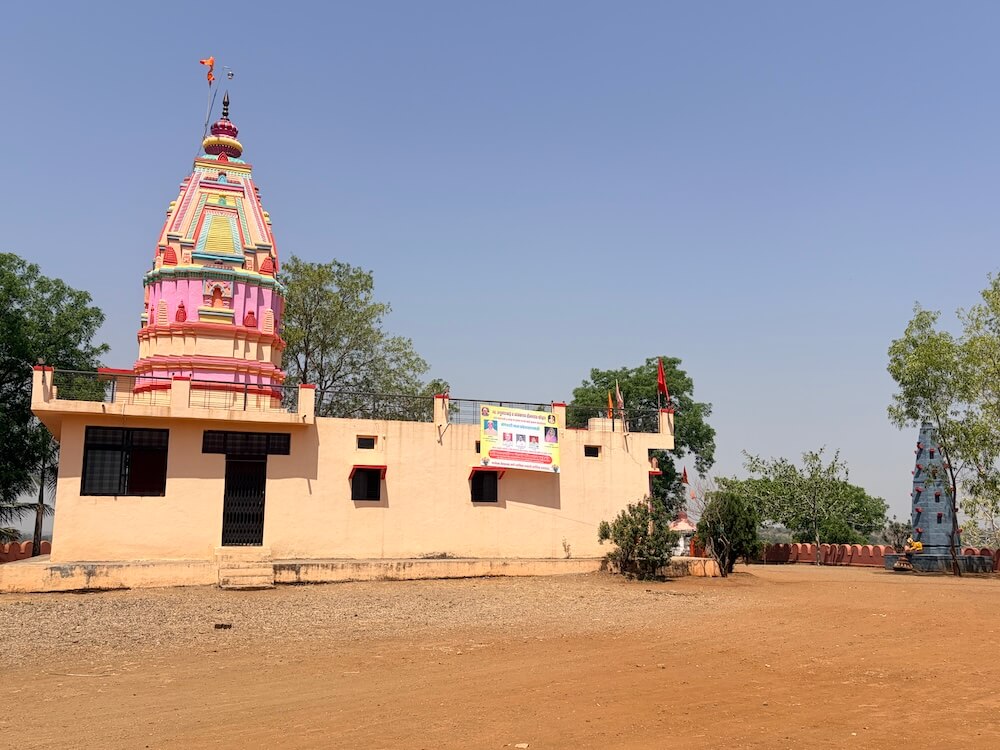
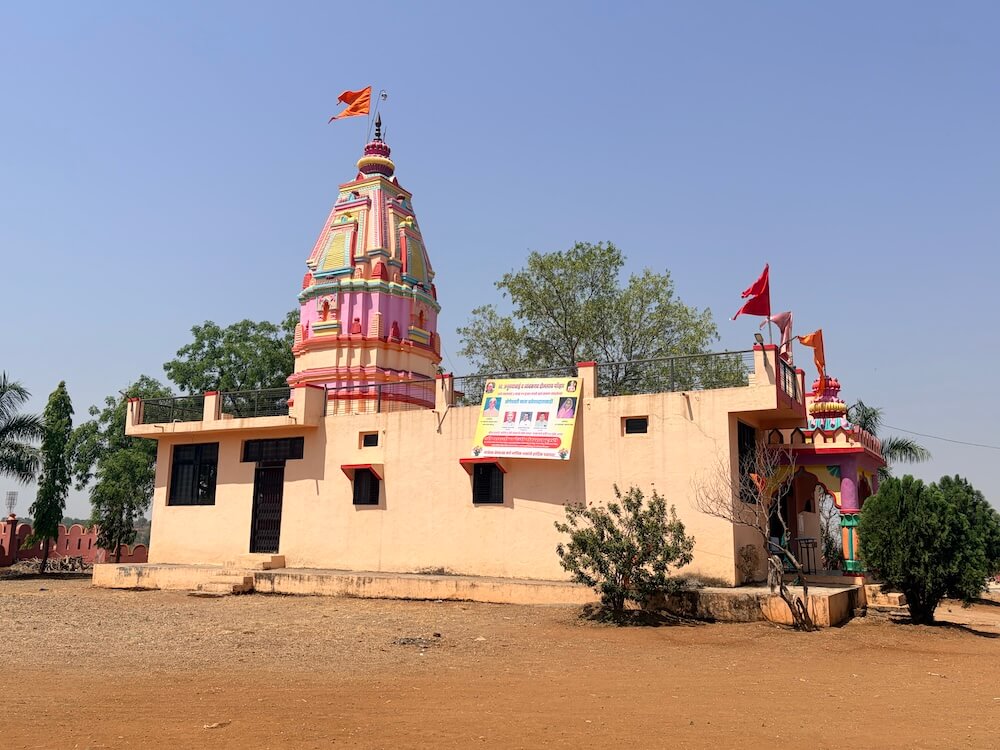
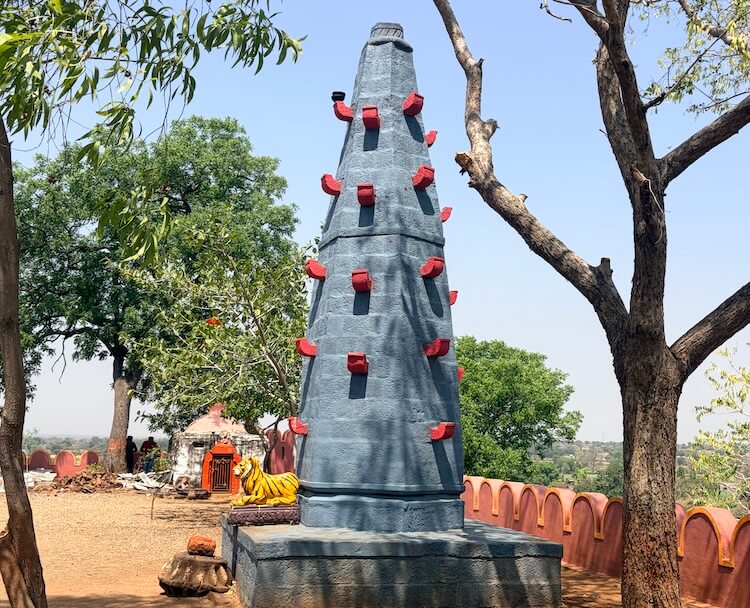
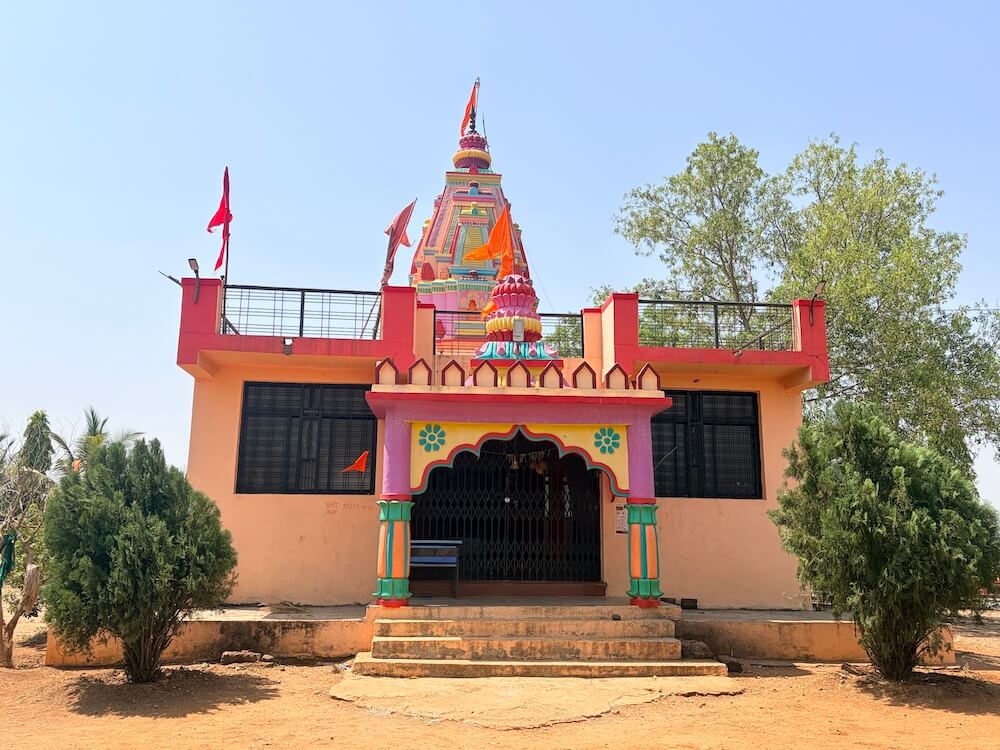
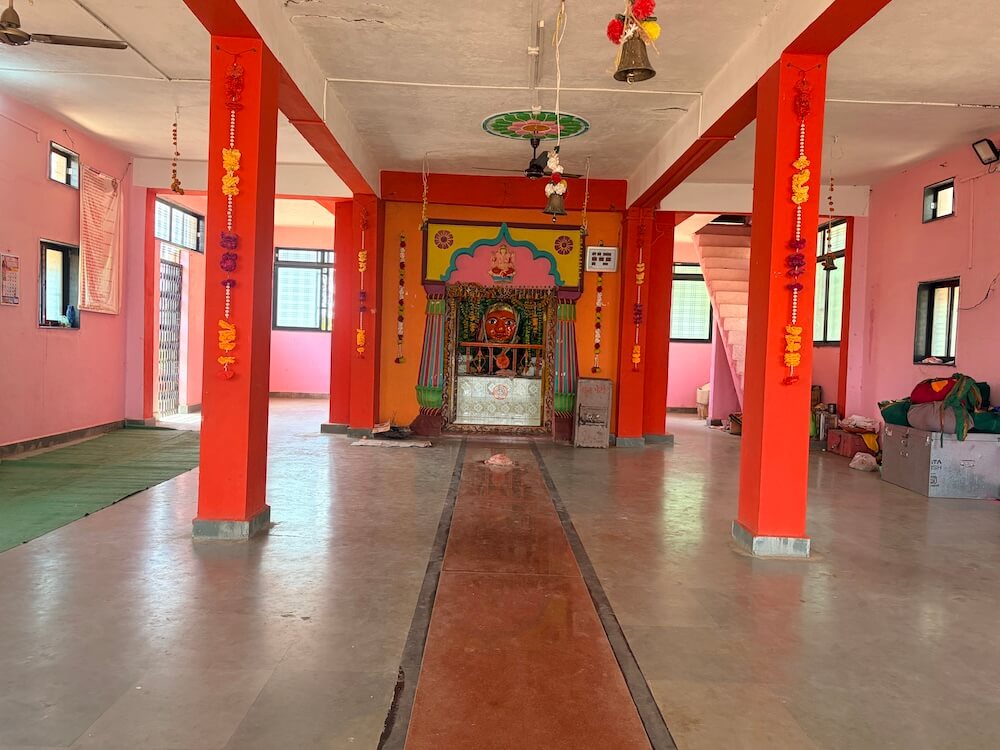
Located at some distance from the main village settlement, this temple is situated in a very quiet and scenic environment. There is a paved road leading to the temple. The fortification wall surrounding the temple has a grand entrance gate, through which one enters the spacious courtyard. In the courtyard, in front of the temple, there is a high stone platform with a circular lamp pillar (Deepmal) that catches the eye. Additionally, there is a Tulsi Vrindavan in the courtyard. The temple structure is divided into three parts: the Mukhamandapa (front porch), the Sabhamandapa (assembly hall), and the Garbhagriha (sanctum sanctorum). One enters the Mukhamandapa, which is on a high plinth, by climbing four steps from the courtyard. Although the Sabhamandapa is enclosed, there are many windows in the walls to allow light and air circulation. The Garbhagriha is designed behind the Sabhamandapa, leaving space for circumambulation (Pradakshina), and there is a tortoise sculpture (Kasav) in front of the entrance to the Garbhagriha. On both sides of the entrance to the Garbhagriha, there is beautiful pillar carving, and above it is an arched lintel (Mahirpi Toran). On both sides of this arch, lotus flower motifs are carved, and an image of Lord Ganesha is placed at the center (Lalatbimba). In the center of the Garbhagriha, on a Vajrapitha, the stone idol of Jogeshwari Devi in the form of a ‘Tandala’ (aniconic stone) is enshrined. The temple roof has a protective railing on all four sides. Directly above the Garbhagriha is a three-tiered, ornate, square-shaped Shikhara. Many deity niches are carved on this Shikhara. At the very top of the Shikhara are two Amalakas placed one above the other, topped by a Kalash.
At a short distance within the Jogeshwari temple premises, there is an ancient temple of Mahadeva. Even today, many ancient sculptures and remnants of construction are scattered in the vicinity of this temple, which proves the antiquity of this place. There is a great tradition of religious festivals in this temple at Konad. The annual fair of this temple, Chaitra Purnima, is celebrated on a very large scale. The main and special attraction of this fair is the procession of various deity impersonations (Sange). In this, many local artists participate by wearing masks and costumes of various forms like Ganpati, Maruti, and Kali Mata. Thousands of devotees from every corner of the district gather to watch this procession. Apart from this, there is an atmosphere of enthusiasm in the temple for ten consecutive days during the Sharadiya Navratri festival. During this time, special Aarti of the Goddess is performed every morning and evening. Special programs of Jagran, Gondhal, devotional songs, and Aradhi dances are organized during Navratri. Aradhi dance is an important folk art of Maharashtra, especially in Marathwada and Western Maharashtra. Devotees who worship the Goddess and have dedicated themselves to her feet are called ‘Aradhi’. Besides this, there is a rush of devotees at the temple during festivals like Mahashivratri, the month of Shravan, Makar Sankranti, Dussehra, and Diwali. Especially on Mondays, Tuesdays, and Fridays, there is a crowd of local devotees for darshan.
This sacred temple stands as a testament to deep spiritual devotion, ancient architectural grandeur, and rich local cultural traditions.
The sanctum sanctorum houses the divine idol consecrated according to ancient Vedic traditions, surrounded by serene courtyards and traditional temple architecture.

Navratri, Maha Shivratri, Annual Temple Jatra & Deepotsav
Compare and book flights, secure top-rated local hotels near the temple, hire reliable guides, and rent cars instantly.
Extend your pilgrimage by visiting other highly sacred temples located nearby.


Add ₹999 more to unlock FREE SHIPPING!
Your sacred cart is currently empty.
Shop Photo FramesFill in your delivery details below to place your order.
Add comment