
Add ₹999 more to unlock FREE SHIPPING!
Your sacred cart is currently empty.
Shop Photo FramesAlthough all four talukas of Dhule district are primarily known as drought-prone, rice cultivation is carried out on a large scale in the Sakri taluka of the western part of the district. The road from Kodaibari to Aamli is completely forested. This region, with its dense greenery and winding ghat roads, is enough to erase the label of it being drought-prone. The ancient Kanhaiya Maharaj Temple in this very village of Aamli is famous. Devotees believe that this Hemadpanti-style temple of Lord Vishnu is ‘Jagrut’ (spiritually awakened).
The legend of the temple is that, according to the wish of a devotee from Dakor in Gujarat, an idol of Vishnu appeared there. However, since the King of Mulher was a supreme devotee of Vishnu, he wished for the Lord to reside in his palace and pleaded with the deity accordingly. That night, the Lord appeared to the King in a vision and told him to bring the idol from Dakor to Mulher. However, he warned that the idol must not be placed on the ground anywhere while bringing it; if done so, He would become permanently stationed there. Following the vision, the King took the idol from Dakor in a palanquin and set off for Mulher. Further on, seeing the lush greenery of Aamli, the palanquin bearers felt like resting there for the night. They propped the palanquin between tree trunks. But when they woke up in the morning, they saw the idol on the ground. The bearers tried to lift the idol, but it would not budge. Finally, leaving the idol there, everyone went to Mulher.
Thereafter, having remained in a neglected and uninhabited place for many years, anthills grew over the idol, forming a mound. Once, when a drought struck the surrounding villages, a villager named Pavba set out with his cattle towards a village called Dang, located some distance away. Seeing a water source in Aamli on the way, he decided to stop there. As Pavba was a devotee of Hari, he was constantly absorbed in devotion. One night, the Lord appeared to him in a dream and told him to remove the idol from under the anthill and build a temple on that spot. However, Pavba expressed his financial helplessness to the Lord. Then, the Lord told him that he would find the necessary wealth to build the temple under a stone in the Dhansara mountain opposite. Following the Lord’s command, Pavba began building the temple, and it was completed in the year 1614 AD. There is also a shrine dedicated to this Pavba in the temple courtyard.
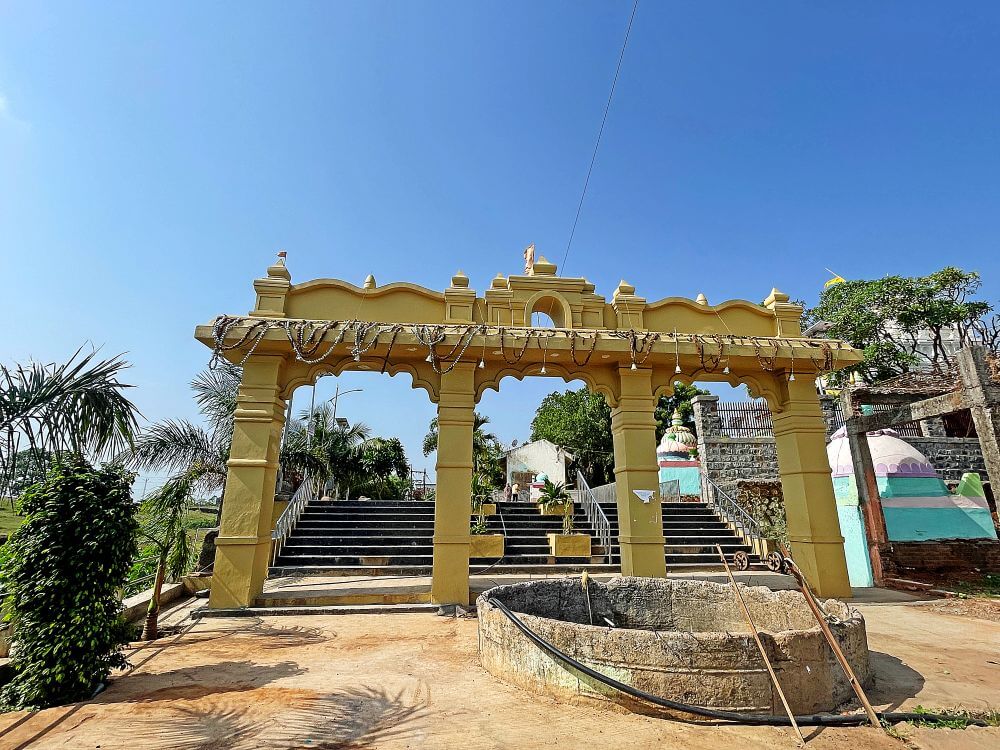
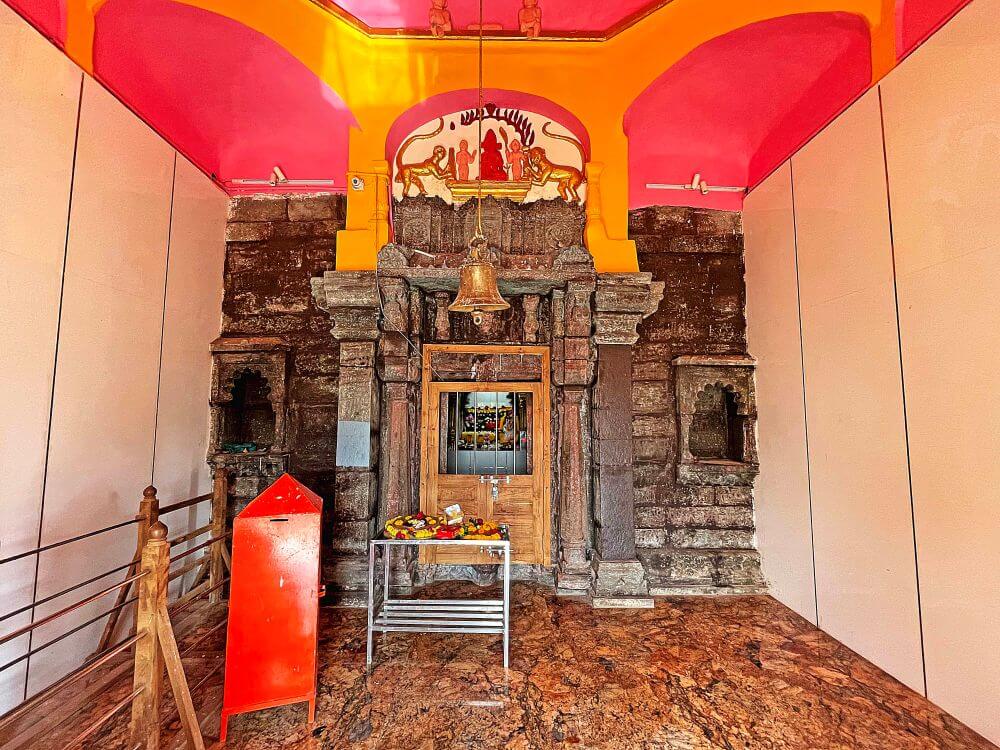
There is a welcome arch adjacent to the temple. One enters the temple courtyard by climbing the twelve steps near the arch. In this courtyard, a path for ‘Darshan’ has been created for the convenience of devotees and to manage crowds. From here, there are eight steps to reach the temple platform, which is at a higher level. The structure of this temple consists of a ‘Sabhamandap’ (assembly hall) and a ‘Garbhagriha’ (sanctum sanctorum). In the niches on the walls near the temple entrance, there are depictions of the Vaman Avatar on the left and the meeting of Krishna and Sudama on the right. Beside the niches are lamp recesses. In this enclosed assembly hall, there is an idol of a tortoise in the center.
In the assembly hall, there are niches on both sides of the front wall of the sanctum. The door frames of the sanctum are carved with floral patterns, and there is an idol of Lord Ganesha on the lintel. There are ornate pillars on the sides of the door frames. Above the lintel, there are elephant motifs, small pillars, and a balcony. In the niche on this balcony, there are sculptures of tigers and humans on both sides, with an idol of Vishnu in the center. Above the niche is an arched canopy. Near the ceiling, there are sculptures of Yakshas and Kinnaras. The front wall of the sanctum is decorated with intricate carvings.
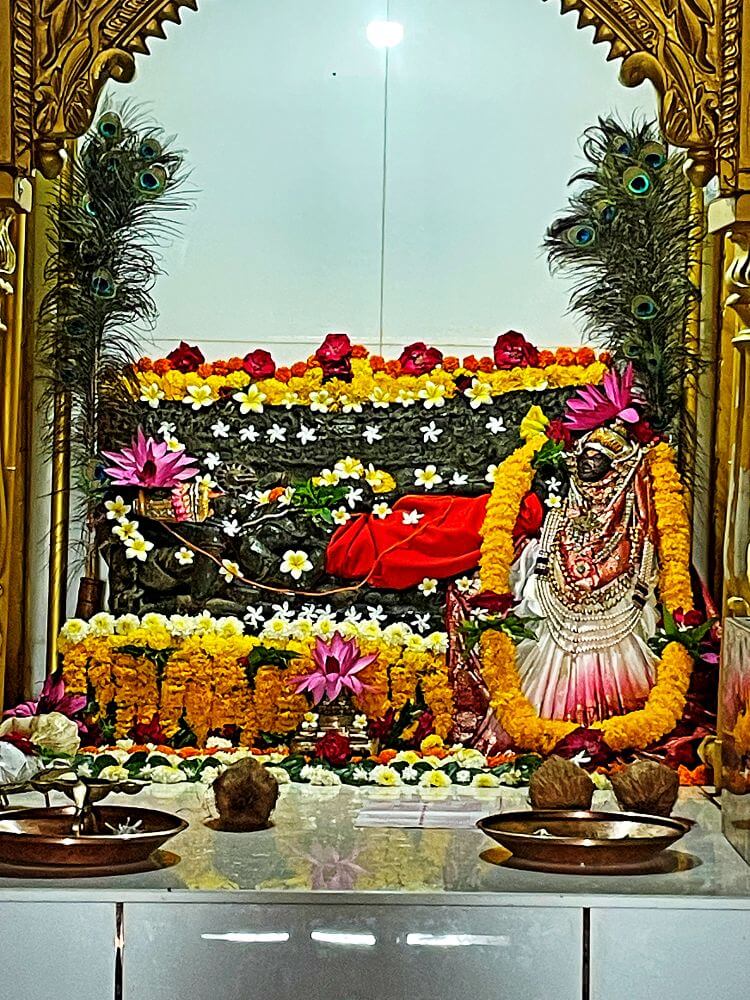
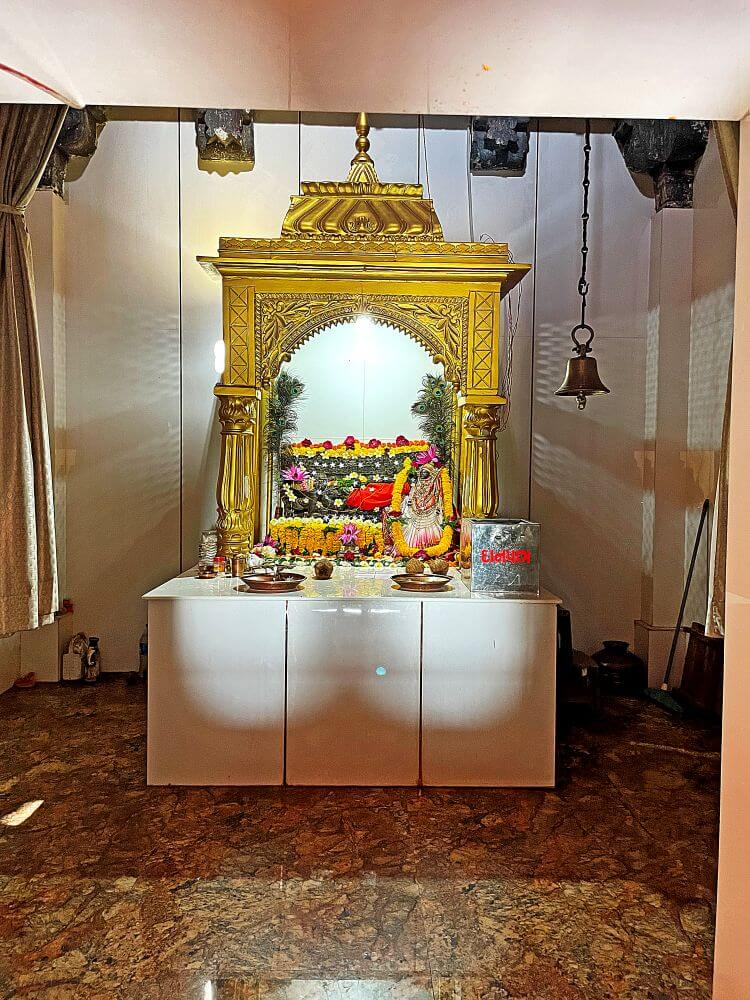
On the ‘Vajrapitha’ (throne) inside the enclosed sanctum, there is a golden ‘Makhar’ (shrine) with four ornate pillars and arched canopies. In this Makhar, there is a four-armed idol of Vishnu in black stone, in a reclining posture on the serpent Shesha. One hand of the Lord is under his head, the second hand is on his stomach, the third holds a lotus, and the fourth is in the ‘Abhaya Mudra’ (gesture of fearlessness). Lakshmi is seated at the feet of Vishnu. The ornate panels surrounding the Lord are carved with floral designs. The ceiling of the sanctum has elephant motifs on all four sides and arched canopies on the vertical pillars above them. In the center of the ceiling, there is a lotus flower carving. On the roof of the assembly hall, there is a dome-shaped spire in the center, topped with an ‘Amalaka’ and a ‘Kalash’. The sanctum’s roof has a three-tiered spire. The lower square tier has a total of twenty niches on all four sides. There are pillars at all four corners. The middle tier has twelve niches, topped by a dome-shaped spire with an Amalaka and Kalash. There are smaller spires on all four sides of the main spire, each topped with a Kalash. There are a total of 21 Kalash on the sanctum’s spire.
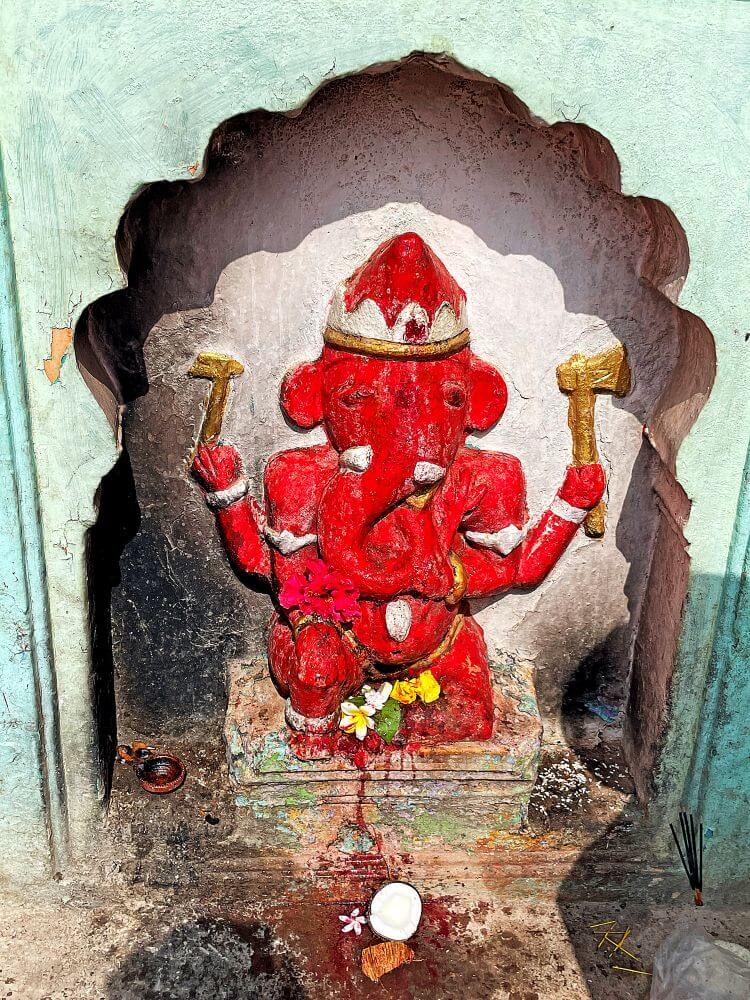
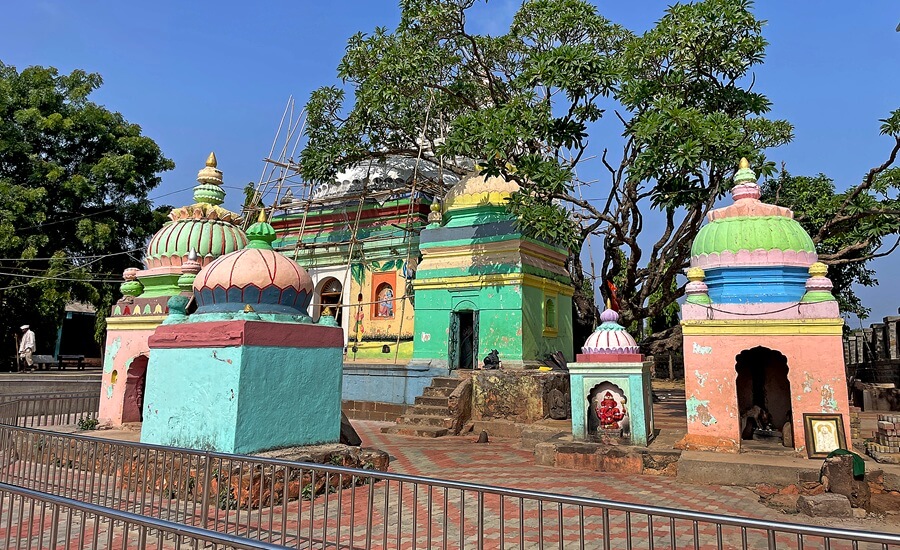
In the temple courtyard, a platform has been built around a massive tree. On this platform, there are many ancient idols and sculptures. In the courtyard, there is a Nandi on a platform and a Shiva Linga in the temple in front of it. In the courtyard, there are temples of deities such as Pavba Maharaj, Brahman Dev, Maruti, and Ganesha.
The main annual festival celebrated in this temple is Tulsi Vivah. On this day, the entire temple premises are decorated with flowers, and the wedding of Lord Vishnu and Tulsi is performed. Thousands of devotees are present on this day for the Lord’s Darshan and the wedding ceremony. On this occasion, the area takes on the form of a pilgrimage site. Apart from this, festivals like Mahashivratri, Hanuman Jayanti, Navratri, Dussehra, and Diwali are also celebrated here with great enthusiasm.
This sacred temple stands as a testament to deep spiritual devotion, ancient architectural grandeur, and rich local cultural traditions.
The sanctum sanctorum houses the divine idol consecrated according to ancient Vedic traditions, surrounded by serene courtyards and traditional temple architecture.
Navratri, Maha Shivratri, Annual Temple Jatra & Deepotsav
Compare and book flights, secure top-rated local hotels near the temple, hire reliable guides, and rent cars instantly.
Extend your pilgrimage by visiting other highly sacred temples located nearby.


Add ₹999 more to unlock FREE SHIPPING!
Your sacred cart is currently empty.
Shop Photo FramesFill in your delivery details below to place your order.
Add comment