
Add ₹999 more to unlock FREE SHIPPING!
Your sacred cart is currently empty.
Shop Photo FramesDharmapuri in Beed district was an important administrative center during the Chalukya era. One meaning of the word ‘Dharmapuri’ is ‘Yamapuri’ (the city of Yama). In the city of Yama, one’s good and bad deeds are accounted for after death. For this reason, there were many memorial sites for warriors here, and the ‘Veergals’ (hero stones) found here bear witness to this. Another meaning of the word ‘Dharmapuri’ is a court, an important office, or a royal seat. Scholars believe that there must have been an important political office in this area during the Chalukya period. It is said that the Kedareshwar temple was built here for this very reason. This ancient and famous Chalukyan-era Kedareshwar temple still stands today as a testament to history.
History scholars state that this temple, built of stone in the Hemadpanti architectural style, was constructed by the Chalukya King Vikramaditya VI in the first half of the 12th century. Excavations in this area have revealed many ancient sculptures and Veergals, leading to the estimation that there were many temples in this region in ancient times. It is said that ancient remains of temples have been used in the construction of many houses in the area. All these facts highlight the antiquity of this temple and its surroundings.
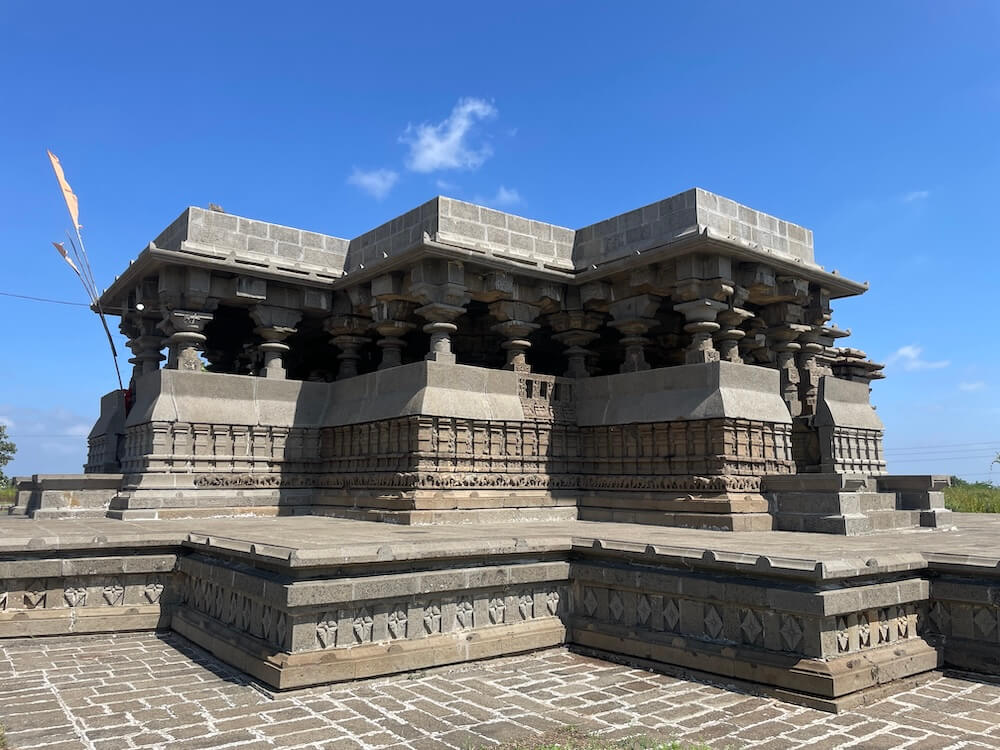
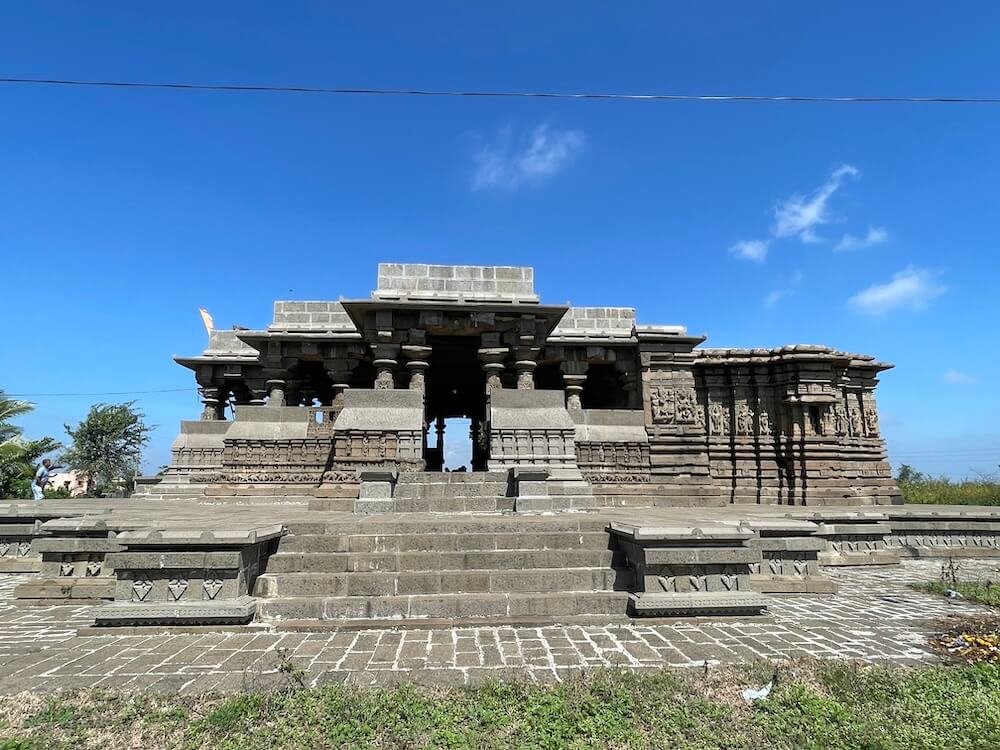
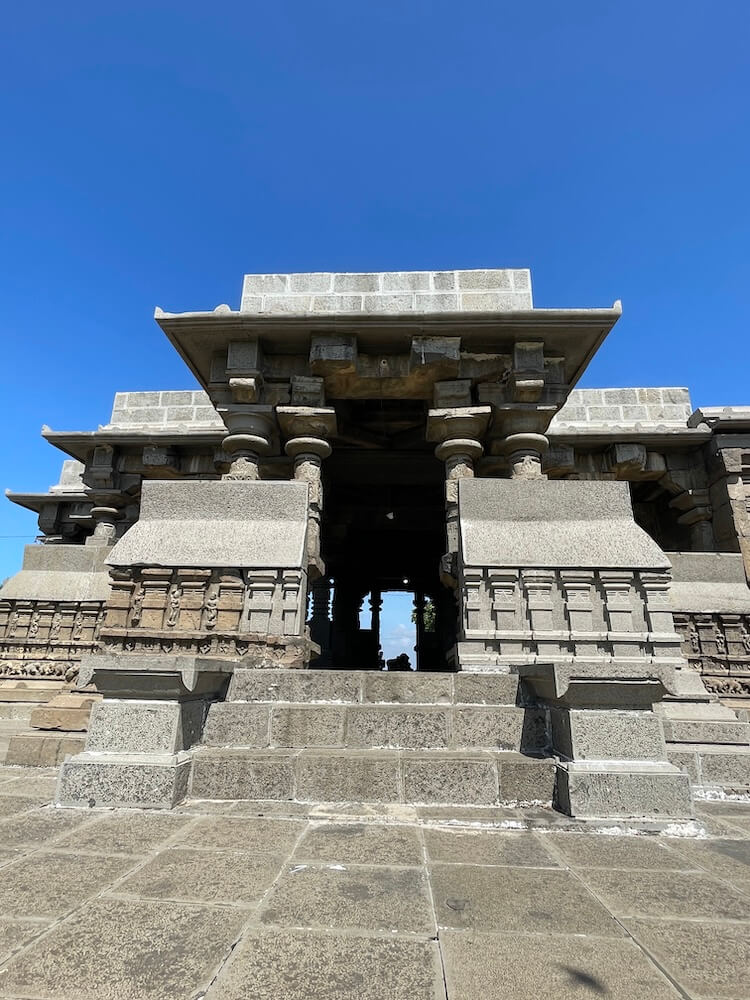
There is a paved road to reach this temple, which is located a short distance from the village. The temple is built on a platform (jagati) about four feet high. There are about five steps built of carved stone to ascend the platform. The temple structure consists of three entrance porches (mukhamandapas) on three sides, a main hall (sabhamandapa), an antarala (vestibule), and the sanctum sanctorum (garbhagriha). Each of these three entrance porches has five steps in front of it. There are safety railings and pedestals on both sides of the steps. In the entrance porches, there are railings on both sides of the entrance, which feature ‘kakshasanas’ (sloping backrests) for devotees to sit. In the kakshasanas, eight half-pillars stand on square bases. The pillar shafts feature geometric shapes such as squares, hexagons, octagons, and circles. At the top of the pillars are brackets (kani) and above them are ‘hastas’ (corbels). Sculptures of load-bearing Yakshas are carved on the hastas, supporting the weight of the roof. The ceiling here features a circular floral design. Since the archaeological department has reconstructed the entrance porch, it appears newer than the other parts of the temple. The floor of the entrance porch is a few inches higher than the floor of the main hall.
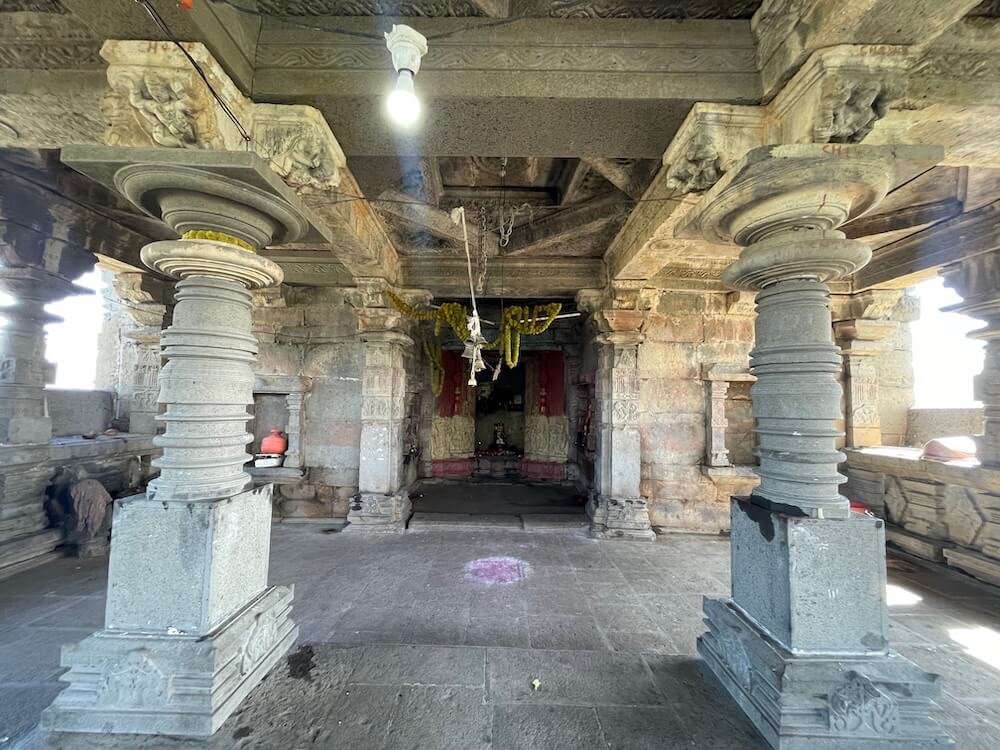
Further ahead is the main hall (sabhamandapa). The sabhamandapa is semi-open in nature. It has railings on the outer side with kakshasanas for devotees to sit. There are a total of sixteen pillars in four rows in the sabhamandapa. There are half-pillars on the outer side of the sabhamandapa, which are part of the kakshasanas. The frames and pillars of the kakshasanas in the entrance porch and the sabhamandapa are carved. The design of the half-pillars on the kakshasanas is similar to those in the entrance porch. In the center of the sabhamandapa, there are four pillars standing on carved square bases. The lower part of the pillars, about two feet high, is square. The upper part features various geometric shapes like squares, hexagons, octagons, and circles. At the top of the pillars is a bracket (kani), and above this bracket are hastas. Yaksha sculptures bearing the load are carved on the hastas. Above the hastas is a beam, which supports the roof. On the octagonal ceiling between every four pillars, there is a circular floral design in the center. On the ceiling between the four central pillars of the sabhamandapa, Saptamatrika sculptures and Kirtimukha are carved. On the floor between these four pillars, there is a ‘rangashila’ (a raised stone platform) a few inches high. Currently, there is an idol of Nandi on this rangashila. In the sabhamandapa, there are empty niches in the front walls on both sides of the entrance to the antarala.
Further ahead is the antarala, which is narrower than the sabhamandapa. In this antarala, there is one niche on the left and one on the right side. The niche on the right side contains an idol of Ganesha. The entrance to the sanctum sanctorum has five door-jambs (dwarashakhas). At the bottom of the door-jambs are sculptures of door guardians (dwarapala and dwarapalika). Above these are the creeper branch, leaf branch, floral branch, and pillar branch. There is a Ganesha sculpture on the lintel (lalatabimba), and the lintel band is decorated with leaf and flower carvings. The threshold has a ‘chandrashila’ (moonstone) on which Kirtimukha sculptures are carved. On both sides of the entrance are carved pillars, over which is the arch (torana) of the entrance. The arch features spire sculptures. In the sanctum sanctorum, there is a Shiva Linga in the center of the floor. On the pedestal (vajrapitha) against the back wall of the sanctum, there is an idol of Parvati. Beside it is an idol of a Shakti deity. Brass bells are hung from the ceilings of the sabhamandapa, antarala, and garbhagriha.
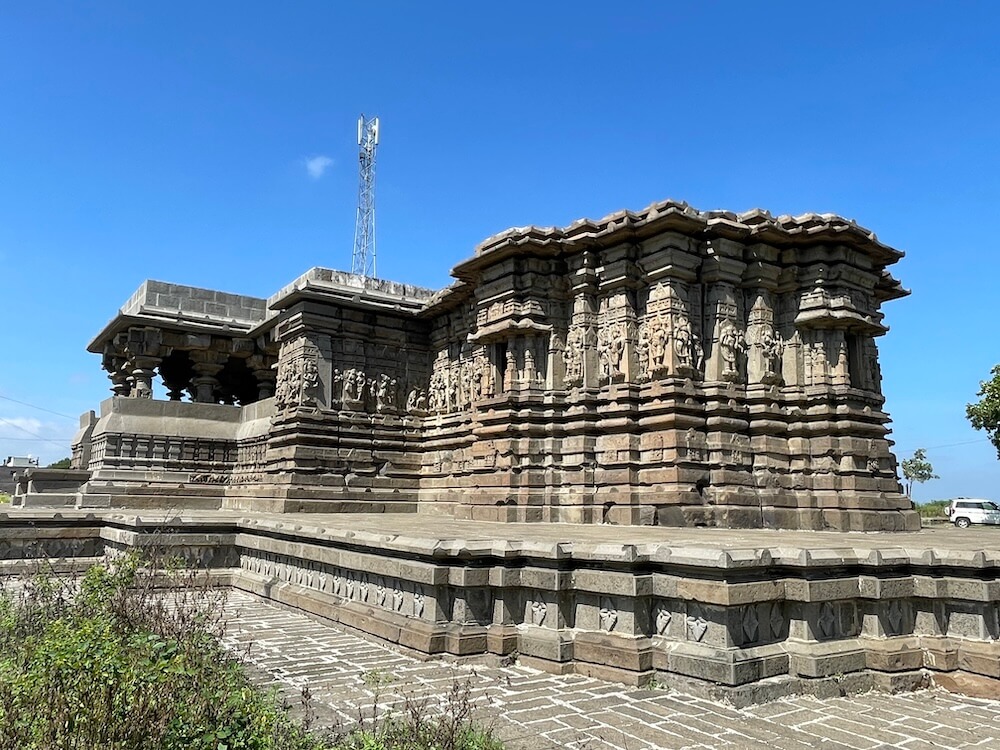
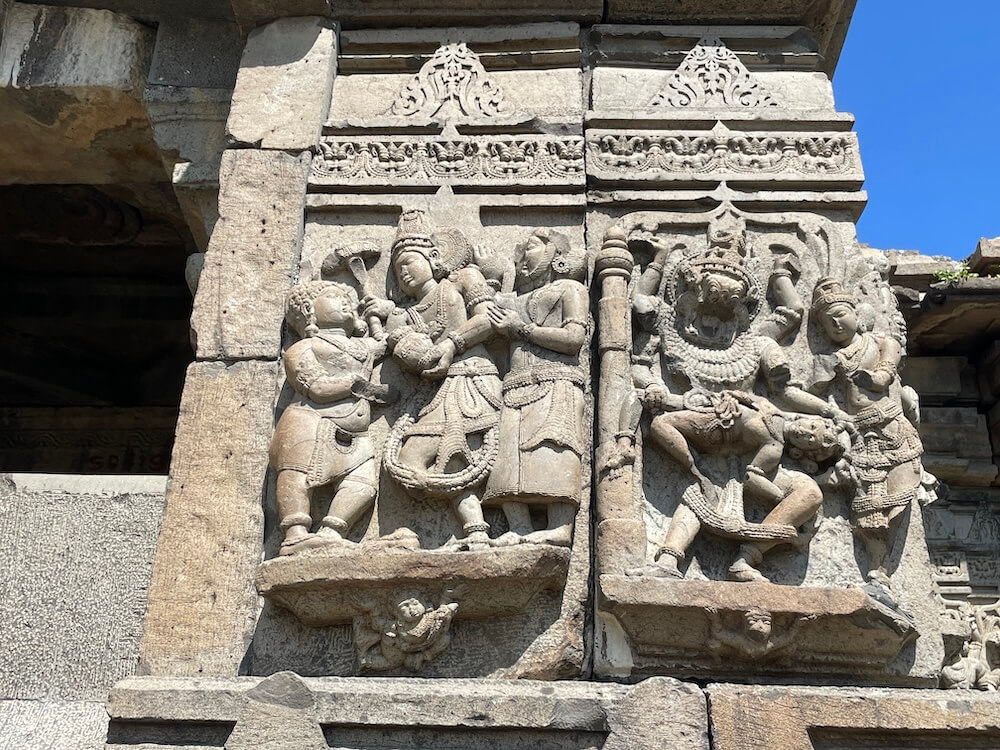
The exterior of the temple is adorned with exquisite carvings and sculptures. The temple’s base (adhisthana) features a row of elephants (gajathara) and other carvings. The wall (mandovara) features various types of Shaiva and Vaishnava sculptures. These include the Dashavatara of Vishnu, Gauri-Hara, Brahmadeva, Ugra-Kali, the four-armed Garuda, Batu Vamana, and King Bali. There are also sculptures of Surasundaris (celestial beauties) such as Shukasarika, Putravallabha, Mardala, Vishakanya, Shubhagamini, and Patralekhika, as well as some erotic sculptures. Below all the sculptures, there are Yaksha sculptures supporting the weight of the sculpture pedestals. On the mandovara, there is a unique ‘prasava’ (childbirth) sculpture. On the back side of the mandovara, there is a ‘makara pranala’ (gargoyle) with a sculpture of Ganga mounted on it.
Mahashivratri is the main annual festival celebrated here with great enthusiasm. During this time, many devotees from the surrounding areas come for the darshan of the deity and to fulfill their vows. During the festival, programs such as Maha-Abhishek, Bhajans, Kirtans, and discourses are organized in the temple. The temple is crowded with devotees on all Mondays of the month of Shravan. There is a constant flow of devotees to the temple on full moon days, new moon days, and Mondays.
This sacred temple stands as a testament to deep spiritual devotion, ancient architectural grandeur, and rich local cultural traditions.
The sanctum sanctorum houses the divine idol consecrated according to ancient Vedic traditions, surrounded by serene courtyards and traditional temple architecture.
Navratri, Maha Shivratri, Annual Temple Jatra & Deepotsav
Compare and book flights, secure top-rated local hotels near the temple, hire reliable guides, and rent cars instantly.
Extend your pilgrimage by visiting other highly sacred temples located nearby.


Add ₹999 more to unlock FREE SHIPPING!
Your sacred cart is currently empty.
Shop Photo FramesFill in your delivery details below to place your order.
Add comment