
Add ₹999 more to unlock FREE SHIPPING!
Your sacred cart is currently empty.
Shop Photo FramesIn Gujarat and Rajasthan’s rich cultural and religious tapestry, Khodiyar Mata holds a profound place of reverence and unwavering faith. The Goddess is regarded as the quintessential personification of valour, devotion and the boundless affection shared between siblings. A sacred sanctuary of this steadfast belief is the Khodiyar Mata Temple, often referred to as Khodal Dham, situated at Dediyasan in the Mehsana district. This temple has emerged as a paramount spiritual haven for countless devotees across the region.
The origins of the worship of Khodiyar Mata are generally traced back to the eighth century. According to mythological legend, during the reign of the Maitraka dynasty in the Vallabhi Empire, the Goddess was born into a Charan (Gadhvi) family. Mamadiya Gadhvi and his wife, Minalde, having remained childless, undertook rigorous penance to appease Lord Shiva. Pleased by their selfless devotion, Shiva bestowed his blessings upon them, resulting in the birth of seven daughters and one son. The son was named Meherak. Amongst the seven sisters, Janbai, the youngest, eventually attained renown as ‘Khodiyar Mata’.
Regarding her naming as ‘Khodiyar’, it is recounted that her brother Meherak (Merakhia) was once bitten by a venomous serpent. When no remedy remained to save his life, Janbai took the courageous decision to descend into the ‘Nag-lok’ (the realm of serpents) to retrieve nectar. Whilst successfully ascending from the underworld with the life-giving nectar, her foot struck a rock, causing a severe injury. This rendered walking nearly impossible for her. Recognising the gravity of time in saving her brother, she sought the assistance of a crocodile and, seated upon its back, reached her brother just in time. She administered the nectar, thereby restoring him to life. Due to the injury to her foot, she developed a persistent limp (referred to as having a ‘khod’ in the local vernacular), leading to her being named ‘Khodiyar’. As the crocodile had assisted her in a moment of crisis, the ‘Makara’ (crocodile) came to be established as her official ‘vahana’ or vehicle. In Gujarat, particularly amongst the Charan-Gadhvi, Leva Patel and Rajput communities, the Goddess is regarded as a ‘Kuldevi’, or ancestral deity. It is customary to commence any auspicious undertaking only after seeking her divine blessings. Descriptions of Khodiyar Mata’s bravery are found extensively in ‘Charani’ literature and regional folklore.
The history of Mehsana city dates back to the fourteenth century, when it was founded by the Rajput king Mesaji Chavda. In the latter half of the twentieth century, the city underwent rapid urbanisation, leading to the establishment of factories and residential colonies in the Dediyasan area. It is said that local residents came together to build this temple to meet the spiritual needs of this burgeoning population. Records from 1875 CE indicate that there was once a practice of animal sacrifice to the Goddess. However, the Government of Gujarat legally prohibited this in 1971 CE. Consequently, worship is now conducted in an entirely ‘Sattvic’ (pure) manner.
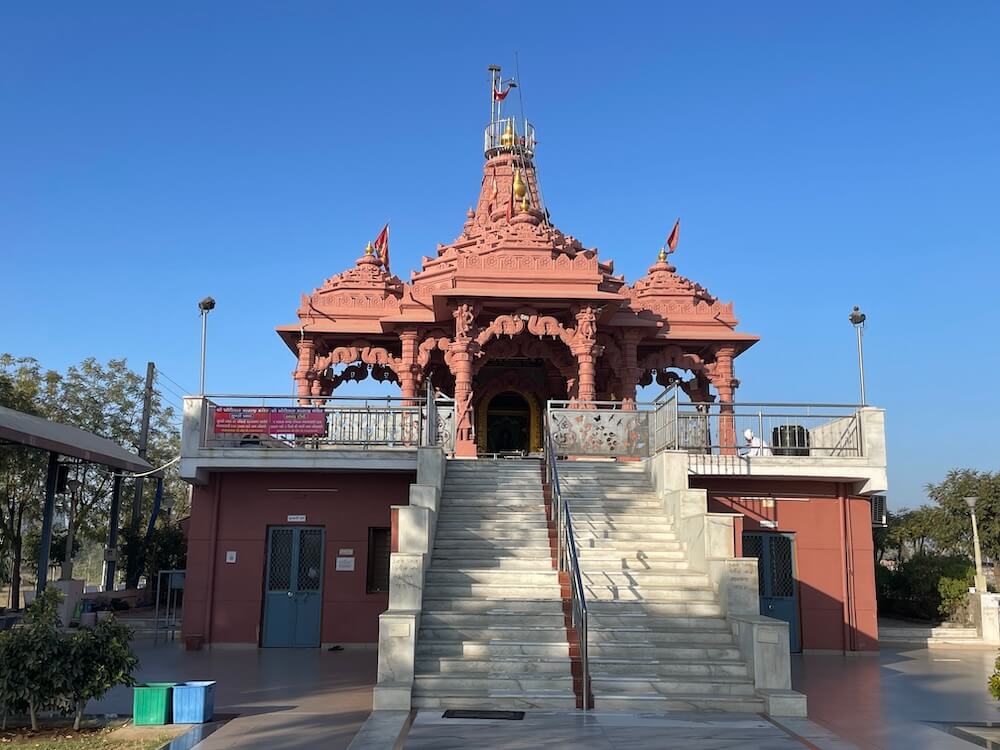
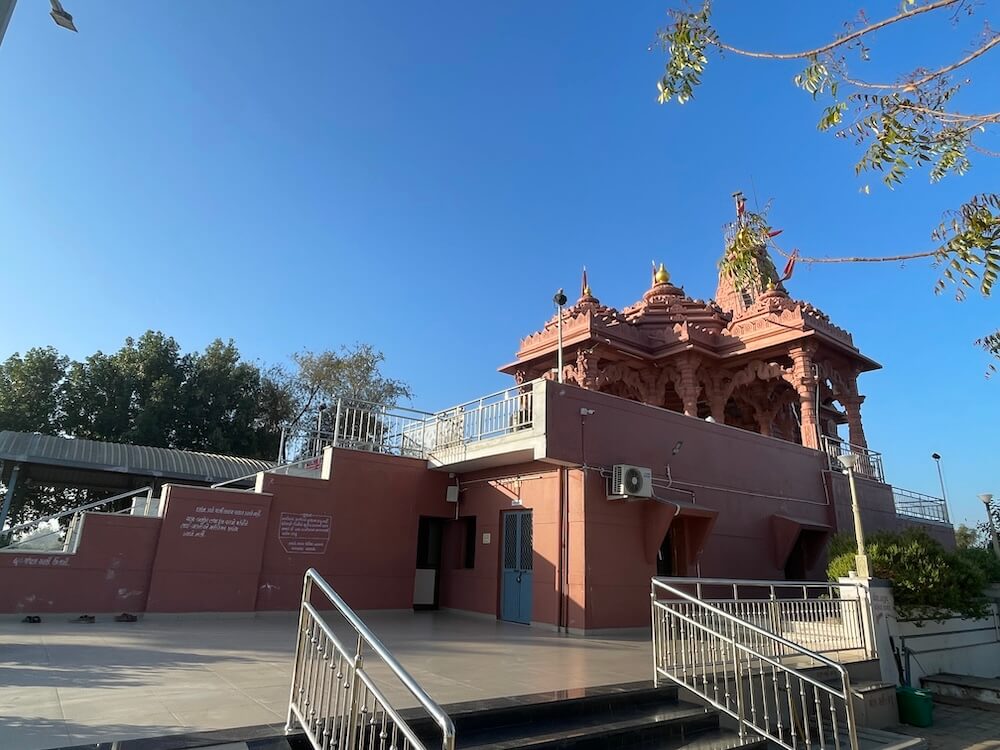
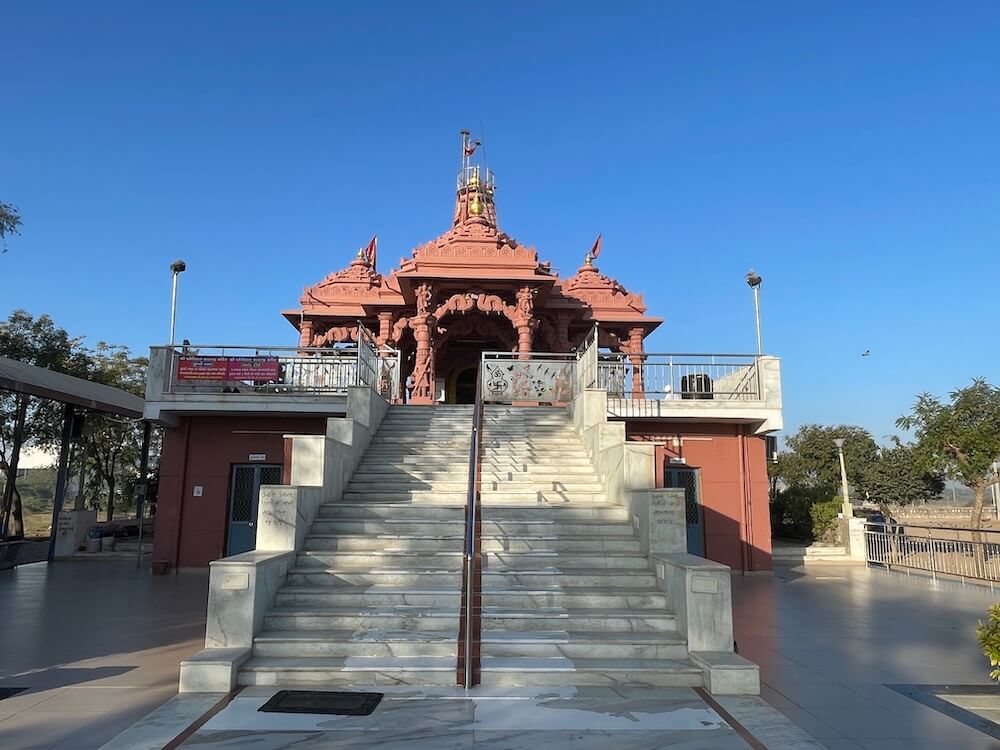
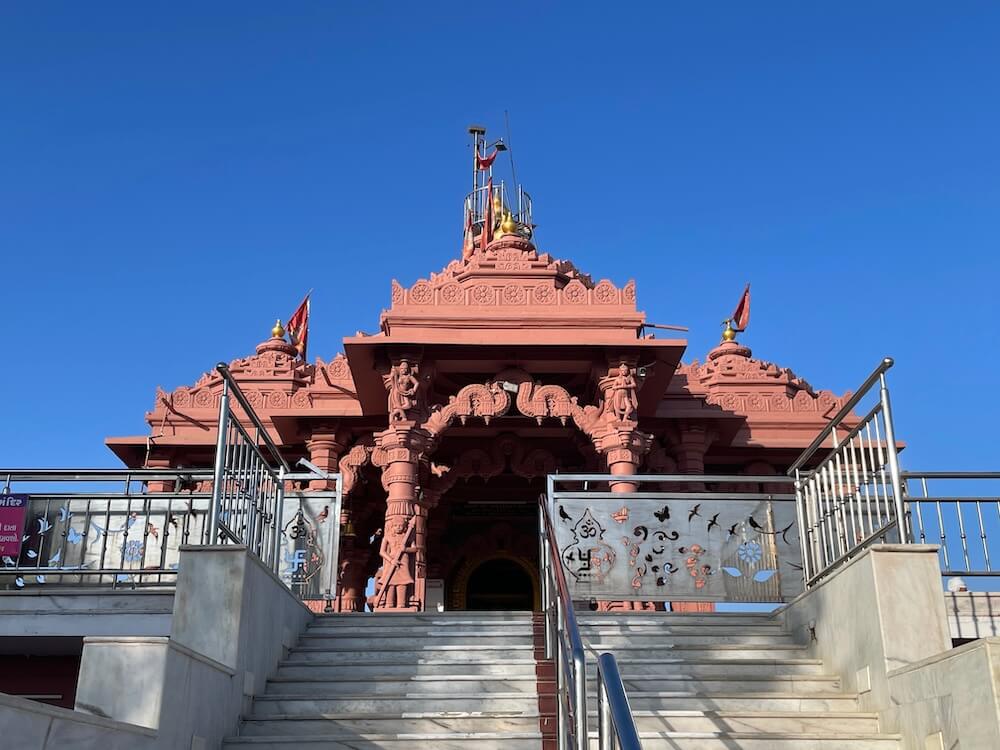
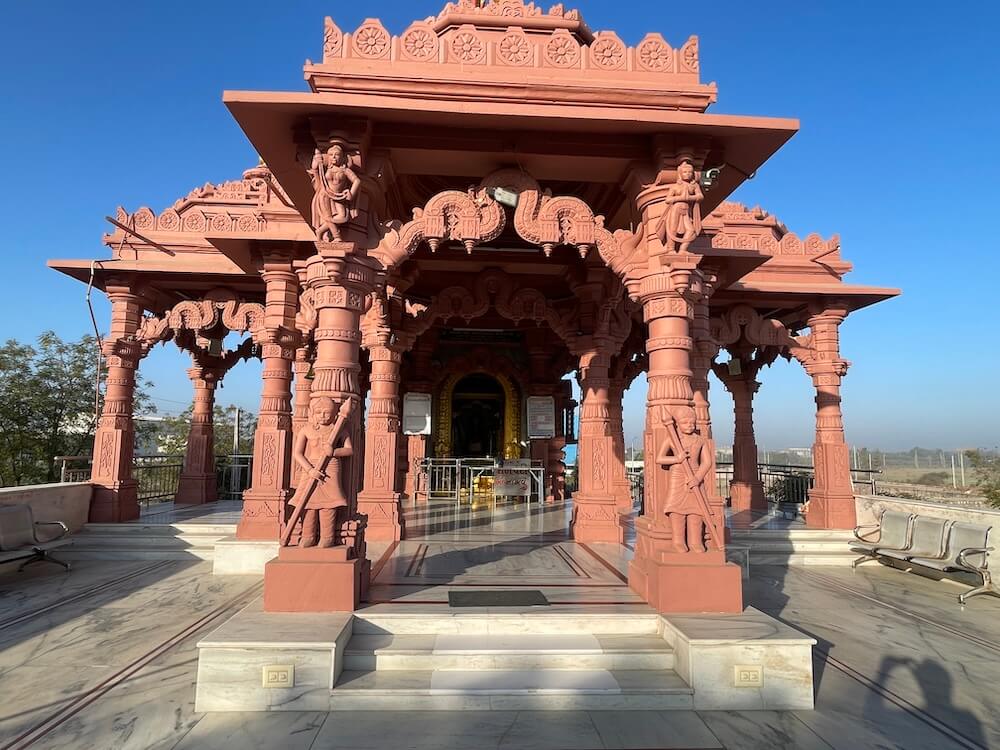
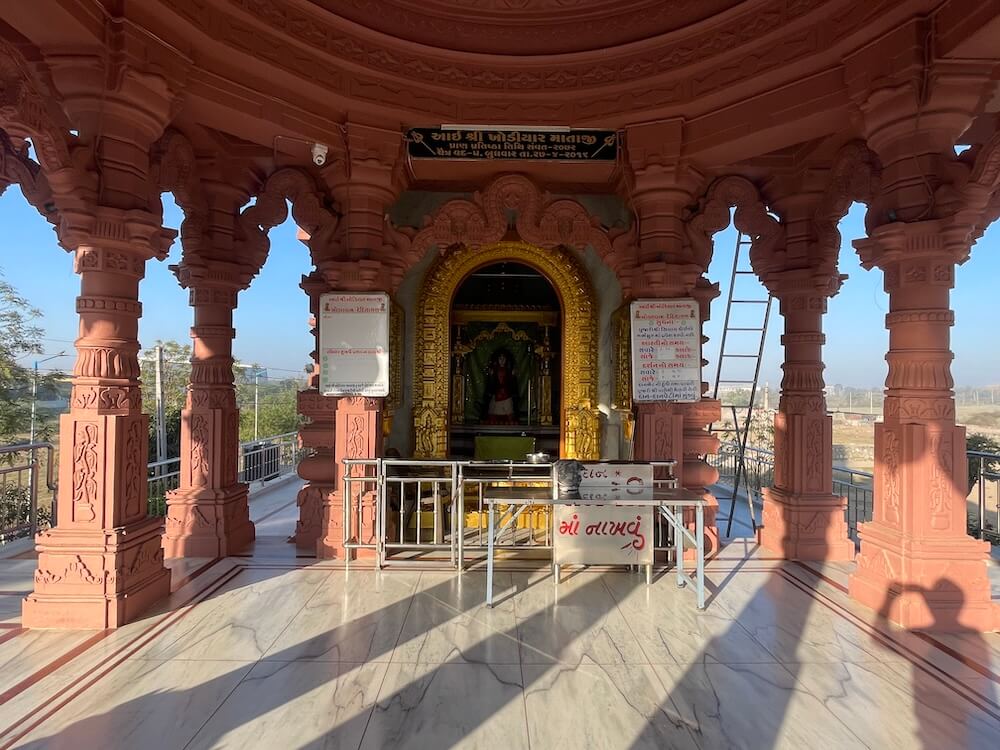
The temple is situated adjacent to the Modhera Road in Phase 2 of the Dediyasan GIDC. A car park for private vehicles is situated in front of the temple. Entry into the expansive temple precincts is through a gateway near the parking area. The courtyard features a garden adorned with various flowering plants and carpets of lush green grass. Standing at the centre of this garden is the two-storeyed edifice of the Khodiyar Mata Temple. One enters the ‘Darshanmandapa’ (viewing hall) of the temple by ascending twenty-four steps from the courtyard. The architectural layout of the temple consists of three ‘Mukhamandapas’ (entrance porches), a ‘Sabhamandapa’ (assembly hall), an ‘Antarala’ (vestibule) and a ‘Garbhagriha’ (sanctum sanctorum). At the front of the entrance porch, sculptures of two ‘Dwarpalas’ (gatekeepers) stand on either side, with ‘Surasundaris’ (celestial maidens) positioned above. Both the viewing hall and the assembly hall are of an open design. All pillars are embellished with intricate craftsmanship and are connected at the top by cusped arches. Within the assembly hall, past the circumambulatory path, lies the vestibule and the sanctum sanctorum. Niches in the walls on both sides of the vestibule enshrine the idols of Ganesha Dada and Bhairav Dada. In the assembly hall, a white marble idol of the Goddess, mounted upon a crocodile, resides within a golden pavilion atop a ‘Vajrapitha’ (pedestal). The Goddess, draped in fine garments and ornaments, holds flowers in her hands. Idols of Yamraj, Varuna and Kuber Bhandari are placed within niches on the exterior walls of the sanctum. The sanctum is crowned by an ‘Urushringa’ style spire that tapers towards the top. This spire is adorned with numerous smaller replicas of the pinnacle. Additionally, the three entrance porches and the assembly hall feature domed spires that also taper upwards.
The temple organises various religious and cultural programmes throughout the year. During the Navratri festival, special prayers, ‘Aarti’ and nightly ‘Garba’ dance sessions take place for nine consecutive days. On the occasion of ‘Khodiyar Jayanti’, which falls on the eighth day of the bright half of the month of Magh, the temple administration celebrates a grand festival of lights. Furthermore, the hosting of ‘Dayro’ – traditional Gujarati folk music concerts – is considered a unique feature of this temple. Through this medium, many renowned folk artists have performed their craft while promoting social awareness. As Tuesday and Sunday are considered special days for the Goddess, the temple witnesses large crowds of devotees. Every Sunday, ‘Sukhadi’ is distributed to the pilgrims as ‘Prasad’. Devotees may visit for ‘darshan’ daily from 6:00 am to 12:30 pm and from 4:00 pm to 9:00 pm.
This sacred temple stands as a testament to deep spiritual devotion, ancient architectural grandeur, and rich local cultural traditions.
The sanctum sanctorum houses the divine idol consecrated according to ancient Vedic traditions, surrounded by serene courtyards and traditional temple architecture.
Navratri, Maha Shivratri, Annual Temple Jatra & Deepotsav
Compare and book flights, secure top-rated local hotels near the temple, hire reliable guides, and rent cars instantly.
Extend your pilgrimage by visiting other highly sacred temples located nearby.


Add ₹999 more to unlock FREE SHIPPING!
Your sacred cart is currently empty.
Shop Photo FramesFill in your delivery details below to place your order.
Add comment