
Add ₹999 more to unlock FREE SHIPPING!
Your sacred cart is currently empty.
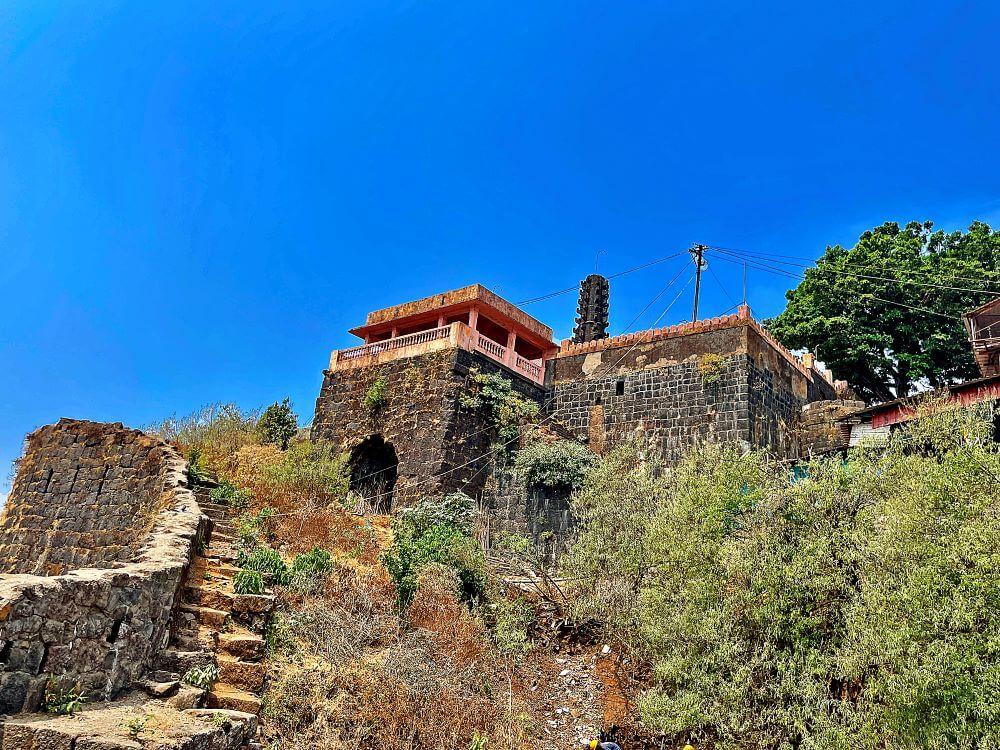
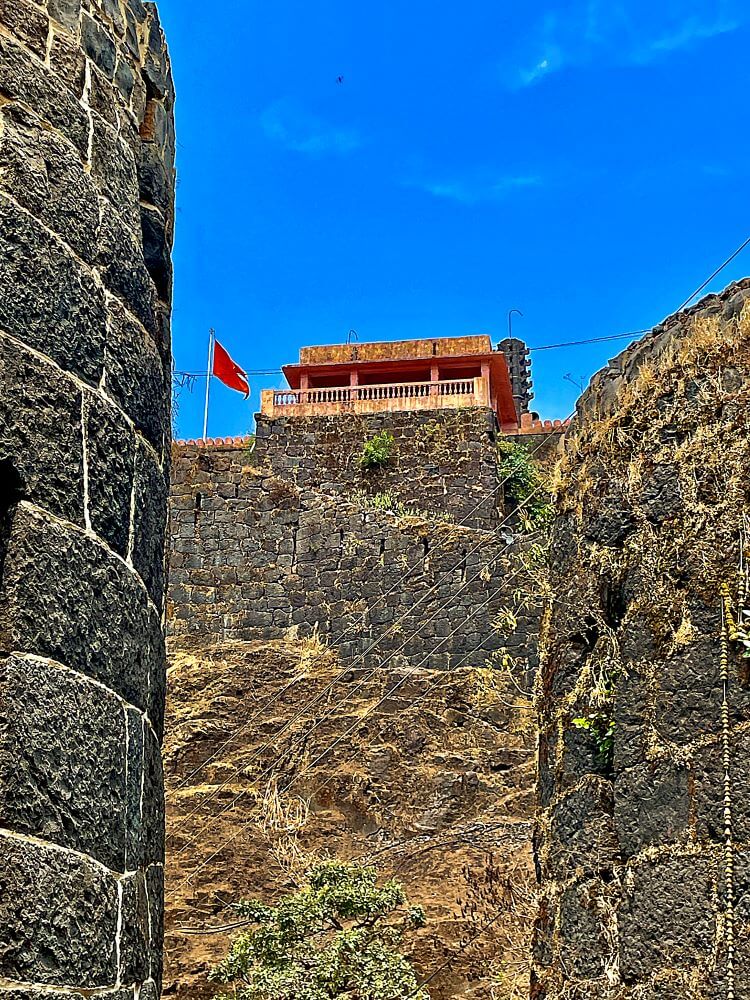
Shop Photo FramesThe very mention of the name Pratapgad brings to mind the valor of Chhatrapati Shivaji Maharaj and his slaying of Afzal Khan at the foothills of this fort. When Afzal Khan marched with a massive army, the Mavalas decimated his forces after Maharaj killed him using the tiger claws. While entering Maharashtra to spread terror, this Afzal Khan had desecrated the temple of Tulja Bhavani in Tuljapur, the mother goddess of Maharashtra. The desire to install this Kuldevi arose in the heart of Chhatrapati Shivaji Maharaj, and in the year 1661, the idol of the eight-armed Mahishasuramardini Bhavani Devi was consecrated at Pratapgad.
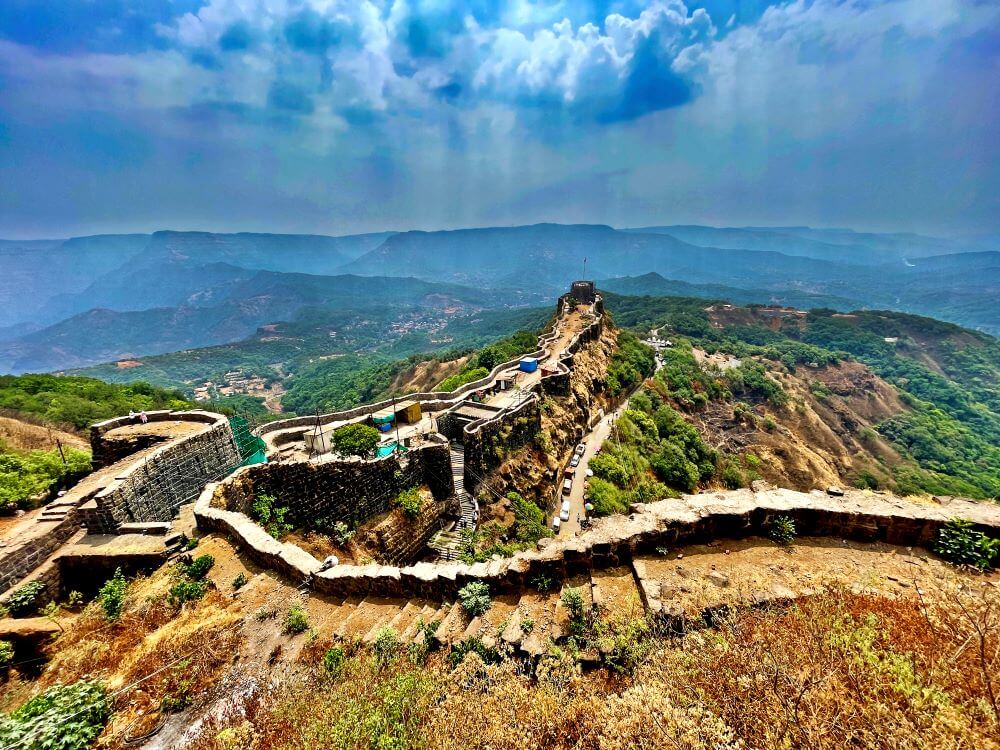
Pratapgad is one of the few significant forts built by Chhatrapati Shivaji Maharaj himself. After Maharaj subdued Chandrarao More of Javali, who refused to join Swarajya and constantly created disturbances, the Javali region was brought under the fold of Swarajya. To keep a watch over this region, Maharaj decided to build a fort on the Bhorpya mountain and entrusted the responsibility to the fort architect Moropant Pingle. Between the years 1656 and 1658, Moropant applied his expertise to construct the fort. Chhatrapati Shivaji Maharaj named this fort Pratapgad.
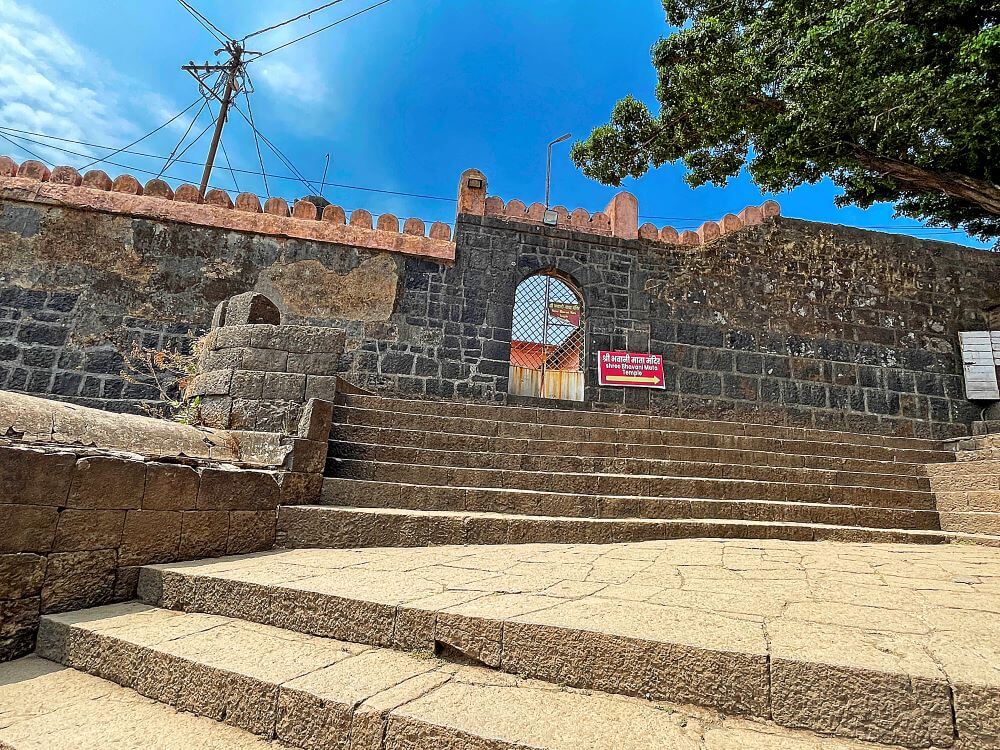
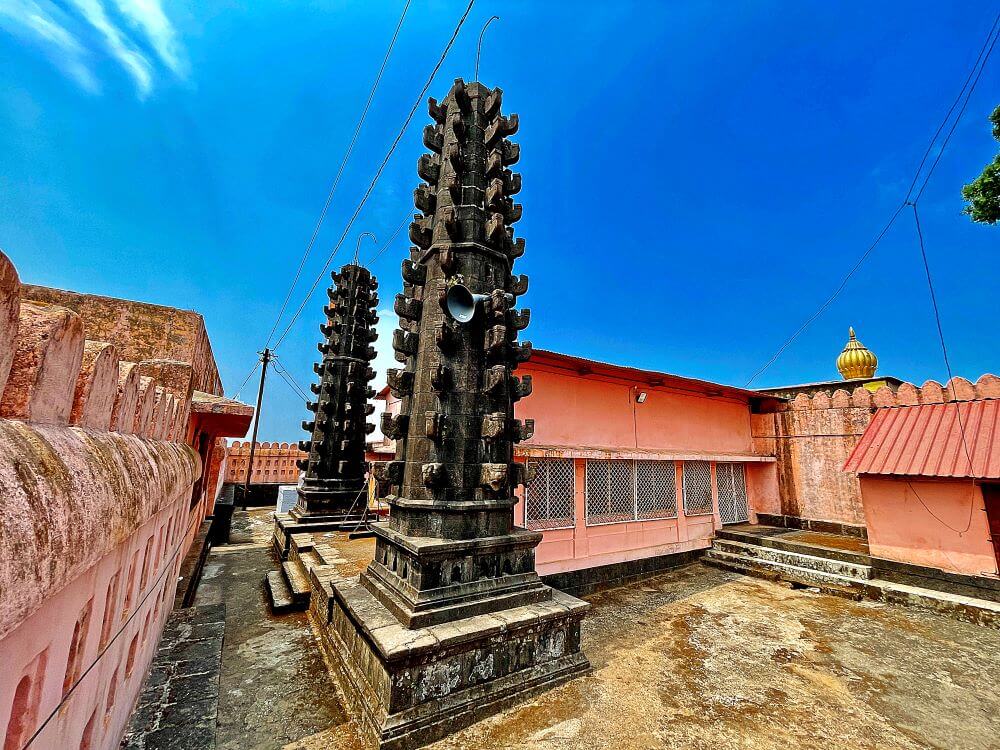
At the time of the construction of Pratapgad, there was no temple of Goddess Bhavani on this fort. When it occurred to the Maharaj that there should be a temple of Goddess Bhavani on Pratapgad, which had granted him immense success, he sent his trusted Mambaji Naik and Gomaji Naik Pansare to Nepal. With the permission of the then King of Nepal, Liladitya, they brought a Gandaki stone from the confluence of the Shwetagandaki, Trishulgandaki, and Saraswati rivers. After the idol of the eight-armed Mahishasuramardini was sculpted from that stone, it was taken to Rajgad in July to be shown to Shivaji Maharaj. Seeing that exquisitely carved idol, the Maharaj was pleased and suggested that it should be consecrated at Pratapgad immediately. Following the Maharaj’s permission, the idol was brought to Pratapgad in a palanquin accompanied by Moropant Pingle. On the auspicious occasion of Lalita Panchami (Ashwin Shukla Panchami) in the year 1657, the idol was ceremoniously consecrated by the hands of Moropant. Today, this very idol is enshrined in the temple of Goddess Bhavani on Pratapgad. According to historical records, the preparations for the coronation of Shivaji Maharaj at Raigad On the day of 19 May 1674, Chhatrapati Shivaji Maharaj himself came to Pratapgad for the darshan of the Goddess. At that time, he offered a golden umbrella weighing three man to Goddess Bhavani. (According to the old calculation, 24 tolas made one sher. An old tola was 11.75 grams. That is, the weight of one sher was: 11.75 grams x 24 tolas = 282 grams. 16 shers made one man. The weight of one man was: 282 grams x 16 = 4,512 grams. According to this calculation, the weight of three man was 13,536 grams, which is approximately thirteen and a half kilograms). Shivaji Maharaj stayed at Pratapgad for two days during this visit. After leaving Pratapgad, Maharaj reached Raigad on 21 May 1674. Later, on Jyeshtha Shuddha Trayodashi, Shake 1596 (Friday, 6 June 1674), the coronation of Shivraya took place at Raigad, and he became the first Chhatrapati of Hindavi Swarajya. The Bhavani Mata temple at Pratapgad holds special significance because it was built by Shivaji Maharaj and was a place of his personal devotion. There is a fortification around this temple. The temple stands on a high plinth (foundation). The structure of the temple consists of a sabhamandap (assembly hall) and a garbhagriha (sanctum sanctorum). In the front part of the temple, there are two tall stone deepmalas (lamp towers). Their uniqueness lies in the fact that the spaces provided for placing lamps are shaped like an elephant’s mouth, and a lamp can be placed on the tip of the raised trunk.
The temple faces east and has entrances from three sides: east, north, and south. The assembly hall (Sabhamandap) here is spacious, and in front of it, within the sanctum sanctorum (Garbhagriha), stands the eight-armed idol of Goddess Bhavani, carved from black Gandaki stone in the Atibhanga posture (a stance of striking while leaning to one side), depicting her slaying Mahishasura. A Shiva Linga is carved on the crown of the idol, and the sun and moon are etched above both ears. In her three right hands, she holds a discus (Chakra), an arrow, and a sword, while the trident (Trishul) in her fourth hand is pierced into the body of Mahishasura. In her three left hands, she holds a conch (Shankh), a shield, and a bow, while her fourth hand grasps the tuft of Mahishasura’s hair. Beside this idol is the idol of Aindriya Bhavani. It is said that this idol of Aindriya Bhavani is a replica of the original Bhavani idol of Tuljapur. To the right, in front of the Goddess Bhavani idol, lies a clear and transparent crystal (Sphatik) Shiva Linga. It is said that whenever Chhatrapati Shivaji Maharaj went on expeditions, he would carry this Shiva Linga with him. The unique feature of this Shiva Linga is that if one darkens the sanctum sanctorum and lights camphor before it, one can carefully observe the appearance of a Bilva leaf, a Tulsi leaf, and the flowing Ganga within it. There is no historical record regarding how this crystal Shiva Linga came into the possession of the Maharaj. On one of the walls of this sanctum sanctorum, there is a sword belonging to Commander Hambirrao Mohite. There are six holes in the blade of this sword. In those days, a hole was made in the sword’s blade after slaying one hundred enemies.
Bhavani Devi is offered Naivedya three times every day. The morning and evening Naivedya are offered by the Bhopes and Sonavanis, while the afternoon Naivedya is offered by the Hadap priests. These traditions continue even today, as per the appointments made by Shivaji Maharaj. The ancient rules regarding the Goddess’s daily attire are also strictly followed. Accordingly, the Goddess is adorned with a white saree on Monday, red on Tuesday, green on Wednesday, yellow on Thursday, sky blue on Friday, black on Saturday, and a pink saree on Sunday. On Akshaya Tritiya, a green saree and a blouse made of Yeola fabric are worn. A grand festival is held at Pratapgad on Lalita Panchami. Every day, before sunrise and after sunset, the Chaughada is played here. On every Purnima, Gondhal, Aarti, and Naivedya are performed. During this time, the Goddess’s palanquin is carried around the fort in the light of torches, amidst the resounding beats of Sambal and cymbals.
Along with the temple of Goddess Bhavani, there is a temple of Kedareshwar Mahadev on this fort. This temple was built at the same time as the construction of the fort. While the construction was underway, Moropant Pingle discovered a Shiva Linga here. He built the temple around this self-manifested (Swayambhu) Shiva Linga. This is the very Shri Kedareshwar Mahadev of Pratapgad. It is said that on the day of the meeting with Afzal Khan, Chhatrapati Shivaji Maharaj performed a traditional worship of Kedareshwar. After this worship, a ritual of charity was performed, and only then did the Maharaj descend from the fort for the meeting with Afzal Khan.
This sacred temple stands as a testament to deep spiritual devotion, ancient architectural grandeur, and rich local cultural traditions.
The sanctum sanctorum houses the divine idol consecrated according to ancient Vedic traditions, surrounded by serene courtyards and traditional temple architecture.

Navratri, Maha Shivratri, Annual Temple Jatra & Deepotsav
Compare and book flights, secure top-rated local hotels near the temple, hire reliable guides, and rent cars instantly.
Extend your pilgrimage by visiting other highly sacred temples located nearby.


Add ₹999 more to unlock FREE SHIPPING!
Your sacred cart is currently empty.
Shop Photo FramesFill in your delivery details below to place your order.
Add comment