
Add ₹999 more to unlock FREE SHIPPING!
Your sacred cart is currently empty.
Shop Photo FramesThe ancient temple of Goddess TaTambdi Jogeshwari is situated in Budhwar Peth, located in the heart of Pune city. This Goddess is known as the Gramadevata (presiding deity) of Pune. This site gained extraordinary significance during the seventeenth century, the era of the establishment of Swarajya. Under the guidance of Rajmata Jijau, the young Shivba (Chhatrapati Shivaji Maharaj) performed the ritual of ploughing the barren land of Pune with a golden plough, with this very temple as a witness. This historic event truly laid the foundation for the rehabilitation and prosperity of Pune. Records in the Peshwa Daftar indicate that during the eighteenth century, or the Peshwa period, the temple received special royal patronage, and the Peshwas made specific provisions for the temple’s administration and festivals.
As a center of Pune’s glorious history and spiritual tradition, the Shri TaTambdi Jogeshwari Temple serves as a primary pillar of the city’s cultural fabric. Historical references state that in the year १५४५, Tryambak Bendre constructed a small temple around this ancient and Swayambhu (self-manifested) idol. At that time, the temple was very simple and located somewhat away from human settlements. The area was covered with dense thickets and fields, and the natural flow of the Ambil Odha (stream) passed nearby. This sacred site was revered as the Gramadevi, protector of the ancient settlement of Pune.
The stay of Chhatrapati Shivaji Maharaj and Rajmata Jijabai in Pune bestowed a historical aura upon this temple. After the destruction of Pune around the year १६३०, the sacred task of rebuilding the city was undertaken under the guidance of Jijau. To remove the curse upon Pune and mark a prosperous beginning for the reconstruction of Swarajya, Chhatrapati Shivaji Maharaj ploughed the land of Pune with a golden plough in the presence of this very Jogeshwari Devi. Jijau provided special encouragement for the renovation and maintenance of this temple.
The glory of this temple truly expanded during the Peshwa period. The Peshwas were originally from Shrivardhan in Konkan, and their family deity was Yogeshwari. As their seat of power became established in Pune, they adopted this TaTambdi Jogeshwari as their Kuladevata. Records in the Peshwa Daftar mention that Shrimant Madhavrao Peshwa would seek the Goddess’s blessings before embarking on any important campaign. During this period, while expanding Budhwar Peth, the cremation ground near the temple was relocated to make way for a new residential settlement. Women from the Peshwa family, such as Anandibai and Ramabai, regularly visited the temple to offer ‘Oti’ and perform worship. According to historical documents, even a letter from the Mughal official Husein Khan contains a respectful mention of this temple. During the Peshwa era, land grants and annual stipends were sanctioned for this shrine.
In the latter half of the nineteenth century, when Lokmanya Tilak initiated the Sarvajanik Ganeshotsav (public Ganesh festival), this temple received special honor. The ‘TaTambdi Jogeshwari Sarvajanik Ganeshotsav Mandal’ was established as the second ‘Mana cha Ganpati’ (honored Ganpati) of Pune. This tradition is still upheld today with equal enthusiasm and devotion. In modern times, the Pune Municipal Corporation has officially declared this temple a Grade I heritage site. Situated in the bustling commercial area of Budhwar Peth, the rituals at this temple have continued without interruption. Even today, the first invitation card for any auspicious ceremony in households across Pune is offered at the feet of this Goddess.
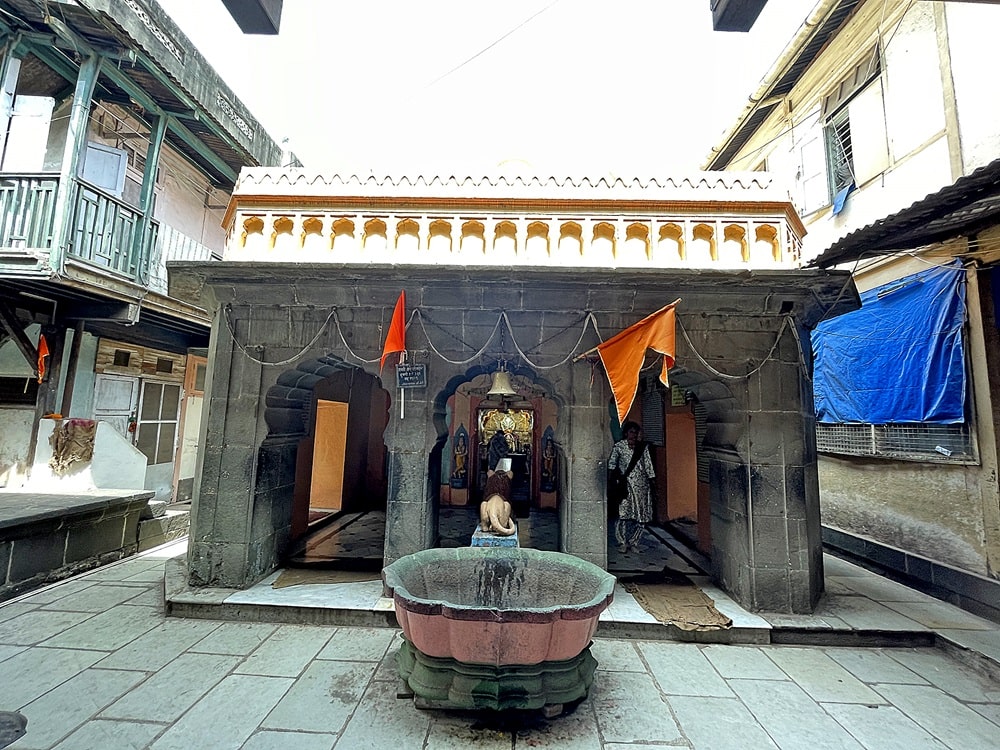
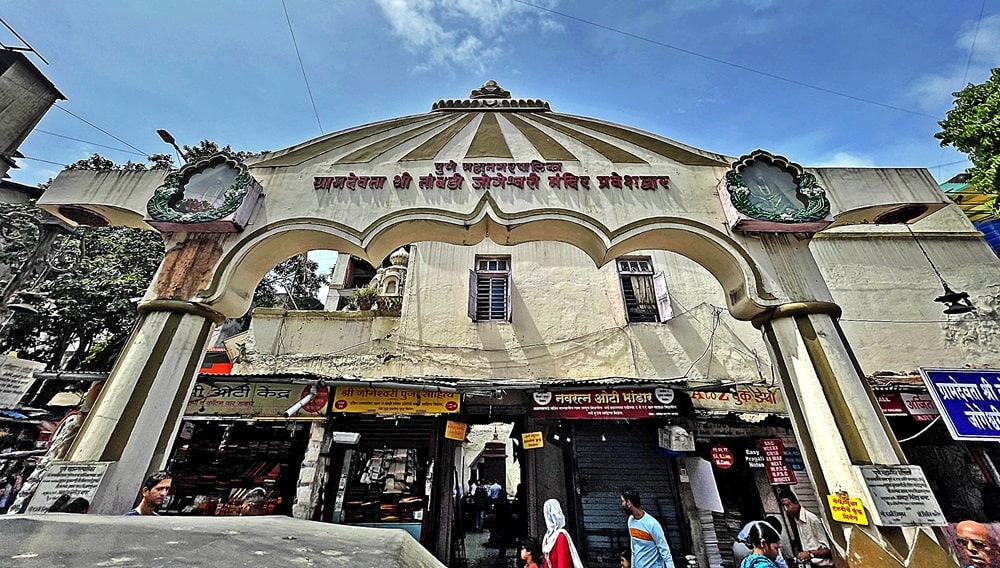
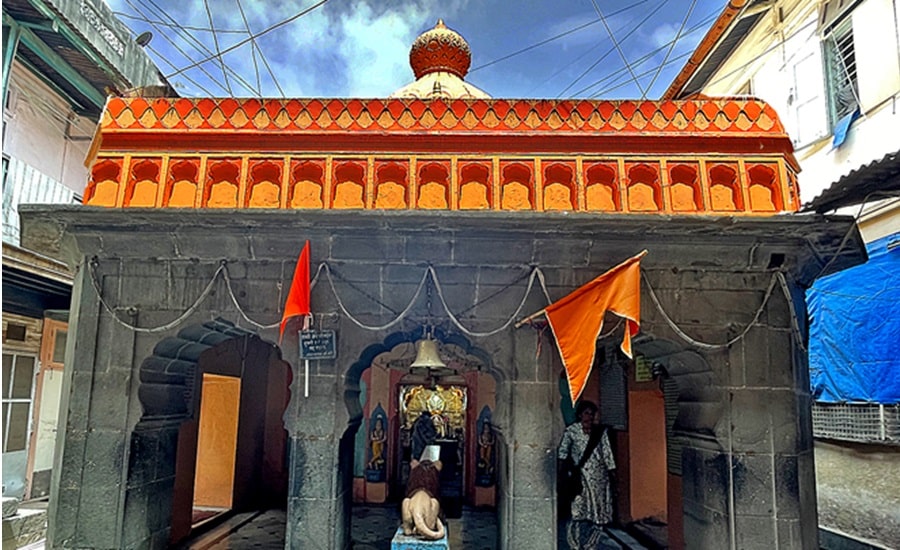
The ornate entrance on the busy street of Budhwar Peth features a beautiful arched gateway. Exquisite carvings of a ‘Bashing’ (marriage headgear) can be seen on the arch. Entering through the gateway leads to the open courtyard of the temple. In the center of this courtyard is a fountain, and nearby, a Tulsi Vrindavan is built on a high platform. Along with the main temple, there is a small temple dedicated to Hanuman in the courtyard, where a vermilion-smeared idol of Hanuman is installed on a Vajrapitha. Additionally, there are separate small temples for Ganpati and Vishnu-Lakshmi. The Vishnu temple houses a beautiful idol made of black stone.
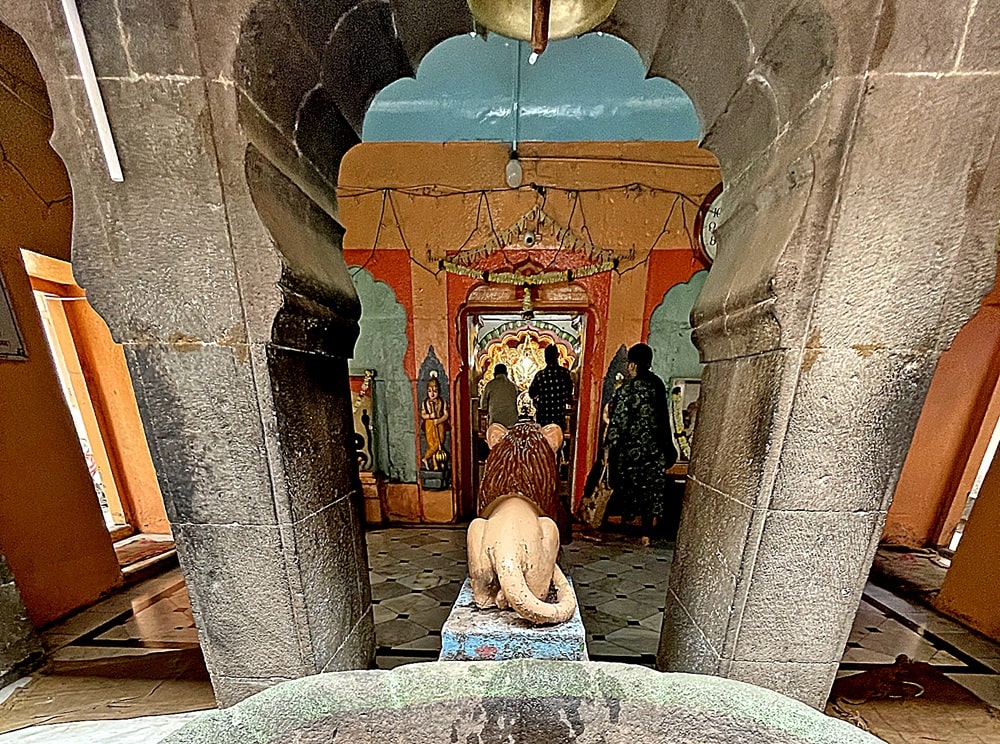
The main temple is constructed in the Hemadpanti architectural style and is entirely made of carved and dressed stone. There are three main entrances to enter the temple’s Sabhamandap (assembly hall). The hall is supported by four sturdy stone pillars, which are connected to each other by arched gateways. The carvings on the pillars are an excellent example of Peshwa-era art and craftsmanship. In the center of the Sabhamandap stands a stone idol of a lion, the Goddess’s vehicle, positioned directly in front of the sanctum sanctorum. Beyond the Sabhamandap is the Antaral, from where devotees can view the Goddess in the Garbhagriha (sanctum). Simple yet attractive geometric patterns can be seen on the stone walls and ceiling.
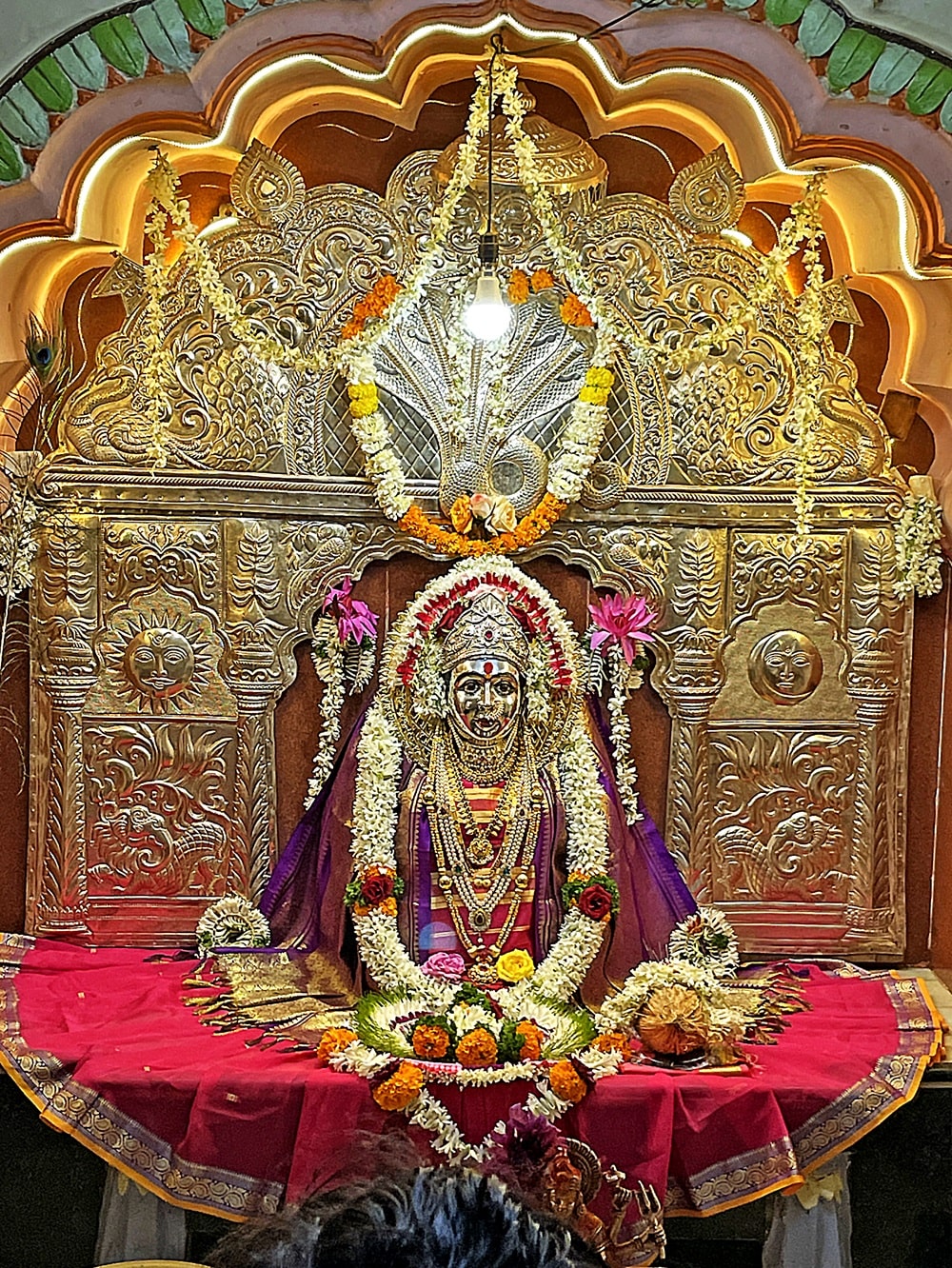
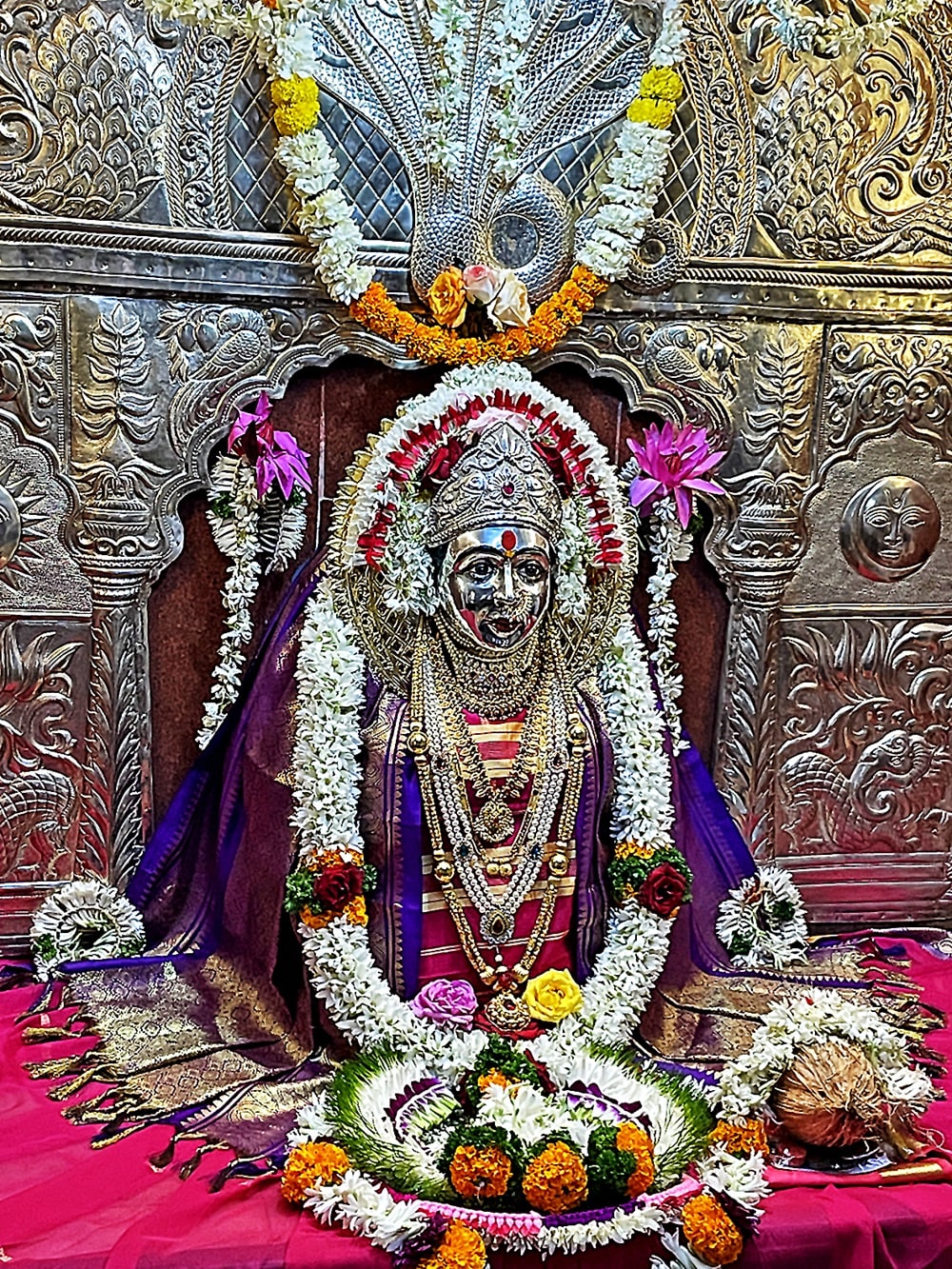
The entrance to the Garbhagriha features elegant sculptures of Dwarapalas (gatekeepers). Inside, the Swayambhu idol of the Goddess is seated on a high Vajrapitha. Because the idol is fashioned from natural red stone, the Goddess is aptly named ‘TaTambdi Jogeshwari’. The Goddess is Chaturbhuja (four-armed). In her upper hands, she holds a Trishula (trident) and a Damaru, while her lower hands hold a Kapala (skull cup) and a Panpatra (drinking vessel). The form of the Goddess is extremely radiant and serene. Behind the Goddess, on a beautiful golden halo, are carvings of the sun, the moon, and a peacock arch. The dome-shaped main Shikhara (spire) above the sanctum is surrounded by smaller spires on all four sides, each topped with an elegant Kalash. At the pinnacle of the main Shikhara is a massive Amalaka topped with a golden Kalash. The carvings on the Shikhara depict various deities and floral motifs.
The cultural traditions and worship rituals at the TaTambdi Jogeshwari Temple have been ongoing uninterrupted since ancient times. Every morning and evening, Shodashopachara Puja (sixteen-step ritual worship) and Aarti are performed for the Goddess in accordance with scriptural traditions. As Tuesday and Friday are considered special days for the Goddess, there is a large influx of devotees for Darshan on these days. She is the Kulswamini (family deity) of many families in Pune. Many people seek the Goddess’s blessings by placing their wedding invitation cards or the first wedding invitation before her. The tradition of bringing the ‘Bhikshaval’ (alms procession) of a thread ceremony and the wedding procession for the Goddess’s Darshan is still followed today with the same devotion.
The most significant festival at the temple is Sharadiya Navaratri. During these nine days, the temple is filled with great enthusiasm from devotees. Throughout Navaratri, the Goddess is adorned daily in different forms and seated upon various divine vehicles. Alongside this, various religious programs such as Jagran, Gondhal, and Navchandi Homa are organized at the temple. Devotees gather here in large numbers to offer Oti and present auspicious ornaments to the Goddess. On the day of Vijayadashami, also known as Dussehra, a grand palanquin procession of the Goddess is taken out. This tradition has been celebrated with great splendor since the Peshwa era. Thousands of Punekars participate in this festival to seek the blessings of the Gramadevi. Additionally, Chaitra Navaratri and Kojagiri Purnima are celebrated with equal fervor.
This sacred temple stands as a testament to deep spiritual devotion, ancient architectural grandeur, and rich local cultural traditions.
The sanctum sanctorum houses the divine idol consecrated according to ancient Vedic traditions, surrounded by serene courtyards and traditional temple architecture.
Navratri, Maha Shivratri, Annual Temple Jatra & Deepotsav
Compare and book flights, secure top-rated local hotels near the temple, hire reliable guides, and rent cars instantly.
Extend your pilgrimage by visiting other highly sacred temples located nearby.


Add ₹999 more to unlock FREE SHIPPING!
Your sacred cart is currently empty.
Shop Photo FramesFill in your delivery details below to place your order.
Add comment